
Welcome back to “Midterm Market Monitor,” a recurring InGame feature between now and Nov. 3 in which we explore the latest and most noteworthy prediction market odds and trends related to the upcoming elections.
As focused as many of us are on the midterm elections (now just four weeks away) and the various betting/trading markets that will be decided on or soon after Nov. 3, the numbers at Kalshi suggest the midterms are not where everyone’s focus lies. Of the top four election markets by volume as of Tuesday morning, three of them concerned the 2028 presidential election.
The most traded market by far, with some $232 million in action as of Tuesday, focused on the 2028 Democratic presidential nominee. There are 48 options to choose from, ranging from the realistic (frontrunners Jon Ossoff, 17%; Alexandria Ocasio-Cortez, 14%; Gavin Newsom, 13%) to the ludicrous (celebrities LeBron James, Dwayne Johnson, and Stephen A. Smith). It’s a fascinating field, and lots of Kalshi users are staking out positions.
The third-most-traded market is who will win the 2028 election, which has a little over $71 million spread around 31 candidates. At the top are JD Vance (19%) and Ossoff (12%).
In fourth place for volume is trading on the Republican presidential nominee, at about $68 million, presumably drawing less action than the Democrat market because it’s not as wide open a race. Among 39 options, Vance is the clear frontrunner at 44%, followed by Marco Rubio at 17%, with nobody else above 5%.
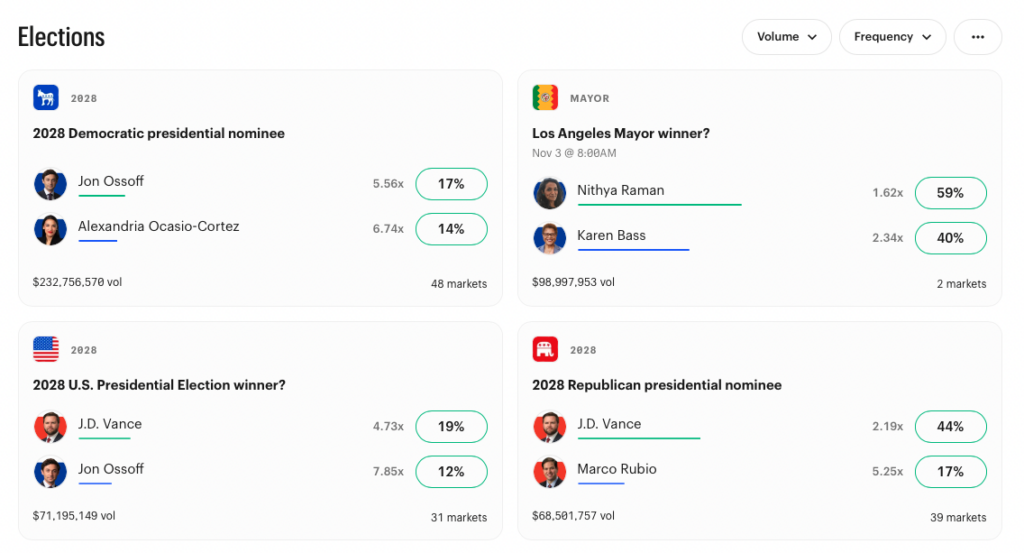
Meanwhile, the second- and fifth-most-traded markets provide a solid hint as to where the largest base of Kalshi users resides. There’s been about $99 million traded on the Los Angeles mayoral race (where Nithya Raman is favored over Karen Bass, 59%-40%), and some $54 million on the now-lopsided California gubernatorial race (where it’s Xavier Becerra at 96% and Steve Hilton a 3% longshot). Yep, it may be time to rename our most populous state “Kalshi-fornia.”
Here’s a closer look at the key markets and trends, less than a month away from Election Day.
Senate control
Since we wondered last week whether the Republican Party had reached its lowest point odds-wise, the prediction markets have given us an answer: nope.
As far as Senate control goes, the Democrats have become larger favorites to hold at least 51 seats with all major operators than they were a week ago. At PredictIt, Dems are up from 62 cents to 65 cents. At Robinhood, same increase amount, from 63% to 66%. At both Polymarket and Kalshi, Democratic control is up from 63% to 65%.
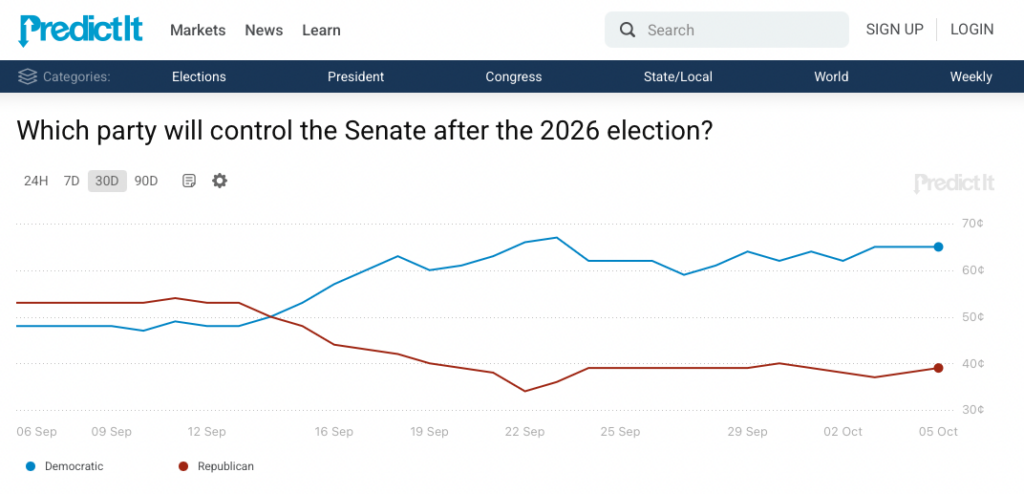
A two-thirds chance means, of course, a one-third chance of the opposite happening, so nobody who has wagered on Democratic control should become overconfident. But the Dems are inching toward that two-thirds chance mark, and at PredictIt, the Republicans holding 47 seats or fewer is now trading at 36 cents, a higher number than the price on 48 seats and 49 seats combined.
House control
To a far greater extent than the Senate, the House is becoming less about who will win and more about the margin of victory. Democrats are favored to take the House by 90% or greater at Kalshi, Polymarket, and PredictIt, though Republican backers will feel marginally better if they check Robinhood, where the Dems are “only” 89 cents:
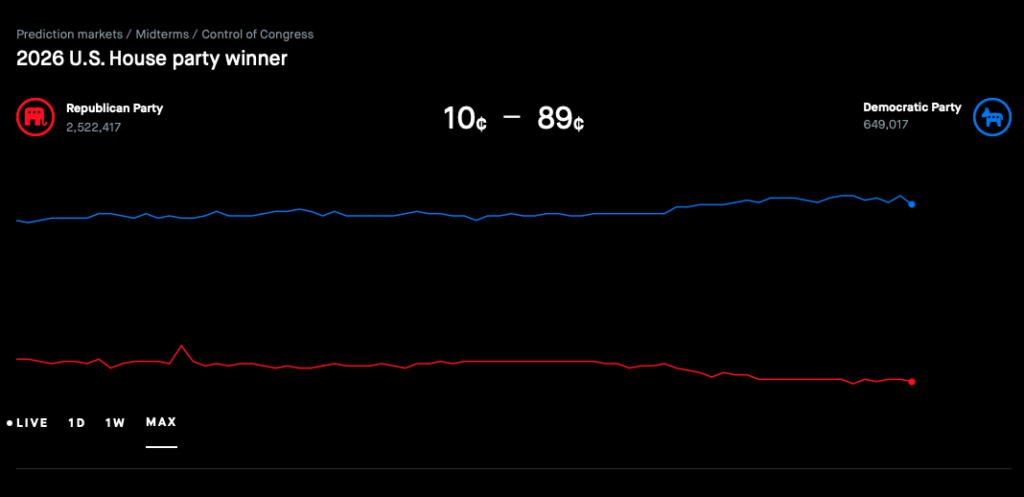
The markets for specific number of seats make for a more intriguing gamble than just backing Democrats to take control. At Kalshi, Republicans ending up with under 193 seats is the favorite at 28%, and the three next highest percentages are all bands between 193 and 207 seats. Added together, the odds suggest there’s about a 75% chance the Democrats will have at least a 228-207 advantage when all the votes are tallied.
Race to watch: Maine Senate
The Maine Senate race has rarely lacked for attention this year, given the Democratic switcheroo with controversial nominee Graham Platner dropping out and Troy Jackson sliding in, while GOP incumbent Susan Collins remains a polarizing figure who wields power in any close Senate vote. But this race got another minor attention bump this week thanks to new polling that suggests it’s going to be tighter than the prediction markets would have us believe.
Jackson, who had emerged in recent weeks as the clear betting favorite amid all the “Blue Wave” talk, was only a narrow 50-47 favorite in an Oct. 1 AARP poll and a 51-47 fave in an Oct. 1-4 Marist poll, while an Oct. 2 CBS News/YouGov poll drew attention by showing the candidates in a dead heat, 50% apiece.
At the prediction markets, the odds have unmistakably narrowed, but they still show the Democrat clearly leading. As of Tuesday morning, Kalshi had Jackson up 57-43, Polymarket had his lead at 59-43, Robinhood went 58-48, and PredictIt had it 57-44.
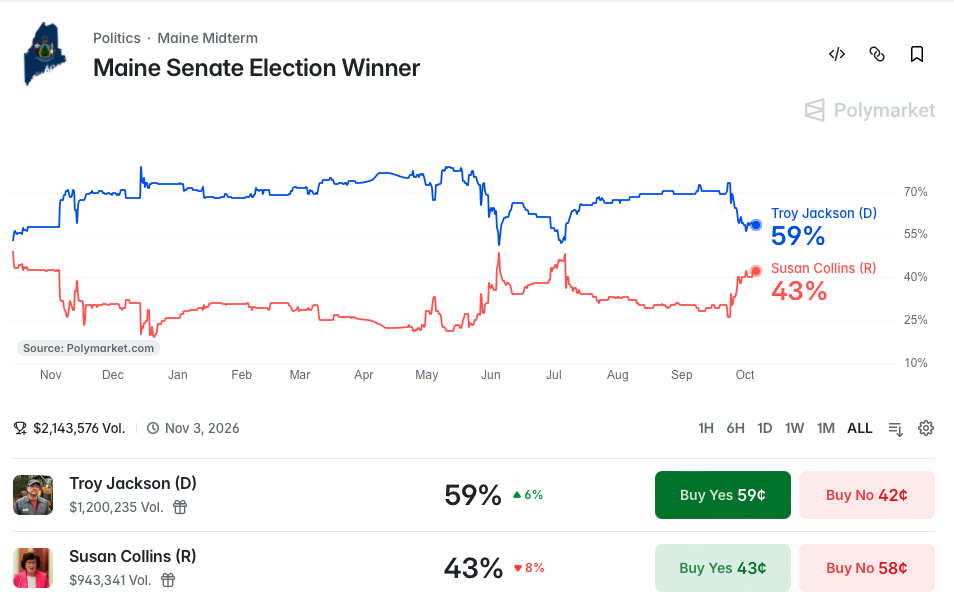
Those numbers aren’t quite the coin flip the CBS News/YouGov poll says the race is, but considering Jackson was comfortably in the 60s and occasionally into the 70s previously, the trends suggest 73-year-old Collins may just serve her sixth term after all.
Presidential election odds
Since we already talked 2028 presidential odds at the top of this article, let’s pivot to something slightly different here: 2028 VP nominee odds.
For the Democrats, Kalshi has Ocasio-Cortez and Elissa Slotkin tied at 9.9% apiece, followed by Pete Buttigieg at 6.6%.
On the Republican side, where, again, current VP Vance is a clear favorite for the top nomination, it’s Rubio leading the way at 25%, followed by Vance (5.7%) and Donald Trump Jr. (4.1%).
Wacky market of the week
As you may have heard, President Trump supports the movement to do away with changing the clocks twice a year and make daylight saving time permanent. The House passed the Sunshine Protection Act in July, though it’s reported to face roadblocks in the Senate.
Naturally, you can bet on whether Congress this year will pass the bill to stop the changing of the clocks.
There are markets on this with various operators, with Kalshi showing a 9.9% chance the bill passes and is signed into law by the end of 2026, Polymarket indicating a 9% chance, and PredictIt spiking this week, from a 10-cent price on Friday to 17 cents Tuesday.
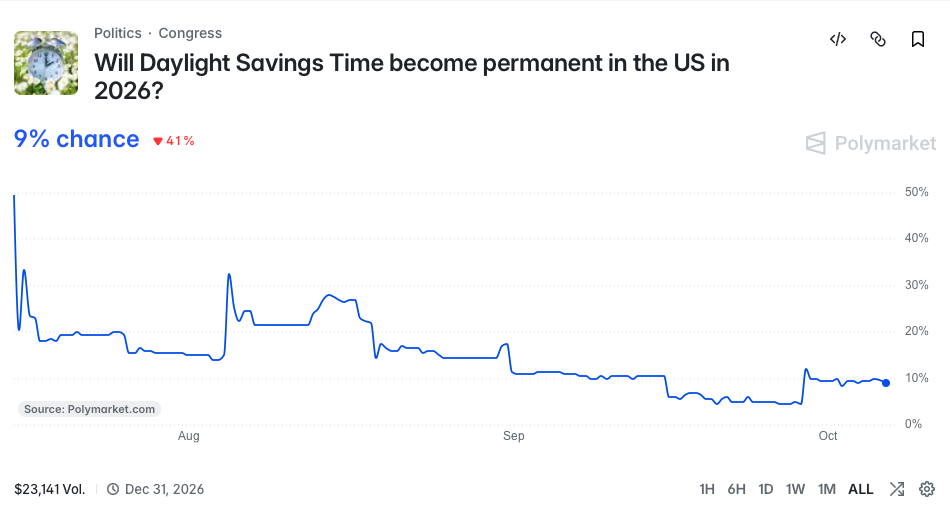
As long as the Sunshine Protection Act doesn’t pass in the next three weeks or so, we are scheduled to turn the clocks back at 2 a.m. on Sunday, Nov. 1 — just in time to be rested and ready for Election Day.