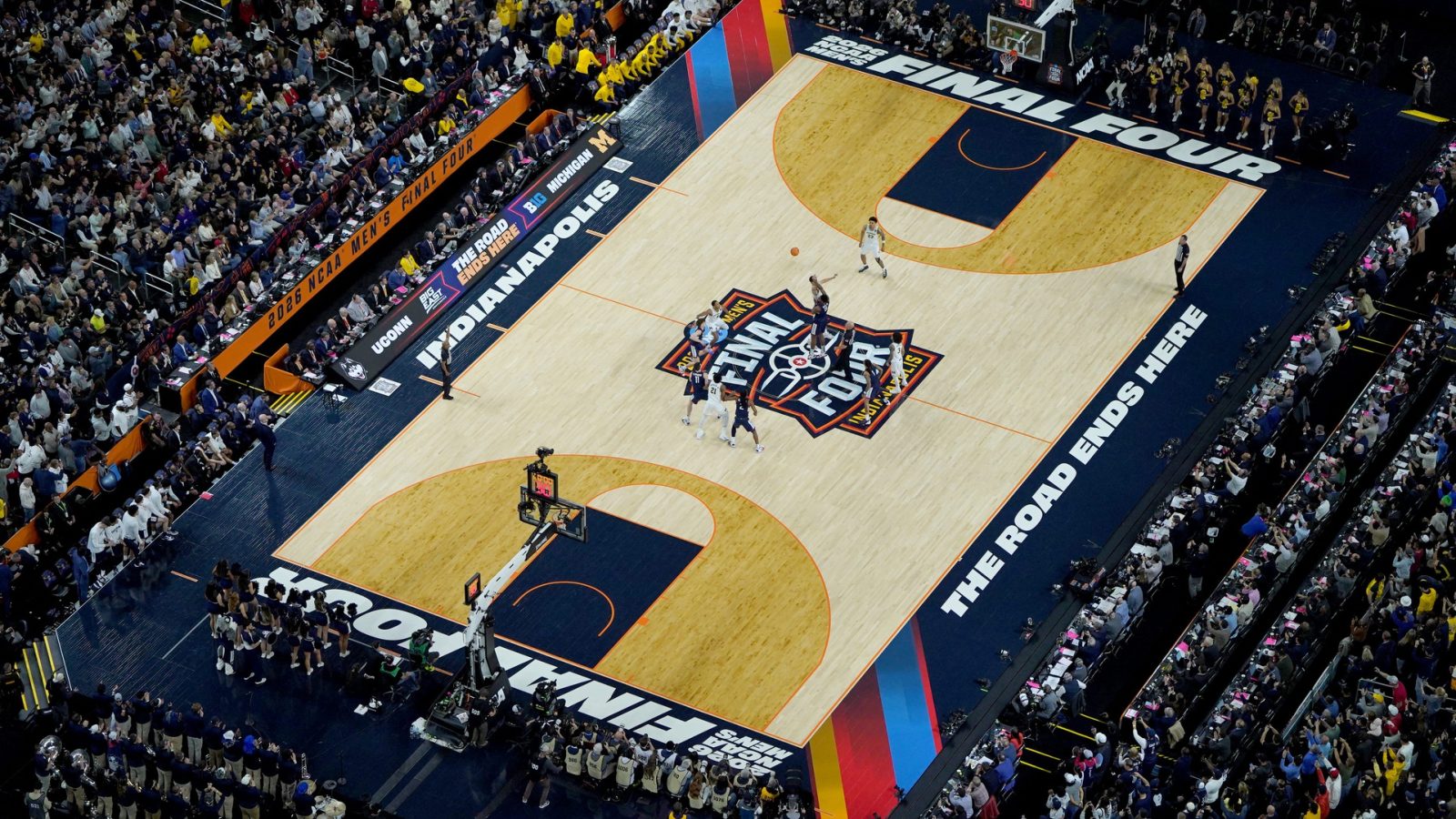
Kalshi made more than $4 million in fees on the Final Four and college basketball national championship games, and $28.5 million across the entire men’s and women’s NCAA basketball tournaments, as volume on the competition quintupled year-on-year to top $2 billion.
In total, the prediction market processed almost $10 billion in volume and made more than $100 million in fees across all categories in the three weeks from March 16-April 6, according to an InGame analysis. That’s an average of $4.7 million in fees per day.
Across those days, $2.18 billion was traded on non-parlay bets on college basketball, representing 22.9% of Kalshi’s $9.52 billion in volume over the period. Those college basketball markets earned Kalshi $28.5 million in fees.
Volume, the total amount staked by all users, is often used as an equivalent to handle, though the comparison is not like-for-like. For example, a $1 bet on an underdog at 1% odds is recorded as $100 of volume, because the other side of the bet is counted too, despite the fact that that side was likely put up by an institutional market maker. In addition, if a user places a bet on a team to win the championship and then cashes out after the first round, this would be recorded as two separate bets for volume purposes.
In addition, a further $1.91 billion of volume came on parlays. Kalshi does not provide full details about the legs of a given parlay, so while a significant portion of that volume likely came on college basketball parlays, it is not clear how much.
Volume was highest early in the tournament, when the flurry of 48 games over four days brought in more than $1 billion of college basketball volume and Kalshi’s second-biggest day ever.
Across the weekend of the Final Four, $283.4 million was traded on college basketball, making Kalshi $4.1 million in fees.
The men’s championship game attracted $89.3 million in volume after the semifinals ended, including bets on both the winner and markets such as the spread and total. The market for the winner of the championship game is the same as the market for the national champion that was open through the season. In total, that market saw $284.1 million in volume.
The women’s championship game attracted $14.3 million in volume after the semifinals ended, or $18.3 million in total.
Outside of the Final Four, top men’s games included UConn’s Elite Eight victory over Duke, the Blue Devils’ first-round comeback win over 16-seed Siena, and Arizona’s win over Purdue in the Elite Eight.
Trading on the NCAA tournament in 2026 was roughly five times higher than in 2025. The 2025 tournament, the start of which coincided with Robinhood launching a “predictions hub,” was a transformative event for Kalshi. The tournament and Robinhood integration sparked an instant uplift in volume, much of which remained even after it ended, and began the domination of sports on the platform.
Kalshi’s volume for the year to date has topped $36 billion. It has made $415 million in fees so far this year, putting it on course to easily clear the $1 billion mark.
As Bank of America analysts noted this week, Kalshi dominates among U.S. regulated prediction markets, with more than 90% of all volume.
What’s next?
The U.S. is now entering a relatively quiet period on the sporting calendar. The NBA and NHL regular seasons are finishing up, while the MLB regular season is still in its early stages.
However, even without marquee sporting events, volume on Kalshi appears to be healthy. The exchange processed $474 million worth of trades Tuesday, earning $4.5 million in fees. As recently as mid-January, that would have been a record day.
Even during the quieter moments on the U.S. sporting calendar, sports dominate on Kalshi. On Tuesday, sports made up 84% of volume on Kalshi. For 2026 as a whole, sports are 89% of volume. However, non-sports volume has grown dramatically over the past year.
During the seven days to April 7, $450 million was traded on non-sports contracts. That is a significant improvement from a year earlier, when non-sports volume was typically around $30 million per week.