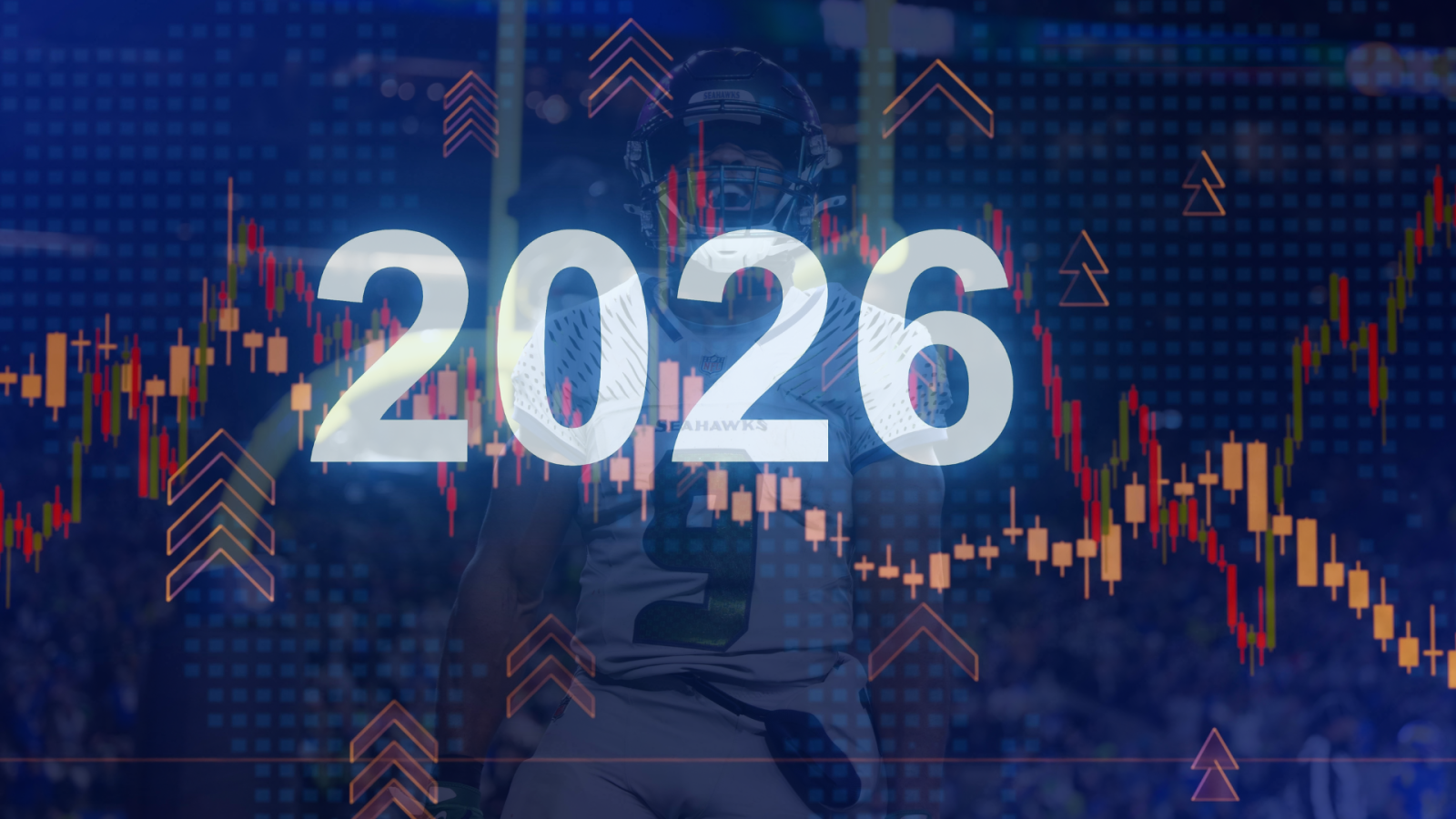
Prediction markets offering sports event contracts will continue to drive the gambling industry news cycle in 2026 as their disruption of the state-level sports betting marketplace deepens.
Not exactly a news flash, but a topic still in need of deeper analysis.
Eilers & Krejcik Gaming (EKG) analyzed the possibilities for the prediction market industry in its recently released report, “U.S. Prediction Markets: How Big, How Fast, What’s Next?”
InGame broke out some bullet points and tapped Chris Grove, the co-founder and managing partner of EKG, for added insights.
Key among these bullet points is that EKG projects that a mature U.S. sports prediction market could produce $200 billion to $400 billion in annual trading volume — “an order of magnitude step-up from today’s ~$14bn base, contingent on regulatory clarity and user adoption.”
Sports betting handle and prediction markets are not precisely comparable, and a true state-regulated national total for handle isn’t possible because of the disparate way states report. But for perspective purposes, the 2024 national sports betting handle was $149.7 billion, according to InGame research.
The EKG study also asserts that there is a “plausible case” for the prediction market volume figure to eventually reach $1 trillion annually.
Key EKG analysis for 2026
Highlights from the report:
- Material legal and political questions create an overhang of uncertainty likely to span
several years. Handicapping this particular basket of risk is beyond the scope of this report,
but a few things are clear: The risk is material (enough to reshape the fundamental opportunity), a resolution of the risk in favor of sports prediction markets (e.g., a Supreme Court decision) would send shockwaves through the regulated gambling industry, and we are unlikely to get that resolution until 2027.
“I’m sure prediction markets will have their fair share of growing pains,” Grove said, “but there’s a reasonable chance the public honeymoon continues through most of 2026. Obviously, an onslaught of advertising or a spate of scandals could quickly dampen mainstream opinion.”
- For prediction markets, understanding parlays matters because the underlying consumer behavior (bundling multiple outcomes into a single, high-leverage wager) is a core driver of [total addressable market]. Any PM product that hopes to compete meaningfully in sports must, in some form, replicate the emotional payoff and upside profile that parlays provide.
- To put it more clearly: The risk to [online sports betting] is not binary; a “good enough” prediction market product can do substantial damage to the current demand for regulated online sports betting.
Eventually, Grove said, niche prediction markets could arise as some remain focused on the core, pre-sports event contract palette of pop culture and political markets, while some cater more heavily toward sports bettors.
“I think we’ll see a highly diverse set of offerings, with different brands focusing on different cohorts and distinct product offerings,” he said.
- Key Takeaway: At maturity, U.S. sports prediction markets could support sportsbook-style handle roughly 60-80% the size of today’s regulated OSB market.
- Sports remain the anchor category for U.S. prediction markets, representing ~44% of long-run volume in our illustrative forecast: larger than financial markets or politics on a category share basis.
EKG added that the best-case scenarios for prediction markets’ volume expansion depended greatly on sports event contracts doing much of the work.

Noted the report: “That path is predicated on a few forces, including (but not limited to): the enthusiastic adoption and promotion of prediction markets by at-scale non-sports brands (e.g., Coinbase, Crypto.com, Kraken, Robinhood), the cultural adoption of prediction markets and related
ephemera (e.g., the Polymarket chart/price becomes a fixture on social media and in news reports), and the demonstrated use of prediction markets by key stakeholders in the financial and investment ecosystems.”
At this time next year, Grove predicted, nothing will be resolved.
“One year from now, I expect us to be talking about the rapid evolution of the product, the expansion of the competitive surface area, and the countdown to intervention by the Supreme Court,” he said.