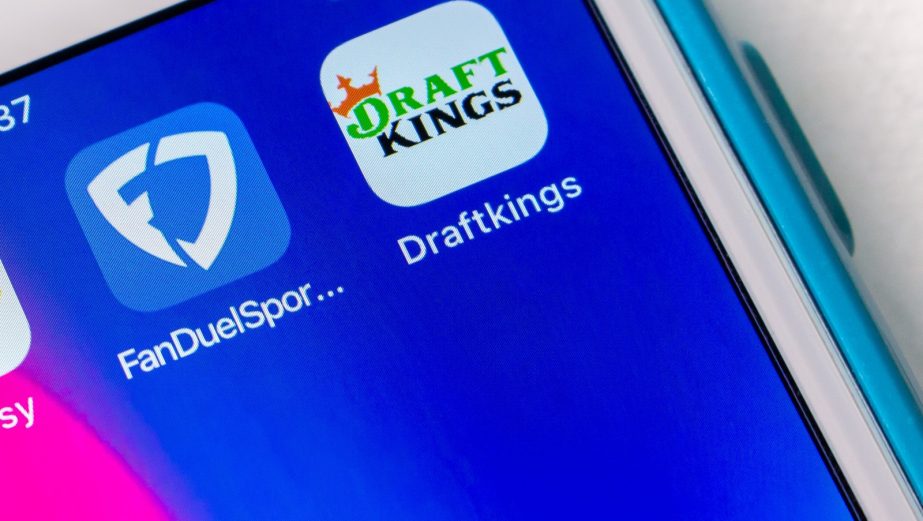

In mid-November, DraftKings and FanDuel resigned their memberships with the American Gaming Association (AGA) when it became clear that the trade organization was not in support of its members offering or being involved in prediction markets. Both companies — the leaders by market share in U.S. sports betting — have since launched prediction products, as has Fanatics, which vacated its AGA membership weeks later.
Annual renewal for the AGA comes up in early January, and an InGame comparison on member operators and suppliers this week revealed that two key suppliers — OpenBet and Sportradar — are no longer members. OpenBet, which supplies back-end services including risk management and geolocation to major operators, counts Fanatics, FanDuel, and FanDuel parent company Flutter among its partners. Sportradar, the official data supplier for MLB, the NBA, NHL, PGA, and many other major professional sports leagues, counts DraftKings and FanDuel among its partners.
“Sportradar has chosen not to renew its membership with the AGA in the ordinary course of business,” Sportradar said in a statement to InGame. “The company remains fully committed to supporting a transparent, regulated sports betting market.”
OpenBet declined to comment.
On the operator side, the membership list remained static other than the departures of DraftKings, Fanatics, and FanDuel.
Participation in prediction markets has become a hot topic over the last year, since Kalshi first offered sports event contracts ahead of the 2025 Super Bowl. The markets are regulated by the federal Commodity Futures Trading Commission (CFTC), and are legally considered derivatives. Though the contracts look and feel like traditional sports betting, they lack the kind of guardrails around consumer protections that state-regulated sportsbooks are beholden to, and they do not pay fees or taxes to individual states.
“The members who’ve departed are pursuing different paths related to prediction markets that don’t align with AGA’s core focus on protecting state and tribal authority,” AGA Senior Director, Strategic Communications & Media Relations Dara Cohen told InGame via email. “Our priority remains defending the legal, state- and tribal-regulated gaming framework.”
AGA, tribes working together
It appears the rift will bring the AGA, which is vocally lobbying against prediction markets being allowed to offer sports event contracts, back to its land-based casino roots. The organization since last summer has partnered with more land-based casino companies, including tribal casinos and organizations, in support of state regulation and against the idea of federally regulated platforms being allowed to operate without having to adhere to state law or regulations surrounding integrity, know-your-customer protocols, responsible gaming, and more.
Tribal gaming “has always been a valued and essential partnership for the AGA,” Cohen said. “We’ve worked closely with tribal leaders and organizations for many years, and that collaboration has only deepened as we’ve aligned around shared priorities like consumer protection, sovereignty, and preserving a strong legal market.”
Tribal leaders called the partnership between the AGA and Indian Country a case of “strange bedfellows” at the Indian Gaming Association (IGA) mid-year conference in September. While both states and tribes pride themselves on comprehensive regulatory frameworks around gambling, the two groups have not always been on the same side of issues. But in the last year, the AGA and IGA have joined together to lobby against all forms of what they consider to be illegal gambling, including sweepstakes platforms and prediction markets.
On Jan. 12, the AGA and IGA wrote a joint letter to Congress on the topic of “unregulated sports event contracts” in which the organizations wrote that prediction markets “undermine state law and tribal sovereignty and flies in the face of existing federal laws and regulation intended to protect consumers and the integrity of our nation’s financial markets.”
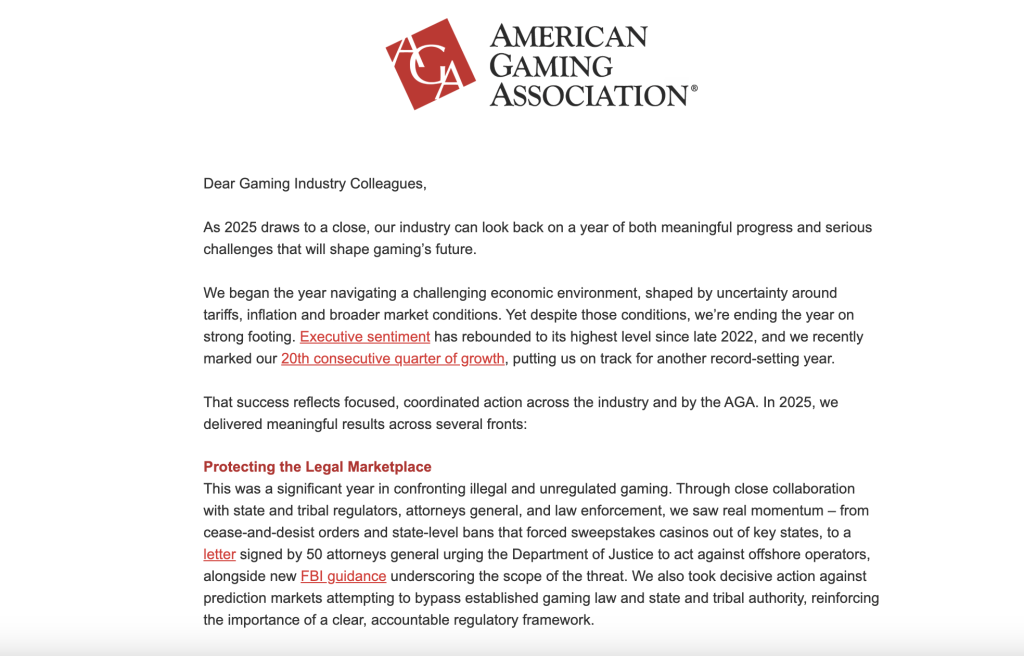
AGA President Bill Miller addressed the partnership and the AGA’s view on prediction markets in a December letter to members.
“Our position is clear and unwavering: sports event contracts are gambling, and gambling is regulated by states and tribes,” he wrote. “In 2026, we will continue to defend this framework and uphold state authority and tribal sovereignty.”
Divide apparent in other quarters, too
DraftKings, Fanatics, and FanDuel are tech-first companies, and OpenBet and Sportradar are as well. That differentiation — tech company vs. traditional casino operator — has emerged as a divide within the industry in other areas, too. Most notably, smaller, regional casino operators like Churchill Downs and The Cordish Companies have lobbied against tech giants DraftKings and FanDuel over the addition of online casino and sports betting in some states.
A core difference between tech companies and traditional casino companies is real estate, and the need for land-based casino companies to continue to have customers visit their locations and patronize not just the casino but restaurants and retail shops as well.
When it comes to prediction markets, however, it appears that the biggest traditional casino companies with online products, like BetMGM and Caesars, don’t want to risk regulatory violations and seem to have no burning desire to build their databases through prediction markets, while DraftKings, Fanatics, and FanDuel say they don’t fear regulatory repercussions and that databases are paramount to getting a leg up in non-legal gaming states.
Some regulators have sent letters to license holders warning against getting involved in prediction markets, but none has taken enforcement action. Last fall, FanDuel surrendered its retail sports betting license in Nevada and DraftKings withdrew an application under pressure from the Nevada Gaming Control Board.
Stock market not enthusiastic
Wall Street has had a mixed reaction to the effect that the prediction market arena will have on sports betting stocks — though stock prices for DraftKings and FanDuel are far off their 52-week highs. DraftKings, which went live with its prediction product Dec. 19, was trading mid-day Monday at $30.58, as compared to its 52-week high of $53.61.
Despite the fact that DraftKings and FanDuel are offering the product, stock prices for both companies have tumbled since November. FanDuel launched its product Dec. 22, and its shares have dropped 50 points since then. FanDuel was trading at $173.55 mid-day on Monday, as compared to $223.97 on prediction launch day, and a 52-week high of $313.68.
Caesars and MGM Resorts International (part owner of BetMGM) have also endured stock-market declines, though both companies face headwinds beyond prediction markets, including declining visitation to Las Vegas.