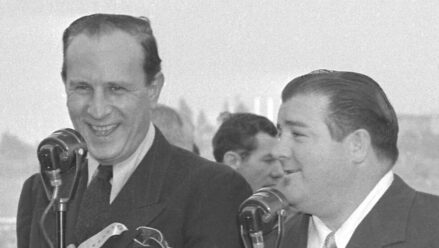
Stevin Smith met Benny Silman during freshman orientation at Arizona State. They had a class together that first semester, then went about their own paths on the Tempe campus of the early 1990s.
For Smith, a decorated basketball player from Dallas nicknamed “Hedake,” that entailed becoming a two-time Pac-10 Conference first-team selection, and the Sun Devils’ all-time leader in three-pointers attempted and made.
For Silman, it was becoming a campus bookie.
Their reunion during Smith’s senior 1993-94 season would prove fateful for both. Even with dreams of All-American plaudits and an NBA career, Smith and teammate Isaac Burton took bribes from Silman and agreed to shave points in four games. Smith banked $20,000, alone, for trimming the spread against Oregon State from 15 to a 6-point win, all the while hitting 10 three-pointers in a 39-point performance.
It seemed easy. It wasn’t. Smith and Silman both went to prison.
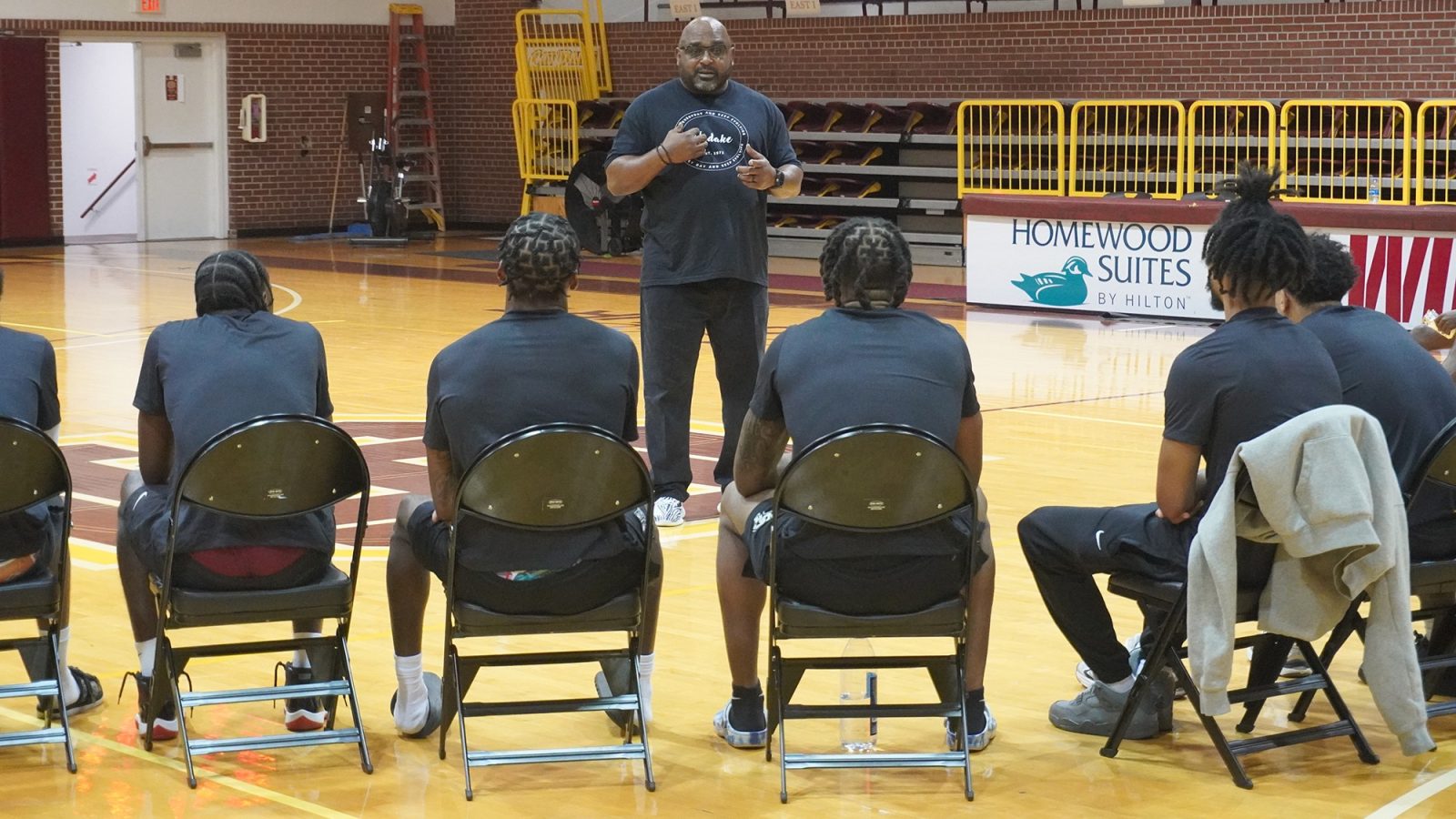
Now 54, Smith has chosen to not passively watch a procession of student-athletes make the same life-altering mistakes. An adviser with EPIC Global Solutions, a gambling-harm mitigation company, he hopes to apply his reality to their future decision making, one face-to-face session at a time, in gyms and coaches’ rooms on campuses where sports corruption remains a constant threat.
Smith has delivered his message to college and pro players 86 times in small-group sessions. Decades from the potential glory and income he squandered, he has one key talking point to cut through generational disconnect.
“Once I say I went from a McDonald’s All-American, ‘Hedake’ Smith, to 01044748, my prison number, they’re hooked,” he said.
Gambling corruption plagues NCAA
The Eastern District of Pennsylvania (EDPA) indictment handed down on Jan. 15 against 26 alleged game fixers included four men’s college basketball players who were active as recently as a week before.
Observers struggle to understand why college athletes conspire to alter games for gamblers, especially now with the opportunity to be compensated, in some cases lavishly, through Name, Image, and Likeness (NIL) deals. But not every player is getting rich.
The EDPA indictment specifically noted that the alleged ringleaders of the NCAA conspiracy targeted players without lucrative NIL contracts: “The fixers targeted for their scheme NCAA basketball players for whom the bribe payments would meaningfully supplement or exceed legitimate NIL opportunities.”
Disparities in contract values, said Dr. Brian Selman, EPIC Global Solutions’ U.S. sport program manager, can create an entry point for corruption.
“As a result of the incongruences [NIL pay] can create within teams, [where] some people are getting more money than others, NIL can expand vulnerability, can make certain athletes more vulnerable and more likely to be able to compromise not only their careers, or their own personal integrity, but the integrity of competition as a reach for more dollars,” Selman told InGame. “It creates yet another angle that leaves our student-athletes exposed.”
The settlement of the House vs. NCAA case in June allowed universities to begin directly paying athletes through a revenue-sharing plan capped at $20.5 million. Schools not in the ACC, Big Ten, Big 12, Pac-12, or SEC conferences must opt in to the College Sports Commission (CSC) program each year.
Every player alleged to have conspired to rig games in 2024 in the most recent indictment played at a school that opted into the program for this academic year.
Security expert Matthew Wein told InGame that compensating players may not be an immediate fix, however.
“What I do think this points to is the CSC keeping more information about NIL deals inside their black box,” he said. “I suspect they may point to more public knowledge about a lack of NIL deals for some players as potentially inviting outreach from would-be match fixers. I think more transparency will lead to more trust in the system from fans, athletes, and others but fear this may pull some in the opposite direction.”
A study by integrity monitoring firm IC360 recently found that 4.3% of student-athletes and staff respondents had been asked for insider information regarding a game in which they were a participant.
Smith said the issue is personal for him because his “low-income” upbringing makes him keenly aware of how young players find themselves in the troublesome intersection of temptation and lack of understanding about the consequences of gambling corruption.
“The ones they target, that’s going to be those single-parent homes that haven’t really been educated on gambling,” he said, “and that’s why it’s so important that we can educate these athletes. That way they can understand there are consequences to everything that you do wrong, and what you’re doing. … You think you can get away with it, when you can’t.”
Student-athletes not insulated on campus
Technology has allowed interlopers to push deep into what was once the insular community of a college campus, into dorm rooms and the decision-making process of young adults. The daily maintenance of an NIL-worthy social media profile, both as an athlete and a brand, has also. The multitude of platforms that athletes utilize to enhance their value as an endorser offers open avenues for the unscrupulous.
“They think they want followers, they want this big-time blue check and all these followers and they don’t see all the red flags,” Smith said. “They’re making it that easy to get them. Everybody wants to have this Instagram page and you get paid through social media, but that’s why they have access to them.
“You’re an easy target.”
Selman estimates that a starting point guard at a major university — like Smith — would have at least 40,000 followers on a social media platform, creating, he said, “40,000 shots on goal that the average person can take to speak to him directly.”
“The reality of this, and what we see too often, is that you’re testing an individual’s willpower over time,” Selman continued. “Hedake can push that person away over and over and over again, but the challenge is those people that are looking to find an angle, they’re looking to pry open the integrity of the sport and the individual athlete.
“They’re going to go from one person to the next until they get somebody that’s willing to ‘play ball’ with them, and that’s where it gets really scary, is that you have a systematic approach to scale up harassment.”
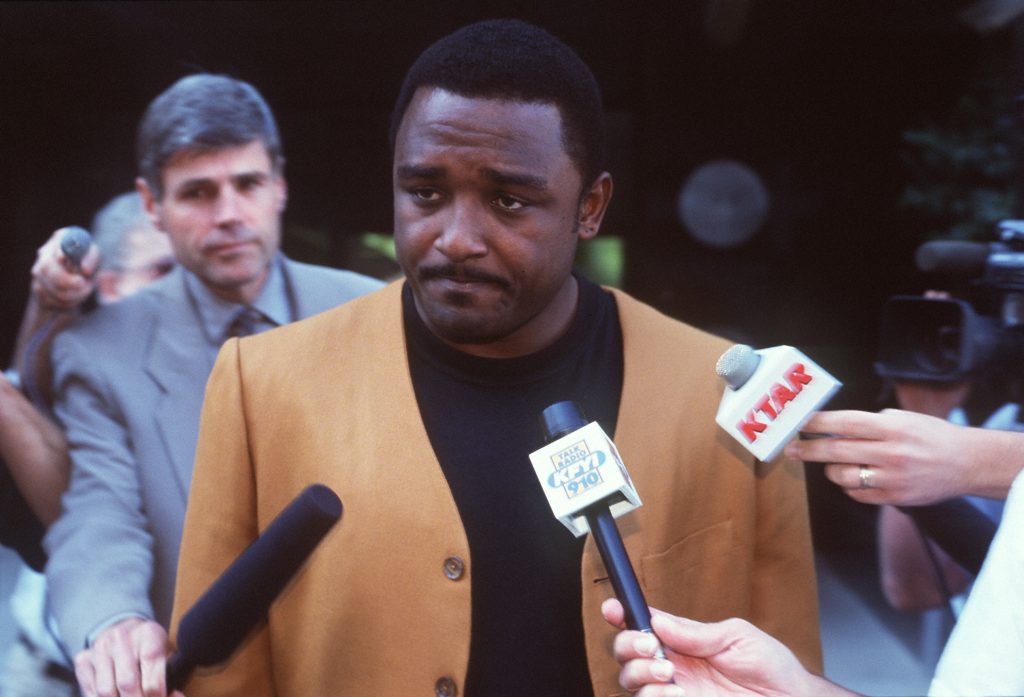
Smith’s ultimately fateful relationship with Silman, meanwhile, took years to develop. The result still took away his budding NBA career and sent him to prison for a year, while Silman was sentenced to 46 months for masterminding the plot.
“Benny Silman was one of the first guys I met in freshman orientation, and then I had a freshman class with him,” Smith recalled. “But it wasn’t until four years later, my senior year, when everything went down. It actually started just playing a video game and we were gambling, and I got in the hole. And that led to me betting on the Dallas Cowboys vs. Arizona Cardinals game, which I lost, and then turned around, chased it on the Pittsburgh-Buffalo Bills game. And I lost that. Before you knew it I had a line of credit, and three weeks later, I was down $10,000 and that’s when they approached me about the fix.”
Alleged fixers, masters of manipulation
Text message transcripts between alleged conspiring basketball players and ringleaders underscore the desperation of some players upon realizing their predicament.
At halftime of a March 4, 2024 game between Coppin State and South Carolina State, according to the indictment, co-conspirator Jalen Smith texted “Person #13,” a Coppin State player, angry that the score was closer than desired. Members of the gambling ring had bet on South Carolina State to cover a 9-point spread.
The text: “Wtf [what the f*ck] u doing[,] it need to be a blowout … You hooping yo ass off wtf [what the f*ck] … U supposed to be fxcking losing[,] you costing us money … Get yo ass blow[n] out next half bro.”
After a 61-58 win, which ruined the gamblers’ bets, “Person #13” responded: “”[T]hey [South Carolina State] so ass I couldn’t even keep they lead together[,] im sorry for th[a]t bro[,] I try to tell my [Coppin State] teammates to chill and all th[a]t bro[,] swear I tried everything in my power second half.”
The desperate tone doesn’t surprise Smith.
“I was talking with somebody and they were asking me how I dealt with it,” he said. “I was dealing with depression, different levels of depression that they didn’t realize because I was trying to hold it inside, and trying to be strong and get through it. But I really was depressed as hell.
“So, when you tell me about somebody actually doing that, they’ve probably realized that, ‘Hey, this thing’s about to go bad.’ So, they’re shouting out loud, they’re crying out, texting and trying to be aggressive when probably they’re at the point of no return.”
Running the point for a solution
Smith and Selman’s work focuses both on combating potential gambling addiction and addressing the factors that could lead a student-athlete to collude with gamblers. While not outwardly anti-gambling, they believe the easy access of it in a country where 41 jurisdictions have legalized sports betting is a complicating factor. As far as can be determined from federal charging documents, the illicit betting activity in the Jontay Porter, Terry Rozier, and NCAA cases involved bets placed at legal, licensed sportsbooks in the United States. That accessibility, Selman said, eliminates one of the friction points to scandal.
“I don’t have any ironclad evidence to tell you that it makes it three times or 10 times or a thousand times more difficult, but I would tell you that 30 years ago, the hurdles that someone had to cross to Hedake, to have enough rapport with him, to trust him, for him to make a choice like this on the court were significant,” he said. “And access and legality of it puts a whole different level and depth of audience in that conversation and a willingness to try and cut corners to earn a buck.
“At some point, gambling is going to come onto their radar and they’re going to be asked to make good choices related to that. So there is a micro lens of, ‘Hey, look, for the next five years, you need to make really good choices for these reasons.’”
Solutions, tactics, aspirations
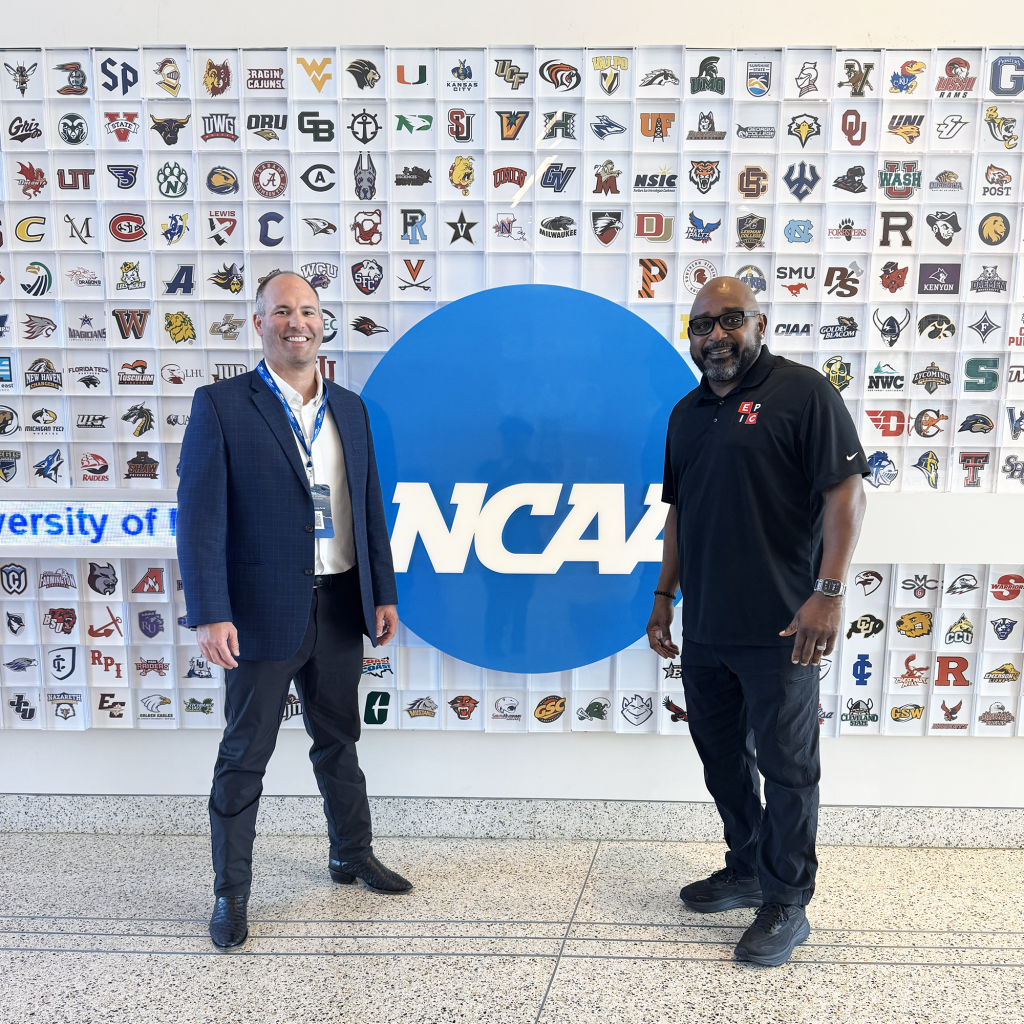
Selman (pictured at right, with Smith) believes that the NCAA and sports conferences are “working on it” in terms of establishing programs and guardrails to help student-athletes make positive choices and find help if they’ve made bad ones. The NCAA in August established a hotline for reporting abuse in conjunction with the payment platform Venmo, and after revolt of its member institutions, in November revoked a proposal to allow student-athletes and staff to wager on professional sports.
On Jan. 15, NCAA President Charlie Baker implored state gambling commissions to eliminate prop bets for college games, although point-shaving was the predominant offense in the most recent indictments.
“I think they’ve become more attuned to how big of a challenge this can pose to, if nothing else, the integrity of their competitions,” Selman said. “And I think they are becoming more emboldened by the day to knock down barriers to get us into rooms and do education.
“So are they doing enough? Black and white answer: probably not. Are they doing a ton and continuing to scale it up? Hell yeah, they are.”
Selman isn’t necessarily an opponent of legal gambling, but stresses that outreach for the young must expand at the pace of the sports betting industry. He envisions future programs where a counselor or someone with Smith’s real-world experience would be available at any time via a call or direct message.
“And I’d give them the confidence to pick up the phone,” he said. “Raising awareness is one thing, but instilling confidence in young people is different. That’s the whole point of the coaching profession. That’s what we’re doing.
“We’re coaching them up on what gambling could do in a negative way.”
“So are they doing enough? Black and white answer: probably not. Are they doing a ton and continuing to scale it up? Hell yeah, they are.”
And if — when — mistakes are made, Smith said, he isn’t there to judge. In each of his talks with athletes or administrators, he said, he “owns it,” in regard to his mistakes. He tries to convey that they must, too, no matter the outcome.
“You never know the situation a player is in, to why they do what they do. I talk about me,” Smith said. “I don’t like talking about anybody else, but here’s my thing: I don’t judge anybody. I don’t know what they went through. I don’t know if their dad had a gambling debt or something, that they were forced to do it. I don’t know.
“So I’m just big on educating kids. For me, I’m not judging Chauncey Billups, Rozier, Jontay, none of them.”