Particularly since April 2020, when the only sporting event that took place in any of the major U.S. leagues was the NFL Draft, football’s biggest offseason event has exploded into one of the most anticipated dates on the betting calendar.
The public enjoys this market, because bettors’ fandom and knowledge of teams have value with situationally based wagers. Sportsbooks, on the other hand, begrudgingly take the action. Since the odds are outside the purview of their powerful algorithms, draft days have hurt them in the past.
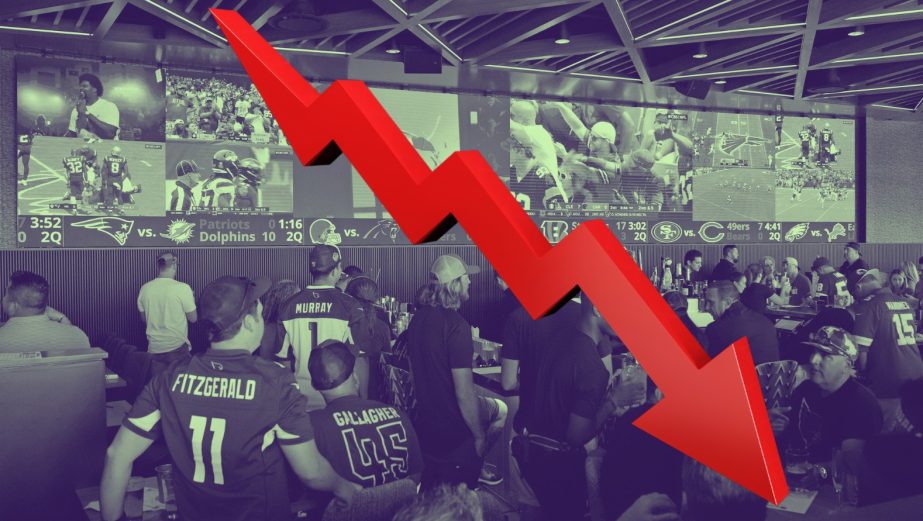
For DraftKings, FanDuel, and friends, the NFL Draft has basically become their Costco rotisserie chicken — a loss leader that gets customers to walk in and shop around for more.
Well, this year, the tenuous relationship between the books and NFL Draft bettors is about to become even more complicated, as prediction markets have nudged in as the third wheel. With names such as Kalshi, Polymarket, and Robinhood in the mix, the legal books find themselves dealing with some newfound competition — not to mention entering that competition themselves, as DraftKings, FanDuel, and Fanatics have all launched prediction markets of their own.
In order to determine what the impact might be, let’s jump ahead from the current Super Bowl hype and focus on the NFL Draft (April 23-25) from the bettors’ perspective to better understand how the action may be altered due to the emergence of prediction markets.
Super Bowl giveth, draft taketh away
The NFL Draft commands so much attention because it offers one of the best betting opportunities for proactive handicappers. Those willing to grind through media sources for information tend to find more profit than with daily wagers.
Long-time bettor and host for the Vegas Stats and Information Network (VSiN) Matt Youmans has always embraced all-night cram sessions to write up mock drafts around this time of year. He has been doing them since the mid-1990s when he was a beat reporter covering the Chicago Bears. When Nevada allowed wagering on the NFL Draft in 2017, Youmans bolted to the betting window.
“I absolutely love betting on it and have been a winner every year but one. It can be a soft market that a sharp handicapper can beat,” said Youmans. “This is an important point — bookmakers aren’t great at making draft odds and can be too slow to adjust prices.
“To bet it, read beat writers as much as possible to get a feel for how the teams might draft. I also rely on some good sources around the league and that helps with more reliable information.”
The general trend has been for the books to clean up from recreational bettors during the Super Bowl, only to give back a portion on the draft when some conscientious handicappers beat them in the race for information.
One of the more recognizable figures in the industry, Doug Kezirian, is also drawn to the NFL Draft market, where he can implement his research and analytical skills.
“I’ve always been fascinated by the NFL Draft and have been tracking the odds as a sports fan back to the early 2000s,” said the analyst for Betting Weekly.
Like Youmans, wagering on it allowed Kezirian to swing some of the different clubs in his handicapping bag.
“Drafts reward intelligence and complex thought,” said Kezirian. “They’re extremely nuanced and the untrained eye can’t decipher those depths. One must understand the domino effect of a particular decision and the betting value of one slot.”
Sportsbooks in unfamiliar territory
Come late April, bookmakers find themselves uncharacteristically playing defense.
“The books, whether in Nevada or nationally at DraftKings and FanDuel, routinely lose to the draft and have been limiting bet amounts and reducing the prop menu,” said Youmans. “The truth is, most Nevada bookmakers hate the draft. The bettors beat it too often.”
According to Kezirian, the bookmarkers trying to mitigate their loss potential during the draft may appease those in the C-suite, but that is leading to consumer dissatisfaction.
“Some sportsbooks are great, but others complain too much,” said Kezirian. “First of all, they won last year. Also, many prefer to whine about fictitious inside information. That protects them from bosses. I’ve always wondered why the suits believe them, rather than demanding their employees improve and evolve.”
He added, “Obviously it’s much harder to book the draft than moving a game’s odds with the screen,” said Kezirian. “However, if they’re going to inundate the consumer with parlay odds and their other shiny toys, I believe they have a professional obligation to meet these demands.”
So the legal books are in a bind. They don’t want to be overexposed, but bettors demand a deep draft market. If that isn’t available from them, then Kalshi and others will gladly offer an alternative.
That is one of the reasons an “old-school” type like Youmans, who has logged many hours in a book with tickets in hand, is thinking about making draft wagers in a new-age way.
“This could be the first year I use the prediction markets,” said Youmans. “But that remains to be seen. We’ll see how the odds and numbers play out.”
Peer (-to-peer) pressure
That the names Kalshi, Polymarket, Robinhood, and other prediction markets are even in the conversation of NFL Draft wagering indicates how quickly the industry is evolving.
This federally regulated peer-to-peer market with odds based on actual wagers is now operating in a number of states with and without legal sports betting.
According to a recent report by the research firm Sensor Tower, Kalshi’s six top-performing markets for December 2025 were New York, Chicago, Los Angeles, Boston, Philadelphia, and Dallas-Fort Worth. This mixture of large sports-crazy cities already muscling in on some of the legal sportsbooks’ turf will likely continue when the NFL fans in those areas want draft action.
That’s why FanDuel, DraftKings, and Fanatics are now in the prediction market business, giving users access to finance, economy, and commodity wagers — plus sports markets in some states where statewide digital sports betting is not regulated. FanDuel Predicts is now available in all 50 states, DraftKings Predictions is operating in 38 states, and Fanatics Markets is in 24.
Gaeten Dugas, a Kalshi trader, said that once prediction markets brought in sports, “it became a game changer. Sports now drives like 90 percent of their daily volume.”
The Minneapolis-based Dugas feels the lead-up to the NFL Draft will provide more time for prediction markets to cultivate interest.
“They’re becoming popular for a number of reasons. First is the crypto rotation that came after crypto went through that rough patch and traders started looking for the next hot thing. That turned out to be prediction markets. Then there are all the partnerships the companies have with media tie-ins that put them in front of a bunch of new people. All that leads to more media coverage, which draws even more eyes to the product.”
Professional handicapper The Real Mr. ACL, a recognizable name in the betting space, has already shifted a considerable amount of his business to prediction markets and expects to keep it going for the NFL Draft.
“The simple fact is the lines are almost always better at PMs,” asserted The Real Mr. ACL.
“Anyone who wins consistently, the books will limit your account,” he added in pointing out advantages to using prediction markets over regulated sportsbooks, which have been known to limit or ban some winning customers. “On the other hand, a prediction market is Person A betting against Person B, and [the prediction market] simply takes a commission from the bet, so their incentives are the exact opposite of the book. They want to encourage bets for as much as possible and just take their cut. So they provide a tremendous advantage to those looking to get down for as much as possible for something like the draft.”
But here’s a touchy point: The legal age to use Kalshi and other prediction markets is just 18. With a few exceptions (Montana, New Hampshire, Rhode Island, Tennessee, Wyoming, and Washington, D.C.), bettors in regulated markets have to be at least 21.
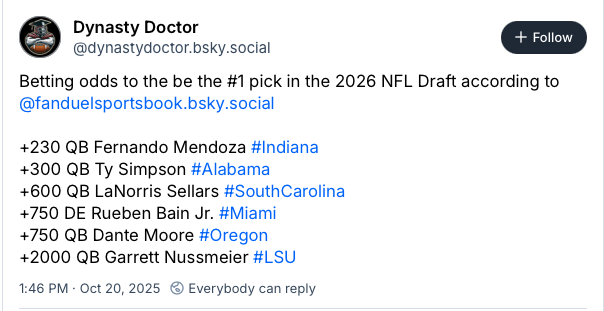
Even if bettors are aware of the business, ethical, and legal concerns associated with prediction markets, come the NFL Draft, their attention will be elsewhere, namely on who goes with the second pick behind Fernando Mendoza.
Market watch
To demonstrate how quickly the NFL Draft market moves, we tracked the odds (on DraftKings and Kalshi) for the No. 1 overall pick during the College Football Playoff.
The action on the field mirrored the competition between bettors and bookmakers simultaneously watching the games, then battling each other for the best number.
Jan. 8 — odds prior to and after semifinal game between Miami and Mississippi
DraftKings
| Before kickoff | After game |
|---|---|
| Fernando Mendoza -425 | Fernando Mendoza -425 |
| Dante Moore +330 | Dante Moore +330 |
| Rueben Bain Jr. +2500 | Rueben Bain Jr. +2500 |
| Trinidad Chambliss +4500 | Trinidad Chambliss +5500 |
| Carson Beck +10000 | Carson Beck +7500 |
Kalshi
| Before kickoff | After game |
|---|---|
| Fernando Mendoza 70% | Fernando Mendoza 67% |
| Dante Moore 26% | Dante Moore 16% |
| Rueben Bain Jr. 1% | Rueben Bain Jr. 1% |
| Trinidad Chambliss 1% | Trinidad Chambliss 5% |
| Carson Beck 1% | Carson Beck 1% |
Jan. 9 — odds prior to and after semifinal game between Oregon and Indiana
DraftKings
| Before kickoff | After game |
|---|---|
| Fernando Mendoza -425 | Fernando Mendoza -1000 |
| Dante Moore +330 | Dante Moore +800 |
| Trinidad Chambliss +2000 | Trinidad Chambliss +1700 |
| Rueben Bain Jr. +2500 | Rueben Bain Jr. +2800 |
| Arvell Reese +3500 | Arvell Reese +3500 |
| Carson Beck +7500 | Carson Beck +10000 |
Kalshi
| Before kickoff | After game |
|---|---|
| Fernando Mendoza 69% | Fernando Mendoza 90% |
| Dante Moore 46% | Dante Moore 7% |
| Rueben Bain Jr. 3% | Trinidad Chambliss 8% |
| Trinidad Chambliss 8% | Rueben Bain Jr. 5% |
| Carson Beck 1% | Arch Manning 1% |
Jan. 19 — odds prior to and after championship game between Indiana and Miami
DraftKings
| Before kickoff | After game |
|---|---|
| Fernando Mendoza -8000 | Fernando Mendoza -8000 |
| Trinidad Chambliss +3000 | Trinidad Chambliss +3000 |
| Rueben Bain Jr. +6000 | Rueben Bain Jr. +4000 |
| Arvell Reese +6000 | Arvell Reese +6000 |
| Ty Simpson +9000 | Ty Simpson +9000 |
Kalshi
| Before kickoff | After game |
|---|---|
| Fernando Mendoza 92% | Fernando Mendoza 90% |
| Trinidad Chambliss 2% | Trinidad Chambliss 4% |
| Rueben Bain Jr. 5% | Rueben Bain Jr. 3% |
| Arch Manning 1% | Arch Manning 1% |
While it might appear trivial to the generation familiar with the work of Jimmy the Greek, Kalshi’s layout and interactive graphics are the type of visual elements that attract a younger demographic.
Draft a prediction gateway for bettors?
While Dugas isn’t an NFL Draft bettor, he senses momentum building for prediction markets.
“If people learn that Kalshi or Poly can consistently provide better odds, I could see bettors moving over,” said Dugas. “It’s probably happening right now to an extent, but because the pool is growing overall, all the platforms are still able to grow. I think DraftKings and FanDuel are likely have an edge in customer acquisition and retention still, but there’s no guarantee that they keep it.”
Speaking directly on the role the NFL Draft will play in this growing competitive landscape, Dugas expects both sportsbooks and prediction markets to be similarly priced.
“Both have a ton of liquidity, but the displayed pricing will likely be better on Kalshi. Once fees are taken into account, though, they’ll likely be pretty similar.”
Perhaps it’s a result of being an early adopter, but The Real Mr. ACL expects other sports bettors to get their initial exposure to prediction markets from the NFL Draft, then continue to use them moving forward.
“As prediction models become more and more available, even in states that haven’t yet legalized sportsbooks, the handle for traditional sportsbooks will decrease, in my view. The big boys like DraftKings and FanDuel see that writing on the wall.”