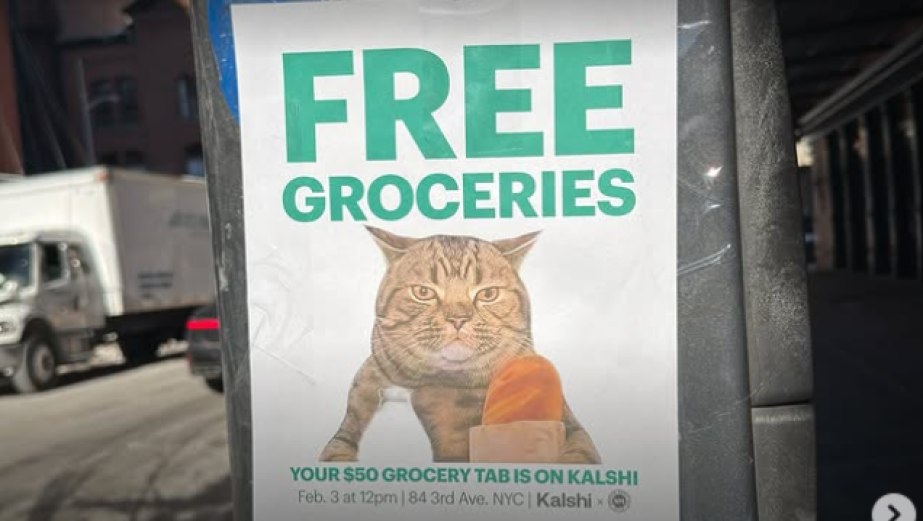
I mean, it’s so on the nose it feels made up, but the dude was reading George Orwell’s 1984 while standing in a line some 500-people deep waiting for $50 worth of free groceries — courtesy of Kalshi.
“It feels apropos for the world we live in these days,” said Sean, the reader. “I read it when I was in high school, like 20 years ago, and it feels much more true now.”
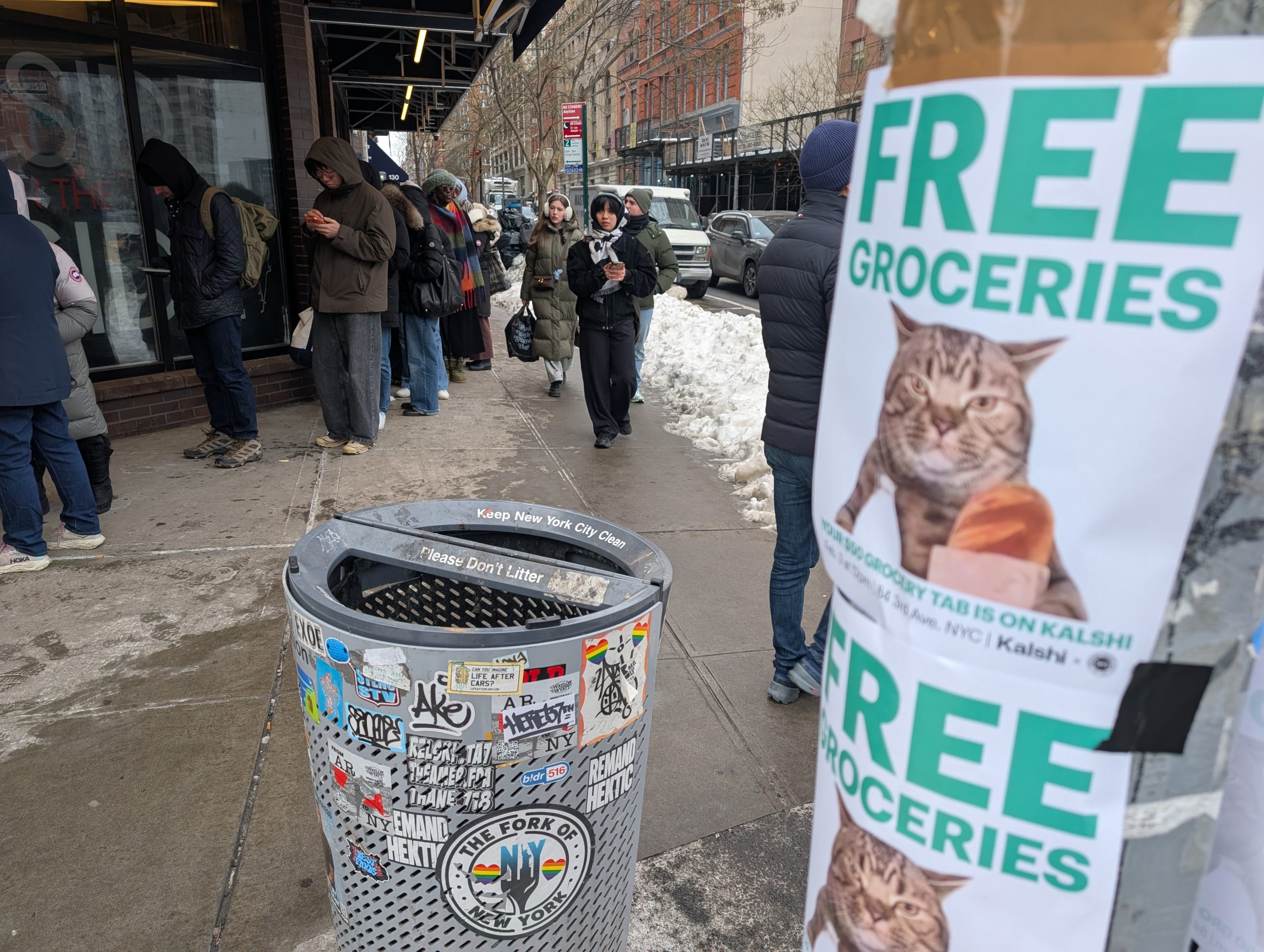
Worth noting: Sean trades stocks for a living, and his girlfriend sent him down to the Westside Market on 12th and 3rd in Manhattan, where he was waiting in line Tuesday — like Winston Smith — for his $50 worth of foodstuffs.
So to be clear: Stock trader waits on line for food while reading dystopian novel about totalitarian regime in a country where half the people think they’re living under a totalitarian regime and it’s all sponsored by — dare I? I dare — a company that claims to basically be able to tell you what the future holds, not all that dissimilar from “The Party” in the novel.
Spooky.
Or, of course, maybe not.
“My girlfriend saw this on Instagram and was just like, ‘Check this out,’” Sean said. “I wasn’t doing anything, so I figured I would come take a look.”
Heck, $50 of free food ain’t nothing in Mayor Mamdani’s New York, amirite?
Waiting, watching, hungry
And that, to be fully transparent, was just about that. While one guy was unironically reading 1984 while waiting in line for food, the vast majority of people on the cloudy and chilly New York day were there for one thing and one thing only, and weren’t thinking too deeply about the forces that delivered us all here.
Mark, also on line, put it plainly as to why he was there.
“Just that they’re giving you $50 for your groceries, so why the hell not?”
As for Kalshi? He had no idea, and asked “who” it was.
He found out about the giveaway the same way almost everyone else did: Instagram. The algorithm, it turns out, is an efficient delivery mechanism for free groceries.
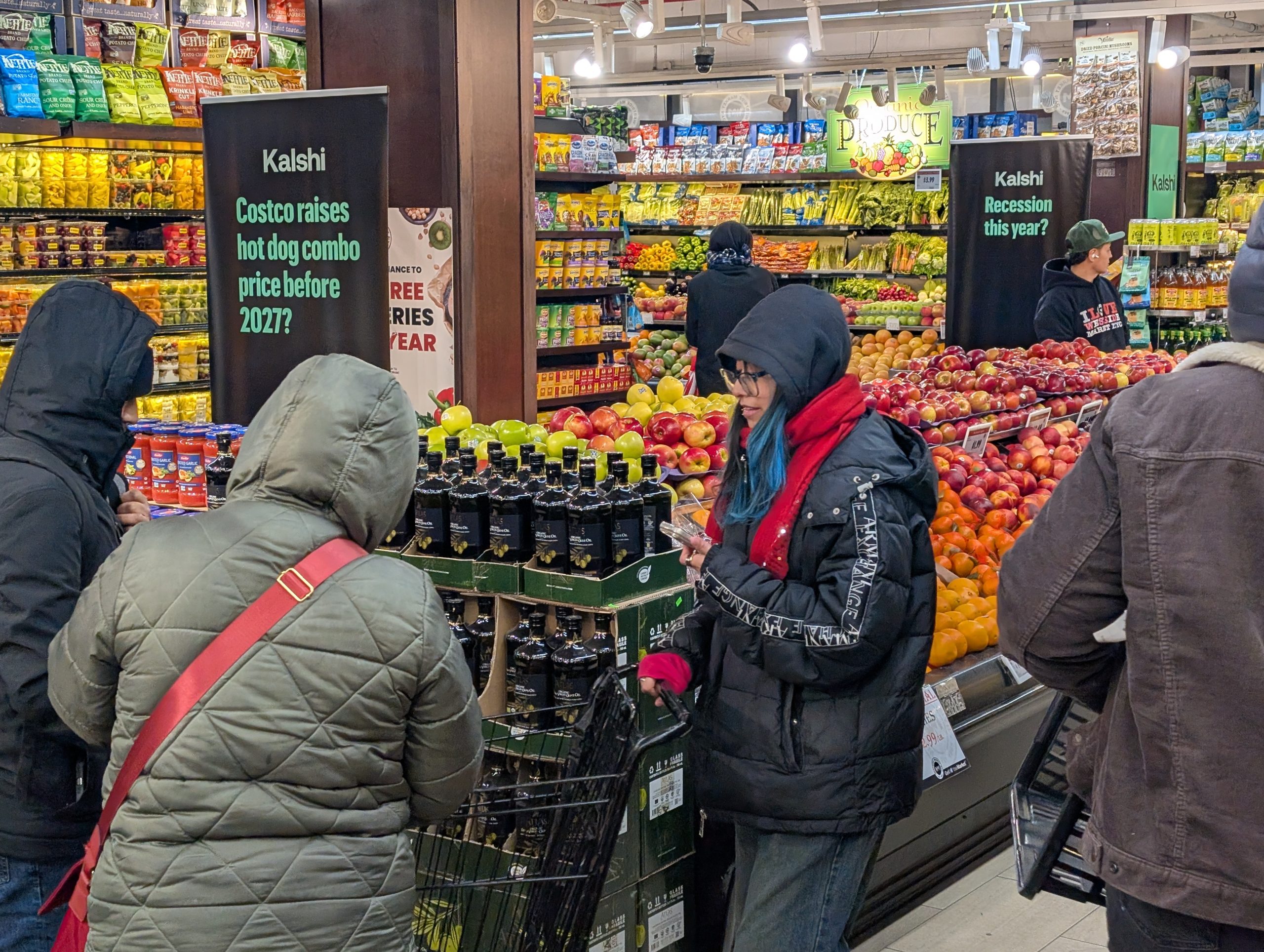
Shakeema, Benjamin, and Livia had been waiting since 10 a.m., about two hours. They’d seen Kalshi ads before but had never visited the site.
“No interest,” Shakeema said.
Their shopping list: milk, organic juices, kombucha. The staples.
Justin, a college student who lives nearby, said he sees Kalshi ads constantly on social media.
“I’m not a big fan of it,” he said, “but $50 worth of groceries — might as well.”
He planned to acquire vegetables and meat.
Christina found out through a New York Local account on Instagram.
“I like the way they’re promoting stuff,” she said. “I saw flyers on the way here with a cat. I don’t know, it’s cute.”
She gave Kalshi credit for the marketing play.
“It’s a great way to get your name out there, especially in this economy.”
Then there was Limler Junior — LJ — who had been standing outside Westside Market since 7 a.m. First in line.
“I woke up at like 6, took the train, and waited for almost five hours,” he said.
Why?
“One, it’s Westside Market. It’s one of the long-standing family-run businesses in New York City,” he said. “Secondly, it was Kalshi. It was free groceries. I don’t really know about Kalshi. I just wanted to jump on the bandwagon and get some groceries.”
This just in …
As I sit here typing this in a library on 23rd Street, my Slack pings me. I open it. What I see … dazzles me.
My colleague, Daniel O’Boyle, on the prediction market beat, saw a tweet. It’s an announcement — I mean, again, this feels made up — but it’s an announcement from Polymarket, Kalshi’s competitor, and it is hyping the imminent grand opening of The Polymarket, New York’s first free grocery store.
Some 24 hours ago, nobody in the public knew about Kalshi’s giveaway or Polymarket’s store.
Today, the two biggest prediction market companies in the world, with a combined valuation of about $20 billion — roughly the market cap of Ford (that’s a company that works with steel and glass and rubber and stuff) — are now in an arms race to see who can give out the most free food in New York City while, simultaneously, allowing people to bet their lunch (and dinner, and breakfast) money on whether or not the announcers in the 2026 Pro Bowl flag football game will say “Mahomes.”
Orwell would have notes.
Price of eggs
Back to Sean, the 1984 guy.
He trades stocks for a living, so, speculation and risk? Not exactly foreign concepts. But Kalshi?
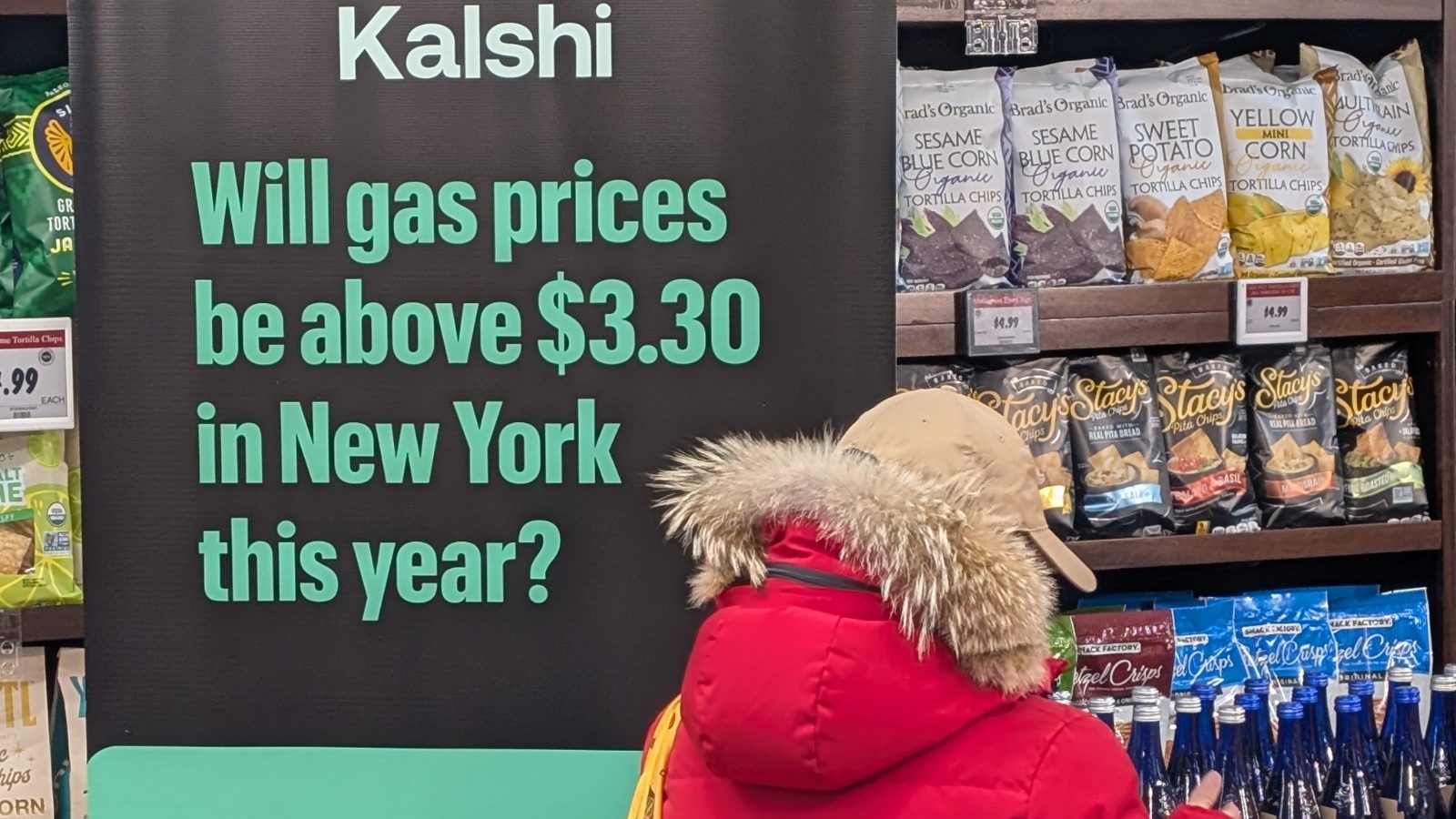
“That’s enough gambling for me,” he said of his day job. “I don’t need to go gamble on the weather and how much eggs are going to cost.”
But he gets the appeal.
“If you want to spend your money on that kind of stuff and try to make a little bit of money doing it, it’s fun,” he said. “It makes other things more fun. And I’m sure some economists can make money knowing how prices fluctuate.”
But for him? No thanks.
“I haven’t really considered hedging through any kind of prediction market. I think there are enough hedges already in the stock market if you trade options. There are enough ways of playing every side and every angle. There’s enough gambling,” he said. “I’d rather keep it all in one place than start going to different casinos.”
What he does think is that prediction markets need guardrails.
“I think it should be regulated more than it is,” he said, and then he brought up the Grammys.
“Like the other day, Trevor Noah made a joke, he was like, ‘Welcome to the Grammys, potato,’ just in case anyone was betting on ‘potato.’ I think that stuff needs to be a little more regulated than it currently is.”
The joke Noah was making — of course? — is about the objective absurdity of being able to bet on virtually anything a person might say on live television. A world where the mere utterance of a random word could move money. Comedy, sure, but also just how things work now.
Anyway, groceries. Sean? What are getting today?
“Probably just the basics. Milk, vegetables, that kind of stuff,” Sean said. “If we want something different, like steak or nice fish, we’ll go to a restaurant. Nothing exciting today, unfortunately.”
LJ, who woke up at 6 a.m. and waited five hours, walked out with $97.74 worth of groceries, $50 of it free. The best thing he bought? Something called Ice Cream for Bears.
“It’s simple ingredients, natural ingredients,” he said. “That’s one of the biggest changes I want to make in my diet — buy healthier stuff.”
He’s trying to learn how to cook. Thinks it’s one of the biggest skills you can have. Hard to argue.
Another day in paradise
Spoiler alert, I guess, but 1984 is 75 years old and it’s not my fault you failed 8th grade English: Winston Smith loses. The guy spends the whole novel resisting The Party, clinging to his humanity, holding onto his own thoughts, and in the end, he breaks. Last line of the book? “He loved Big Brother.”
Not because Big Brother earned it. Because Big Brother won.
Nobody in line on 12th and 3rd loves Kalshi. Most of them couldn’t tell you what Kalshi does. But they showed up. They took the milk and the kombucha and the Ice Cream for Bears. They’ll see the next Instagram post, too.
And at some conference table in Manhattan right now, two fintech companies worth $20 billion are planning their next move in the Great Grocery Wars of 2026. Somewhere else, an algorithm is already serving up the next free thing to the next 500 people who weren’t doing anything anyway.
Dystopia, baby.
Or, you know, Tuesday.