Exchanges such as Betfair existed in the United Kingdom long before prediction markets became what many sports betting stakeholders in the United States deem an existential threat to state-licensed wagering.
As with many facets of a legal gambling industry in the U.S. that mushroomed onto the internet following the repeal of the Professional and Amateur Sports Protection Act in 2018, not enough time has passed to determine tastes, winners, losers, benefits, and damage.
InGame interviewed Sabin Brooks, chief executive officer of Bettormetrics, a UK-based, sports-focused, data-analytics platform and data provider, and company analyst Alfie Arrand about what they have so far observed, using the history of prediction markets globally as context.
Arrand said that the true delineation between prediction market gamblers and sportsbook customers has yet to be determined in the U.S. While Arrand believes sportsbook bettors are generally recreational sports fans, he said that prediction markets haven’t “nailed exactly what their customer will look like.” The overlap between the experienced day trader and sports bettor, he said, remains undefined.
“The typical argument that seems to be happening every day is whether or not it’s gambling, because they’re suddenly interacting with sports in a way that they wouldn’t normally have done before,” he said of typical financial speculators. “And everything is currently happening on a much shorter horizon than those individuals – the day-trader types – might be used to.”
Ultimately, he said, “I think it’s going to be a bit of both.”
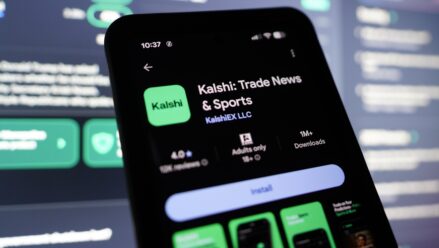
“Obviously,” Arrand added, “the likes of Robinhood and Kalshi have been massively successful outside of sports contracts. These are obviously a relatively new thing compared to that.”
Fonts of truth or insider trading playground
After a heady year of rapid growth and bawdy social media proclamations from prediction market CEOs about the future of sports betting and speculation, the platforms are currently absorbing one of their first major public blowbacks over insider trading. Robinhood CEO Vladimir Tenev and Kalshi counterpart Tarek Mansour had long touted prediction markets as so-called “truth engines,” where informed and monetized sentiment yielded accurate, actionable forecasts of the future.
This ethereal process was eventually distilled for the general public as “insider trading.” Recent events created easily understandable examples. In January, an anonymous Polymarket trader became the largest shareholder of a market predicting the ouster of Venezuelan President Nicolas Maduro a week before his abduction by U.S. forces. The trader banked roughly $400,000.
In October, Coinbase CEO Brian Armstrong glibly manipulated Kalshi and Polymarket mention markets by closing a Q3 earnings call by saying, “And I just want to add here the words Bitcoin, Ethereum, Blockchain, Staking, and Web3 to make sure we get those in before the end of the call.”
“This ‘source-of-truth argument’ is the very justification for their own existence,” Brooks said. “They’re being licensed and allowed to do it, only because it’s an extension of ‘What’s the price of a milk going to be or a corn crop going to be?’ It’s economically useful, having that wisdom and crowdsourcing.
“It’s just morphing that into sports, which I think is less economically useful or justifiable. And the reality is that already exists in sports betting anyway, to a certain extent, and is equally open to abuse, especially when you think about player markets and some of the controversies that have happened in the U.S. and elsewhere when that’s been manipulated or abused.”
An entire online industry, Arrand said, has been created to monitor signs of potential market manipulation. Not to stop it, but to exploit it. The question, then, is whether these stealth traders are manipulating real-life circumstances or those chasing supposed insider information. There is the potential for quick, mass gains, but also for drowning in signal noise.
“There are robots, there are websites now, and there are people monitoring new accounts, any accounts being opened up, suddenly holding large positions in markets that have relatively near horizons,” Arrand said. “And that’s currently something that people are actively recording and sharing with the rest of the market.
“How then can a market decide whether that information is any good or not or the extent to which it reacts to it? If, suddenly, you’re sharing this information with the world, to what extent are other people just going, ‘Oh, big position, I’m going to follow it’? How is that going to disrupt the rest of the market as well? In that sense, that is how something like Polymarket can democratize that. It’s then up to the rest of the world to make use of that information. But ultimately, if there is an insider there, they know one way or another.”
Insider trading is not yet explicitly forbidden on prediction markets, but has been cast with an increasingly oily sheen from industry observers and aggrieved traders. And there could also be legal repercussions. On Monday, a Tel Aviv District Court indicted an Israeli civilian and reservist for allegedly using classified military information to place bets on Polymarket.
Former Betfair employee turned professional bettor Luke Paton offered an insight with a widely distributed X post on Feb. 9.
“What we see from Polymarket and Kalshi is interesting,” he wrote.
“1. They crave the publicity of mkts that generate questionable PR. They adopt the notion that there is no such thing as bad PR.
“2. They have had markets that involve things like wars. Markets involving foreign leaders like Venezuela. See number 1. No shame. Where do they draw the line? Betting on the death of someone? Any morals within the company? Public perception can change in a heartbeat.
“3. They are getting themselves into a constant pickle with regards to how to offer some of these markets. They don’t seem to care. It seems like they have no one to answer to. Just look at the farce with Cardi B this weekend. If it does cost them some money, they aren’t bothered.”
Bots, so many bots
Trader/gamblers venturing onto prediction markets are not sharing a space just with other like-minded speculators interested in melding economics, pop culture, and sports portfolios. They’re competing with internet bots built to identify and exploit market opportunities far faster than a human with a myriad of screens at a work station.
Their influence, Arrand said, is sobering, with traders or groups of them not only monitoring multiple markets automatically, but trading across multiple books or platforms as hedging mechanisms.
“I used to work for a syndicate in the UK that operates on the exchanges there,” he said. “And that was a bit of an eye-opener in terms of exactly who is running the large liquidity markets when we were trading football during the 2022 World Cup, the volumes of money that you’re operating on there, and the level of sophistication in a relatively small team, but all automated, all of it tuned in with our trading engine in the Isle of Man right next to the exchange. All of it with things that you’re used to seeing in financial markets and all the old-school arbitrage techniques.
“Insider trading is now being democratized, as opposed to regulated in a specific way against it. I think you’d be very foolish betting into any form of financial exchange, whether it be sports betting or otherwise, thinking that you have a piece of information that’s not currently available to anyone else — unless you’re within that insider group and you have a piece of information that others do not.”