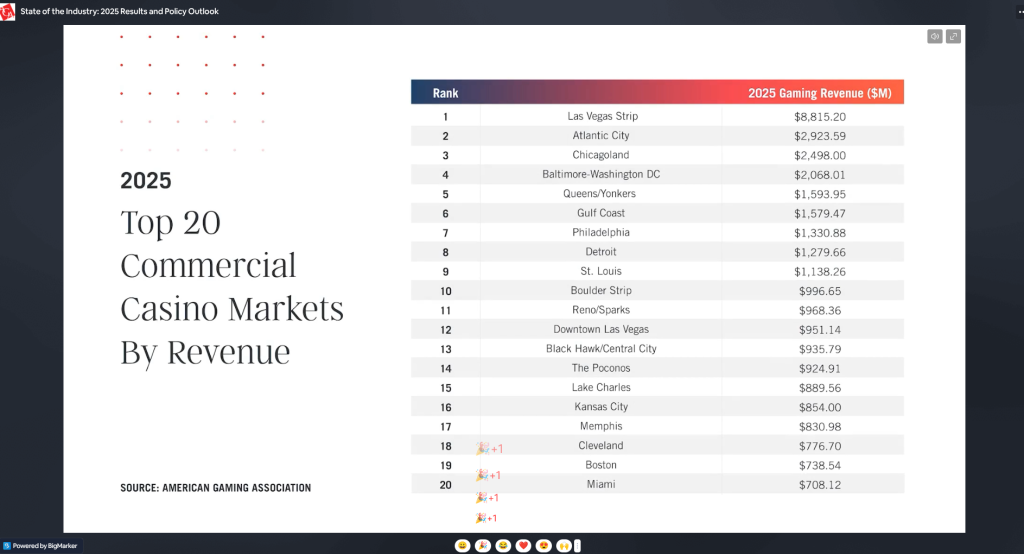

In its “State of the Industry: 2025 Results and Policy Outlook” webinar on Thursday, American Gaming Association (AGA) officials laid out results from what they deemed a smashing past year in the legal sports betting and casino sectors, before pivoting to lambaste their perceived existential threat: prediction markets.
Bill Miller, president of the trade group, noted multiple revenue and legislative industry successes at state and federal levels, including a higher slots winnings tax threshold in the 2026 federal budget.
“Here’s the bottom line,” Miller (pictured below) said during the 33-minute webinar. “All industry verticals set records in 2025, and we saw strong success across commercial and tribal gaming. Brick-and-mortar operations showed continued strength, while iGaming continued its strong performance. Gaming manufacturers had a very impressive year, pushing innovation to new levels while elevating the entire player experience.
“All of this is especially remarkable given the economic uncertainty and the headwinds we’re facing, particularly related to international travel to the U.S. To me, our record-setting growth confirms the strength of America’s gaming market. Robust regulations that protect consumers and give them confidence in our industry, and a framework that gives us room to innovate, expand our offerings, and reach new customers.”
The AGA webinar came on the same day that Penn Entertainment and Flutter were scheduled to report their earnings, with mixed results, for 2025.

The national revenue figures for 2025, according to AGA research, included the following:
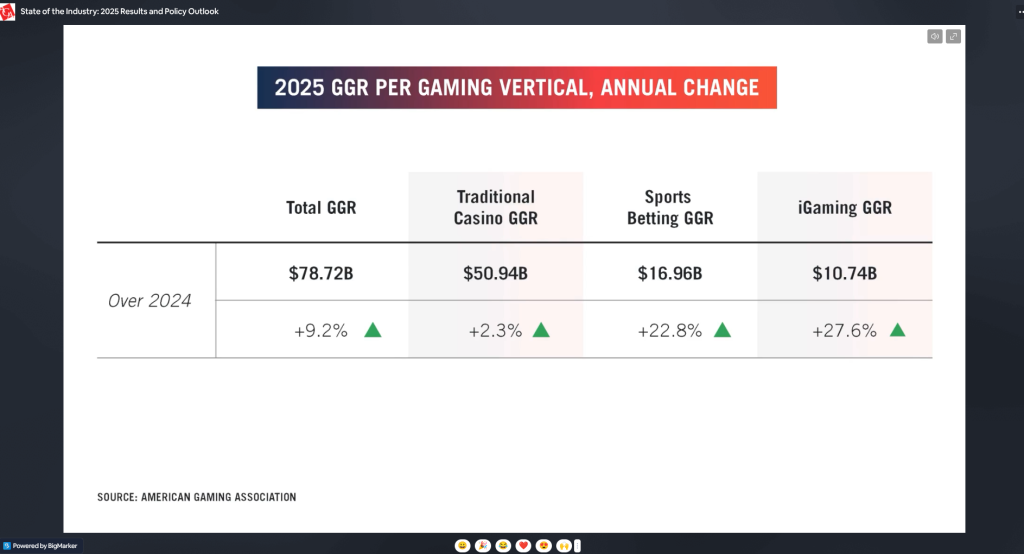
- The U.S. commercial gambling industry recorded a record high of $78.7 billion in gross gaming revenue (GGR), a 9.2% improvement from 2024, according to the AGA’s Commercial Gaming Revenue Tracker. “Adding in tribal gaming revenue,” AGA Vice President, Research Dave Forman said, “the legal U.S. gaming industry likely generated $125 billion in gross gaming revenue.”
- State-regulated gaming yielded $18.1 billion in gaming tax revenue, a 15.1% increase from 2024.
- Casino gambling generated $50.9 billion in revenue, up 2.35%. This yielded $11.3 billion in taxes, a 7.2% increase.
- Sports betting revenue rose to just shy of $17 billion, representing a 22.8% increase. Total handle was $166.9 billion (up 11%), producing $3.7 billion in taxes, up 32.4% year-over-year from 2024.
- Online casino reached $10.7 billion in revenue (up 27.6%), generating $2.6 billion in taxes, a 36.9% increase.
AGA claims broad industry impact
Miller cited additional 2025 gambling industry successes at the national level:
- Gambling supported 1.8 million jobs and generated $53 billion in tax impact. Miller noted that $53 billion exceeds the annual budget of 34 individual states, including Pennsylvania, New Jersey, and Illinois. “One of the AGA’s top priorities is to make sure policymakers continue to understand and recognize that impact, both here in Washington, D.C., and in state capitals. Impacts and reputations translate into policy, including some impressive success over this past year,” Miller added.
- The 2025 federal budget raised the slot tax threshold to $2,000, indexed for inflation, up from $1,200. Miller also noted that the budget preserved a “low corporate tax rate,” and included provisions he claims will “spur innovation and reinvestment.”
Miller did not address the federal budget’s change to the federal tax code that now allows gamblers to deduct only 90% of losses against winnings, instead of the previous 100%.
Miller: AGA’s state-level successes
Miller touted the AGA’s support for statehouse action against unlicensed operators, with prediction markets joining sweepstakes casinos as the invasive species of scorn.
“We continue shutting down illegal sweepstakes casinos nationwide, and we’re taking the same aggressive approach against sports event contracts offered by prediction markets,” Miller said.
In a “fireside chat” during the webinar, former New Jersey governor and early sports betting proponent Chris Christie hammered the federally regulated prediction markets as illegal, a consumer protection menace, and too large for the Commodity Futures Trading Commission (CFTC) to adequately control.
“This is a state’s rights issue, and the states should govern it,” he explained. “So Congress now has another opportunity to look at it. Is this really something they want the federal government involved in?”
Added Miller: “Prediction markets threaten what I’ve long called the American blueprint for gaming. This blueprint has been a key to gaming’s growth into a nationwide industry. It’s built on some ironclad commitments, including a state-by-state, tribe-by-tribe approach that gives local communities the deciding vote on gaming. [It’s] a social contract, where we’re granted the privilege to operate and we deliver economic and social benefits, and a regulatory partnership, where consumers are protected and operators have the flexibility to innovate.”
Miller also highlighted AGA progress in two key areas:
- Responsible gambling programs, where the AGA invested, Miller said, $500 million, and “generated $123 million for state problem gambling intervention and treatment. Our commitment to responsibility represents one of the biggest differentiators between licensed legal operators and backdoor entrants who want a free ride on gaming success without following the rules.”
- A “deepened partnership with the Indian Gaming Association (IGA) and tribes nationwide,” he said, that perpetuates the legacy of late IGA Chairman Ernie Stevens, Jr.