
Gambling used to be cool. Like cowboy cool, or James Dean cool, or punk rock cool. Gamblers lived outside the mainstream and for a certain segment of the population (present company included), they presented an aspirational dream.
That dream was basically this: Forget the 9-to-5 grind, leave the cheap suits and uncomfortable ties on the rack at Marshalls, put your resume in the paper shredder, and go. Poker in smoky backrooms. Sports betting with duffel bags of cash. Being on a first-name basis with guys whose first names were Lucky, Little Petey, and Larry the Lock.
Or for that matter, Worm, The Cincinnati Kid, or Ace.
Remember gambling movies? I say “remember,” because I’m pretty sure, as a genre, they’re dead. Forget the bright lights of Vegas or the dim lights of private card rooms. Forget the cigar-infested smoke of pool halls and the notion of staying one step ahead of your bookie, your banker, and the law. Those days are over. No joke: Uncut Gems may be the last of its kind.
What could a gambling movie be these days? Some guy sitting in front of three computer screens buying contracts on how long MrBeast’s next video will be? Filling out his tax returns in an effort to get around the 90%-loss-deduction cap? Putting a daily wager limit on his iCasino app after he loses $50 playing Huff n’ Even More Puff?
I dunno. The gambling outlaw is dead. Gambling is everywhere now, quite literally, and I am well aware as to what “literally” means. It’s inescapable. It’s become part of the day-to-day. It’s sometimes less exciting than finding a $49 suit at Marshalls that fits right off the rack.
Bill’s wrap hits close to home
Honestly, I hadn’t thought about this way until I saw Bill Maher’s monologue about gambling last week.
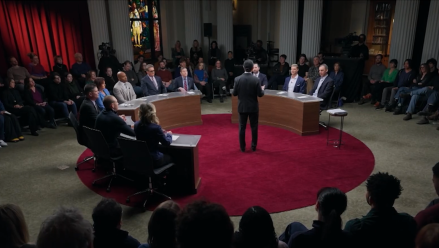
Maher, whom I find myself often loving and hating in equal measure and sometimes in the same sentence, riffed on America’s newfound love affair with gambling toward the end of Real Time with Bill Maher on HBO Friday.
He didn’t come out against gambling — that’s not Maher. He noted his libertarian bona fides and demanded that it should be a person’s choice as to whether or not they gamble. (Side note: He was doing this in front of his guest, former New Jersey Gov. Chris Christie, who had a thing or three to do with the current state of gambling in this nation).
So Maher went on, got in a few pretty good zingers, a concise history of gambling in America, and how the odds are against you.
All standard stuff. I did not, however, expect the landing he provided. In full:
“Gambling isn’t just bad because you lose the rent,” Maher started by way of wrap-up. “It’s bad because it gives permission to stop believing that you control your destiny. But this is still America and you still do. When I was in college and wanted money, I didn’t gamble. I got a job, OK? It was selling drugs. At least I wasn’t just leaving my future to chance. That’s not us. That’s Eastern culture. I’m not putting it down, but it is more fatalistic. In the Middle East, you can’t say three words without someone responding, ‘If God wills it.’ … This is why Macau does three times the gambling business that Vegas does. It’s why every movie with a foot chase through Chinatown ends up in a basement full of guys playing mahjong. That’s why many Chinese restaurants have the word ‘luck’ in their name, but that’s not us. We’re the ‘we-don’t-accept-fate, we-make-it’ people, not the ‘we’re-up-all-night-to-get-lucky people.’”
False grit
He’s got a pretty good point there. Today, with everyone* (*well, 57%) gambling and with gambling living on our phones, it’s become more of a passive experience where — and Maher is right here — we’re hoping to get lucky. That’s not the hard work and grit that defines classic America. That’s not the hard work and grit that defined the olde-tymey gamblers.
Today’s gambling is, in fact, diametrically opposed to the gamblers of yore, the cool ones, the cowboys and outlaws and ne’er-do-wells. Today, precious few of us gamblers are trying to be smart and gain an edge. For the vast majority (allow me this generalization), it’s just blindly throwing darts and hoping you 20x.
To be very, very clear: I love it. I’ll still throw money on a game, still give Lucky Larry and his lobsters a try on iCasino, still piece together daily fantasy lineups on the daily. But Maher’s onto something, even if his cultural analysis could use some editing.
The gamblers who were cool — the ones in the movies, the ones we wanted to be — weren’t cool because they were fatalistic and leaving things to chance. They were cool because they thought they had an edge. They studied the horses. They counted cards. They read the table. Whether they actually had an edge is beside the point. They believed they did. They walked in thinking, “I’m smarter than this room,” not “Let’s see what happens.”
These people still exist. I spent an evening with 200 of them at the Blackjack Ball. They are the minority.
That’s different from what we’ve got now, where gambling is everywhere and nowhere at the same time. I’m not going from town to town looking for a game; instead, I’m tapping a screen while waiting for my frozen Trader Joe’s lunch to microwave.
And maybe that’s what Maher was getting at, where our separate ideas meet. The old version of gambling, the badass version, was about believing you could beat the house, outsmart the room, control the outcome. The new version is about … well, not quite that. Sometimes it’s just killing time. Sometimes it’s just another app on my phone, sitting between DoorDash and TikTok, all designed to make me feel like I’m doing something when I’m really just waiting for life to start.
Not exactly movie material, you know?