Calling it a “weakness” in federal law, Canadian politician Brian Masse is having second thoughts about legal sports betting in Canada. Masse was the original bill sponsor for legal wagering before passing the baton to Kevin Waugh, who carried the bill that decriminalized single-event sports betting at the federal level and put the provinces in charge.
The setup is similar to that in the U.S., with formerly illegal gambling now regulated at the state (U.S.) and provincial (Canada) levels. But some federal lawmakers in both countries continue to push back against local regulation. Masse told the Canadian Broadcasting Corporation Monday, “It’s deplorable the way that some of the provinces have actually implemented it. They’ve allowed the private sector to basically own and operate.”
Masse’s comments came just days after the fourth anniversary of the launch of sports betting in Ontario and three months ahead of the Alberta market opening, which is planned for July 13. Ontario regulators launched legal wagering April 4, 2022. The province now has 81 platforms operated by 47 entities, spanning online casino, poker, and sports betting.
In a key difference from U.S. states, Ontario officials allowed gray market operators the opportunity to move into the regulated market with no penalty.
The Alberta Gaming, Liquor, and Cannabis Commission (AGLC) will allow the same, though it appears gray market operators will be on a shorter timeline to move into the legal market. It’s not clear if and when another province will follow Alberta. British Columbia and Quebec have been part of the conversation, but neither province has passed legislation to legalize.
National ad guidelines being discussed
From a national perspective in Canada, Masse isn’t alone in his concerns. Sen. Marty Deacon is trying for a second session to pass a national gambling advertising framework. Her bill, S-211, is still on second reading in the House of Commons following some debate Feb. 12. The bill passed out of the Senate Oct. 21.
The proposal calls for the Office of the Minister of Canadian Heritage to set national guidelines, and it suggests tougher policies on the use of athletes and celebrities in gambling advertising. In Ontario, athletes and celebrities may be used only in responsible gambling advertising, not to promote gambling itself. Alberta will have a similar rule. Deacon’s bill could potentially be in conflict with provincial regulations.
In addition, the Edmonton Journal reported Tuesday a group of students at the University of Edmonton has asked the ALGC to further tighten its guidelines, including by lowering a betting cap.
In the U.S., lawmakers in several states have expressed regret at legalizing. The most high profile is Ohio Gov. Mike DeWine, who one year after launch pushed through a doubling of the sports betting tax rate in that state from 10% to 20%. He tried unsuccessfully for another increase in 2025. He’s also a proponent of eliminating — or at least severely curbing — the availability of proposition bets.
Masse said the goal of making the legality of gambling a provincial decision was to rein in the industry. But given the number of platforms live in Ontario, he now believes that goal was not met — and says that the black market still exists.
“”But what they’ve done is, they’ve launched full throttle,” he said. “They have allowed all of this unregulated activity.”
Masse is from Windsor in Ontario, just across the U.S. border from Detroit, and the cities compete for in-person casino business.
Illegal betting doesn’t just go away
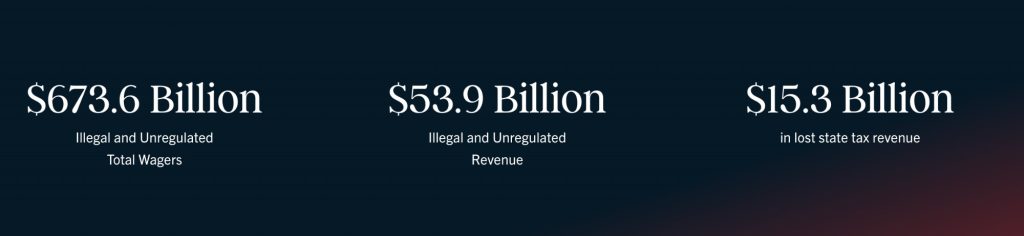
Even within the most stringently regulated jurisdictions — think Massachusetts in the U.S. — illegal gambling continues to exist. Offshore platforms or gray market machines often offer bettors a wider range of betting markets and better odds because they are not beholden to state regulation and don’t pay taxes. At the same time, there are no consumer protections, responsible gaming regulations, or a guarantee that bettors will be paid. Those in the legal market must offer responsible gaming tools and problem gambling support. In a regulated market, there is also an avenue for a bettor to challenge an operator and a guarantee that bettors will be paid.
But industry proponents say the size of the illegal market shrinks with every new legal market. According to a 2025 American Gaming Association (AGA) report, the illegal market accounts for one-third of all gambling in the U.S. For sports betting, the estimate is lower — the AGA reported that the illegal market accounted for 24% of all sports betting in the U.S. in 2025 vs. 36% in 2022.
In the last 18 months, a key topic in the U.S. has been the rise of prediction markets — the federally regulated sports betting lookalike. Those in the legal market say the sports event contracts offered by prediction markets are siphoning business. State regulators say their jurisdictions are losing money, consumers are left unprotected, and the responsible and problem gambling requirements are limited.
Prediction markets have not exploded in the Canada the way they have in the U.S., and it appears they won’t. According to Geoff Zochodne of Covers, the Canadian Securities Administrators late last week reiterated its restrictions around prediction markets. A week earlier, the Canadian Investment Regulatory Organization released a bulletin specifically stating political contracts are not legal, and that any event contracts must “have a term to maturity of 30 days or longer.” This would seem to eliminate sporting events, other than futures bets.