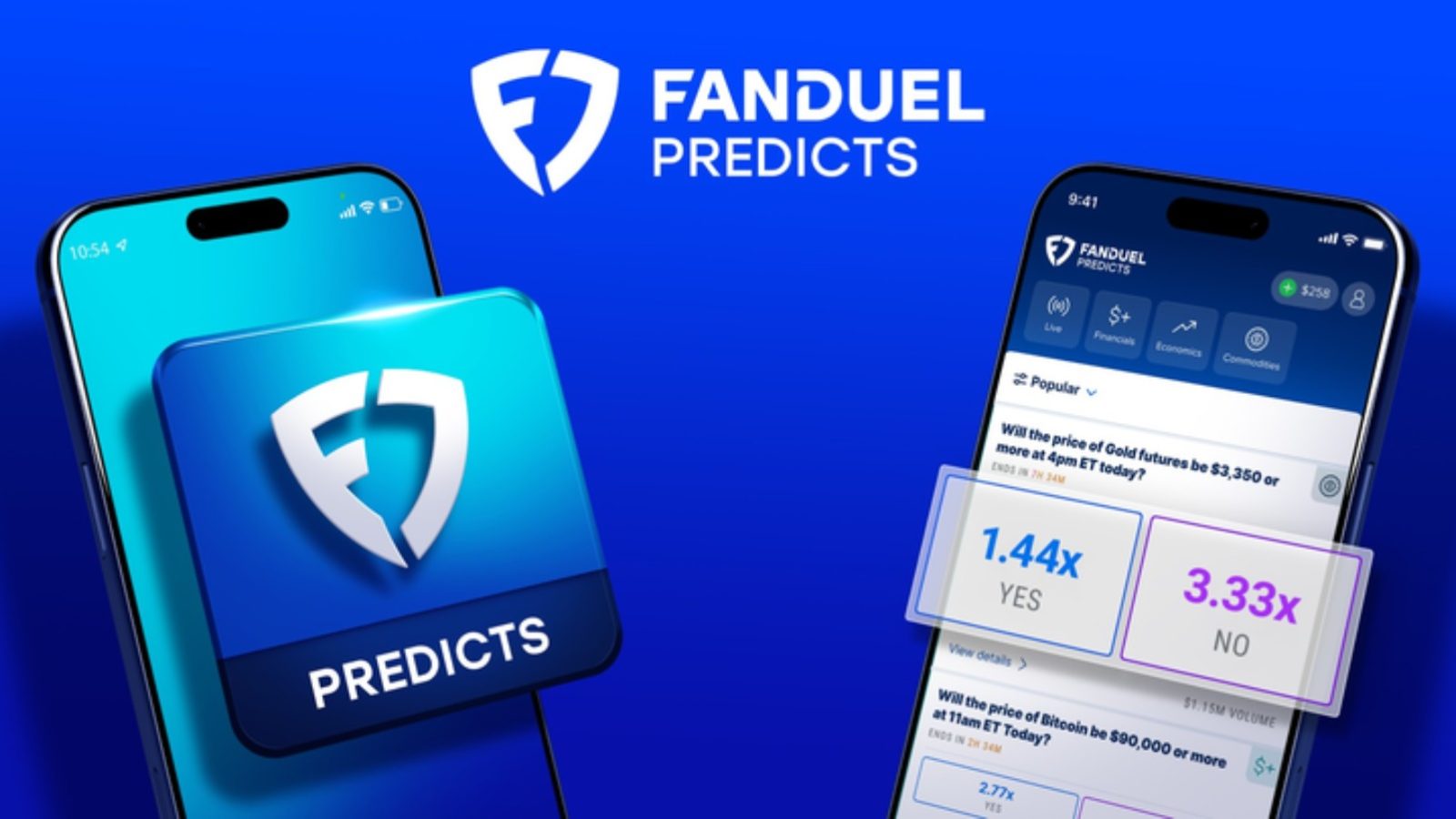
FanDuel Monday launched its prediction product, FanDuel Predicts, across five states, with plans to roll out across the U.S. through the end of this year and beginning of next, per a company press release. The launch marks the third by a major state-licensed sportsbook this month — Fanatics Markets launched Dec. 3 and DraftKings Predictions went live Friday.
FanDuel launched in Alabama, Alaska, North Dakota, South Carolina, and South Dakota in partnership with CME Group. The launch includes sports event contracts for baseball, basketball, football, and hockey in states that do not have legal sports betting, according to the press release, and FanDuel will pull down sports event contracts as additional states legalize digital sports betting. Of the states where FanDuel launched, South Dakota has legal retail and on-site mobile sports betting, and North Dakota has retail sports betting at tribal casinos. FanDuel is not licensed in either state.
Customers will also be able to buy contracts on more traditional commodities futures, such as oil, gas, and gold, as well as cryptocurrency.
FanDuel and CME, which announced a partnership in August, did not reveal what the cost of purchasing contracts will be.
Responsible gambling tools available
FanDuel will bring its sportsbook responsible gaming and consumer protections to its prediction market product. Consumers will be able to set deposit limits, create deposit limits, self-exclude, and have access to mental health services.
Customers can download the app in the App Store and Google Play and will be required to register through the company’s “Know Your Customer” process, which includes providing birthday, social security number, and a government-issued ID.
“We’re giving our customers a new platform to engage with the world around them — whether that’s the next Fed rate decision or a sports event,” said FanDuel Flywheel and New Ventures Senior Vice President James Cooper. “This launch in five states will provide valuable insights into customer engagement with this new platform, enabling us to refine our approach as we expand to additional states in 2026.”