
Low-resistance access to online gambling in the United States is creating both a growing mental health crisis and a financial crisis that caregivers are not prepared for, according to “Gambling-Related Financial Harm: A Public Health Approach to Financial Stability in a Digital Era,” a collaboration of the Kindbridge Research Institute Financial Stability & Responsible Gambling (FSRG) Initiative and UCLA researchers.
“Financial stress linked to gambling often appears long before people reach crisis or clinical care,” FSRG project lead Kary Carbone wrote in the report. “But today those signals are scattered across financial, healthcare, and payment systems that rarely connect the dots. This report highlights why earlier coordination could help identify risk sooner and prevent harm from escalating.”
An increased push in both the gambling and finance sectors to pack more ways to speculate into one app suggests the phenomenon has yet to crest. While prediction markets have proved the most aggressive in offering wagers on everything from sports to cryptocurrencies or the weather in Miami, sportsbooks are moving to erase the friction of extra thumb swipes. DraftKings announced on March 2 that it will this month roll out a “super” app housing its sportsbook, prediction market, online casino, and lottery verticals. The aim is to put everything legally available in each particular jurisdiction instantly at the disposal of users.
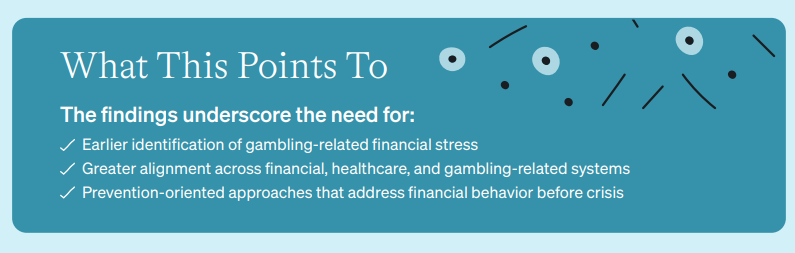
Included among the FSRG report insights:
- Mainstream “gamblification” and marketing is outpacing the availability of public health, financial, and regulatory frameworks.
- “Everything” apps, with frictionless movement of money, create the illusion of painless play.
- Young adult bettors/speculators don’t possess the proper financial literacy for complex wagering options.
- Responsible gambling resources remain “fragmented across sectors, limiting coordinated
prevention and early intervention across finance, payments, gambling platforms, healthcare, and regulators.”
The FSRG report asserts, “Gambling in the United States has shifted rapidly from a discrete, cash-based activity to a normalized, digitally embedded financial behavior. Online platforms, instant payment systems, and pervasive marketing have made gambling and gambling-like products part of everyday financial life. This shift has outpaced existing public health, financial, and regulatory frameworks, leaving early indicators of gambling-related financial harm largely undetected and unaddressed.”
Immaturity, availability, vulnerability
Academics and gambling industry executives have collectively decried the theory behind the “everything app,” with Sporttrade CEO Alex Kane calling it “something I’m very concerned about, personally.” Dr. Joshua Shuart, a gambling expert at Sacred Heart University in Connecticut, believes that “any of the all-in-one stuff is just a horrible issue,” considering the impact on an emotionally and financially immature younger demographic, which coincides with the coveted cohort for all companies, including gambling.
Elliott Rapaport, the CEO of the Birches Health gambling addiction recovery center, told InGame that “constant access to gambling or gamification plays a major role in how quickly problems can escalate.”
The report notes minors’ and young adults’ “heightened exposure to digital payments, peer-driven financial narratives, and gambling-adjacent content, often without corresponding financial literacy or protective safeguards.” Navigating a landscape requiring fast and fastidious decisions is often beyond them, especially considering that “wagering can occur in seconds through digital wallets, contactless payments, microtransactions, and in-app upsells. Despite this growing complexity, most young people in the United States receive limited formal instruction in money management.”
According to the study, only 38% of Generation Z — born, roughly, between 1997 and 2012 — can be considered financially literate, which compounds the effects of approximately 15% of individuals aged 18-to-34 reporting “concerning gambling behavior.”
“Financial harm is often one of the earliest and most damaging consequences of problematic gambling behavior,” Dr. Timothy Fong, clinical professor of psychiatry at UCLA and co-director of the UCLA Gambling Studies Program, said in the report. “By the time people reach clinical care, the financial fallout can already be severe. This report underscores the need for prevention strategies that connect financial wellbeing and mental health earlier in the trajectory.”
KindbridgeFSRG-Insights-Report