Several members of a House of Representatives committee questioned the legality of sports event contracts during a hearing on authorizing funding for the Commodity Futures Trading Commission (CFTC), with one arguing that any reauthorization package should be tied to an agreement to change the rules on sports contracts.
The House Committee on Agriculture held a “stakeholder perspectives” session Thursday to discuss reauthorization of the CFTC.
Reauthorization is partially a symbolic move, as the CFTC continues to operate even if its funding is not “authorized.” However, the gesture is usually accompanied by amendments to the Commodity Exchange Act (CEA) or instructions to make changes to CFTC regulation, both of which have real consequences. The last formal authorization expired on Sept. 30, 2013.
In this case, and with regard to prediction markets, questioning from some members of the House suggests that they would wish to see the reauthorization come with rules that would limit the ability for event contracts to be offered on sports.
There were also calls for the CFTC to be better staffed, particularly if the scope of what it regulates has widened.
Could Congress ban sports contracts in reauthorization?
A CFTC reauthorization bill involves amending the CEA, and therefore could also include amendments that definitively make sports event contracts illegal.
For example, the current “special rule” within the CEA that concerns contracts related to gaming, war, terrorism, or assassination could be amended to make it clear that sports contracts are both a form of gaming and against the public interest, and therefore cannot be listed.
That CEA passage reads as follows:
(C)Special rule for review and approval of event contracts and swaps contracts
(i)Event contracts
In connection with the listing of agreements, contracts, transactions, or swaps in excluded commodities that are based upon the occurrence, extent of an occurrence, or contingency (other than a change in the price, rate, value, or levels of a commodity described in section 1a(2)(i) [2] of this title), by a designated contract market or swap execution facility, the Commission may determine that such agreements, contracts, or transactions are contrary to the public interest if the agreements, contracts, or transactions involve—
(I)activity that is unlawful under any Federal or State law;
(II)terrorism;
(III)assassination;
(IV)war;
(V)gaming; or
(VI)other similar activity determined by the Commission, by rule or regulation, to be contrary to the public interest.
During the 2008 reauthorization, congress gave the CFTC new powers over foreign exchange markets.
However, whether the votes would exist to write a rule clearly outlawing sports event contracts remains unclear. While some committee members appeared to support a change to the Act, any amendment would require support of the committee, followed by a majority of the House and then the Senate. Most members of Congress have still not given an opinion one way or the other on sports event contracts, and their status may not be a priority for most.
House members raise questions
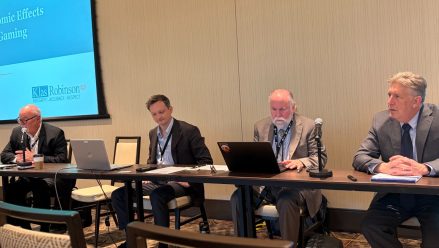
The committee brought in five experts to share their views on the CFTC and respond to questions. They were former CFTC Commissioner Dawn Stump, agriculture supply chain executive Ed Prosser, Futures Industry Association Chair Alicia Crighton, former CFTC General Counsel Rob Schwartz, and market reform group Better Markets’ Director of Securities Policy Ben Schiffrin.
Most of the event contract-related questions were addressed to Stump, Schwartz, or Schiffrin.
In his opening remarks, Schiffrin said that he felt prediction markets shouldn’t be in the CFTC’s purview at all.
“The CFTC is taking on responsibilities that it is ill-equipped to handle with prediction markets,” he said.
Rep. Doug Lamalfa of California was among those who questioned whether the CFTC should be regulating sports contracts.
“Sports betting is somehow being defined as in the bailiwick of the CFTC,” he said. “They’re being called trades when it’s flat-out gambling.”
He asked Schwartz whether he felt the agency had the resources to be a “federal gambling regulator.”
“I don’t think the CFTC has adequate resources now, so expanding its remit without expanding its capacity is not helpful,” Schwartz said.
Stump also answered questions on the topic from Lamalfa, and suggested that Congress may not have fully understood the consequences of its wording choices in the Dodd-Frank Act, which put event contracts under the purview of the CFTC. The Act says the CFTC “may” take action against contracts that involve certain enumerated categories, including gaming, if it believes them to be against the public interest. Prediction markets like Kalshi have argued in court that this is not a prohibition on gaming contracts.
Stump said that Congress may not have “sufficiently take[n] into account the public interest determination within the statute.”
Lamalfa questioned whether there was really any public interest in allowing sports betting to be offered under a regulatory regime that was not designed for it.
“That’s the question,” he said. “What is the public interest and would it be better served by a more specialized body?”
Stump said that she agreed.
Congressman: Committee should modify rules
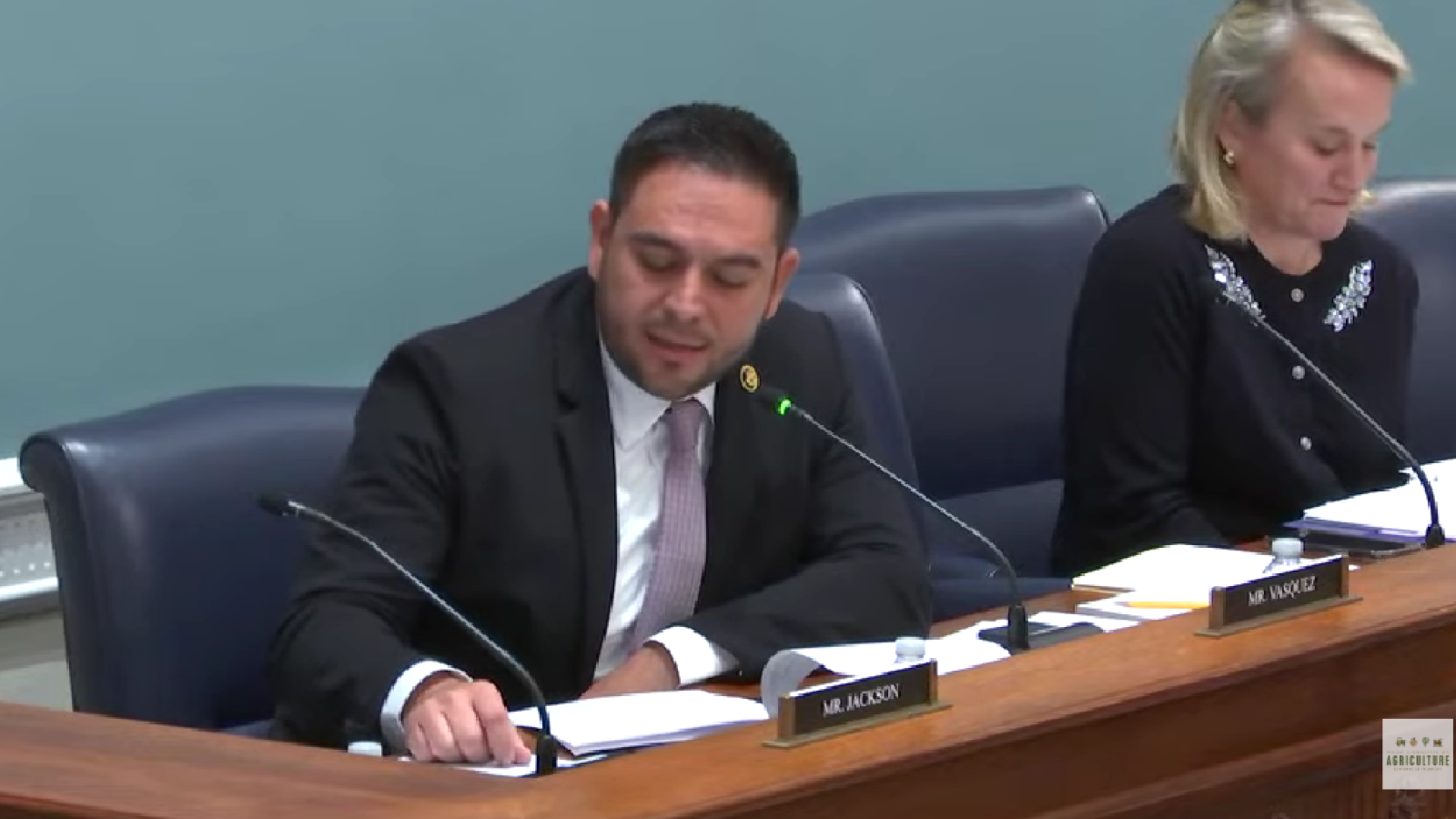
Rep. Gabe Vasquez of New Mexico said prediction market operators were “trying to get around” sports betting rules.
“We’re also dealing with tribal sovereignty,” he said. “I have seven sovereign nations in my district and some of them operate gaming operations. They depend on us upholding our treaty obligations as a nation to them.
“When it comes to sports betting, the rules are simple. In New Mexico, it only happens at tribal casinos under tribal, federal, and state supervision with strong safeguards in place.”
Schwartz said sports event contracts fit within the definition of a “swap,” particularly now that the products have become widely listed and therefore meet the bar of being “commonly known to the trade as a swap.” However, he declined to comment on whether they should be regulated in this way, or if they would be better suited to being regulated like gambling products.
Vasquez ended his questioning with perhaps the clearest call during the session for the committee to recommend a rule change that would prevent or limit the ability of CFTC-registered exchanges to offer sports event contracts.
“If online sports betting shifts into the CFTC’s purview, the traditional system gets bypassed, along with tribal compacts,” he said. “And that has an impact on tribal revenue, on tribal authority, and in rural New Mexico that has an impact on our schools, our communities.
“This committee has a responsibility to make sure that the CFTC is enforcing the laws Congress has passed and modify those that we understand are outside of the law, so as we discuss reauthorization I hope we continue to protect consumers and stand with tribes all across the country, not just in New Mexico.”
Self-certification
Rep. Salud Carbajal of California linked the rise of sports event contracts to use of the self-certification process. Almost all new contracts listed by CFTC-registered exchanges are self-certified, a process by which the exchange tells the CFTC that it plans to list the contract, and if the regulator does not object then it can list it as soon as the end of the same business day, even if it is not technically considered “approved.”
“My office has been hearing rising concerns about unregulated betting,” Carbajal said. “Stakeholders have been warning that this unregulated industry known as prediction markets has been abusing the self-certification process.”
He asked Schiffrin about whether the CFTC should be involved with sports event contracts.
“I don’t think the CFTC has the authority or the expertise to regulate gambling,” Schiffrin said. “It’s the Commodity Futures Trading Commission and it’s meant to regulate derivatives contracts.”
Rep. Jim Costa, also of California, also questioned whether a number of non-sports markets should be allowed by the CFTC. He cited contracts related to the war in Ukraine and the possibility of a U.S. invasion of Venezuela, which appear to be offered on Polymarket’s global site — which is not regulated by the CFTC — rather than an exchange under its jurisdiction.
While there do not appear to be markets directly concerning the war in Ukraine or a potential war in Venezuela offered on a CFTC-registered exchange at this point, the same interpretation of the law that Kalshi typically points to when making the case for the legality of sports event contracts would also allow contracts on wars to be listed if the CFTC believes them to be within the public interest. CFTC-registered Kalshi has also offered contracts on whether there will be a famine in Gaza, which did not receive public interest review from the CFTC.
Costa also suggested that some contracts lack any kind of relevance or utility.
“Thirteen million dollars traded on how many tweets Elon Musk will post in December,” he said. “I don’t give a damn.”