About 21% of Americans are familiar with prediction markets, 3% use them, and 91% of those who use them say prediction markets are financially risky, based on the results of an American Institute for Boys and Men/Ipsos poll released Tuesday.
More respondents think online sports betting is “bad for society” than think that for prediction markets — 52% said sports betting is bad, compared to 38% who said prediction markets are bad. The study, conducted online Feb. 27-March 1 using the “probability-based Knowledge Panel,” queried 2,363 U.S. adults online aged 18 or older.
According to the press release from the American Institute for Boys and Men (AIBM), those in legal online sports betting states were more likely to view online sports betting as bad for society than those in non-legal states.
Since the U.S. Supreme Court made legal sports betting a state’s rights issue in 2018, 32 U.S. states and jurisdictions allow online sports betting, and eight allow online casino. About 40 U.S. states offer some form of legal sports betting.
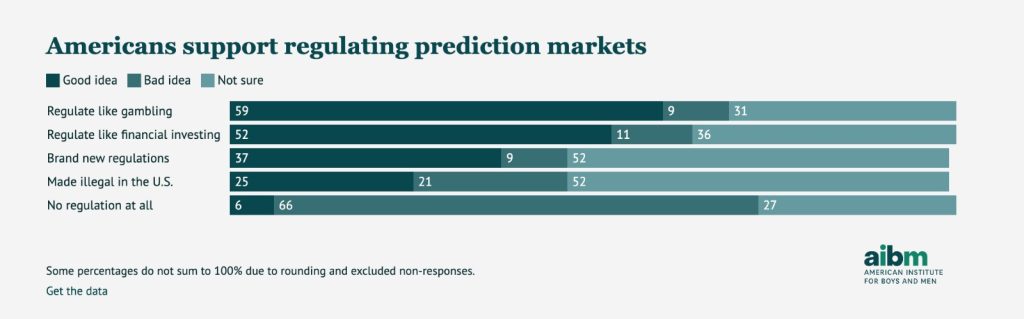
The study revealed that 59% of those polled say prediction markets should be regulated like sports betting while 52% said the platforms should be regulated like financial markets. Twenty-five percent of respondents said prediction markets should be banned in the U.S.
Only 9% of those polled believe that prediction markets can prevent insider trading, as compared to 13% who believe legal sports betting can, and 30% who believe the stock market does.
“A growing body of evidence shows how smartphone-based, low-friction sports gambling can escalate financial and social harms, especially for young men,” the AIBM wrote in its press release. “Some reports have shown that prediction market users lose money more quickly than users of online sports betting platforms. Prediction markets may pose a risk to consumers, then, as well as a whole new set of challenges for lawmakers, scholars, and advocates alike.”
Most say predictions mimic gambling
Per the poll, 96 respondents had used a prediction market within the last six months — of those, half pointed to entertainment as the top reason to trade on a prediction market, and 41% said the top reason was to make money.
With regard to whether or not sports event contract trading is more like gambling or investing, those in every age category view it more like gambling, but the percentage differs significantly. From the sample, 61% of those in the general public view sports event contracts to be more like gambling, while 47% of men aged 18-24 think the same.
The AIBM pulled out polling results for young men aged 18-24, and found that a higher percentage of that cohort reported participating in some form of gambling, including prediction markets, vs. the general population (26% vs. 14%). About 29% of those in the same age group said they were familiar with prediction markets, which is about 8% higher than familiarity in the general population.