Ohio’s place in the complicated history of gambling in the United States reached another milepost on Tuesday.
The Ohio Casino Control Commission (OCCC) became the first U.S. jurisdiction to signal intent to impose a civil penalty or monetary fine on a prediction market offering sports events contracts, citing it for offering a form of unlicensed, illegal, and untaxed wagering.
In a letter to Kalshi executives, the OCCC said it intends to seek damages of $5 million. It’s unclear what enforcement mechanism the OCCC could leverage to collect the sum and to what extent, if at all, Kalshi would comply.
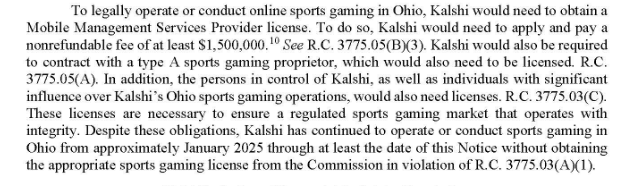
Kalshi, claiming federal oversight by the Commodity Futures Trading Commission (CFTC), has continued to offer controversial sports bet-like markets throughout the country despite the ebb and flow of results from regulatory cease-and-desist orders and court opinions.
A $5 million fine would hardly damage Kalshi’s profit outlook, but it would mark a symbolic concession it might try to avoid. Agreement to the penalty might be an invitation for more state fines that could eventually sting. Kalshi’s valuation is currently around $22 billion, and for comparison purposes, it took in $263.5 million in fee revenue in 2025 alone.

Ohio, Arizona, Minnesota, litigation
The most high-profile of the Kalshi court battles is currently underway in Arizona, where the CFTC has intervened to at least temporarily stop state regulators from pressing criminal proceedings in U.S. District Court.
The Minnesota Senate Commerce and Consumer Protection Committee, meanwhile, advanced a bill Tuesday that would bar prediction markets from offering contracts on sports, war, and politics, among other things. Sports betting is not legal there.
Ohio, again, a gambling flashpoint
The OCCC move comes at a moment of intense national scrutiny of prediction markets, with numerous federal bills floated in Washington, D.C., seeking to mute their expansion in the wake of controversial markets being posted. Polymarket’s briefly open market offering wagers on the rescue of a downed U.S. fighter pilot in Iran appears to have been a galvanizing moment.
It’s also another data point in Ohio’s noteworthy relationship with gambling. Arguably the most scandalous sports betting case in American history — the 1919 Chicago White Sox fiasco — gifted a World Series to the Cincinnati Reds at the behest of gamblers. The second-most notorious involved Reds hero Pete Rose, whose statue is nestled in a cherished spot outside Great American Ball Park even though an MLB ban made him ineligible for the National Baseball Hall of Fame after he admitted betting on baseball. (Following his death, he was declared eligible).
Last summer, Cleveland Guardians pitchers Emmanuel Clase and Luis L. Ortiz were indicted by the U.S. Department of Justice for their alleged part in a pitch-rigging scheme.
In 2023, Bert Neff used insider information from Alabama baseball coach Brad Bohannon to win a bet on a Crimson Tide-LSU game that he placed at the BetMGM sportsbook at Great American Ball Park. Bohannon was fired and Neff sentenced to eight months in prison on obstruction of justice charges when the plot was discovered.
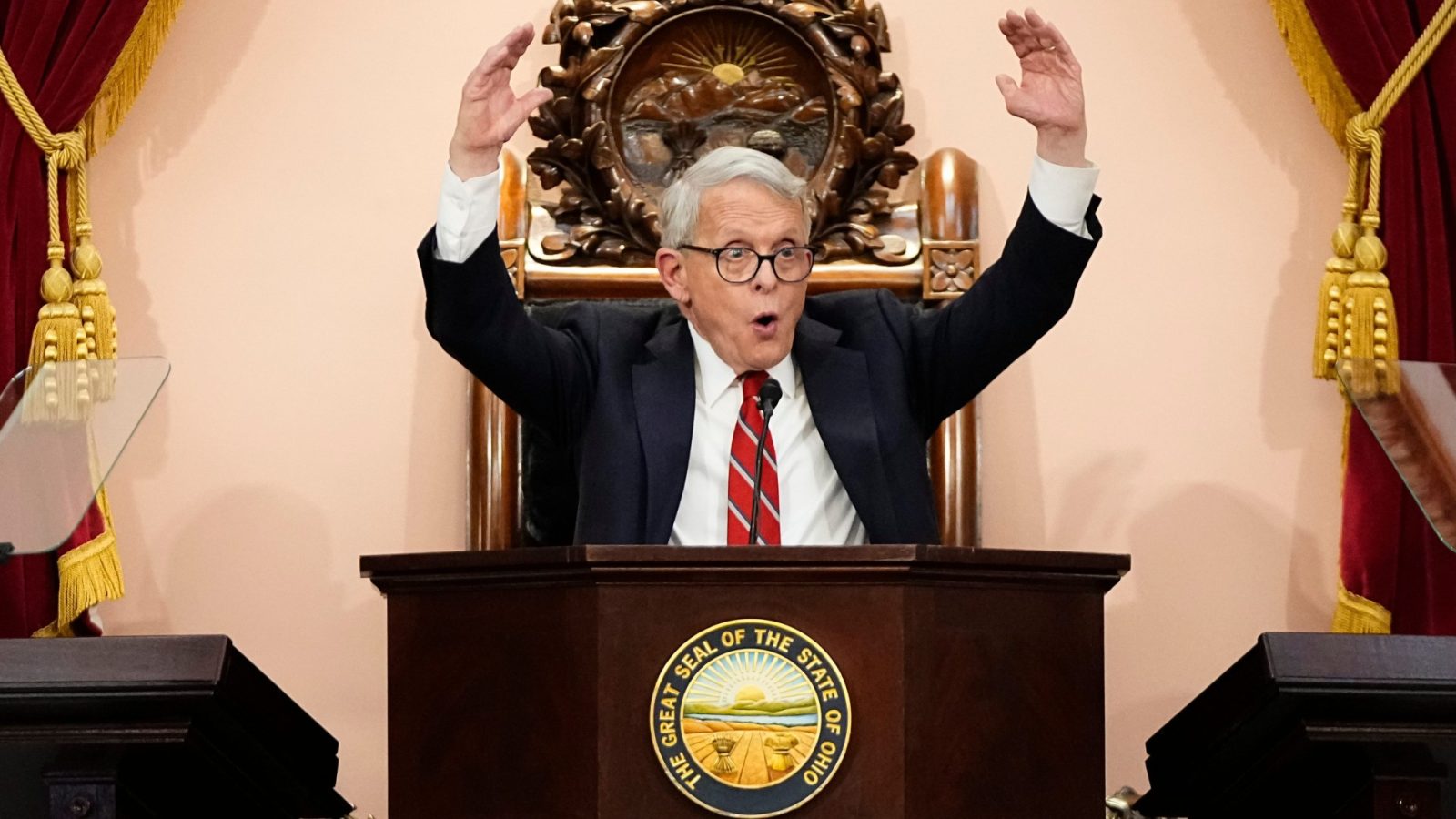
Perhaps out of retrospection or political jiu jitsu, Republican Gov. Mike DeWine (above) in November lamented his part in helping legalize sports betting in Ohio in 2021.
Three Republican legislators this month proposed the Save Ohio Sports Act, which is expected to be introduced in two parts. One part would, notably, outlaw mobile sports betting. If enacted, it would make Ohio the first state to roll back the mobile/online version of sports betting that is the most popular with bettors and most lucrative for sportsbooks and taxing authorities. The other bill would outlaw prop bets, parlays and live microbetting, the type of market involved in the Guardians scandal.
Bettors have wagered more than $28.58 billion in Ohio since legal sports betting’s launch there in 2023.