

It remains to be seen whether last week’s sanction by the Arizona Department of Gaming (ADG) of daily fantasy sports purveyor Underdog will embolden other gambling regulators to punish licensees who offer controversial sports event contracts on prediction markets.
And in becoming the first state to follow through on the threat to strip a state license, the ADG raises the question of whether it or its counterparts will be as aggressive with larger operators like DraftKings or FanDuel. These gambling giants also plan to launch prediction markets they, like Kalshi and Crypto.com before them, which are regulated not at the state level but federally by the Commodity Futures Trading Commission (CFTC).
What was clear at the National Council of Legislators from Gaming States (NCLGS) conference last week in San Juan, Puerto Rico: State gaming officials are eager to do something to thwart not only prediction markets, but sweepstakes casino sites that they, like the ADG, see as illegal gambling siphoning tax dollars from their states.
The general mood was crystallized by Massachusetts Gaming Commission Chairman Jordan Maynard, responding to a question about sweepstakes gaming.
“I would say as an overall principle,” he said, “if you’ve been following what we’re doing in Massachusetts, is, if you come up there and you eff around, you’re going to find out.”
Underdog found out that working with Crypto.com cost it its DFS license in Arizona, according to Chris Kotterman of the Arizona governor’s office. Kotterman told InGame at NCLGS: “We know that Crypto.com was offering contracts in Arizona. We told them to stop, and then Underdog partnered with them. And so that’s the problem.”
Will sanctions continue, and who’s next?
Arizona and Massachusetts are among numerous states that warned state licensees that partnering with outlets offering sports events contracts anywhere were conducting illegal sports betting and risking their in-state standing. Kotterman said that the Underdog penalty was incurred on Dec. 5 because Crypto.com did not stop offering them in Arizona when ordered.
This presents the ADG the opportunity for the next escalation point for Arizona and nationally: Will any history of association with a prediction market matter, and will it go after a more major player?
Fanatics and PrizePicks would be immediately in line to serve as answers.
Underdog began a prediction market on Sept. 2 in 16 states, excluding Arizona. Crypto.com continued offering sports event contracts there independently until early December. It stopped, according to an industry source, a few days before Fanatics announced the debut of Fanatics Markets on Dec. 3, also excluding Arizona.
PrizePicks, which is licensed to offer DFS in Arizona, would also seemingly be in a precarious spot as a Kalshi and Polymarket partner.
An ADG spokesperson told InGame, when asked whether Fanatics’ situation would be considered different than Underdog’s:
“Consistent with its authority as a state regulator, the Arizona Department of Gaming regularly reviews the conduct of its licensees, including activities and partnerships that run counter to regulated, legal gaming in Arizona. As a general matter, all licensees are expected to comply with Arizona law and are responsible for ensuring their business relationships and conduct meet applicable regulatory requirements. The Department does not comment on potential or future enforcement actions and has no further comment on this matter.”
Kotterman, however, noted that the Underdog sanction was “unique” to Arizona.
“They all got the same letter. So they know what our expectations are from the department side,” Kotterman said. “We now are evaluating their individual conduct to see what’s going on. I don’t know what the department’s next move is, if anything. I just know what they did.”
Kotterman, noting that the ADG had heard strong complaints about prediction markets from its 22 gaming tribes, said he expected a legal response from Underdog.
Citizens equity research analyst John Bender said in an analysis: “The two major companies we believe this will impact are Fanatics, with a high-single-digit handle market share in AZ (gaming license), and PrizePicks (fantasy license),” observes the analyst. “Fanatics launched Fanatics Markets two weeks ago with Crypto.com, and PrizePicks has a relationship with Kalshi and Polymarket.”
Regulator mood: fired up, figuring it out
Some legislators and regulators used the NCLGS conference as a rare chance to brainstorm future action in person over coffee and Spanish bean soup. There is the general concern among them at the prospect of taking action against large operators who plan to run prediction markets, like DraftKings and FanDuel, who together absorb as much as 80% of the legal sports betting market in the United States. Fanatics in the last year has made a move on third place.
Operators already balk at the tax rates they pay in many states and if they chose to abandon sports betting on the state-level should courts eventually uphold national regulation of sports event contracts, they would take massive amounts of taxable revenue for states with them.
Jasmine Tompkins, director of external affairs and tribal relations with the Michigan Gaming Control Board, said the situation is being reviewed with operators.
A spokesperson for the Louisiana Gaming Control Board told InGame: “The Louisiana Gaming Control Board is closely monitoring recent developments involving gaming operators’ entry into the prediction market space, including the multiple lawsuits currently pending across the country that address the legal and regulatory implications of these products.
“As with any emerging or evolving gaming model, the Board is carefully evaluating how prediction markets may intersect with Louisiana law and the state’s existing gaming framework. We are actively coordinating with our counsel at the Attorney General’s Office to assess these developments and determine whether any regulatory or enforcement action is warranted.
“At this time, the Board believes it is prudent to allow the ongoing litigation to progress while we continue our review. Our priority remains protecting Louisiana consumers, ensuring regulatory clarity, and maintaining the integrity of the state’s legal gaming market. We will take appropriate action consistent with Louisiana law once there is greater legal guidance or clarity.”
Some regulators said that while all possible sanctions remain on the table for both prediction market or sweepstakes operators, the speed with which these operators have come to market has left them scrambling.
“I think clarity and precision matter now more than ever. From a regulatory standpoint, ambiguity is one of our biggest challenges,” Christopher Hebert, chairman of the Louisiana Gaming Control Board, said during a panel discussion. “And when statutes leave key terms undefined or rely on outdated concepts, regulators are forced to fill gaps for rule-making, guidance, or enforcement discretion. And this creates uncertainty for operators.
“I think second, legislation should be written with flexibility built in. We’ve got laws now that are decades old, and we’re in the process of revisiting some of those. But we’re at a point now where the industry evolves, is evolving, much quicker than the legislation.”
Massachusetts: Seeking fairness
Any action in Massachusetts is legally required to be conducted in conjunction with the attorney general’s office. Maynard was guarded about the specifics of what could happen next in a state that vigorously defends its legal gambling market.
“What I will tell you is we will ensure that it is a rigorously regulated market, and we work all the time to ensure that we’re the fairest we can possibly be,” he told InGame. “And I would hope that anybody that has a peerless privilege and a license in Massachusetts to conduct sports wagering would see that we are the best partners to ensure that we have a regulated market. Again, it’s the law.”
All of the gaming commission’s correspondence with operators on the subject has been conducted as part of the public record, Maynard said.
Tribal interest mattered in Arizona
Part of the balance of punishment is not hurting local operators, regulators say. Fanatics is partnered with the Tonto Apache Tribe in Arizona, while DraftKings and FanDuel are aligned with TPC Scottsdale golf and the Phoenix Suns, respectively.
“A lot of it’s about the tribes,” Kotterman told InGame. “We made an agreement with our tribal partners in Arizona that we would authorize sports wagering under these circumstances. If we encounter conduct that we think violates that, and we don’t do anything, then our tribal partners get upset with us because we’re not honoring the agreement that we made with them.
“On the other hand, we don’t want to hurt their own revenue. But we felt in this instance that we had to do something to demonstrate that when we said, ‘Don’t do this,’ we were serious about it.”
Six sportsbook or fantasy operators in Arizona have announced intentions or actually launched prediction markets under supposed CFTC purview.
Prediction battle pulling from other areas
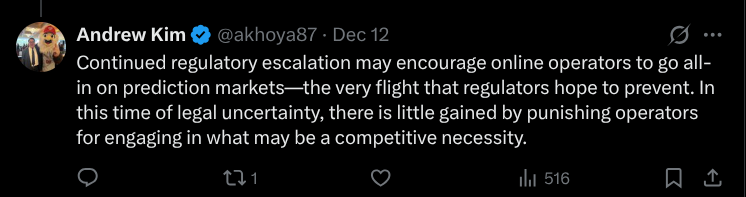
Maynard said with so much energy being expended on improving the legal market in Massachusetts — including, he said, responsible gambling, player-limiting, and AI measures — he didn’t want to see the licensed market there to “stoop down to that level” of what he considers gray market platforms like prediction markets.
He added that MGC sports wagering division chief Carrie Torrisi “has fired off a letter letting our legal operators know what we expect of them in Massachusetts when it comes to if they’re going to get into this type of product. I’m holding our operators to the highest standard in the United States.
“And meanwhile, they’re between a rock and a hard place because we have folks out there that don’t care about [reforms]. And so it puts me in a rock and a hard place because there is a fairness. But what I want to do is, I want to bring the entire industry up.”
A major part of the issue is that licensed gambling operators delving into prediction markets believe they are very much on the up-and-up.
Jay Atkins, FanDuel’s government relations director, made a point during a NCLGS forum to insist panelists not “co-mingle” prediction market and sweepstakes casino arguments. FanDuel’s new prediction market, in conjunction with CME Group, is scheduled to arrive this month with sports events contracts.
“Prediction markets are, in fact, not illegal at all,” Atkins said. “They are regulated by the CFTC. Now, the question of whether or not sports contracts are proper derivative contracts or gaming that should be regulated by the states, that is the question that the courts are wrestling with now.”
And increasingly, so are state regulators, who will determine whether Underdog is just an example or becomes the first of many.