
The pressure is on.
Tribal leaders last Wednesday told a congressional committee that sports event contracts are challenging the very way of life in Indian Country. A day later, 23 Senate Democrats, including three from the committee, sent a strongly worded letter to Commodity Futures Trading Commission (CFTC) Chair Michael Selig telling him to stand down.
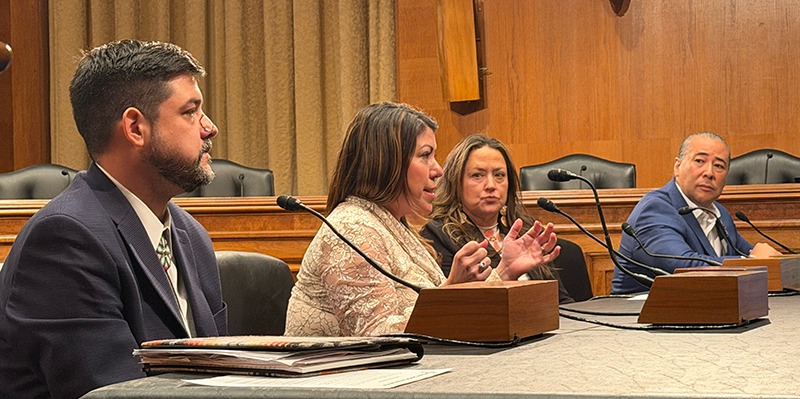
For Indian Country, the rise of sports event contracts on prediction markets is a direct threat to sovereignty and a clear violation of the Indian Gaming Regulatory Act (IGRA). Indian Gaming Association (IGA) Chair David Bean and National Congress of American Indians (NCAI) President Mark Macarro led a tribal-commercial briefing before the Senate Committee on Indian Affairs saying “Tribal nations are unified with states to stop this illegal betting market. We are asking Congress to step in before irreversible damage is done to state and tribal budgets and our citizens’ livelihoods.”
For some in Congress, the very existence of prediction markets points to a rogue federal agency being led by a Trump appointee who is talking out of both sides of his mouth. In the letter, the senators wrote that during his confirmation hearing, Selig called it “irresponsible” to determine whether or not sports event contracts should be defined as gambling, and that he said he would “look to the courts” to decide the issue.
“However, two months later, you announced that the Commission will intervene in the
matter before it has been fully litigated in the courts by withdrawing guidance cautioning against
the use of prediction markets for sports betting, and that the Commission may even enter
ongoing litigation. In addition, you recently posted that you “strong[ly] disagree” that prediction
markets violate the law, a stark reversal of your statements before the Committee,” the letter reads.
Among the signatories are Connecticut Sen. Richard Blumenthal, who has long been pushing for federal gambling oversight, and Minnesota Sen. Amy Klobuchar, who is the ranking member on the Committee on Agriculture, Nutrition, and Forestry, which confirmed Selig.
Taken together, the actions are significant efforts to rein in Selig and the CFTC. The agency is tasked with interpreting and enforcing the Commodities Exchange Act (CEA), which explicitly “prohibits event contracts that reference terrorism, assassination, war, gaming, or an activity that is unlawful under any State or Federal law.” CFTC rule 40.11 says the same.
Despite that, Selig has already said he will direct his agency to craft rules around the contracts, and file briefs in some lawsuits. In addition, Selig is withdrawing a 2024 proposal that would have banned sports and political contracts.
“Your recent comments instead suggest that you view the prohibitions Congress enacted
in 7 U.S.C. § 7a-2(c)(5)(C)(i)(I) through (VI) as subject to reinterpretation through regulatory
posture or litigation strategy,” the senators wrote. “That approach converts a statutory prohibition into case-by-case policy judgments. It also places the Commission in direct conflict with state and tribal
governments whose gambling laws Congress expressly chose not to preempt.”
Preemption still a big question
The situation raises the question about which federal law — the CEA or IGRA — preempts the other. It also brings the Unlawful Internet Gambling Enforcement Act of 2006 and the Supreme Court’s 2018 reversal of the Professional and Amateur Sports Protection Act into play.
The interplay between the federal laws — and the question of whether or not federal law preempts state law in this case — will likely be answered in the courts. Kalshi and other prediction market platforms are in court across the country with states and tribes. In their lawsuits, prediction markets argue that the CEA preempts all. Indian Country has filed amicus briefs in support of states in several lawsuits.
From a practical standpoint, more than a year after Kalshi began offering sports event contracts, gambling state and tribal regulators say the financial tools so closely mimic traditional sports betting that the average consumer can’t tell the difference. That confusion means consumers are playing with less protection than they would get on a state-regulated gambling platform, and states and tribes aren’t deriving the tax or revenue benefit they say they are entitled to.
“Sports event contracts being offered through prediction markets are the biggest threat to Indian gaming since IGRA was introduced to restrict Indian Gaming,” Bean told the committee. “They are not innovative financial tools. They are illegal sports betting products being routed through futures exchanges to avoid gaming law. That is a direct attack on tribal sovereignty.”
Bean noted earlier in the week at an NCAI meeting that sports event contracts may well be just the first step.
“These are gambling products and the next step will be casino-style games if we do not act,” he said.
Indian Country hasn’t been alone — but it has been at the forefront — in the fight against prediction markets, which has put sometimes sparring gaming groups squarely on the same side. The IGA in the last year has partnered with the American Gaming Association (AGA) to lobby across the country against prediction markets. The AGA, a national gambling trade group, participated with tribal leaders in last week’s congressional briefing, and the groups have lobbied together in opposition to prediction markets and unregulated sweepstakes sites in state houses across the U.S.
Selig called a liar and a cheerleader
Nevada Senator Catherine Cortez Masto, a member of the Senate Committee on Indian Affairs and a signatory on the congressional letter to the CFTC, late last week said Selig “lied” during confirmation hearings, and that “it’s past time for the CFTC to do its job and enforce both its own rules and the will of Congress.” California Nations Indian Gaming Association Chair James Siva called Selig a “cheerleader” for the contracts.
“Two months after telling senators he would allow the courts to conduct a neutral review of what constitutes ‘gaming’ under the Commodity Exchange Act, CFTC Chair Michael Selig appears to be abandoning his duty to regulate these illegal gambling platforms and instead will serve as their cheerleader as they flagrantly violate federal and state law, undermine tribal sovereignty, compromise sports integrity, and inflict grave harm on consumers in all 50 states,” Siva said in a press release Jan. 29.
“It is more urgent than ever that Congress step in and insist that online gambling and sports betting through prediction markets is not legal anywhere, anytime to anyone with a smartphone.”
Not everyone is anti-prediction market
Former U.S. Congressmen Sean Patrick Maloney and Patrick McHenry are proponents of prediction markets. Hired by the trade group the Coalition for Prediction Markets (CPM) in January, Maloney and McHenry will, according to a Spectrum News report, be working on proposed legislation around the platforms.
You can “make a little income, use your expertise, it has to do with finally getting some decent forecasting that competes with polling and punditry,” Maloney said during the interview. “We’re happy to talk to anybody who wants to, you know, shore up what is already a strong system of federal regulation.”
Maloney, a New York Democrat, sat on the House Committee for Agriculture, which, like its Senate counterpart, oversees commodities. McHenry, a North Carolina Republican, is a former chair of the House Committee on Financial Services.
McHenry called prediction markets a “very, very different model” from traditional sportsbooks, and both pointed to the idea that with sportsbooks, consumers play against the house, but with prediction markets, consumers play against each other.