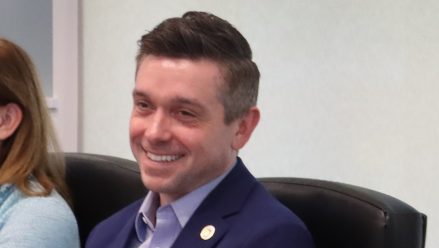
Even Victor Rocha isn’t really sure what all of his social media s**tposting is all about.
“It’s very Trumpian,” said the man who is the voice of Indian Country, and most definitely not a Trumpie — he says he “leans left, but has equal contempt for both parties.”
“It’s like being the kid in the back of a classroom just shouting things out,” he said of social media. “With Twitter, I can tell people to f**k off or drop a Shelley quote. I can go either way.”
And whichever way he goes, Indian Country (and many others) have his back and are listening.
“He’s a bit of a political pundit but for gaming,” California Nations Indian Gaming Association (CNIGA) Chairman James Siva said. “He’s very much Indian Country’s pundit. … He knows exactly when to say the thing that is inappropriate for a tribal leader to say and he says it.”
The Indian Gaming Association (IGA) conference starts Monday in San Diego, and Rocha is the conference chair.
IGA Executive Director Jason Giles describes Rocha’s social media presence as “calling someone out for hypocrisy or pointing out issues that are inconsistent with the message.” In his eyes, the X account and Rocha’s public persona are merely how people get heard in the 21st century, and, “as long as he’s out there making noise and getting recognized and it’s to the betterment of Indian Country, I’m glad there is someone out there doing it and calling attention to Indian Country.”
Said American Gaming Association (AGA) Vice President of Governmental Relations Tres York: “He is the tip of the sword. And he is definitely the public face of the tip of the sword. He is also, in many ways, the face of defending tribal sovereignty against threats.”
And that, if you cut through the s**tposting, is Rocha’s calling.
Information and institutional knowledge
For many in the gaming industry, Rocha stormed into the public consciousness over the last eight years, after the Supreme Court overturned the Professional and Amateur Sports Protection Act and opened another avenue for tribal governments to monetize Class III gaming. But Rocha has been a force inside and out of Indian Country for far longer.
In 1998, 10 years after Congress drafted the Indian Gaming Regulatory Act, California’s tribes ran Proposition 5, which allowed slot machines, some table games, and lottery games on Indian land. It also mandated the governor to compact with the tribes. Proposition 5 was ultimately struck down, but compacts were put into place, and in 2000, Proposition 1A gave California’s tribes the exclusive right to Class III gaming.
Rocha was there.
“I started making this little newsletter for my cousin, so he would have information,” Rocha said of his project for Pechanga Band of Luiseno Indians Chair Mark Macarro. “And there was information out there, and the night we won was an incredible, glorious evening, and someone said to me, ‘Now that this is over, you can stop sending me emails,’ and I was like, ‘This is just the beginning.’ So I thought I would put it on the internet, just like Drudge [Report]. That was kind where the kernel of the idea came from.”

Three decades later, Pechanga.net is the go-to for Indian Country and many others seeking the latest news about tribal gaming. But its origins are far more modest than its reputation today. When Rocha, then in his 30s, had the idea for the website, he was fresh off the earlier period in his life during which he followed his passion for music, and didn’t have the funding to start. He reached out to Knute Knudson, an executive at IGT.
“I was in my office,” Knudson said, “and a marketing guy named Kenny Putnam came into my office — he was a fiddler with [country singer] Roy Clark — and said, ‘You know, there is a guy on the phone and I’ve been talking to him for awhile and he’s got some great ideas.’ And Victor Rocha was on the phone and he told me he had this idea that he wanted to start some level of news reporting in Indian Country, and he wanted to represent all of the tribes and be a source of news and information that reflected the tribal point of view, and covering it all. He said, ‘What I need is money. I need to buy two powerful computers and some seed money to get going.”
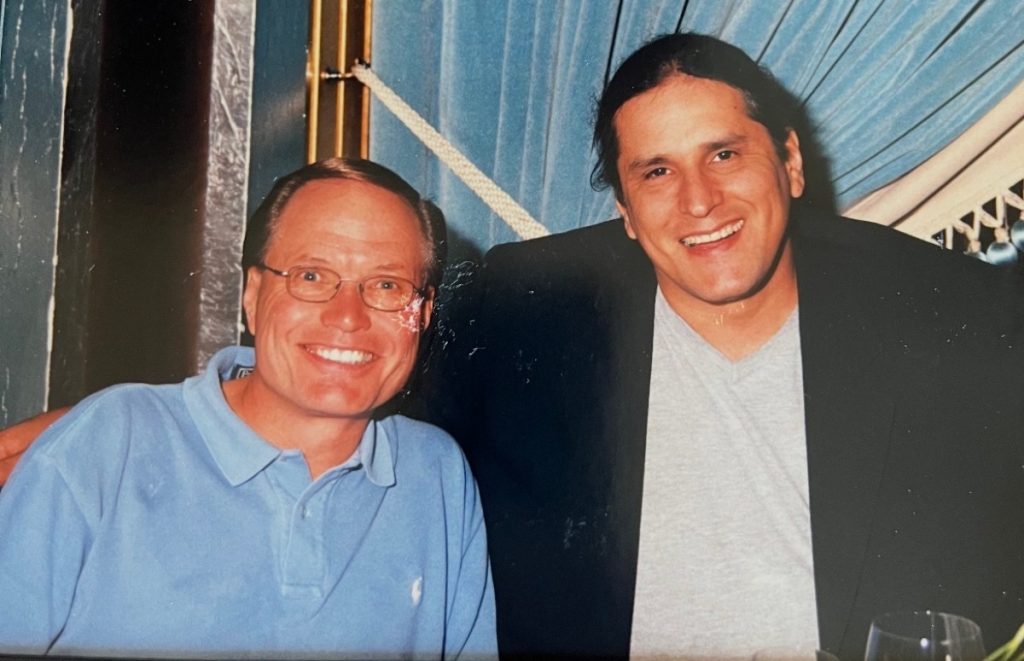
Knudson said yes, and IGT was long a key advertiser, but more importantly, Knudson and Rocha formed professional and personal relationships that have endured. Knudson was at Rocha’s wedding — and helped him have a suit for it tailored the morning of the wedding — as well as help with the fostering of tribal children and ultimately the adoption of Rocha’s son. On the business side, the two worked together on many issues.
“I think all of those years, he’s become the most important spokesperson and leader for strategy in tribal government gaming in the country,” Knudson said. “And outside of tribal government gaming, he is an extremely important person for strategy. There have been many people through the years who have called him a charlatan, but he outlasted all of them.”
Information is power
For Rocha, information is power. And when the internet came along, well …
“Learning the power of information and the power of aggregating information … I always knew I was supposed to do something really important, and when I finally found it, I was so excited,” he said. “I was using the internet for the value that it brought us [with Pechanga.net]. The internet is like having the Library of Congress” anywhere. For what it’s worth, Rocha said his first internet search ever was to learn more about the Knights Templar.
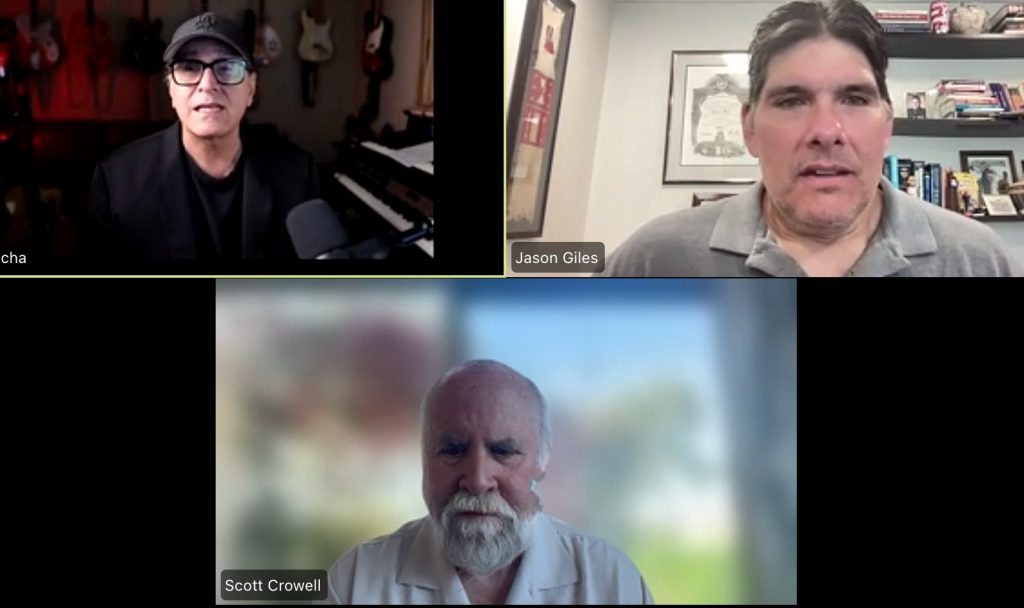
IGA’s Giles (pictured below, right), who has long worked with Rocha on education and is a co-host on Rocha’s The New Normal webcasts, agrees that Rocha is a key figure in Indian gaming and affairs. But he doesn’t want the part about Rocha as a human being to get lost.
“If you only watch and listen to Victor on social media or the podcast, you definitely do not get the full picture of the man,” Giles said. “I hope your story starts with fostering. … He is definitely the kind of guy who will give you the shirt off his back.
“He’s almost the opposite of what you would think you would get if you listen to him on social media or his podcast.”
Talk to anyone who works in or alongside Indian gaming, and they all call Rocha a champion.
“He filled a vacuum for reliable information in Indian Country,” said Scott Crowell (pictured center above), a lifelong tribal attorney who is heavily involved in the tribal fight against sweepstakes and prediction markets. “Just like I found the courtroom where I could be most effective, he found that this is where he can make a difference. He is driven by his heart and his infallible sense of justice and injustice. And he’s not shy to call bulls**t bulls**t.”
Rocha is … everywhere
Rocha nearly blushes when he hears what people who are in his corner have to say about him. He sees himself as a crusader, but also as a regular guy — a father, a son, a husband — and is surprisingly humble in person. He is still sometimes surprised by how many people pay attention to him and what doors he can open.
“He likes to have the spotlight, and shine it on other people,” CNIGA Chairman Siva said. “He’s searching. He doesn’t want it on himself.”
While he may not like the spotlight, Rocha has earned a spot under it. Since launching Pechanga.net, he has gone on to become IGA’s conference chair (which he started doing for free because he wanted to get the right people in the right room to share information), founded a gaming consultancy, and started the New Normal webinar exploring tribal and gaming issues. He has also taken Indian gaming on the road with an education track at non-tribal events, including the annual Global Gaming Expo in Las Vegas and the ICE conference in Barcelona, which brings together more than 60,000 industry professionals.
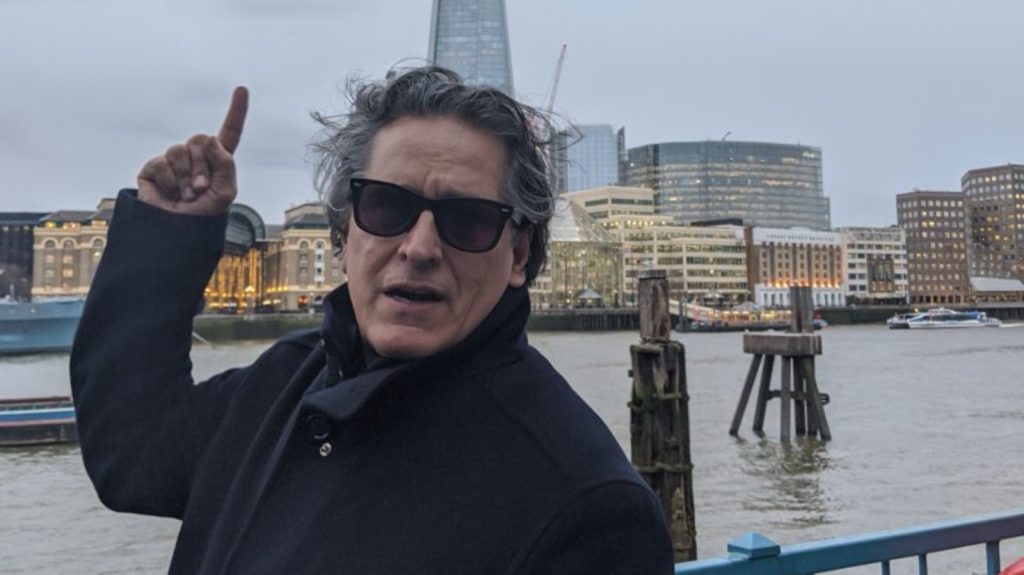
Rocha has the ear of IGA Chair David Bean, the AGA, and myriad tribal leaders across the U.S., and in California is often a gatekeeper between the tribes and the commercial industry. Rocha has a blood connection to some key tribal chairmen in California, but he has forged professional connections in and out of Indian Country.
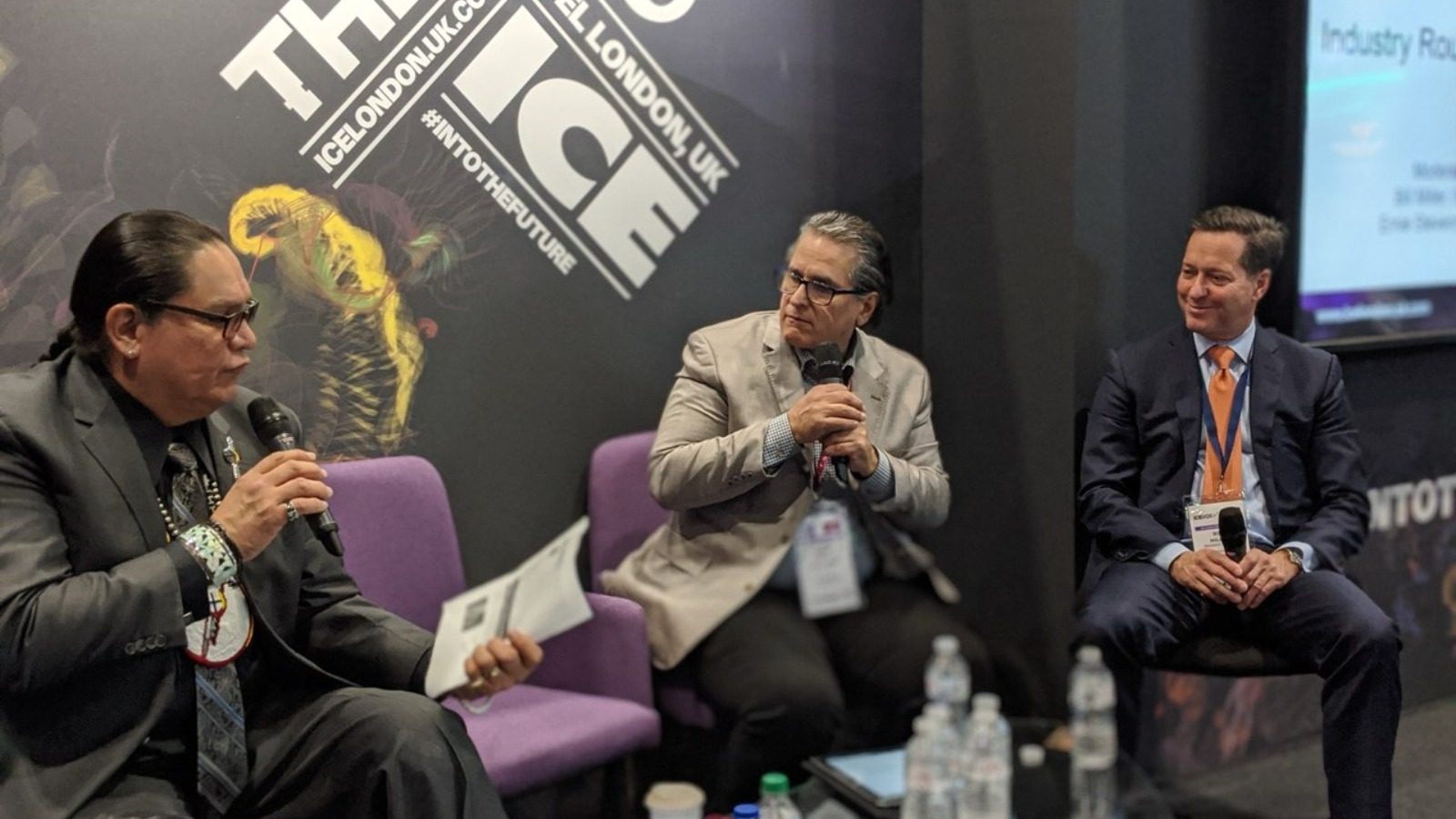
Much of Rocha’s growth came under the wing of former IGA Chair Ernie Stevens (lead photo, left), who died suddenly last September. Stevens, with his down-home, aw-shucks drawl and demeanor, was a master of negotiation, education, and compassion, and he gave Rocha the space and support to develop.
Rocha is the first to point out that he is neither a journalist nor a politician, but he often wears both hats. “I was just able to see the ramparts and I have a gift for the fight,” he said. “Once I found out I was good at this, I was able to see things as they are before a lot of people do.”
He’s a fierce force who traces his roots to a blue-collar family in California’s San Bernardino County. He’s an enrolled Pechanga Indian, and while he didn’t grow up in that life, his grandmother “was the one who told me who I was and how I fit in.” She gave Rocha the powerful Native American book, Bury Me at Wounded Knee, which helped to shape his views on Indian Country.
Rocha finished high school, and knowing that college wasn’t his jam, he got a job at a recording studio, which tipped off a 20-plus-year journey across the U.S., playing music and finding his roots. His band opened for popular alternative rock acts like the Smithereens and The Del Fuegos, he visited some of the most iconic Indian landmarks and poorest tribes during a turn in South Dakota, and he eventually settled in New Jersey where he “fell in love with the people and the Jersey attitude. … The people were honest and real. In New Jersey, when you go on stage, people were excited for you and they hope you’re going to make it. In Hollywood, they hope you will fail.”
But sometime in his early 30s, Rocha said, it wasn’t “cute anymore. You’re still sleeping on couches and you can’t pay your bills.” During that stretch, Rocha met the woman he would marry, had found as much of himself as he could through music, and moved back to California.
“In the 1970s, everybody’s motto was sex, drugs, and rock and roll, and I bought into that,” Rocha said. “And here I was in the ’90s, and all I wanted to do was nap. You realize you didn’t make it, son, and you have to move on.”
In his words, he “fell into Indian gaming,” but the truth was that by that time he already had the passion and fire that would make him a leader in defending tribal sovereignty. And in the mid-1990s, when Rocha returned to California, life for Golden State tribes was on the verge of massive change.
Passion at the perfect time
Rocha didn’t grow up the way today’s Pechanga — and many other — Indians do. When California’s tribes secured the right to Class III gaming, it ultimately opened a monetary spigot for members of the biggest gaming tribes. Many gaming tribes pay their members a per capita, which is a share of the tribe’s net gaming revenue. Pechanga is one of the five highest grossing gaming tribes in the Caliornia, and per capita payments are distributed to enrolled members starting at age 18.
That safety net didn’t exist for Rocha. It wasn’t until he was in his 30s and gaming began to take root that he netted the benefits. But when the money came, it was life changing.
“My tribe was all of a sudden ready to elevate its members from abject poverty,” he said. “It started as a drip, and then it was middle class and then it was the salary for a doctor or a lawyer. I was prepared for it, but what it did for my family? It was a gift from God. Everyone in my family got clean and sober. My sister didn’t have to worry about where she was going to sleep, my mother didn’t have to worry about paying rent.”
The windfall sounds a lot like winning the lottery, getting a massive inheritance, or making a big stock-market play, but Rocha said it was different. He, his family, and other tribal members didn’t fall into a more comfortable lifestyle in a vacuum. “We were elevated together. I had my cousin [Chairman Mark Macarro] and other tribal leaders as an example.
“We all wait for opportunity to knock,” he said. “Maybe it’s Ed McMahon kicking on your door, but when it’s your whole group, it’s a whole different beast. How am I supposed to act now? That’s when I knew it was time to clean up my act.”
For Rocha, that meant embracing the only other thing he’s as passionate about as music — tribal sovereignty. (Truth be told, he’s probably more passionate about his family and helping people than either of those endeavors.)
“He found himself in the early days of tribal gaming, and it was like a light went on,” said Knudson, his original Pechanga.net benefactor. “It often happens to people who write a good novel or invent something, and it just clicked. He found himself and he found a way to have an outlet for what he found. And he’s dedicated his life to this thing. He’s done such an extraordinary job of finding people and he’s committed himself this endeavor.”
Pechanga.net and Rocha’s influence grew. In 2016, he partnered with former gaming executive Gene Johnson (below, left) to found Victor Strategies, a consultancy Johnson says offers “more accurate consulting at lower rates that strives to be a more meaningful consultant to tribal and commercial stakeholders.” Among its gaming clients are the AGA, Bally’s, the Choctaw Nation of Oklahoma, Delaware North, Graton Casino & Resort, H2 Gaming Capital, IGT, Kambi, Sportradar, and Tropicana Entertainment.
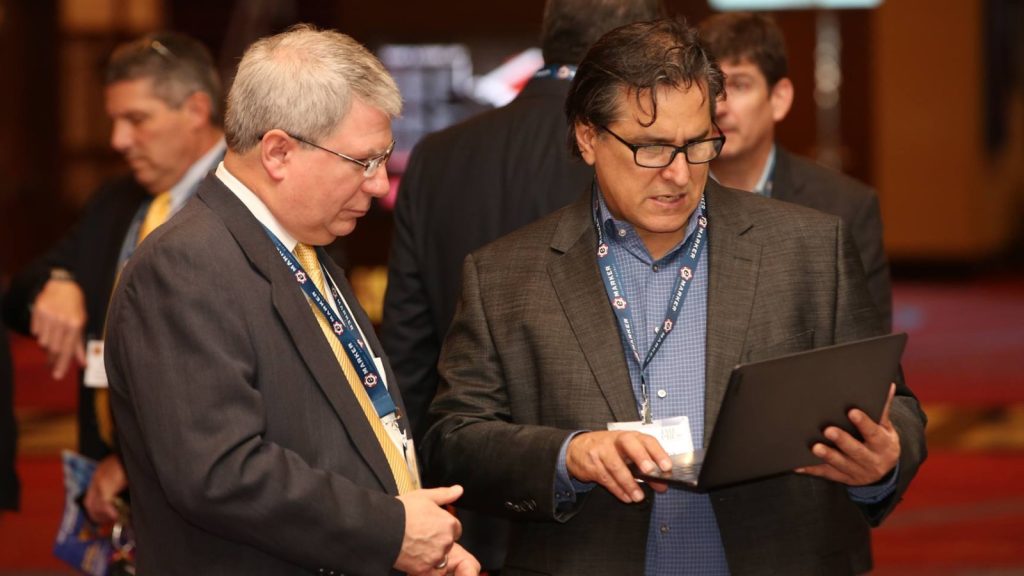
Johnson is one of the more unassuming, reserved characters on the gaming landscape. His demeanor balances out Rocha’s more explosive personality, but Johnson won’t lie — he sometimes revels in his partner’s passion, and shared this story of a panel discussion in 2014 or 2015 the morning after a bar crawl in Barcelona.
Among the panelists were “an old Vegas guy” and Rocha. Johnson was the moderator.
“The old Vegas guy started talking about the Indians and how they have all of the advantages,” Johnson said. “They don’t pay taxes, they don’t have competition, they don’t hire Vegas guys. … And I look over and I see Mount Etna starting to percolate, so when he was finished, I pulled the pin out and rolled [the grenade] over to Victor. He started with, ‘Since you didn’t succeed in wiping us off the face of the planet …’ and went from there.”
Rocha’s rise
Since sports betting became a states’ rights issue, and particularly in the last three years, Rocha has become a grassroots leader who has effected tangible change for Indian Country. He delights in telling the story of his epiphany about dual-currency sweepstakes platforms — two years ago, he walked out of an event at G2E that he dubbed the “Vampire Party,” at which he realized that some people wanting to do business with the tribes were actually siphoning potential revenue away from the tribes by running unregulated gaming platforms.
“Jason and I were like, ‘Oh, sh**!’ Are we wrong about this or are we just so ahead of the curve?'” Rocha said. “And it turned out that we were ahead of the curve. And now it’s about the prediction markets.”
Said Johnson, “Sweeps were taking money out of California. … And once the light came on, Victor was very good at informing people and doing something.”
Immediately after the conference, Rocha began spreading the word — via his webinar with Giles and any other way he could — about his concerns about sweepstakes. It was a key moment during which Rocha transcended being the voice of Indian gaming and started to become a critical voice in gaming in general.
“If people want to frame him as a loudmouth on Twitter or pods, then they don’t know his expertise in Indian gaming,” Giles said. “His expertise is that he was there at the beginning of Indian gaming and he had to fight the fight, and he knows all of the people.”
After that moment at G2E in 2024, Rocha laid a foundation that resulted in California lawmakers banning sweepstakes. Beginning Jan. 1 of this year, the platforms had to exit the state. California wasn’t the first to ban the platforms — they were deemed illegal in Connecticut, Montana, New Jersey, New York, and other states — but it was the biggest. The ban came just months after the state attorney general released an opinion that another kind of unregulated gaming — daily fantasy sports — isn’t legal, and a year after the state legislature granted tribes a one-time opportunity to sue commercial card rooms, which Indian Country says encroaches on its exclusivity.
Those three victories alone are stunning, and represent a major shift in gambling laws in California. But Rocha sees more to do. He says prediction markets — sports event markets, in particular — are the latest threat.
“How is this going to change things?” he asked of prediction markets. “It’s existential, and not just for Indian gaming, but for the commercial industry, too.”
Rocha has taken the lead in education and spreading the word about what he says is the threat of prediction markets. He’s made the issue the centerpiece of the IGA annual conference, which starts Monday in San Diego, as well as the education track at ICE in January. He also travels across the country to educate tribal leaders, does reams of research (on everything, really), and explores the subject from myriad angles on his weekly webinar.
How prediction markets — and sweepstakes before them — have affected the gambling industry isn’t just a question tribes have to wrestle with — state regulators and operators are pondering it, too. The issue has aligned Indian Country with the AGA and state regulators. Previously, the tribes had been in conflict with the industry as a whole and some states over gaming issues. In particular, Rocha has been working with the AGA’s York.
“It was kind of a melding of the minds between us at the AGA and Victor, in particular,” said York, who was on a prediction market panel at the IGA mid-year conference in September. “We’ve worked very closely to educate other tribes, which is the starting place, but it goes beyond that. … The one unwavering thing when you get to know him is that he is focused on protecting the tribes and protecting what the tribes have rightfully earned.”
Curiosity didn’t kill this cat
Putting the issues aside, Rocha, at his core, is a passionate guy willing to speak his mind. Stories abound about Rocha seeing a wrong and “righting it,” which sometimes involves a loud voice, a lot of intensity, and a little foul language. He’s not afraid to lose his cool and defend a cause, and that passion is what drew Jesse Robles, the editor at Pechanga.net and the founder of his own platform foodandgaming.com, to Rocha.
Robles first met Rocha when he spoke in a class at San Diego State University, where Robles was a student.
“He is a keeper of truth,” Robles said. “I think that was his mission [with Pechanga.net], to bring the truth out into the open.
Robles said Rocha is “one of the reasons” he has the confidence to pursue his own venture. Being around Rocha has taught him that hard work and passion can lead to success.
“I think he’s been successful at following his curiosity,” Robles said. “He taught me to listen to — and trust — my inner voice and passion.”
Most everyone in Rocha’s orbit uses the word “passion” to describe him at some point. Colleagues and friends also call him intense, focused, inquisitive, compassionate, committed, and driven.
“His muse is bringing information to Indian Country,” Johnson said. “But his views have always been broader than Indian Country. That’s just now being discovered.”
Said the AGA’s York: “He views tribal sovereignty as kind of the Holy Grail and all of his decisions are to make tribal gaming as strong as possible, and it’s not just to defend Pechanga’s tribal sovereignty, but everyone’s against anyone who is trying to take it away from them.
“That passion makes him a formidable opponent.”