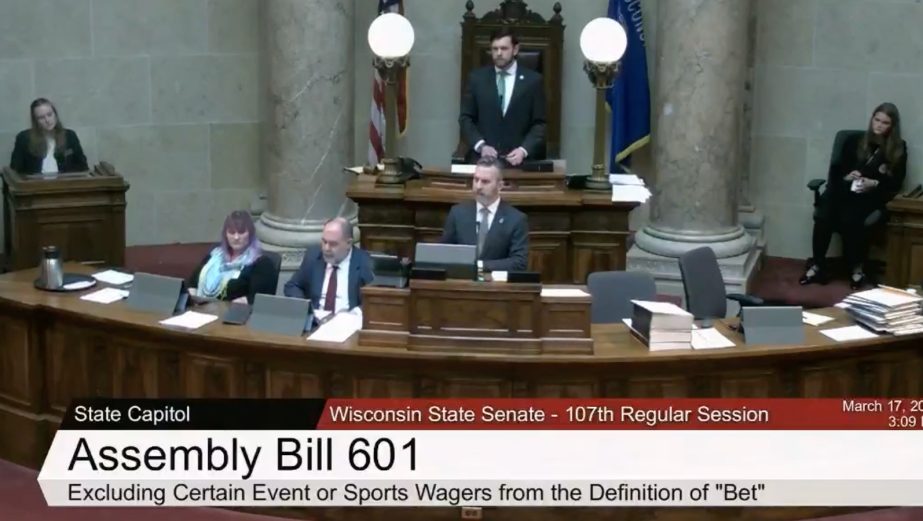
Wisconsin Gov. Tony Evers Thursday signed a bill that makes online sports betting legal, and puts the tribes in charge. With his signature, Evers made Wisconsin the second state to give tribes exclusivity to statewide mobile sports betting under an Indian Gaming Regulatory Act (IGRA) model, and the first with a competitive market. The only other state in which Indian Country owns the market is Florida, where there is a single platform, the Seminole Tribe’s Hard Rock Bet.
The Wisconsin bill could well provide a blueprint for other not-yet-legal online sport betting states with tribes, including California and Oklahoma. In California, the tribes have long said that they will fight to maintain their exclusivity and seek legalization under the IGRA model, meaning any operator must pay a partner tribe 60% of revenue.
Potential sports bettors in Wisconsin will have to wait a little while still before they are able to place bets. Because the tribes will be the licensees, they must first compact with the state to add sports betting, and then those compacts must be approved by the U.S. Department of the Interior. The timelines for each are at least a few months, and likely longer. In addition, there is no model compact in Wisconsin, and each of the 11 gaming tribes will negotiate its own compact.
At the Indian Gaming Association annual conference last week, Oneida Nation Chair Tehassi Hill said, “[All the tribes] are traditionally competitors, but today is a new world, and hopefully we can come together and help each other to be successful.”
Evers echoed that Thursday.
“The real work begins today,” he said in a statement. “Each of the 11 Tribes must now work diligently — and together — to shape the future of sports betting in Wisconsin. … An approach that exacerbates long-standing inequalities among Tribal Nations is not good for Wisconsinites or Wisconsin. I will not entertain it as governor.”
The Oneidas were the first to negotiate in-person sports betting into their compact, and they went live with it in 2021. The state has a “me-too” clause for tribes, meaning that if one tribe negotiates something in its compact, every other tribe can get it. Compacts are negotiated in a certain order. In 2021, all tribes knew what the Oneidas were negotiating for.
“Our compact came up for negotiation [first],” Brandon Yellowbird Stevens, then the Oneida vice chair, said during a webinar in 2021. “We kept all 11 tribes in the loop every step of the way, that’s how we kept it a secret. The premise was that we were going to set the template for what all tribes could do, and we needed to make sure that this was fluid.”
Among the big questions in Wisconsin will be how or if the commercial industry will enter the market. Last fall, the Sports Betting Alliance (SBA) opposed the Senate version of the bill, causing the tribes to ask legislators to put on the brakes. The bill was pulled from consideration, and it was the House bill that made it across the finish line.
In other news …
Here’s a look at the status of some other active bills around the U.S.:
Kentucky: Time is running short for Gov. Andy Beshear to sign the bill that would require sports betting operators to take wagers of up to $1,000, raise the minimum age from 18 to 21, and ban prediction markets in the state. HB 904 was delivered to Beshear April 2, and he has 10 days, not including Sundays, to take action on it. If Beshear does not sign or veto the bill, it would become law after the 10th day.
Minnesota: SF 4139, the bill that would legalize statewide mobile sports betting, is set for a hearing in the Senate Commerce and Consumer Protection Committee Tuesday at 12:30 p.m. local time. The bill was introduced March 4 and has been bouncing between the Rules and Commerce Committee and the Consumer Protection Committee, but has not passed out of either. There is no crossover deadline in Minnesota, and the legislature is set to adjourn May 18.
Virginia: Gov. Abigail Spanberger has until Monday to take action on HB 515, the bill that would prohibit funding of gambling accounts by credit card. The bill passed the House and Senate March 13, and Spanberger can sign it, veto it, or do nothing, at which point it would become law after Monday. Should the bill become law, Virginia would join about 10 other states in not allowing credit card funding. The sports betting industry has been steadily moving away from allowing accounts to be funded by credit cards — in the last year, BetMGM, DraftKings, and FanDuel have joined Fanatics Betting & Gaming in not accepting them.