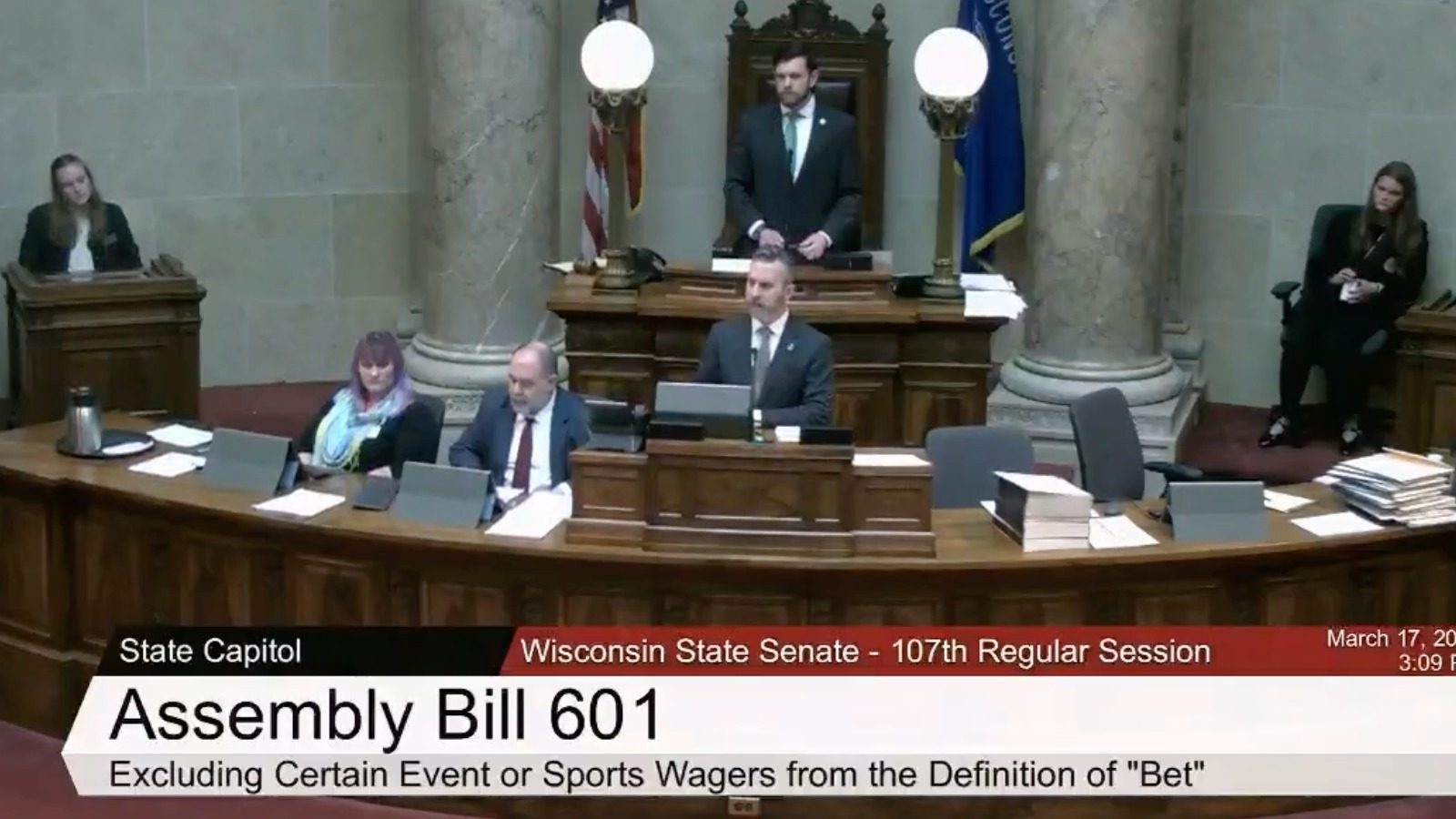
Wisconsin could become the first state since November 2024 to legalize sports betting statewide after the Senate concurred in AB 601 Tuesday afternoon. The bill would allow for digital sports betting with the tribes in charge. Its counterpart, SB 592 was met with heavy opposition from the Sports Betting Alliance (SBA) last fall.
In Wisconsin, Republicans are the majority, and Democrats have been carrying online sports betting. Tuesday, half of the state’s 18 Republican senators voted for it. The bill was approved, 21-12 via voice vote, and will be sent to Democratic Gov. Tony Evers, who has six days (not including Sunday) to act.
Should Evers sign the bill, Wisconsin would become the first state other than Florida to agree to allow Indian Country to offer statewide mobile sports betting with an Indian Gaming Regulatory Act (IGRA), or hub-and-spoke model. In every other legal sports betting state, tribes have agreed to share exclusivity and be regulated, at least in part, by the state.
Once the bill is signed, it will provide a blueprint for others in Indian Country — including California, Minnesota, and Oklahoma — which are aiming for similar arrangements.
Florida is currently the only U.S. state with sports betting under an IGRA model. In Florida, the Seminoles have a monopoly with their Hard Rock Bet platform. They were able to get a monopoly by compacting with the state, which agreed to have the phrase “bets are considered placed where received” in the deal. Every sports bet in Florida flows through a server on Seminole land.
Wagering is regulated by a tribal council and the Seminoles pay the state a fixed revenue share of about $500 million for all gambling, per year for the first five years.
Wisconsin’s bill includes the language the tribes there would need for exclusivity and the ability to offer bets across the state:
“An event or sports wager made by a person physically located in this state using a mobile or other electronic device if the server or other device used to conduct such event or sports wager is physically located on a federally recognized American Indian tribe’s Indian lands.”
Opponents lean into social harm argument
During floor debate, opponents argued that legal sports betting brings with it many social harms, and that AB 601 would shut out commercial operators. The text of the bill would allow for the tribes to be the key licensees, and craft market-access agreements with commercial operators. Per IGRA, such agreements require that operators pay the tribes 60% of revenue — not profit.
“This is another example of what is wrong with politics,” Republican Sen. Steve Nass said. “Voters did not elect Democrats and Republicans to bring more gambling to the state of Wisconsin. In fact, public revenue built on addiction, family disintegration, and predatory practices is neither moral nor sustainable.”
He went on to say that the potential social harms would “far outweigh any benefit to the state” and that “other entities are excluded under the legislation. They would have to do an agreement with the tribes at great expense. Competition would be nil.”
Wisconsin has 11 federally recognized tribes and each could offer online sports betting either with a wagering partner or via “white label,” meaning they hire a technology provider, but the platform is branded as the tribal entity. It’s possible that there could eventually be 11 platforms in the state, making the market open and competitive. What would not be allowed is for commercial operators to enter the state without a tribal partner.
Wisconsin’s tribes have gaming exclusivity in the state, and collectively own and operate more than 20 Las Vegas-style casinos — some with retail sportsbooks. In 2021, the Oneida Nation became the first in the state to add in-person sports betting.
“The hub-and-spoke structure in this bill is designed for scale and constant engagement, it streamlines access, removes friction, and encourages higher betting volume and frequency,” Republican Andre Jacque said. “In other words, it does not merely allow sports betting, it optimizes it, and that design choice carries real consequences. When sports betting is confined to casinos … a person has to make a deliberate choice to go somewhere to engage and eventually to leave.”
Let’s ‘err on the side of our tribes’
Proponents did not argue that social harms do exist with legal gambling, but did argue that they also exist without it — and in that scenario, Wisconsinites are not protected. They also pointed to money leaving the state.
“If we are going to have gambling, which we already do … it’s [illegal gambing] happening behind closed doors … I’d rather have as many parameters as possible, and keep the money in the state,” Democratic Sen. Kristin Dassler Alfheim said. She also said lawmakers that if lawmakers were going to “err on the side of caution, [let’s] err on the side of our tribes.”
Dassler Alfheim and Democratic Minority Leader Dianne Hesselbein also said the legislature should protect the tribes.
“Just last month, we listened to the state of the tribes,” Hesselbein said. “It was not surprising that they mentioned this very bill … I really think that this is a moment of collective assertion of tribal sovereignty and the preservation of exclusivity that tribes have fought decades to establish.”
Said Dassler Alfheim: “I think that it’s fair to say follow the money. There’s been an enormous amount of money spent on this issue, it’s coming from the DraftKings of the world, because what they would really like is to not have the tribes involved at all. They would like a mainline to those people that we are all so concerned about. I don’t think that’s right.”