Last updated: September 1, 2026 | Last verified: September 1, 2026
Prediction markets are federally regulated as derivatives under the Commodity Futures Trading Commission (CFTC), not as gambling products under state gaming commissions. That distinction matters, because it means there are no federal disclosure requirements, no mandatory helpline numbers in the fine print, and no state regulators forcing operators to build in deposit limits or self-exclusion programs. Whatever responsible trading tools exist on these platforms, operators are building them voluntarily (perhaps to avoid the imposition of certain rules or limitations from Congress).
Some have done more than others. Here’s what’s actually available as of April 2026, who offers it, and where the gaps still are.
🛡️ Responsible trading tools on prediction markets
The toolkit is thin compared to what sportsbooks offer, but it’s not empty. Five core tools exist across the major platforms, though no single operator offers all of them.
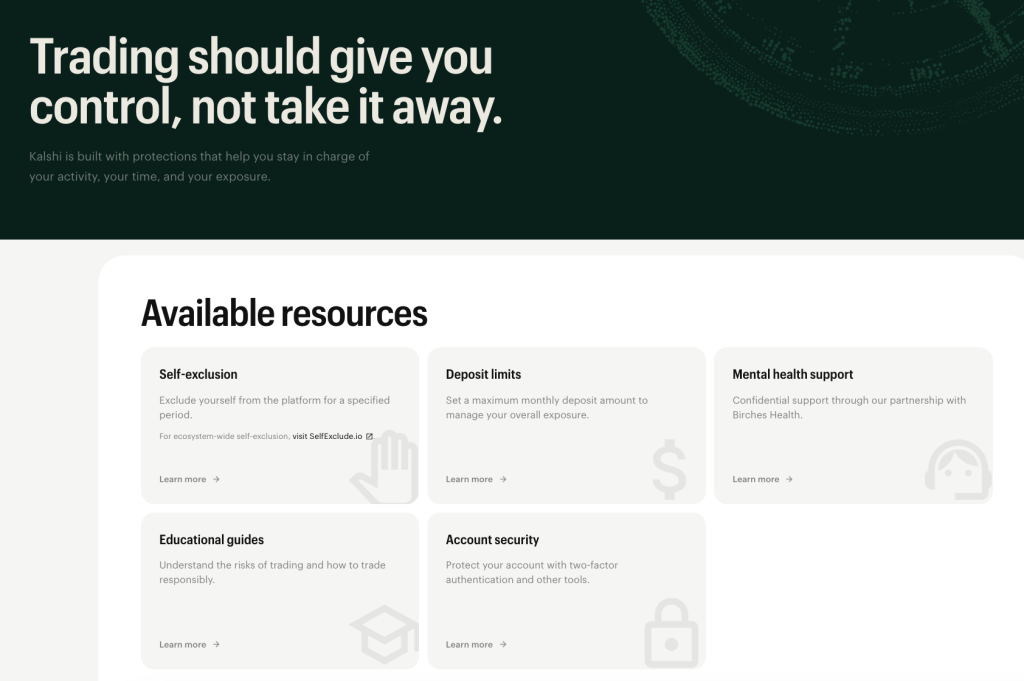
Deposit limits let users cap how much money they can add to their account in a given period. Kalshi offers a personalized funding cap (monthly maximum). Fanatics Markets goes further with daily, weekly, and monthly deposit limits, which is the same granularity you’d find on a regulated sportsbook.
Session time limits restrict how long you can use the app in a single sitting. Fanatics Markets includes this; Kalshi and Polymarket do not. If you’ve ever lost track of time scrolling through NBA player prop markets at 1 a.m., you know why this matters.
Trading breaks/timeouts temporarily lock your account for a set period, typically ranging from a few days to several months. Kalshi and Fanatics Markets both offer these. Fanatics lets you set a timeout from 3 days up to a full year.
Voluntary self-exclusion is a longer-term lockout, usually lasting at least a year and sometimes extending to a lifetime. Kalshi offers this, and in April 2026, it became the first prediction market to integrate IC360’s SelfExclude tool, a cross-platform exclusion system. Users who sign up are blocked not just on Kalshi but on every platform that partners with SelfExclude. Polymarket, Robinhood, and ProphetX are reportedly in the onboarding process.
Whistleblower tools are newer. Kalshi added a reporting function to its market pages in March 2026, letting users flag potential manipulation or suspicious activity directly from the trading interface. It’s not a traditional responsible gambling feature, but it adds a layer of accountability.
⚠️ Watch Out: Polymarket currently offers zero responsible trading tools. No deposit limits, no self-exclusion, no session alerts, no timeouts. For a platform backed by a $2 billion investment from the parent company of the NYSE, that’s a notable gap, and may soon change if Polymarket indeed merges its international and U.S. platform. If you need guardrails, Polymarket doesn’t have them yet.
Platform-by-platform comparison
The sportsbook-turned-prediction-market operators (Fanatics, DraftKings, FanDuel) brought more tools at launch than the prediction-market-native platforms, but none of them carried over their full sportsbook responsible gambling stack. A Sportico investigation in January 2026 found that all three launched without gambling addiction helpline information or the same betting history visualizations available on their sportsbook apps. FanDuel added a support hotline to its prediction market app after the story was published.
The reason is strategic, not accidental. Operators worry that labeling their prediction market products with gambling-specific language could undermine the legal argument that event contracts are financial instruments, not gambling products. The CFTC isn’t supposed to approve contracts based on “gaming,” so companies avoid the word. That tension between legal positioning and consumer protection runs through every responsible trading decision in this industry.
| Feature | Kalshi | Polymarket | Fanatics Markets | DraftKings / FanDuel |
|---|---|---|---|---|
| Deposit limits | ✅ Monthly cap | ❌ | ✅ Daily/weekly/monthly | ✅ |
| Session time limits | ❌ | ❌ | ✅ | ✅ |
| Trading break/timeout | ✅ | ❌ | ✅ 3 days to 1 year | ✅ |
| Self-exclusion | ✅ + SelfExclude (cross-platform) | ❌ | ✅ 1 year to lifetime | ✅ |
| Helpline in app | ❌ | ❌ | ✅ | ✅ (added post-launch) |
| Activity/loss tracking | ❌ | ❌ | ❌ | ❌ |
One thing that stands out: no prediction market platform offers real-time activity or loss tracking. Sportsbooks like BetMGM and DraftKings display session summaries showing net wins/losses, time spent, and betting patterns. That kind of behavioral feedback loop doesn’t exist on any prediction market app I’ve tested. It should.
⚖️ Sportsbooks vs. prediction markets on responsible gambling
Sportsbooks operating under state licenses are required to offer responsible gambling resources. Many states mandate helpline disclosures on every ad, every app screen, every promotional email. Operators must make deposit limits, cooling-off periods, and self-exclusion programs accessible. They partner with organizations like the National Council on Problem Gambling and Gamblers Anonymous. The American Gaming Association spent nearly half a billion dollars on responsible gaming initiatives in 2024 alone.
Prediction markets have none of those mandates, yet. The CFTC regulates event contracts the same way it regulates corn futures and interest rate swaps. No disclosure rules. No mandatory helpline numbers. No required self-exclusion programs. Any responsible trading tools that exist are voluntary.
That regulatory gap creates a paradox. A 19-year-old in Texas can open a Kalshi account and trade NFL game contracts with no deposit limits, no session alerts, and no state-mandated responsible trading disclosures. The same person can’t legally place a $5 NFL bet on DraftKings in Texas because sports betting isn’t legal there. The prediction market route offers the same financial exposure with fewer guardrails.
💡 My Take: The sportsbook industry spent years building responsible gambling infrastructure under regulatory pressure. Now prediction markets are absorbing much of the same customer base, with a fraction of the consumer protections. The sportsbook operators entering prediction markets (Fanatics, DraftKings, FanDuel) are in an awkward spot: they know how to build these tools, they’ve championed them publicly for years, but deploying the full suite could undermine their legal argument that event contracts aren’t gambling. Consumer protection shouldn’t be a legal liability.
Why responsible trading matters more than operators admit
A George Washington University study estimated that the average prediction market trader has a negative expected return of roughly -20%. That’s worse than most casino table games. Academic research consistently finds that prediction markets, like sportsbooks, are negative-expectation activities for the majority of participants.
The behavioral triggers are similar, too. Real-time price movements, live in-game trading, rapid settlement, easy redeposits. Kalshi’s app lets you trade on NBA games while they’re being played. Fanatics Markets launched a parlay-style “Combos” feature in April 2026 that bundles multiple contracts into a single high-risk position. These are features designed to increase engagement, and they work on the same reward pathways that make sports betting compelling and, for some users, compulsive.
The NCPG’s Cole Wogoman put it this way: from a problem gambling perspective, buying and selling futures contracts through prediction markets is functionally gambling, regardless of how the product is legally classified. The legal distinction between a “trade” and a “bet” doesn’t change the neurological reality of what happens when someone watches real money move in real time on an uncertain outcome.
Nearly 20 million U.S. adults reported at least one indicator of gambling-related harm in the past year, according to NCPG research. As prediction markets add more sports contracts and parlay-like features, there’s no reason to think their user base is immune to those same patterns.
Getting help: resources that exist right now
If you or someone you know is struggling with compulsive trading or gambling, help is available regardless of whether the product is called a “prediction market” or a “sportsbook.” The behavioral patterns are the same, and so are the treatment options.
National Council on Problem Gambling (NCPG)
The NCPG is the primary national resource for problem gambling support. In January 2026, the organization launched 1-800-MY-RESET (1-800-697-3738) as its new National Problem Gambling Helpline number, replacing the less memorable 1-800-522-4700 (which also remains active). The rebranding followed a legal dispute over the 1-800-GAMBLER number, which reverted to the Council on Compulsive Gambling of New Jersey.
The NCPG helpline is free, confidential, and available 24/7. It connects callers to one of 24 contact centers across the country. You can also text 800GAM or chat online.
Beyond the helpline, the NCPG offers a self-assessment quiz for adults and a separate version for youth and young adults, a counselor directory, a treatment facilities database, and state-by-state resource guides.
Gamblers Anonymous
Gamblers Anonymous runs a 12-step program with meetings in all 50 states, including in-person, virtual, and telephone options. There are no dues or fees. The related Gam-Anon program supports family members and loved ones of problem gamblers.
Birches Health
Birches Health is a newer option worth knowing about. It’s a telehealth platform specializing in gambling addiction treatment, available in all 50 states, with licensed counselors who focus specifically on gambling disorder. Most sessions are covered by insurance ($0-25 copay for many clients). Birches treats sports betting addiction, casino gambling, and crypto/financial trading compulsions, the last of which maps closely to prediction market behavior. They raised $20 million in combined Series A and Seed funding in 2025, backed by AlleyCorp, General Catalyst, and Will Ventures.
I haven’t used Birches personally, so I can’t speak to the experience firsthand. But the insurance-covered, virtual-first model lowers the barrier significantly compared to traditional in-person treatment.
1-800-GAMBLER
The original 1-800-GAMBLER line (now operated by the Council on Compulsive Gambling of New Jersey) is still active and remains the number displayed on most sportsbook ads and in many state regulatory disclosures. If you see it in a sportsbook’s fine print, it still works. The NCPG’s 1-800-MY-RESET and 1-800-GAMBLER now operate as parallel resources, not competitors.
🔑 Bottom Line: Don’t let the “prediction market” label fool you into thinking this isn’t gambling from a behavioral standpoint. If you’re checking contract prices compulsively, chasing losses, or spending more than you planned, the same resources that help sports bettors can help you. Call 1-800-MY-RESET, text 800GAM, or visit ncpgambling.org.
What we’re watching
IC360’s SelfExclude is the most promising development in prediction market consumer protection right now. If more major prediction-market operators adopt cross-platform self-exclusion tools such as SelfExclude, users could eventually gain stronger protections across multiple platforms rather than having to exclude separately from each one. That’s genuinely ahead of where sportsbooks are on this particular issue.
The sportsbook operators (Fanatics, DraftKings, FanDuel) are likely to add more tools over time. They’ve built the infrastructure already for their sportsbook products. The question is whether their legal teams will let them deploy it on the prediction market side without undermining the “this isn’t gambling” argument.
We don’t expect the CFTC to impose responsible trading mandates anytime soon. The agency has no history of consumer protection requirements comparable to state gaming commissions. If regulation comes, it’ll more likely come from Congress or from state-level enforcement actions that recharacterize event contracts as gambling products.
InGame will update this page as new tools launch and as the regulatory picture evolves. We covered the prediction market industry’s new trade group, what DraftKings and FanDuel’s exits from the AGA mean for responsible gambling, and we track the ongoing legal battles between states and the CFTC.
Related InGame coverage
- Prediction markets announce their own trade group
- What DraftKings, FanDuel exits from AGA mean for prediction market responsible gambling
- Responsible gaming lobbyist: Industry must put money where its mouth is
- AiR Hub connects AI with responsible gambling
- FanDuel turns to machine learning for new responsible gambling tool
- Prediction market fees compared
- Kalshi vs. Polymarket
- Best prediction market sites for 2026
Prediction market responsible gambling frequently asked questions
Does the CFTC require prediction markets to offer responsible trading tools?
Not currently. The CFTC treats event contracts the same as other derivatives, with no responsible trading mandates, no required helpline disclosures, and no self-exclusion program requirements. Everything that exists on these platforms is voluntary.
Which prediction market has the best responsible trading tools?
Kalshi, followed closely by Fanatics Markets. Kalshi offers deposit caps, trading breaks, self-exclusion, and the cross-platform SelfExclude integration through IC360. Fanatics Markets adds session time limits, which Kalshi lacks. Polymarket’s U.S. responsible-trading tools remain more limited than those offered by Kalshi and Fanatics Markets.
Can prediction market trading become addictive the same way sports betting can?
Yes. The NCPG has stated that the legal classification of prediction markets is irrelevant to whether they can contribute to a gambling problem. Real-time price movements, live in-game trading, and rapid settlement trigger the same reward pathways. If you notice compulsive checking, loss-chasing, or spending beyond your means, treat it the same way you would a sports betting problem: call 1-800-MY-RESET or visit ncpgambling.org.
What is the NCPG’s new helpline number?
The NCPG launched 1-800-MY-RESET (1-800-697-3738) in January 2026 as its primary helpline. The older 1-800-522-4700 number also still works. The separate 1-800-GAMBLER line is now run independently by the Council on Compulsive Gambling of New Jersey. All three numbers are active.
🛡️ Responsible Gambling Resources: If you or someone you know is struggling with compulsive trading or gambling, help is available 24/7. Contact the National Council on Problem Gambling at 1-800-MY-RESET (1-800-697-3738), text 800GAM, or chat online. You can also reach Gamblers Anonymous for free peer support, or explore insurance-covered treatment through Birches Health. The 1-800-GAMBLER line remains active as well.