Last updated: September 1, 2026 | Last verified: September 1, 2026
Not all trades are created equal, or assessed fees equally. A $100 position on a 50/50 can carry very different costs depending on the platform and trade type. On Novig Prediction, pre-game straight trades and maker fills are currently fee-free, while taker fees apply to live straight trades and parlays. The same trade, but wildly different costs. And the gap gets even wider (or narrower) depending on the contract price.
Prediction market fees look small on paper. A penny here, two cents there. But they compound across dozens or hundreds of trades, and the way each platform calculates them produces real differences in your bottom line. Some platforms charge variable fees that take a bigger cut from 50/50 toss-ups, but reward high-conviction picks. Others use flat per-contract fees that ding longshot buyers hardest. A few charge nothing upfront but take a cut of your winnings. If you’re serious about prediction markets, understanding what you’re paying, and to whom, is imperative. Even if you’re a recreational trader looking to take a position here and there, it’s still valuable to know how different fee structures work.
This page breaks down every fee you will encounter on every major U.S. prediction market platform as of late August 2026, with real dollar examples and math behind them.
🔑 Bottom Line: Polymarket is the cheapest regulated exchange for most trade sizes. Kalshi’s variable fees reward high-conviction contracts near 0 or 100 but cost more in the 30-70 range where most trading happens. Flat-fee platforms like Robinhood ($0.02/contract) are simple but quietly expensive on longshots. Novig Prediction takes a hybrid approach: pre-game straight trades and maker fills are currently fee-free, while live taker trades and parlays carry probability-weighted fees. Novig now operates through Ludlow Exchange, LLC, a CFTC-designated contract market.
💰 Fee structures explained
Not every prediction market charges fees the same way. Before comparing platforms, you need to understand the three models in play, because the same dollar amount trades at dramatically different costs depending on the model.
Variable (probability-weighted) fees scale with how uncertain a contract is. Kalshi and Polymarket both use formulas tied to the contract price. The fee peaks at 50 cents (a true coin flip) and drops toward zero as the price approaches 0 or $1. The logic: it’s riskier to provide liquidity on uncertain outcomes, so the exchange charges more for those trades. If you’re buying a 90-cent favorite, the fee is a fraction of a cent. Buying at 50 cents where there is roughly equal probability on the outcome? You’re paying the maximum.
Flat per-contract fees charge the same amount regardless of where the contract is priced. Robinhood charges $0.02 per contract whether you’re buying at 5 cents or 95 cents. DraftKings charges roughly $0.02 per side. This looks clean on paper but creates an asymmetry: $0.02 on a 5-cent contract is a 40% fee relative to your cost basis. On a 95-cent contract, it’s 2%. Flat fees quietly punish longshot buyers.
Commission on winnings is the model used by sweepstakes exchanges like ProphetX (2% of net winnings) and, in a modified form, by Crypto.com’s technology fee on winning positions. You pay nothing if your trade loses. The upside is psychological simplicity: no fee unless you profit. The downside is that it’s harder to compare directly to per-contract models.
The difference between these models isn’t academic, though.
- On a $100 position at 50 cents, Kalshi’s variable fee costs about $3.50 total (100 contracts x $0.0175 x 2 sides).
- Robinhood’s flat fee costs $4.00 (100 contracts x $0.02 x 2).
- But flip the scenario to a $100 position at 90 cents: Kalshi’s fee drops to roughly $1.26, while Robinhood’s stays at $4.00. The model you’re trading under changes the math.
For a broader look at how prediction market fees compare to traditional sportsbook vig, we cover that separately.
📊 Master fee comparison
The table below is the most comprehensive prediction market fee comparison I could assemble as of late April 2026. Kalshi and Polymarket look nearly identical on paper, but the details (maker discounts, interest, deposit fees) create some separation. The Crypto.com ecosystem platforms (Fanatics, Underdog) share the same underlying fee structure. FanDuel and DraftKings both route through CME Group (for now) but charge differently: DraftKings takes a flat per-contract fee on every trade, while FanDuel only takes a cut when you win. And the sweepstakes exchanges operate in a different universe entirely.
| Platform | Fee Model | Taker Fee at 50¢ | Taker Fee at 90¢ | Maker Discount | Settlement Fee | Deposit Fees | Interest on Balance |
|---|---|---|---|---|---|---|---|
| Kalshi | Variable (7% coeff.) | $0.0175/contract | $0.0063/contract | 75% (maker = 25% of taker) | None | 2% debit card; ACH free | ~4% APY |
| Polymarket (U.S.) | Variable (5% coeff.) | $0.0125/contract | $0.0045/contract | 100% (makers free + rebate) | None | None (third-party ramp fees may apply) | No |
| Robinhood | Flat ($0.02/contract) | $0.02/contract | $0.02/contract | None | None | Free | Via cash sweep |
| ForecastEx (IBKR) | Flat ($0.01/contract) | $0.01/contract* | $0.01/contract* | N/A (fee embedded in spread) | None | Free (ACH) | 3.14% APY coupon |
| DraftKings Predictions | Flat ($0.02/side, via CME) | $0.02/contract | $0.02/contract | None | None | Free | No |
| FanDuel Predicts | 2% of payout (winners only, via CME) | N/A (payout-based) | N/A (payout-based) | None | Included in 2% payout fee | Free | No |
| Crypto.com | Flat + tech fee on winners | $0.02/contract ($1 tier) | $0.02/contract ($1 tier) | None | Tech fee on $10/$100 winners | Free | No |
| Fanatics Markets | Variable (via Crypto.com) | ~$0.02/contract | ~$0.01/contract | None | None | 2% debit/Apple Pay; ACH free | No |
| Underdog Predict | Flat (via Crypto.com) | ~$0.02/contract | ~$0.02/contract | None | None | Free | No |
| PrizePicks Predict | Variable (via Kalshi) | $0.005-$0.02/contract | $0.005-$0.02/contract | None | No fee if held to settlement | Free | No |
| Novig Prediction | Variable by trade type | Pre-game: $0; Live straight: $0.0075/contract; Parlay: $0.025/contract | Pre-game: $0; Live straight: $0.0027/contract; Parlay: $0.009/contract | Makers pay $0 | None | Bank/crypto fee-free; card/debit/Apple Pay 3% | No |
| ProphetX*** | 2% of net winnings | N/A (win-based) | N/A (win-based) | N/A | Included in commission | N/A (sweepstakes currency) | No |
*ForecastEx embeds its $0.01 fee in the spread (Yes + No = $1.01). No separate fee line item.
**FanDuel’s 2% fee is deducted from your potential payout at order placement but only collected if the market resolves in your favor. Losing trades incur no fee.
***ProphetX operate as a sweepstakes platform, not a CFTC-regulated exchanges. Virtual currencies are used instead of USD. See the sweepstakes section below for details.
📈 The fee curve: why contract price matters
The single most important thing to understand about prediction market fees is that they aren’t flat. On Kalshi and Polymarket, your cost depends on where the contract is priced. A 50-cent contract (coin flip) costs roughly 3x more in fees than a 90-cent contract (heavy favorite). This is the opposite of how most people think about it, and it changes your trading strategy.
Kalshi’s formula is public: fee = 0.07 x price x (1 – price) per contract. At 50 cents, that’s 0.07 x 0.5 x 0.5 = $0.0175. At 90 cents, it’s 0.07 x 0.9 x 0.1 = $0.0063. The curve is a parabola, symmetric around 50 cents, meaning buying Yes at 80 cents costs the same as buying No at 20 cents. This is elegant and well-designed. It rewards conviction.
Polymarket’s U.S. exchange uses the same parabolic structure with a lower coefficient (0.05 vs. Kalshi’s 0.07), producing a max fee of $0.0125 at 50 cents. The global Polymarket platform (unavailable to U.S. users) uses category-specific rates that range from 0.03 (sports) to 0.072 (crypto), but U.S. users trade on the regulated DCM with a flat 0.05 coefficient.
Flat-fee platforms like Robinhood don’t have this curve at all. Your $0.02 per contract is the same whether you’re buying a 5-cent longshot or a 95-cent lock. That simplicity comes at a cost: on longshots, flat fees eat a big percentage of your position.
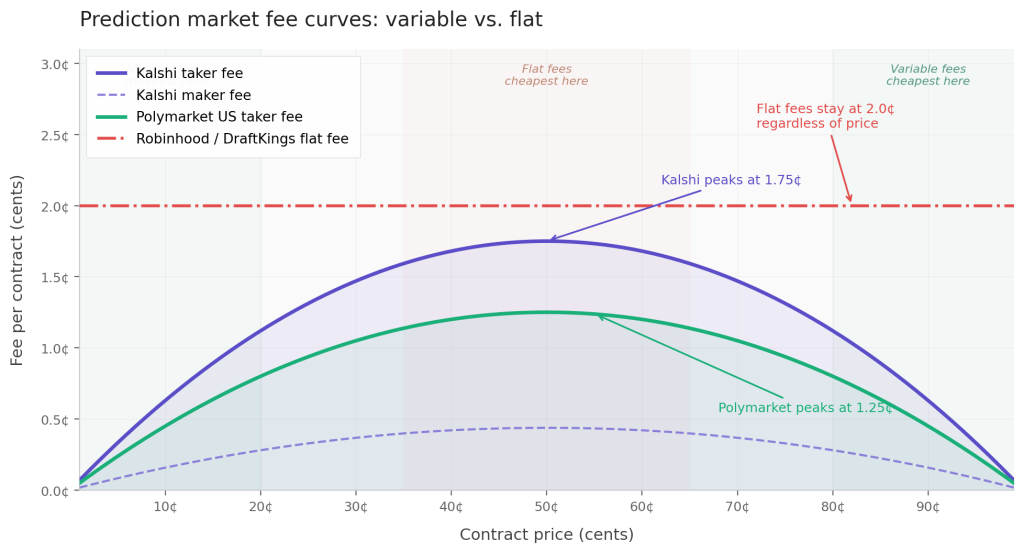
⚠️ Watch Out: The fee-per-contract number can be misleading in isolation. What matters is fee as a percentage of your position. A $0.02 flat fee on a 5-cent contract is 40% of your cost basis. That same $0.02 on a 95-cent contract is roughly 2%. Always think about fees relative to the contract price, not in absolute terms.
💵 What does a $100 trade actually cost?
Theory is fine. But let’s put real dollars on it. The table below shows the total fee you’d pay on a $100 position at three different contract prices across the major platforms. This includes the buy-side fee only (since you might hold to settlement). If you sell early, roughly double these numbers.
| Platform | $100 at 50¢ (200 contracts) | $100 at 75¢ (133 contracts) | $100 at 90¢ (111 contracts) |
|---|---|---|---|
| Kalshi (taker) | $3.50 | $1.75 | $0.70 |
| Kalshi (maker) | $0.88 | $0.44 | $0.18 |
| Polymarket U.S. (taker) | $2.50 | $1.25 | $0.50 |
| Robinhood | $4.00 | $2.66 | $2.22 |
| DraftKings | $4.00 | $2.66 | $2.22 |
| ForecastEx (IBKR) | $2.00 | $1.33 | $1.11 |
| Crypto.com / Fanatics / Underdog | ~$4.00 | ~$2.66 | ~$2.22 |
The pattern is clear. Polymarket is cheapest for takers across the board. Kalshi is close behind and becomes competitive when you factor in maker discounts and interest. Flat-fee platforms (Robinhood, DraftKings, Crypto.com family) are most expensive at the 50-cent midpoint and maintain a consistent drag at all price points. ForecastEx is surprisingly cheap in absolute terms, though its market catalog is much narrower.
I should note one thing I couldn’t fully confirm: how Crypto.com’s technology fee stacks on $10 and $100 contracts when the position settles as a winner. The exchange fee is consistent at about $0.02 per contract for $1 tiers, but winning $10 and $100 contracts appear to incur an additional technology fee ($0.10 and $1.99 respectively).
Platform-by-platform breakdown
⭐ Kalshi
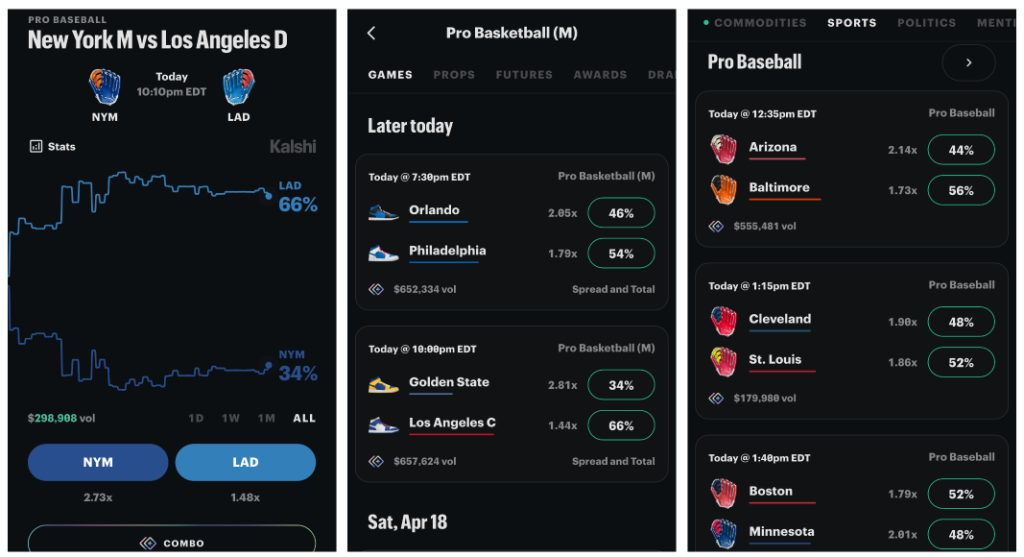
Kalshi’s fee formula has been stable since launch: taker fee = 0.07 x P x (1-P) per contract, where P is the contract price. Maker fees are exactly 25% of the taker fee. The maximum taker fee is $0.0175 per contract at 50 cents. There is no settlement fee, no membership fee, and no inactivity fee.
What sets Kalshi apart from other platforms is the combination of low fees at extreme prices and interest earned on your balance. Your deposited funds (including money in open positions) earn approximately 3.25% APY. That’s meaningful. If you keep $1,000 on the platform and trade actively, the interest income can offset a substantial portion of your trading fees over a year. And if you have some long-term open positions (thus locking up funds), that’s a help too.
Deposit fees: ACH and wire transfers are free. Debit card deposits carry a 2% processing fee. Crypto deposits are free on Kalshi’s side, though blockchain network fees may apply. Withdrawals follow the same pattern: free for ACH, 2% for debit card.
The reduced fee schedule for S&P 500 and NASDAQ-100 markets (half the standard coefficient at 0.035) is a nice touch for financial traders, though most sports-focused users won’t encounter it.
New users can currently trade $25 and get up to $500 with Kalshi’s signup offer. For more detail on the platform itself, see our full Kalshi review.
Disclaimer: Certain limitations apply. The offer is available to new users only, subject to the terms and conditions at kalshi.com/tc/500. 18+ only. Restrictions and eligibility requirements apply. Event contract trading involves significant risk and is not appropriate for everyone. Please carefully consider if it is appropriate for you in light of your personal financial circumstances. Kalshi products are not available in all jurisdictions. See kalshi.com/regulatory for more information.
Polymarket
Polymarket’s fee story has changed dramatically in 2026. Through most of 2025, the global platform charged zero fees. That era appears to be over. As of early 2026, Polymarket charges category-tiered taker fees on nearly every market.
The U.S. regulated exchange (which operates through Polymarket’s acquisition of CFTC-licensed QCEX) uses a taker coefficient of 0.05, producing a max fee of $0.0125 per contract at 50 cents. The maker rebate coefficient is 0.0125 (25% of taker fees), meaning makers actually get paid to provide liquidity. There’s also a temporary 50% taker rebate applied weekly on all trades, running through at least April 30, 2026.
The global platform (for non-U.S. users) uses a different, category-based structure: crypto markets peak at 1.80%, sports at 0.75%, politics at 1.00%. Only geopolitics markets remain free. U.S. readers trade on the regulated DCM, so the flat 0.05 coefficient applies regardless of category.
No deposit or withdrawal fees on the platform itself. But because Polymarket runs on blockchain infrastructure (Polygon network), users who fund via fiat on-ramps like MoonPay or Coinbase may pay 1-4.5% in third-party processing fees. Direct USDC transfers from an existing wallet avoid this entirely.
For the full platform breakdown, see our Polymarket review.
Novig Prediction
Novig Prediction uses a fee structure that depends on both the trade type and whether you are making or taking liquidity. Pre-game straight trades placed through the app or website are currently fee-free for both makers and takers. For live straight trades, maker fills remain free, while takers pay a variable fee based on the contract price.
The live taker formula is 0.03 × P × (1-P) per contract, where P is the contract price. That means the fee peaks at 50 cents, at $0.0075 per contract, and gets smaller as the contract price moves toward either $0 or $1. Parlays use the same probability-weighted structure but with a higher 0.10 coefficient, producing a maximum fee of $0.025 per contract at 50 cents.
Maker orders are the cheapest way to trade on Novig. A filled Make Order carries no trading fee, including on live markets, while Take Orders are subject to the applicable live-trading fee. This makes order type particularly important for active traders who are willing to wait for another participant to accept their price.
Deposit costs also vary by method. Bank transfers through Stripe or Aeropay and stablecoin/crypto deposits through Coinflow are currently fee-free. Credit card, debit card and Apple Pay deposits carry a 3% processing fee, which is shown before the transaction is confirmed.
For sports traders, the main advantage is that pre-game straight trades and maker fills can be made without a trading fee. Live taker orders and parlays are more expensive, so the all-in cost depends heavily on when and how you place the trade. For more detail on the platform itself, see our full Novig review
Robinhood
Robinhood keeps it simple: $0.02 per contract, split between a $0.01 exchange fee (paid to Kalshi, which provides the underlying exchange infrastructure) and a $0.01 Robinhood commission. You pay this when you buy and again if you sell before settlement. Hold to settlement and you only pay once.
The simplicity is the selling point. No formulas, no tiers, no guessing. The tradeoff: you cannot place limit orders to capture maker discounts like you can on Kalshi directly. Every Robinhood trade is effectively a taker order. And you don’t earn interest on your deposited funds within the prediction markets product, though Robinhood’s broader cash sweep program may apply to your overall account.
Deposits and standard withdrawals are free. Instant withdrawal processing carries a 1.75% fee. Sports contracts are restricted in Maryland, New Jersey, and Nevada.
If you’re already a Robinhood user, the convenience of trading prediction markets alongside stocks and crypto in one app is real. But if you’re a dedicated prediction market trader, you’re paying more per trade and getting fewer tools than you would on Kalshi directly. The $0.02 flat fee is more expensive than Kalshi’s taker fee at any contract price above 78 cents or below 22 cents.
ForecastEx (Interactive Brokers)
ForecastEx is the quietest bargain in prediction markets. The only fee is $0.01 per contract, embedded directly in the pricing. When two sides of a trade are matched, Yes + No = $1.01. That penny is the total fee, split between both parties. There are no additional exchange fees, clearing fees, brokerage fees, or commissions at Interactive Brokers.
On top of that, ForecastEx positions earn a 3.14% APY incentive coupon that accrues daily and pays monthly. You’re getting paid to hold positions. Nice.
The catch is market selection. ForecastEx’s catalog focuses heavily on economics (CPI, Fed rate decisions, unemployment), climate, and some politics. Sports markets have been added but are currently limited to NFL and NBA game winners. If you trade economic events, ForecastEx is hard to beat on cost. If you want deep sports coverage, you’ll need another platform.
Crypto.com
Crypto.com uses a two-part fee structure through its Derivatives North America (CDNA) exchange. For $1 contracts (the standard tier for most sports and events), the exchange fee is approximately $0.02 per contract. The technology fee is waived for $1 contracts. For $10 contracts, the exchange fee is $0.10, plus a $0.10 technology fee on winning settlements. For $100 contracts, exchange fees scale up and a $1.99 technology fee applies to winners.
The technology fee on winning positions is unusual in this space and adds a hidden cost that doesn’t show up in simple fee-per-contract comparisons. If you’re trading on $10 or $100 contract tiers, the all-in cost on a winning trade is materially higher than on competing platforms.
No deposit or withdrawal fees. Available in all states except New York. Sports contracts restricted in several additional states (NV, OH, MI, MD, MA, IL).
Fanatics Markets
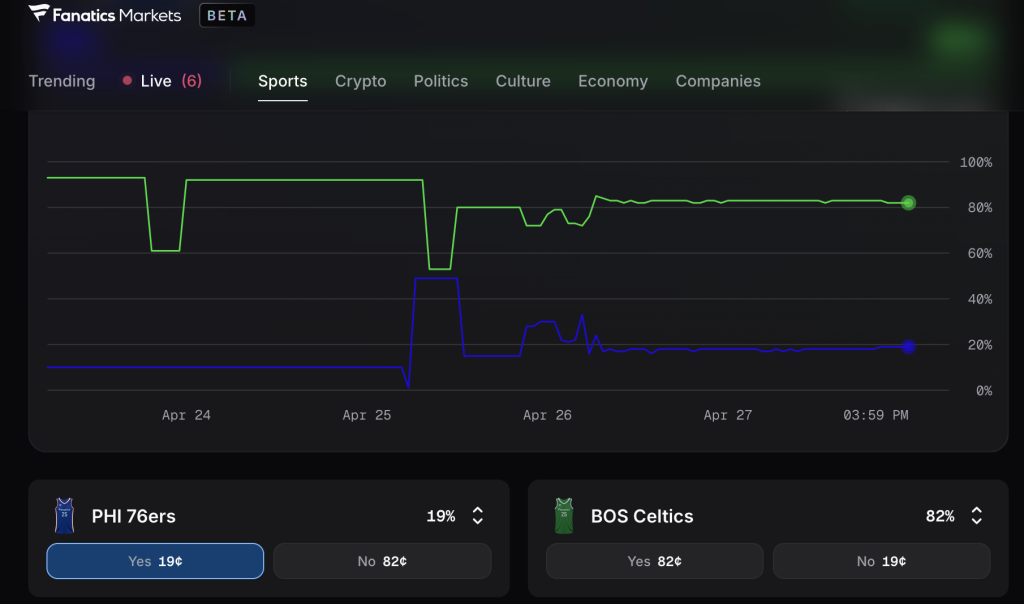
Fanatics Markets operates as an introducing broker to Crypto.com’s CDNA exchange (for now). The fee structure mirrors Crypto.com’s: approximately $0.02 per contract on $1 tiers, with fees ranging from $0.0034 to $0.02 depending on contract price, rounded up to the nearest cent. In practice, most trades will cost $0.02.
Deposit fees: 2% on debit card and Apple Pay. ACH transfers are free. Wire deposits are free but require a $1,000 minimum. No withdrawal fees, though wire withdrawals require a $10,000 minimum.
Fanatics is currently running a rebate program (April 15 through May 14, 2026) that returns a portion of transaction fees as nonwithdrawable trading credit. Profits earned from trading with rebate credit are withdrawable. It’s a decent sweetener for active traders during the promotional window.
Available in 24 states: AK, AL, CA, DE, FL, GA, HI, ID, ME, MN, MS, NE, NH, NM, ND, OK, OR, RI, SC, SD, TX, UT, WA, WI.
Underdog Predict
Underdog Predict also routes through Crypto.com’s CDNA exchange (for now). The fee is a flat $0.02 per contract. Some sources report an additional $0.10 exchange fee per contract, but this wasn’t consistent across my research and may apply only to specific contract tiers or trade sizes.
No deposit or withdrawal fees. Deposits are limited to debit cards (including Apple Pay) and Trustly bank transfers. Withdrawals can be made to debit card, PayPal, Venmo, or Paysafe. An inactivity fee of $4 per month kicks in after 18 months of no activity.
Available in 23 states plus DC. The state list is narrower than Kalshi or Polymarket.
PrizePicks Predict
PrizePicks routes contracts through its partnership with Kalshi. Service fees range from $0.005 to $0.02 per contract, charged on both buy and sell orders. If you hold a contract to settlement, no fee applies at resolution. This makes PrizePicks one of the cheaper options for buy-and-hold traders who don’t plan to exit early.
The platform displays contracts using payout multipliers rather than dollar prices, which can make fee comparisons harder. A “2.5x” payout on PrizePicks corresponds to roughly a 40-cent contract on Kalshi, and the fee math follows Kalshi’s underlying structure.
Culture Picks are available in 48 states. Team Picks (sports) are available in a smaller subset. No deposit or withdrawal fees.
DraftKings Predictions
DraftKings charges $0.01 per contract per side (buy and sell), plus a $0.01 per side exchange fee from CME Group, which provides the underlying exchange infrastructure. That’s $0.02 per side or $0.04 round trip if you buy and sell before settlement.
The market catalog at launch is limited: sports (NFL, NBA, NHL, college), financial markets (S&P 500, Bitcoin, Ethereum), and some economics. DraftKings acquired Railbird Exchange in late 2025 for up to $250 million and plans to integrate Railbird’s CFTC-licensed exchange to expand market depth and improve economics. Once Railbird is fully integrated, fees and market variety may change. For now, DraftKings Predictions is a clean, beginner-friendly interface.
Available in 38 states. Sports contracts are restricted in states where DraftKings already holds a sportsbook license.
🔍 Hidden costs beyond trading fees
The fee schedule only tells part of the story. Several costs don’t appear on any comparison table but affect your actual returns.
Deposit fees. A 2% debit card deposit fee (Kalshi, Fanatics) turns your $100 deposit into $98 before you’ve placed a single trade. Over multiple deposits, this adds up. ACH transfers are free on every platform and should be your default funding method.
Bid-ask spread. The gap between the best buy and sell price on any contract is an implicit cost. On liquid markets with lots of activity (major sports, high-profile politics), spreads are tight, often 1-2 cents. On thin markets (niche entertainment, obscure weather), spreads can be 5-10 cents or more. A wide spread costs you more than any fee ever will.
Opportunity cost of idle cash. Money sitting in a Polymarket or DraftKings account earns nothing. The same money on Kalshi earns ~3.25% APY. On ForecastEx, it earns 3.14% APY. If you keep $2,000 parked across platforms, the difference between earning interest and not earning interest over a year is $60-80. That’s real money that never shows up on a fee schedule.
Third-party on-ramp fees. Polymarket users who buy USDC through MoonPay, Coinbase, or similar fiat gateways may pay 1-4.5% in processing fees before their money even reaches the platform. Direct wallet transfers avoid this, but not every user has a crypto wallet ready to go.
🔄 Maker vs. taker: why order type matters
If you trade on Kalshi or Polymarket, the distinction between maker and taker orders is the single biggest lever you have for reducing fees.
A taker order (market order) fills immediately at the best available price. You pay the full taker fee. A maker order (limit order) rests on the order book until someone else matches it. You pay a reduced fee, or on Polymarket, no fee at all plus a rebate.
On Kalshi, the maker fee is 25% of the taker fee. At a 50-cent contract, that’s $0.0044 per contract vs. $0.0175. Over 100 round-trip trades of 100 contracts each, the difference is roughly $262 per month. That is not trivial.
On Polymarket’s U.S. exchange, makers pay zero and receive a rebate (0.0125 coefficient). Placing a limit order that gets filled doesn’t cost you anything; it pays you. This creates a strong incentive to trade patiently rather than crossing the spread.
Novig also rewards patient order placement. Maker fills currently carry no fee across trade types, while taker fees apply to live straight trades and parlays. Pre-game straight trades are fee-free even for takers on the app and website.
Flat-fee platforms like Robinhood and DraftKings don’t distinguish between maker and taker orders. You pay the same $0.02 whether you hit the market price or place a limit. This simplifies things but removes a tool that experienced traders use to manage costs.
📋 Tips for minimizing fees
- Use limit orders on Kalshi and Polymarket. The maker discount on Kalshi is 75%. On Polymarket, makers pay nothing and earn rebates. This alone can cut your trading costs by more than half.
- Fund via ACH, not debit card. A 2% deposit fee on Kalshi and Fanatics turns every $500 deposit into $490. ACH takes a day or two longer but costs nothing.
- Trade high-conviction contracts when possible. On variable-fee platforms, contracts near 0 or $1 carry almost no fee. If your edge is on near-certainties, the fee structure works in your favor.
- Hold to settlement when practical. Some platforms (PrizePicks, Robinhood) charge a fee on both the buy and the sell. If you hold to settlement, you only pay once. Early exits double your fee load.
- Park cash where it earns interest. Kalshi pays ~4% APY. ForecastEx pays 3.14%. If you keep money on the platform between trades, choose one that pays you for the privilege.
- Batch deposits instead of funding in small increments. This applies particularly to debit card users facing percentage-based fees and to Polymarket users dealing with blockchain on-ramp costs.
- Track your all-in costs, not just the listed fee. Spread, slippage, deposit fees, and opportunity cost on idle funds all factor into your real cost per trade. A platform with a lower listed fee but wider spreads and no interest on deposits can end up more expensive.
Frequently asked questions
Which prediction market has the lowest fees?
For CFTC-regulated exchanges, Polymarket’s U.S. platform has the lowest taker fees (5% coefficient vs. Kalshi’s 7%). Makers pay nothing on Polymarket and receive a rebate. ForecastEx charges only $0.01 per contract but has a limited market catalog. Novig Prediction is also inexpensive for certain trade types: pre-game straight trades and maker fills are currently fee-free, while live taker trades and parlays use variable probability-weighted fees.
Do prediction markets charge fees on losing trades?
Most platforms charge fees when you buy or sell a contract, regardless of the outcome. The exception is ProphetX, which only charges a 2% commission on net winnings. Crypto.com’s technology fee on $10/$100 contracts also only applies to winning positions. On Kalshi, Polymarket, and Robinhood, fees apply to every trade.
Are prediction market fees lower than sportsbook vig?
Generally yes. Traditional sportsbooks embed 4.5-10% vig into their odds. Kalshi’s maximum taker fee at the 50-cent midpoint is 3.5% (round trip), and it drops sharply at extreme prices. Polymarket is even cheaper. On high-conviction contracts (90 cents or above), prediction market fees can be under 1%, which no sportsbook can match.
Does Robinhood charge fees on prediction markets?
Yes. Robinhood charges $0.02 per contract ($0.01 exchange fee + $0.01 Robinhood commission). This applies when you buy and again if you sell before settlement. Standard deposits and withdrawals are free, but instant withdrawals carry a 1.75% fee.
🛡️ Responsible trading
Prediction markets involve real financial risk. Contracts can and do settle at zero, meaning you lose your entire position. Fees reduce your returns on winning trades and increase your losses on losing ones. Never trade with money you cannot afford to lose.
🛡️ Responsible Gambling Resources: If you or someone you know is struggling with gambling, help is available. Contact the National Council on Problem Gambling or call 1-800-GAMBLER. You can also text “GAMBLER” to 1-800-426-2537. Set deposit and loss limits before you start trading.