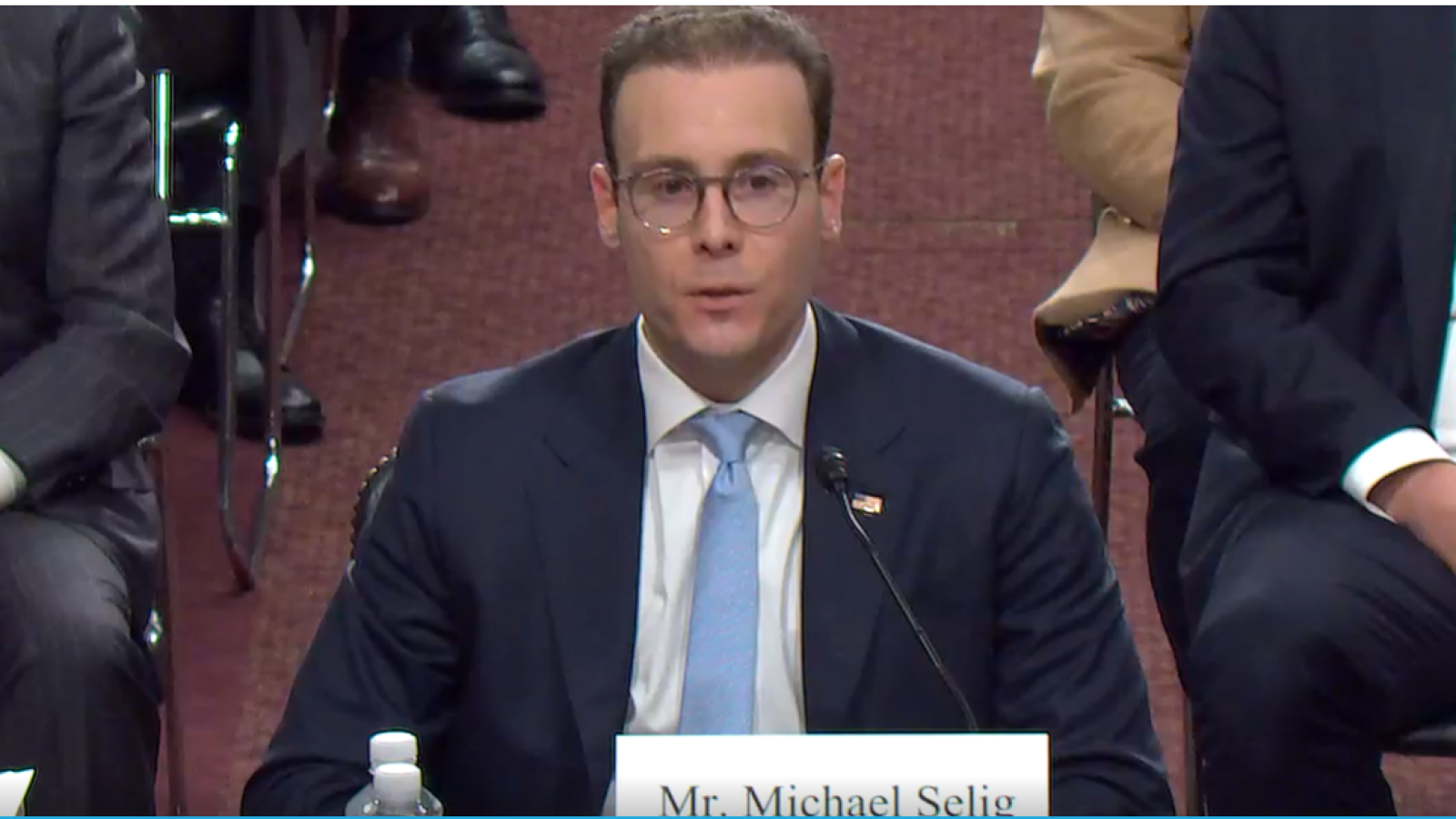
A group of 12 senators signed and sent a letter asking Commodity Futures Trading Commission (CFTC) Chair Michael Selig to explain the regulator’s approach to insider trading on prediction markets.
The letter, dated Sunday, followed reports of activity that appeared consistent with insider trading on prediction market Polymarket, on contracts related to former Venezuelan President Nicolas Maduro.
2026-January-Cortez-Masto-et-al-Letter-to-CFTC-Chair-Selig-re-Suspicious-Polymarket-TradeOn Polymarket’s global exchange, which is not registered with the CFTC, a recently created account made $436,000 in profit from betting that Nicolas Maduro would be removed as president of Venezuela, shortly before he was captured by U.S. forces.
Polymarket’s global site has rules prohibiting market manipulation, but does not have any rules directly banning insider trading.
Currently, Polymarket US is only open to members who have received invitations from a waitlist, and it only offers trades on sports.
“While Polymarket US, a registered CFTC Designated Contract Market (DCM), has not fully launched in the United States, suspicious trading on Polymarket’s non-registered exchange raises concerns about the lack of safeguards against insider trading,” the letter said. “This improbable increase in trades against Maduro’s continued authority in Venezuela mere hours before Maduro’s capture exemplifies the dangers of unregulated gaming and raises national security concerns.”
The letter went on to argue that the existence of the contracts themselves on matters such as Maduro’s removal also raise national security concerns.
“If prediction market contracts that implicate military operations or other national security considerations are manipulated by insider information, or even listed, it is possible for foreign adversaries to use this to their advantage,” the letter said.
Letter asks nine questions
The senators asked nine questions of Selig:
- Have CFTC-regulated exchanges listed similar contracts to Polymarket relating to Maduro’s capture?
- Are there other instances of suspicious trading of Maduro-related event contracts facilitated through U.S. registered DCMs?
- When Polymarket US fully launches, how will the CFTC ensure its event contracts comply with all relevant rules and regulations, particularly 17 CFR § 40.11 and 7 U.S. Code § 9?
- According to Polymarket US Rulebook, “no person shall take action or direct another to take action based on non-public Order information, however acquired.” How will the CFTC ensure Polymarket US complies with this provision?
- In response to the previous letter, when asked how the CFTC ensures that athletes, referees, team employees, and others do not manipulate outcomes; how the CFTC enforces the anti-manipulation requirements of sports event contract marketplaces; and how often the CFTC examines against those requirements, the CFTC responded:
“The CEA and CFTC regulations require that all DCMs comply with 23 Core Principles on an ongoing basis. Division of Market Oversight (DMO) is responsible for DCM oversight, and evaluates a DCM’s compliance with certain integrity-related core principle requirements related to its self-regulatory program. […]”
How will DMO ensure Polymarket US complies with the 23 Core Principles on an ongoing basis? - How does the CFTC monitor suspicious trading activity in event contracts? If so, what is the process for identifying and remedying insider trading?
- Does CFTC regulation 180.1 (17 CFR 180.1) apply to instances of fraud and manipulation in event contracts?
- Has the CFTC, including DMO or any other CFTC oversight or enforcement arm, ever investigated an event contract for insider trading?
- Has the CFTC coordinated with state commodities regulators or other appropriate state agencies with oversight of gaming activities?
Regarding the first question, while no exchange appeared to have offered a contract that directly references a “capture,” Kalshi users could bet that Maduro would be out of power before the end of the year.
Trade data shows that Maduro’s odds of being out of power appeared to spike before his capture was announced (the announcement came at 4:21 a.m. ET), though this could have been driven by reports of apparent strikes in Venezuela or by observers noting the change in odds on Polymarket.

In terms of the questions on insider trading, CFTC rules do not include a blanket ban on the practice, instead only banning use of non-public information if the information is “misappropriated” or there is market manipulation involved. As a result, specific insider trading oversight may be limited. However, all CFTC-registered prediction markets have generally included bans on all insider trading within their own house rules. The CFTC’s “Core Principles” include a requirement that exchanges enforce their own rules.
Senators asked for responses by Feb 9.
It was signed by 12 senators — Catherine Cortez-Masto, Chris Van Hollen, Jacky Rosen, Elissa Slotkin, Andy Kim, Peter Welch, Adam Schiff, Jeffrey Merkley, Cory Booker, John Hickenlooper, Richard Blumenthal, and Alex Padilla.
AGA and IGA send letter to Congress
The letter is one of the latest signs of heightened congressional attention toward prediction markets. Monday, the American Gaming Association and Indian Gaming Association sent a letter to Congress, calling on representatives to add a ban on sports event contracts to an upcoming bill concerning cryptocurrency market structure.
“Since these contracts, that are indistinguishable from legal sports betting, were launched last January, they have grown exponentially in trading volume and have expanded beyond the outcome of single games to include complex parlays and even potential wagers on the collegiate transfer portal,” the letter reads. “This growth has occurred by exploiting regulatory inaction by the Commodity Futures Trading Commission (CFTC), which undermines state law and tribal sovereignty and flies in the face of existing federal laws and regulation intended to protect consumers and the integrity of our nation’s financial markets.
“We firmly believe that congressional consideration of cryptocurrency market structure legislation provides an important, bipartisan opportunity to prevent sports betting and casino gambling under the guise of ‘event contracts.’”
The crypto market structure bill is currently being considered by the House Committee on Agriculture.
The letter also followed one sent by House Rep. Dina Titus on Friday to Shayne Coplan, CEO of Polymarket. That letter questioned Polymarket’s processes related to insider trading, though it appeared to conflate Polymarket’s global site and its U.S. site.