
Live Coverage
We're Live!
Casino Association of New Jersey Asks Supreme Court To Hear Kalshi-NJ Lawsuit

The Casino Association of New Jersey (CANJ) is the latest organization to urge the Supreme Court to take up New Jersey’s appeal in the state’s lawsuit against Kalshi, filing an amicus brief Friday.
20261009130833025_26-299-acTheCasinoAssociationOfNewJerseyIncThe CANJ said it submitted its brief “to address the disruptive effects that prediction markets’ unlicensed sports wagers have had, and will continue to have, on the longstanding regulatory framework in New Jersey and other states.” The brief asks the court to take up the case, arguing that the Third Circuit was incorrect when it ruled in Kalshi’s favor and upheld the prediction market’s injunction against the state of New Jersey.
The brief said that the Third Circuit’s ruling that sports event contracts are swaps under the Commodity Exchange Act (CEA) and are under the exclusive jurisdiction of the Commodity Futures Trading Commission, preempting state law, “defies the CEA’s most natural reading.”
“Nothing in the text, structure, or history of the CEA suggests that Congress meant to make the CFTC a national gaming czar, with the power to legalize sports betting around the country,” the brief says.
“This Court should grant certiorari, reverse the Third Circuit’s opinion, and return ‘the controversial issue of gambling’ back to the States.”
CFTC Says Sportsbook Bets Aren’t Swaps, Sports Event Contracts Are
The Commodity Futures Trading Commission (CFTC) has published new rules stating that event contracts are swaps, but sportsbook wagers and casino games are not.
The definition of a swap, whether sports event contracts fit, and what the consequences of including them would be, have been important questions in the widespread litigation nationally over sports event contracts.
NRPM_EventContractsSwapInclusions100926The CFTC opened a notice for proposed rulemaking on a rule that seeks to “clarify that event contracts, including those based on sports-, politics-, cultural-, and weather-related events, are swaps within the CFTC’s jurisdiction.”
In addition, it adopted an interim final rule, which is also open to public comment.
IFREventContractsSwapExclusion100926The interim final rule excludes from the swap definition “any agreement, contract, or transaction in which a licensed sportsbook or sports wagering operator accepts a wager on the outcome of one or more sporting events,” and “any agreement, contract, or transaction in which a licensed casino operator accepts a wager in connection with a casino table game, slot machine, or other electronic gaming device.” Although sports event contracts could be described as wagers on sports, the notice for proposed rulemaking suggests that these are not intended to be excluded from the swap definition.
The CFTC said that a key distinction between a swap and non-swap is that swaps must be “tradable.” The regulator acknowledged that this definition does not appear directly in the Commodity Exchange Act (CEA) but says it can be understood from the context of the act. The CFTC determined that sportsbook bets are not tradable, and so don’t fit the definition.
Ordinarily, regulatory agencies’ definitions of ambiguous words in statutes are not assumed to be the correct definition. However, the CEA specifically includes a clause giving the CFTC authority to further define terms introduced by the Dodd-Frank Act, including “swap.”
Escalators And Ladders, Now Live On Kalshi

Are these sports bets or swaps?
Kalshi self-certified these types of scalar contracts on Sept. 21, and they look to be rolling out a few weeks later.
That certifications points to “further information about the Contract, including an analysis of its risk mitigation and price basing utility,” although the relevant appendix is confidential.
145 Indian Groups, Former CFTC Chair, Former Sen. Dodd File In Support Of NJ

As of 2 p.m. ET Thursday, nine amicus briefs in support of New Jersey’s petition to the Supreme Court to consider its case against Kalshi were on the docket, including four filed Thursday. After the NFL’s brief was docketed in the morning, amicus briefs from 145 tribes and tribal groups, former Commodity Futures Trading Commission Chair Gary Gensler, and former U.S. Sen. Chris Dodd were added to the list.
Since New Jersey filed its writ of certiorari Sept. 2, gambling stakeholders including Indian Country, lawmakers and politicians, public health organizations, professional sports leagues, and state attorneys general have weighed in urging the court to take the case. The arguments across the briefs are similar — Kalshi is infringing on state and tribal sovereignty, the Commodity Exchange Act was never intended to allow legal gambling, sports event contracts should not be considered swaps, and federal law should not preempt state law. Kalshi’s reply brief is due Nov. 9.
The list of tribes that signed off on the tribal amici brief is a who’s who of the most well-known and powerful tribes in the U.S. from the Mashantucket Pequots in Connecticut to the Seminole Tribe in Florida to the Forest County Potawami and Oneida tribes in Wisconsin to the Yuhaaviatam of San Manuel Nation in California. The list of tribal organizations is headlined by the Indian Gaming Association, the National Congress of American Indians, and key state associations. Their lawyers wrote that for centuries “prospectors have encroached on Indian lands, stealing gold, minerals, and other vital resources,” and that Kalshi is now doing the same.
Gensler, who was the CFTC chair from May 2009-January 2014, wrote that “as someone who was there … no one working on Dodd-Frank was attempting to put a curve ball by the Senate Majority
Leader to legalize a national sports-betting regime or preempt the Nevada Gaming Commission, a
Commission Majority Leader [Harry] Reid had chaired (1977–1981). He would not have allowed it. Nor did Congress do so.”
Dodd, one of the architects of the 2010 amendment to the CEA, wrote that “Congress sought to regulate complex financial instruments, curb dangerous speculation, protect consumers, and preserve legitimate markets for businesses to hedge commercial risk” and that “Congress did not
set out to authorize nationwide sports betting through derivatives markets or displace decades of state and tribal primacy over gaming regulation.”
GAO Opens Probe Into CFTC Staffing, Enforcement Drop
The Government Accountability Office is investigating the Commodity Futures Trading Commission (CFTC) over its workforce cuts and questions about its fraud enforcement, per a letter obtained by NPR. The probe follows a July request from Sen. Elizabeth Warren and is set to formally begin in December.
How’d we get here? The CFTC ended 2025 with 21% fewer staff than its 10-year average, and enforcement actions fell nearly 80%, according to NPR’s findings and the agency’s annual reports. Meanwhile, the workload keeps piling up, with 18 prediction market applications pending, trading volume on registered DCMs exploding, and new swap rules awaiting White House review. And the CFTC remains under the direction of a single commissioner, Michael S. Selig, with other seats vacant. Traditionally, four or five commissioners have led the agency.
Warren, a Massachusetts Democrat, has also demanded a public Senate hearing. Expect more scrutiny if Democrats flip one or both Republican-controlled chambers in the November midterm elections.
Past Is Prologue? Market Researcher Says Predictions Will Ultimately Implode
If history informs the future, prediction markets will ultimately fail, no matter if the U.S. Supreme Court takes a case about the issue or how it rules. So said James Klas of KlasRobinson Wednesday on the weekly New Normal webinar hosted by Indian Gaming Association (IGA) Conference Chair Victor Rocha and IGA Executive Director Jason Giles.
Sometime in the next five to 10 years, “the whole prediction market scheme is likely to collapse under its own weight,” Klas said. “It’s happened in derivatives markets before, it has happened in hedge funds before, and it has happened in gaming.
“It will happen in one of three ways or likely a combination of those ways.”
Klas went on to explain that “massive losses” by individuals — losses big enough to cost them their homes — will happen, causing them to walk away. Other possibilities are that there will be “massive cheating scandals” that “impact across much larger scales of sporting entities,” or a maker group will “overextend” in error so far that it will “collapse.” He went on to compare such an implosion to the savings-and-loan crisis, the dot-com crisis, and other financial meltdowns in history.
For the gaming industry, which is already intertwined in the public view with prediction markets, such a crash could be devastating, he said.
Klas and his partner Matt Robinson were sharing topline findings from an 84-page study commissioned by IGA that looked at four potential legal scenarios and what the economic impact of prediction markets on legal gambling would be. The research has not yet been released.
Klas and Robinson found that if the final decision allows prediction markets to continue to offer sports event contracts as financial tools in all 50 states, they would siphon $7.3 billion and 38,000 jobs from the existing legal gambling market. The study reached the conclusion that the commercial sector would lose $5.8 billion in annual revenue and Indian Country would lose $1.5 billion.
Coinbase Agrees To Stop Sports Contracts In Michigan
The Michigan Gaming Control Board (MGCB) announced on Wednesday that Coinbase has agreed to stop offering sports event contracts within the state’s borders. Coinbase will shutter the markets and close out any open positions by midnight ET Oct. 10. Kalshi and Robinhood have already stopped offering sports contracts in the state following a state court order and an opinion by the Sixth Circuit.
Per the MGCB press release, the regulator will not take enforcement action against Coinbase as long as it remains in compliance. “Like the Robinhood agreement, this stipulation does not resolve the underlying legal dispute over whether Michigan may regulate CFTC-registered event contracts as gambling,” the MGCB wrote. “It preserves all parties’ rights, obligations, and defenses pending a final ruling from the Sixth Circuit or the U.S. Supreme Court.”
Michigan is one of three states that has gotten court orders allowing it to enforce its gambling laws against prediction market sports event contracts. Nevada and Washington have similar court orders against Kalshi and/or other prediction markets. Late last week, an Illinois federal district court became the first in 16 cases to find in favor of the prediction markets, issuing an opinion that allows Coinbase and Kalshi to continue to operate.
FanDuel Approved For FCM Without CME Involvement
FanDuel now owns a futures commission merchant (FCM) license independent of CME, as its application was approved by the National Futures Association.
The approval of New Venture III LLC, which is owned by FanDuel, was first noted by PredictionMarketPulse. It came six months after the company applied. The National Futures Association says approvals take “six weeks or longer.”
An FCM can provide its users access to contracts offered by a designated contract market, such as Kalshi, Polymarket US, or Crypto.com. FanDuel already had approval as an FCM, but via a joint venture with CME. In contrast, New Venture is fully owned by FanDuel, potentially offering the sports betting business more control over its prediction market product.
FanDuel Predict currently directs customers to Crypto.com for sports contracts and CME for non-sports contracts.
CBS Latest Network To Incorporate Kalshi Trading Data In Elections Coverage
Kalshi has added another network to its roster. The prediction market operator confirmed this week that it will provide data for CBS News’ midterm election coverage. That puts CBS alongside CNBC, CNN, The Associated Press, and Fox News Media, which already use Kalshi’s numbers in their reporting.
“Our midterm election coverage will include not only CBS News polling data, but also integrated data from Kalshi, our prediction market sponsor,” says the CBS Mornings handle on X. “We’ll offer a glimpse into how prediction market traders are pricing race outcomes — but it will be the voters that decide it all.”
Here’s a look at the integration in motion:
DOJ Weighs In On Swap Definition In Maduro Insider Trading Case
The U.S. Department of Justice stepped in to give its view on what prediction market contracts count as a swap for the first time Wednesday, in the case against a soldier charged with insider trading on contracts on Nicolás Maduro’s ouster as president of Venezuela.
Gannon Van Dyke was charged with trading using classified information regarding the timing of a U.S. military operation to capture Maduro in April, and the U.S. District Court of the Southern District of New York is currently considering the case.
Van-Dyke-letterAs part of his defense, Van Dyke’s attorneys have argued that the contracts involved are not swaps, and so U.S. authorities do not have jurisdiction over them.
The Commodities Exchange Act says swaps are “dependent on the occurrence, nonoccurrence, or the extent of the occurrence of an event or contingency associated with a potential financial, economic, or commercial consequence.”
Unlike with sports contracts, courts have not ruled on whether contracts about the removal of a country’s leader are or are not swaps. They would appear to fit the definition much more cleanly than sports contracts would, which the Department of Justice noted in its response Wednesday. It added that previous court rulings about the definition would not be binding over the district court, as they took place in circuits that don’t cover New York. The Second Circuit, which does cover New York, is currently considering a case about sports contracts.
“Even applying the Sixth and Ninth Circuits’ narrow reading of the definition of swap — and there are compelling reasons not to — the event contracts in this case, which involve major military action against Venezuela and removal of a foreign head of state, qualify as swaps because they are inherently economic and investors and institutions could have used them to hedge exposure to potential financial consequences,” the DOJ wrote.
Polymarket Introduces Responsible Trading Tools

Polymarket has added a suite of responsible trading tools to its platform. The tools include voluntary self-exclusion, deposit limits, and access to mental health resources for traders who are acting in a compulsive manner.
Additionally, Polymarket has launched a “Trust & Safety Center,” where users can learn how the company protects people on the platform.
“People should be able to set their own limits, step away on their own terms, and know what the rules are,” Malea Otranto, global head of trust and safety for Polymarket, said in a statement. “That is what launched today, and it is the floor, not the ceiling. We’re excited to continue to build out from here.”
Traders can exclude themselves for 30 days, a year, or a lifetime. Additionally, users can set daily, weekly, and monthly deposit limits. Much like how sportsbooks operate, action to lower limits takes effect immediately, while raising or getting rid of a limit requires a mandatory cooling-off period.
Additionally, Polymarket has teamed with Birches Health to provide mental health resources for traders who need them. The resources will become part of the platform, appearing within the product and in customer support chats.
CFTC Submits New Rules On Swap Definitions To White House
The CFTC on Tuesday submitted three new rules to the White House, including a rule stating that event contracts count as swaps and another rule saying that casino-style games do not.
The rules, which are pending review, have not been published yet, meaning their full contents are unknown. One is named “Further Definition of ‘Swap’ to Include Event Contracts” and another is “Further Definition of ‘Swap’ to Exclude Casino-Style Gambling Products.” The third is called “Regulation Crypto Asset Transactions and Regulation Crypto Asset Markets.”
The rule titles do not explicitly mention event contracts on sports, but the CFTC has vocally backed those products in the past.
The rules would go into effect immediately once they are published, without the need for any consultation period.
Courts considering whether state gambling laws apply to sports event contracts, a question that hinges on whether these contracts count as swaps, would not be required to use the CFTC’s interpretation of the term.
Kalshi Tops $3 Billion In Volume Twice On Another Record Weekend
Kalshi broke its all-time volume record again Saturday, then set an even higher mark Sunday.
Volume on Saturday hit $3.031 billion, breaking a record set the previous Saturday, with the record day driven mostly by parlays. Parlay volume on Saturday was $2.04 billion.
On Sunday, Kalshi narrowly beat Saturday’s volume record, with $3.034 billion traded. Parlay volume was $1.96 billion.
Among parlays, those at very long odds were an especially large share of volume.
Notional volume for parlays, especially long-odds parlays, can arguably be misleading if compared to a measure like sportsbook handle, because both the taker and maker side are counted. The maker side for parlays, which puts up the vast majority of the money, is mostly professional or institutional market makers.
However, Kalshi still hit a new high in taker-side volume – a closer, but still inexact proxy for handle – Sunday, at $681.9 million. It also set a new high in fee revenue at $18.3 million.
Senate Banking Democrats Demand Public Hearing On Prediction Markets
Eleven Senate Banking Democrats, led by Ranking Member Elizabeth Warren (D-MA), called on Committee Chairman Tim Scott (R-SC) Thursday to swap his reported Republican-only prediction markets roundtable for a public hearing.
According to Punchbowl News, the closed-door session this week focuses on securities-based event contracts, with Kalshi executives expected to attend.
“It is critical that Congress examine prediction markets on a bipartisan basis in a public hearing — not behind closed doors in a Republican-only, industry-friendly roundtable,” the letter reads.
2026.09.23-Letter-to-Chair-Scott-Wednesday’s letter also flags contracts tied to corporate earnings that could qualify as security-based swaps falling under the SEC’s jurisdiction.
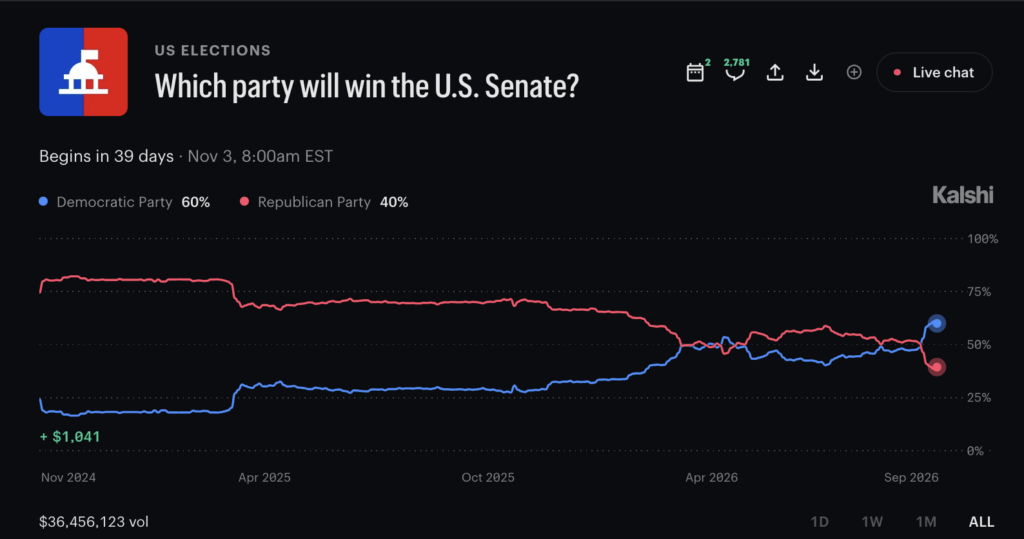
More broadly, with the midterm elections only 40 days away, there is growing sentiment that the Democrats will pick up the requisite seats to take control of the upper chamber, which would likely result in more hearings and scrutiny over prediction markets and their oversight by the Commodity Futures Trading Commission.
NCLGS Files SCOTUS Amicus Brief In Support Of New Jersey
The National Council of Legislators from Gaming States (NCLGS) filed on Tuesday an amicus brief urging the Supreme Court to grant that writ of certiorari petition filed by the state of New Jersey in its Third Circuit case against Kalshi. The court should accept the case, the NCLGS brief reads, because states have long been the regulators of gambling, and clear federal guidance is needed.
In the petition, NCLGS’ attorneys wrote that the Third Circuit opinion and Kalshi’s position invalidate this long-held belief that gambling falls under states’ purview and that such a view “would fly in the face of the clear tradition and policy of state-level gambling regulation, as recognized in Murphy and as effectuated through the state and federal laws and compacts cited herein.”
The brief was filed on the same day that the court granted Kalshi an extension from Oct. 8 until Nov. 9 to respond to New Jersey’s request. It is the first amicus brief filed.
The state of New Jersey initially appealed to the Supreme Court in September, shortly after the Ninth Circuit found in favor of the state of Nevada, creating a circuit split in cases between states and Kalshi.
Utah Senator Calls For Probe Into Prediction Market Ties Of Donald Trump Jr.
Utah Sen. John Curtis has called for an investigation “into the use of presidential family relationships for private financial benefit,” specifically highlighting Donald Trump Jr.’s ties to prediction markets as one example of a connection deserving more scrutiny.
Curtis, a Republican, sent a letter Monday to Senate Judiciary Committee Chairman Chuck Grassley and ranking Democrat Dick Durbin, calling on the committee to subpoena both the president’s son and Hunter Biden, son of former President Joe Biden, to testify.
09.21.2026-Curtis-Letter-to-Senate-Judiciary-re_-Don-Jr.-Hunter-Biden-1Trump Jr. is an advisor to Kalshi and an investor in Polymarket. The letter said his links to the prediction markets raise questions because both businesses rely so heavily on decisions made by the Commodity Futures Trading Commission.
The letter specifically mentioned Trump Jr.’s “significant financial and advisory ties to prediction-market platforms that depend on favorable federal regulatory decisions being considered by the Commodity Futures Trading Commission.”
CFTC Reportedly Examining Kalshi Crypto Perpetual Futures Trades
The Commodity Futures Trading Commission (CFTC) is reportedly “examining” a series of perpetual futures trades on Kalshi after social media posts alleged the trades were linked to wash trading.
A series of regular trades of $5,500 on perpetual futures contracts on the price of the cryptocurrency Ethereum, worth a combined $5 billion, made up more than a third of volume on that contract.
The Wall Street Journal reports that the CFTC is looking into those trades after they received attention on social media site X.com. Some cryptocurrency influencers have suggested that the trades show signs of wash trading, where two parties agree to make trades to create a false impression of market activity occurring.
Kalshi responded to the online allegations with a blog post suggesting that the trades could be explained by one market maker putting up liquidity as part of Kalshi’s liquidity rewards program and then getting picked off by a trading firm with better information on the price of the underlying cryptocurrency.
The Wall Street Journal reported that the parties involved in the trades were Jump Trading, a Wall Street market-making giant that is invested in Kalshi, and crypto-focused market maker Wintermute. It did not indicate which side of the trade each trading firm was on.
Despite Being In Court With State Of Michigan, Polymarket Puts Logo On Water Tower
Polymarket has wrapped a water tower in Detroit with its logo, and the city is now investigating whether the company put the logo there illegally. The advertisement on its own is bold — Polymarket is in court with the state of Michigan, and a judge in June declined to issue the company a preliminary injunction. Polymarket appealed. Competitor Kalshi is banned from offering certain contracts in Michigan, and the regulator began enforcement there over the summer.
Per the Detroit Free Press Sept. 17, the water tower with the logo on it sits on private property and is visible from the I-94 freeway, a key artery in the state. Detroit city officials said no permit for the ad was pulled.
Michigan is one of three states — Nevada and Washington are the other two — that have secured state-court decisions that allow them to ban or restrict prediction market offerings and enforce their gambling laws against Kalshi. According to the Free Press, a reporter was able to sign up for and fund a Polymarket account and place a trade on a baseball game.
Judge Denies Kalshi Request To Overturn Washington State Ban
Washington’s ban on most of Kalshi’s event contracts looks set to continue, after a state court rejected the prediction market’s request to overturn the ban last Wednesday.
Kalshi’s sports contracts, alongside its contracts on elections, politics, entertainment, culture, mentions, and tech and science, have been banned in Washington since Aug. 19. The business has been required to geofence the state, rather than use customers’ addresses to determine if they were in Washington, from Sept. 2. King County Superior Court Judge John McHale issued a final order and injunction at that time requiring Kalshi to cease offering sports contracts.
Kalshi submitted a motion for reconsideration asking the court to lift the ban, but the court denied that motion Wednesday. It did not provide its reasons for doing so.
413447218_v3The injunction can remain in effect until the court makes a full decision on the merits of the case.
Washington is one of three states in which Kalshi’s sports contracts are banned, alongside Nevada and Michigan.
Missouri AG Issuing Cease-And-Desists To Prediction Markets
Add Missouri to the pile. Attorney General Catherine Hanaway is issuing cease-and-desist orders to every prediction market company operating in the state, arguing their sports contracts are gambling under Missouri law and should be taxed accordingly.
“The way that they take contracts, as what they would call them, I call them bets online on sporting events is just like how FanDuel and others do it,” Hanaway said, per KFVS based in Cape Girardeau, Missouri.
Hanaway cited lack of safeguards like age verification as a concern, in addition to insider trading, and she believes the platforms are siphoning money from licensed sportsbooks that pay state taxes. The plan appears to be to try to broker some agreement where the prediction markets would pay a certain amount of taxes, which is what materialized in North Carolina.
Absent that, her office will bring a lawsuit, but she anticipates (correctly) that the prediction market operators may get there first.
“Chances are they may sue us once they get this cease-and-desist letter, because these companies argue that they are regulated at the federal level as a commodity, like the corn and bean futures or farmers’ trade, that they have the same regulatory entity, and we say not quite like that,” Hanaway said.
LeBron’s Polymarket Deal Worth $15M Per Year, Per FOS
Front Office Sports is reporting that LeBron James’ Polymarket endorsement deal is worth $15 million annually, which is more than four times greater than his $4 million annual salary from the Philadelphia 76ers this season. Of course, the 41-year-old legend could have commanded much more but took a veteran minimum deal that allowed him to join a loaded roster that had recently added Boston Celtics star Jaylen Brown (earning $57 million annually) via trade.
James is an endorser, not a Polymarket investor, and the partnership centers on promoting football, not basketball. High profile New York sports legends Derek Jeter and Eli Manning also have deals with Polymarket, though at lower figures, per FOS. The terms underscore just how aggressively prediction market platforms are spending to acquire mainstream credibility for the 2026-2027 football season.
James was previously an endorser for DraftKings Sportsbook in a deal that expired during the summer.
Clarity Act Fails To Advance After Senate Cloture Vote
The Clarity Act, which prediction market critics feared could entrench the industry, has failed to advance in the U.S. Senate.
Senators voted 50-49 to reject cloture — an end of debate, allowing a vote — on the bill. A cloture motion needs 60 votes to pass.
The bill mostly dealt with cryptocurrency, but tribes were concerned that it could give a new legal shield to prediction markets by providing the CFTC power over blockchain-based transactions, even if those transactions were forms of gambling traditionally regulated by states or tribes. Tribes and commercial gaming operators had previously attempted to amend the bill to include language banning sports event contracts, but none of those amendments were included.
Nevada Sen. Catherine Cortez Masto was among those who voted against the bill advancing. She highlighted the treatment of prediction markets as one reason why she couldn’t support the bill.
“This version of the CLARITY Act is a step backwards from the language passed out of the Banking, Housing, and Urban Affairs Committee and clearly undermines law enforcement’s ability to both investigate crypto crimes and to ensure bad actors cannot use crypto for illicit finance,” she said. “The bill would allow prediction markets to continue to perpetuate illegal gaming operations that ignore state and Tribal law.”
Polymarket Hires Boardroom Veteran Jenson As First CFO
Polymarket has appointed its first chief financial officer, Warren Jenson, who previously held the same role at Amazon, Delta Air Lines, and most recently Nielsen.
The 69-year-old boardroom veteran “will lead the company’s finance organization, set financial and capital strategy, strengthen long-range planning, and build the infrastructure to carry Polymarket into its next phase,” according to a press release issued Thursday.
“Prediction markets are changing how the world gets information, and Polymarket is at the forefront of that industry,” Polymarket founder and CEO Shayne Coplan said in the release. “We’re assembling the team to match the opportunity in front of us. Warren has led finance at some of the most consequential companies in the world, and his experience will be critical to everything we build from here.”
Polymarket has brought in more experienced executives lately, including former Uber Vice President of International Growth Travis VanderZanden as its chief growth officer last month. The hires come as the business has largely struggled to keep up with Kalshi’s growth.
Underdog Sues Five States
Mere days after Underdog announced it was pulling its draft products out of seven states where it said regulators viewed operating a prediction market as incompatible with offering fantasy sports, the company has sued a quintet of other states for a wholly different reason.
Underdog filed the suits Tuesday in courts in Ohio, Massachusetts, Wisconsin, New Mexico, and Washington, seeking a permanent injunction against state gambling laws that prohibit the company’s foray into prediction markets.
As first reported by SportsBettingDime, Underdog is also asking each court to rule that the challenged laws — and any other state gambling or wagering laws applied to its prediction markets — conflict with federal law and are therefore unconstitutional under the Supremacy Clause.
“We’re licensed by the federal government to offer markets, and we take our responsibilities as a federal exchange seriously and strictly comply with all regulations. Do we believe we are right on the law? Yes. Do we accept that these state gaming boards believe they are right on the law? Yes. We’ve worked with them, we respect them, and we didn’t want to sue, but sometimes it’s the only way to resolve a dispute,” Stacie Stern, Underdog’s senior vice president, government affairs and partnerships, said in the article.
“With cases and divergent rulings across the country, everyone can see what’s happening in our industry: it’s a mess. We need the Supreme Court to decide whether we’ll have one, enforceable federal standard or state-by-state regulation.”
Defying CFTC And NFL, Kalshi Reposts Player Injury Markets

One week after Kalshi adhered to a reported request from the Commodity Futures Trading Commission (CFTC) to remove its contracts related to athlete injuries, the prediction market operator has reversed course and reposted those markets.
Sportico’s Dan Bernstein was the first to report on Kalshi’s defiance, tweeting on Tuesday night:
Indeed, as of Wednesday morning, several markets based around player health were available on Kalshi. For example, there’s a market titled “Malik Nabers: Next Game Played,” which allows users to wager on when the New York Giants wide receiver will return to the field after missing most of the 2025 season due to a torn ACL. (The latest reports indicate he’s likely to play this Sunday night against the Dallas Cowboys.)
Not only has Kalshi gone against the reported wishes of the CFTC by reintroducing the injury markets, but it has defied the NFL as well. NFL Chief Compliance Officer Sabrina Perel sent a letter last Thursday outlining several types of contracts the league doesn’t want offered, in which the “Inherently Objectionable” category included “player injuries, including whether certain players will compete, when a player’s next game will be, and whether a player will compete in every week of the regular season.”
Robinhood Hooks Up With Crypto.com, Expanding Event Contract Breadth
Robinhood has struck a deal with Crypto.com that will further expand the brokerage’s breadth of event contract offerings, The Wall Street Journal reported Tuesday. Robinhood continues to work with the market leader, Kalshi, separate from its joint venture platform Rothera alongside Susquehanna International Group.
The terms of the investment into Crypto.com and its spinoff platform OG.com, valued at $15 billion and $5 billion, respectively, will provide Robinhood with additional contract supply and crypto-adjacent flow. Exact deal terms were undisclosed. Per the WSJ, the two companies have also “discussed equity-linked perpetual futures should regulators approve the product.”
All of this just in time for football season and the 2026 midterm elections, both of which should turbocharge trading in the months of September and October.
Streaming Coming To Kalshi Via Catalist
Kalshi now has access to official livestreams from sporting events around world, as Catalist Sports on Tuesday announced a multi-year partnership. Per the press release, the deal gives Kalshi increased access to tennis events via “official livestreaming and low-latency data.” The package includes streaming of the Australian Open, Davis Cup matches, and the World Tennis Tour.
In addition, Kalshi users will have access to “key international soccer properties,” as well as international basketball and ice hockey.
Catalist Sports is partnered with the biggest sportsbooks in America, including bet365, BetMGM, Caesars Sportsbook, DraftKings, Fanatics Sportsbook, and FanDuel. It streams more than 40,000 sporting events per year and supplies official league data from more than 65,000 events per year.
With the combination of livestreams and access to low-latency data, Kalshi will be able to create and settle markets using official data, according to the press release. Catalist Sports is Kalshi’s first streaming partner.
Details of the deal were not disclosed.
NFL Warns DCMs To Cut Markets In ‘Objectionable’ Categories
NFL Chief Compliance Officer Sabrina Perel Thursday sent a letter to “a number of prediction markets” reiterating the league’s demand that exchanges pull what the league considers “easily manipulated” or “objectionable” sports event contracts. The letter’s transmittal was reported by Dustin Gouker of The Event Horizon and ESPN’s David Purdum.
Among other comments, Perel writes:
The DCMs must defer to the expertise of the sports leagues to protect the integrity of our games. CFTC Commissioner Selig has asserted that the leagues are best suited to determine which contracts to prohibit, noting that “the leagues are very well positioned to make those calls and so we are going to afford a lot of deference to the leagues on these types of issues.” The failure of DCMs to meaningfully incorporate the perspective and integrity expertise of the NFL is undermining public confidence in the markets themselves.
The letter was also sent to Commodity Futures Trading Commission chief Michael Selig and outlined what the league views as “objectionable” markets. In the letter, the league “requests that all DCMs refrain from offering contracts in the following categories:”
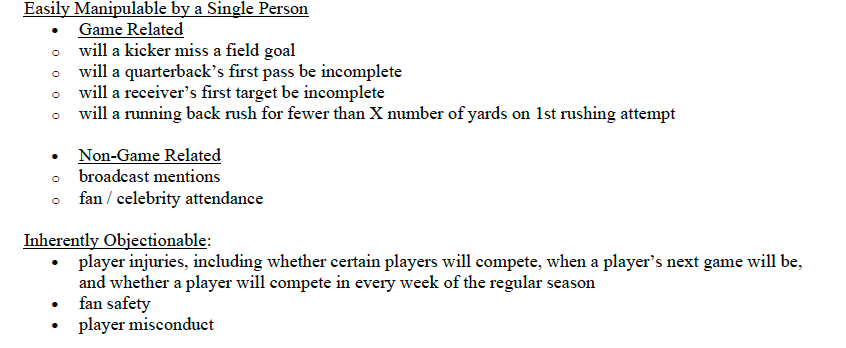
Kalshi recently stopped offering markets around whether certain players will compete or when the player will next appear, which are basically proxies for injury markets.
There is not a readily available catalogue of which “objectionable” markets are still being offered by registered DCMs under Selig’s watch. But the NFL will be monitoring.
Report: NBA Next Pro League Up For A Prediction Market Deal
Front Office Sports (FOS) reported Thursday that the NBA is close to a deal with a prediction market partner and that “deal terms [are on] the table.” Details of a deal were not reported, but according to the story, the league has been in contact with Fanatics Betting & Gaming, Kalshi, Novig, Polymarket, and Rothera, which is a joint venture between Robinhood and Susquehanna.
The NHL was the first major professional U.S. sports league to make a deal with a prediction market when it partnered with Kalshi and Polymarket last October. Since then, Major League Soccer signed a deal with Polymarket in January, and Major League Baseball partnered with Polymarket in April. The NFL does not have a prediction market partner and does not have plans to sign one.
Per an unnamed source in the report, “the NBA has circulated a deal to everybody.” The same source told FOS that the value of the deal “is going to be bigger than MLB,” and that there may be multiple partnerships. The expectation is that a deal will be in place before the season tips off next month.
Kalshi Removes Injury-Related Player Markets, Reportedly At CFTC’s Urging
Looking for sports contracts on Kalshi that allow you to wager on whether a player with a possible injury will participate in an upcoming game? You won’t find them anymore. The prediction market operator had listed such markets for various sports at various times this year, but removed all of them Tuesday — which, according to a Sportico source, was a direct result of the Commodity Futures Trading Commission (CFTC) expressing its opposition to such markets.
In March, the CFTC’s Division of Market Oversight issued an “advisory” stating contracts “that resolve or settle based on injuries to individual sports participants” may “create a heightened potential for manipulation or price distortion.” Kalshi did not heed that advisory when it listed a series of markets last month specifically about whether certain NFL players would play in Week 1, but it is now complying — leaving consumers who’d traded on these markets to await Kalshi’s decision on how it will pay them out.
While Kalshi is the only CFTC-registered prediction market that has taken bets on these player-health-related contracts, Polymarket US self-certified a market in August on whether Kansas City Chiefs quarterback Patrick Mahomes would return from injury in Week 1, but never posted the market. A Polymarket source told ESPN last Friday that the company withdrew the market based on the CFTC’s guidance.
As InGame wrote last week, offering such contracts also risked “upsetting the NFL, which called injury contracts ‘inherently objectionable’ in a letter to the CFTC.”
Kalshi Named Official Prediction Market Partner of US Open
Kalshi has been named the official prediction market partner of the US Open in tennis, with its logos displayed on court signage and the tournament’s digital platforms.
The partnership was announced Monday, the day after the men’s and women’s singles tournaments began.
“We’re relentless about keeping tennis at the cutting edge of global sports innovation and fan connection,” U.S. Tennis Association (USTA) CEO Craig Tiley said. “Partnering with Kalshi gives us an opportunity to pioneer that next generation of fan engagement while ensuring the integrity of our sport.”
As part of the partnership, the USTA and Kalshi have “established a comprehensive integrity framework for the US Open.” Under the framework, bets on “umpire decisions, player injuries, and code violations” will not be permitted.
Trump Jr.’s Fund To Inject Another $300M Into Polymarket
Donald Trump Jr.’s venture capital firm 1789 Capital will more than double its investment in Polymarket, adding another $300 million as part of a $1 billion round of financing, The Wall Street Journal has reported.
Polymarket’s valuation in this round is nearly $21 billion, up from $15 billion in April, while rival Kalshi has leaped way ahead with a current valuation of approximately $40 billion.
Last week, The New York Times reported on a meeting in March between the president’s son and a crowd of Republican state attorneys general in which Trump Jr. suggested that prediction markets were adequately regulated and were under attack from traditional gambling entities. From The Times:
“Mr. Trump’s tone was friendly, the people said. But his comments, which have not been previously reported, dovetailed with a message his father’s administration has sent to state leaders: Back off.”
Kalshi Bans And Fines George Santos, Agrees To Settlements With Three Political Candidates
Kalshi on Monday fined former Congressman George Santos for market manipulation and agreed to settlements with three political candidates over insider trading.
Santos was found to have manipulated the market on his own attendance at the State of the Union in January. He tweeted that he would attend, only to place bets on his absence and then reveal that he would not be present. Kalshi has now permanently banned him from “directly or indirectly” using the platform and fined him $71,356.
North Carolina congressional candidate Laurie Buckhout, former Maine gubernatorial candidate Ben Midgley, and former California gubernatorial candidate Stephen Cloobeck all agreed to settlements after trading on their own election markets. Buckhout will pay $2,589.96, Midgley $5,434.30, and Cloobeck $31,770.
Meanwhile, user Eric Park will pay a penalty of $14,472 and disgorge profits of $7,342 after Kalshi found he “improperly accessed another user’s account and engaged in prohibited trading activity with his own account.”
On Friday, Gabriel Perez — formerly President Trump’s teleprompter operator — agreed to pay a $65,000 penalty and disgorge $107,539.02 in profits after he was found to have placed insider trades.
Ninth Circuit Rules States Can Ban Sports Contracts
The U.S. Court of Appeals for the Ninth Circuit Friday ruled that states can ban sports event contracts from prediction markets.
The 3-0 ruling upheld decisions from the U.S. District Court for the District of Nevada against Kalshi, Crypto.com, and Robinhood.
25-7516With the decision, one federal circuit court has now ruled in favor of prediction markets (the Third Circuit) and one against. A circuit split is often a trigger for the Supreme Court to hear a case.
“The panel concluded that the CEA likely does not preempt Nevada’s gaming regulations as applied to Kalshi’s sports event contracts,” the court’s opinion said. “As to express preemption, the panel concluded that, based on its plain wording, § 2 of the CEA expressly preempts state regulation of swaps that are “traded or executed” on a DCM.
“There was no dispute that Kalshi’s sports event contracts were traded on a DCM. However, under the CEA’s definition in § 1a(47)(A)(ii), the sports event contracts were not ‘swaps’ because they were sports bets.
“In addition, the Special Rule in § 7a-2(c) did not establish that Congress intended the CFTC to make a public interest determination regarding swaps and event contracts involving ‘gaming’” because Kalshi’s self-certification and listing of the contracts was unlawful under the Special Rule and its associated regulation.”
Novig Ditches American Odds In Apparent Response To CFTC Directive
Novig founder and CEO Jacob Fortinsky announced on Thursday that the federally registered exchange had ditched American odds (e.g., -110) in favor of percentages, an apparent response to a directive from the Commodity Futures Trading Commission (CFTC) three weeks ago.
In an Aug. 13 letter titled “Misleading or Deceptive Practices,” the commission cited rules and stated that the use of American-style odds is “likely to mislead market participants about the nature of the transaction into which they are entering and may deprive users of access to indicia of market depth and pricing impact.”
The commission added that, “displaying derivative contract prices directly not only provides market participants with accurate and relevant information, it also reflects that the prices of these derivatives products are determined by market forces on a regulated exchange.”
The guidance from the CFTC is part of a greater effort from the commission to help distinguish — legally, as much as possible — sports event contacts being traded on registered exchanges from state-by-state regulated sportsbooks where wagers are most commonly expressed in American odds.
Of course, some of those sportsbooks with a big footprint are taking notice of some of the ideas from prediction markets and modifying their menus accordingly.
Meanwhile, seasoned sports bettors accustomed to American odds are not thrilled, but also not taking Novig’s snap to attention as a fait accompli.
Polymarket, Sportradar Expand Partnership To Include 20-Plus Leagues
Polymarket and Sportradar are significantly scaling up an agreement, with Sportradar supplying the prediction market operator premium sports data and live odds, marketing, streaming, and integrity services.
Under the original U.S. agreement executed in March between Swiss-based Sportradar and the growing prediction market, Sportradar already covered events associated with the ATP Tour, Major League Baseball, National Hockey League, Major League Soccer, and Ultimate Fighting Championship.
The expanded deal brings the suite of products to now 20-plus leagues and roughly 300,000 matches annually, adding the Bundesliga, Euroleague Basketball, tennis grand slams, and more.
Polymarket previously expanded the scope of its agreement with Sportradar competitor Genius Sports this month. Genius is the exclusive official data supplier of the National Football League, which is set to kick off its regular season on Sept. 9.
Kalshi Partners With Five MLB Teams
Kalshi announced new partnerships with five Major League Baseball teams Tuesday, its first agreements with pro baseball teams.
The prediction market signed multi-year deals with the Atlanta Braves, Boston Red Sox, Los Angeles Dodgers, San Diego Padres, and San Francisco Giants.
The Red Sox partnership is notable as a state court in Massachusetts handed down an injunction in January that would ban Kalshi’s sports contracts in the state. The state’s Supreme Judicial Court is currently deciding whether or not that injunction will go into force. Meanwhile, the other four partnerships are with teams in Georgia and California — states that do not have legal sportsbooks — which likely make up a disproportionate share of Kalshi’s sports activity.
The Mets and Yankees also have prediction market partnerships, with Novig and Polymarket, respectively.
Kalshi Self-Certifies G League Overtime Bets
Kalshi self-certified contracts on the NBA G League with the Commodity Futures Trading Commission (CFTC) Friday, in what appear to be the first prediction market self-certifications specifically designed for contracts in a developmental league.
The two self-certifications both deal with whether games will go to overtime. More traditional bet types like game winners, spreads, and totals have not yet been self-certified. The G League uses a “target score” overtime system rather than a traditional overtime format.
ptc08212619019The filings state that Kalshi could offer the contracts by the end of the business day Friday. Prediction markets do not always list new contracts at the time mentioned in the self-certification filings.
Kalshi previously self-certified contracts that referred to a generic “basketball game,” which might be able to cover any level of the sport, but did not mention the G League specifically. The prediction market does not currently offer any G League contracts.
Few, if any, state-regulated sportsbooks in the U.S. offer betting on the G League.
Kalshi Could Face Connecticut State Court Lawsuit As Appellate Court Denies Temporary Injunction Request
Connecticut could soon be the latest state to sue Kalshi in state court, as the U.S. Court of Appeals for the Second Circuit Wednesday denied the prediction market a temporary injunction that would have shielded it from enforcement.
d7330f18-4e53-48c5-976a-15746663ca3aThe U.S. District Court for the District of Connecticut earlier this month denied Kalshi’s request for an injunction to block state enforcement of its gambling laws, with a comprehensive opinion that rejected just about all of Kalshi’s arguments. Kalshi is appealing that decision to the Second Circuit.
Kalshi had requested an injunction to hold off any enforcement until the Second Circuit makes its decision, but the court denied that motion. Kalshi’s appeal continues, but there is nothing right now to stop Connecticut authorities from suing the platform and trying to have its sports contracts shut down. Nevada, Michigan, and Washington have all blocked Kalshi sports contracts within their borders or from state residents via state-court orders, and the prediction market has yet to record any real victory in a state court.
The Second Circuit is also hearing Kalshi’s appeal for an injunction in New York.
CFTC Innovation Advisory Committee Meeting Begins
The CFTC’s Innovation Advisory Council meeting kicked off at 1 p.m. ET.
Members of the Innovation Advisory Committee include Kalshi’s Tarek Mansour, Polymarket’s Shayne Coplan, DraftKings’ Jason Robins, FanDuel’s Christian Genetski, and Fanatics’ Matt King.
The first two panels will concern cryptocurrency and artificial intelligence, before a prediction markets panel at 3 p.m.
A stream of the meeting can be viewed below.
Cantor Fitzgerald To Offer Clients Kalshi Block Trades
Wall Street giant Cantor Fitzgerald will allow its clients, mostly hedge funds, to make block trades on prediction markets, starting with Kalshi.
Cantor Fitzgerald will act as an introducing broker, “arranging and facilitating the execution” of the trades, the company announced Wednesday by press release. Susquehanna International Group will take the other side of the trades.
Initially the trades will be on Kalshi, but other venues will follow too.
“Cantor has spent more than eighty years building institutional access to new markets, and prediction markets are the next one,” Pascal Bandelier, Co-CEO and Global Head of Equities at Cantor Fitzgerald, said in the press release. “Prediction markets are growing rapidly, but institutional participation has not kept pace because investors have lacked the ability to transact at scale on a regulated exchange. The liquidity is here. With the launch of block trading, institutional investors can now access block trading in event contracts through an institutional intermediary they know and trust.”
Prediction Market Leaders To Meet With Trump Wednesday
Prediction market executives are set to meet with President Donald Trump Wednesday at a White House meeting on cryptocurrency and prediction markets, according to reports.
The White House meeting was first reported Thursday by Politico. On Friday, Bloomberg reported that the president would attend, as would Commodity Futures Trading Commission (CFTC) Chair Michael Selig and Securities and Exchange Commission Chair Paul Atkins.
According to Semafor, representatives from Kalshi will attend, but no other prediction market was mentioned in its report. Other attendees mentioned include representatives from venture capital firms Paradigm and Andreessen Horowitz, which have both invested in Kalshi.
The meeting will come just before the CFTC’s first Innovation Advisory Committee meeting, which will take place Thursday.
Kalshi Shelves Sports ‘Mention Markets’ Amid Federal Probe
One of the more controversial, yet growing, categories of event contracts for prediction market leader Kalshi is getting sidelined while federal regulators undertake a review of the “mention markets.” For now, Kalshi appears to have pulled mention markets within the sports world, while others concerning public officials remain open for trading.
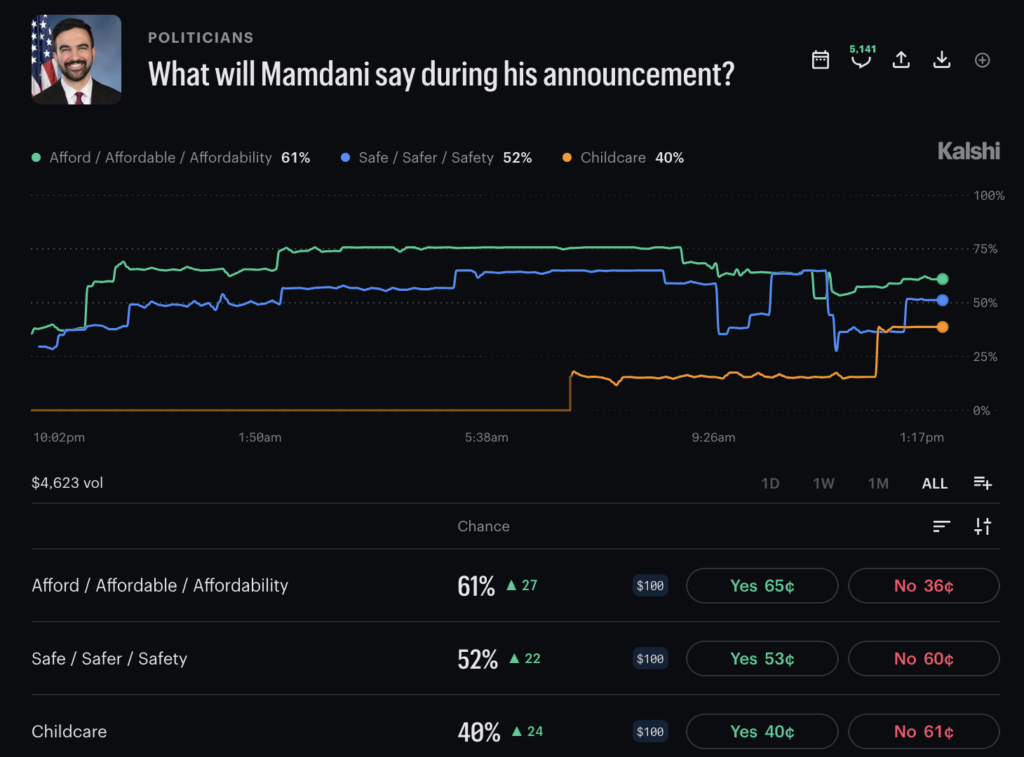
NPR’s Bobby Allyn has some new reporting confirming that regulators, presumably the Commodity Futures Trading Commission (CFTC), are broadly examining mention markets, which allow users to bet on whether or not public figures such as the president, CEOs, or sports broadcast announcers will utter certain words or phrases.
“In response, Kalshi, the largest prediction market in the U.S., has removed all mention markets from its betting offerings for sports as the Commodity Futures Trading Commission pursues its inquiry, according to one of the people,” per Allyn.
A set of new proposed rules by the CFTC in June did not specifically address the role and future of mention markets, whether in the sports realm or beyond. But numerous stakeholders and commenters did home in on them in public comments, including Republican Sen. David McCormick of Pennsylvania, who wrote in part:
Popular categories beyond sports will also require the Commission to dutifully apply the Core Principles in assessing the public interest, such as in so-called mention markets, in which an event contract is generally settled based on a particular word or phrase being expressed during an event. I am skeptical that some mention markets are in the public interest, but the Commission should evaluate these contracts accordingly.
City Councils In New York And Baltimore Take Aim At Kalshi And Polymarket
It’s no secret that major prediction market operators Kalshi and Polymarket have drawn the ire of quite a few states. Now cities are getting in on the fun too.
Separately, the New York City Council and the Baltimore City Council took action against both Kalshi and Polymarket this week.
First came the announcement from New York City Council Speaker Julie Menin Wednesday that the council is launching an investigation into the prediction markets’ advertising practices within New York’s five boroughs — and that the council is looking at Coinbase and Gemini Titan in addition to Kalshi and Polymarket. The city council’s focus is on whether “false and deceptive” marketing tactics are being used and whether advertisements or social media posts are targeting consumers under 21 years old. Polymarket issued a statement saying it “looks forward to engaging with the New York City Council on this matter.”
On Thursday, the Baltimore City Council and Mayor Brandon Scott filed lawsuits against Kalshi, Polymarket, and their affiliate companies, accusing them of violating Baltimore’s Consumer Protection Ordinance by facilitating illegal sports betting and “misleading consumers about the legality and regulatory status of their products.” A Kalshi spokesperson responded to CBS News Baltimore, “Kalshi is not violating any consumer protection laws; it’s operating lawfully under the exclusive jurisdiction of its federal regulator. We look forward to defending these claims in court.”
The city of Baltimore and its mayor have a history of legal aggressiveness toward gambling operators. In 2025, Scott and the city sued DraftKings and FanDuel parent company Flutter Entertainment, accusing the sportsbooks of “engaging in shady practices” to target vulnerable citizens.
Novig Unveils Responsible Trading Framework, Highlighted By 21+ Restriction
Novig on Thursday announced the adoption of a broad set of internal standards it says is aimed at curbing potential problematic, financially risky trading behavior. Designed as a sports-centric if not sports only exchange, at least for now, Novig outlined its new trading standards (below) with an accompanying statement from company founder Jacob Fortinsky.
“Responsible trading shouldn’t rest solely with the customer — it should always begin with the exchange itself,” he said. “By codifying responsible trading standards directly into our rulebook, we’re holding ourselves to the same high standard we expect of our participants and establishing a new benchmark for how federally regulated prediction markets should operate.”
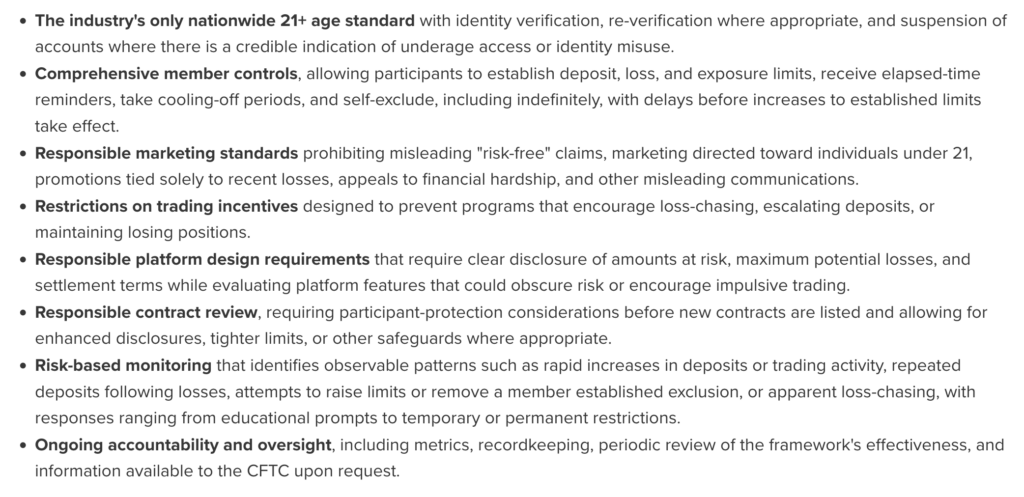
The first bullet is probably the most crucial and controversial. Controversial because the two current market leaders, first Kalshi by a wide margin and also Polymarket, do allow persons 18-20 to trade on their platforms. But Fortinsky explains the concerns and considerations that guided the decision to prohibit that cohort without having to be told.
Per WIRED, he says that decision was made “in response to ‘valid concerns’ put forth about the susceptibility of younger participants to risky behavior, including lobbying from the NCAA and other professional groups.
“There’s a broader reckoning coming with the younger traders. That group is particularly susceptible to irresponsible behavior and financial ruin.”
Novig recently pivoted away from a “sweepstakes” approach in which it operated on a state-by-state basis, in favor of a federal footprint via Ludlow Exchange, LLC, which is owned by Novig and was approved in June as a designated contracts market by the Commodity Futures Tradition Commission.
FlightAware Sues Kalshi Over Airport Cancellation Markets
Flight tracking service FlightAware has sued Kalshi over the prediction market’s use of its data to resolve flight cancellation markets.
Kalshi last month self-certified contracts on flight cancellations and listed a market titled, “Will at least 50% of scheduled flights at JFK be cancelled on October 21, 2026?” Industry event NextPredict used the contract in what it described as a hedge against travel disruption impacting the event.
FlightAware is described as “the primary Source Agency” for the contract in Kalshi’s rules. After the contract was self-certified but before it was listed, FlightAware sent cease-and-desist letters to Kalshi. Kalshi continues to list the contract, albeit with a disclaimer saying, “This market and these products have not been endorsed by FlightAware LLC or its affiliates.”
According to the complaint, Kalshi is violating FlightAware’s terms of use by using its API to settle the contracts. The complaint says that a Kalshi employee signed up for a FlightAware API account on the day the contracts were self-certified, and they “could not have signed up for the User Account without accepting the Terms of Use.”
The complaint says that FlightAware is being harmed by the use of its data, “as commenters mistakenly assume that FlightAware is sponsoring or otherwise collaborating with Kalshi in establishing these markets.”
The complaint adds that “Kalshi does not need to use FlightAware’s marks or data to offer or resolve its flight-cancellation markets” and could instead use U.S. Department of Transportation Bureau of Transportation Statistics On-Time Reporting data.
Kalshi Taps Nasdaq Market Surveillance For Oversight Efforts
Leading prediction market operator Kalshi has inked a multi-year deal with Nasdaq Market Surveillance to monitor its markets and perpetual futures in real time, Kalshi announced on Monday. Nasdaq’s system covers more than 50 exchanges and 20 regulators worldwide. Per the release:
The institutional-grade platform is designed to support real-time detection of market abuse, manipulation, insider trading, and related misconduct. It will be integrated into Kalshi’s trading infrastructure, with the ability to scale alongside the exchange as the asset class expands and new products and markets come online. The platform will also support the delivery of Kalshi’s trade data to the Commodity Futures Trading Commission (CFTC), in the format the agency requires, in line with Kalshi’s obligations as a CFTC-regulated exchange.
Kalshi, obviously, is efforting to protect its markets and platform from abuse and bad actors. This is good. Of course, in some cases, Kalshi itself holds a crucial role in ensuring equitable outcomes.
CFTC Warns Prediction Markets Against American-Style Odds
The Commodity Futures Trading Commission (CFTC) has warned prediction market operators against using American-style odds, according to a report.
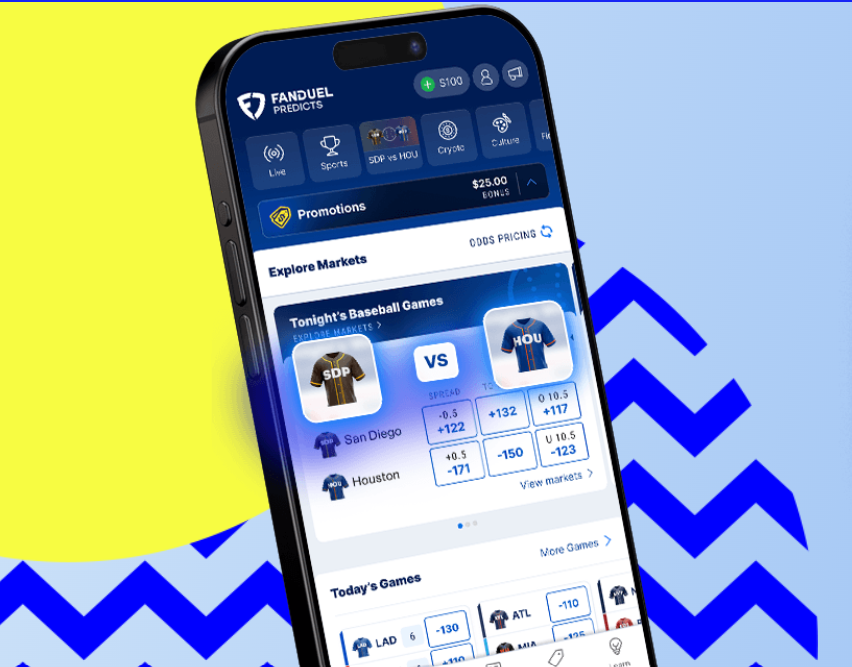
Bloomberg reports that the CFTC sent a letter to operators on “deceptive” marketing. That letter included a warning about American-style odds, where a number is preceded by a + or – sign, for example +110 or -110. The CFTC said that use of these odds can lead to increased risk taking.
Leading prediction markets like Kalshi and Polymarket offer users the options to switch between percentage-based and American style odds, as well as decimal odds common on European betting exchanges.
Prediction markets owned by companies that also operate sportsbooks, such as FanDuel or DraftKings, often show American-style odds by default.
Bloomberg said that introducing brokers, futures commission merchants, and designated contract markets must confirm that they have received the letter by Aug. 31.
Senate Punts Clarity Act Vote To September
The Senate will not vote on cryptocurrency bill the Clarity Act until after the Congressional August recess, Politico reported Thursday, potentially buying more time for groups opposing prediction markets to attempt to get an amendment in.
Politico reports that Senate Majority Leader John Thune said the bill will be “queued up first thing [when] we come back in September.”
The bill requires bipartisan support to pass, but it has faced opposition from Senate Democrats so far.
The American Gaming Association and Indian Gaming Association earlier this year called on Congress to amend the bill to include a ban on prediction markets offering sports or casino event contracts.
Genius Sports Enters Prediction Markets By Partnering With Polymarket And Kalshi
Sports data provider Genius Sports made two moves in the prediction market space in the course of three days, partnering with both Kalshi and Polymarket.
Genius announced a partnership with Polymarket Tuesday, before announcing a deal with Kalshi Thursday.
In the company’s financial results, released Thursday, CEO Mark Locke said “prediction markets are opening an entirely new avenue for growth.”
The Polymarket deal includes exclusive streaming rights for certain sporting events, including Italian soccer’s Serie A, on Polymarket’s U.S. site. In addition, data from Genius sports will be used to settle contracts on events where Genius owns the official data rights.
The Kalshi deal also includes official data for settlement, as well as integrity services.
“Prediction markets will scale on a foundation of trusted, fast and accurate data, reliable technology and robust integrity services, and that is exactly where Genius Sports is uniquely positioned,” Sean Conroy, EVP of Rights & Partnerships at Genius Sports, said in the press release announcing the Kalshi deal. “This partnership with Kalshi demonstrates how we can provide the essential technology layer that enables accurate and transparent sports markets.
“As this category grows, we believe Genius Sports will play a central role in shaping its development while helping protect the integrity of sports.”
Nine Senators Tell CFTC To Block Prediction Market Contracts On Wildfires
Nine Senate Democrats, led by Sen. Jeff Merkley of Oregon, sent a letter Monday to CFTC Chairman Michael S. Selig demanding action on prediction market contracts tied to wildfires. The letter cites Polymarket — apparently the international version, not subject to CFTC oversight — taking $1.2 million in bets on the deadly Palisades and Eaton fires in California.
The group also cites the launch of Wyldfyre, a standalone California wildfire betting platform. Notably, that site operates with play money and is not federally registered.
2026.08.03-LTR-Wildfire-Prediction-Markets-FINALThe senators raise arson incentive concerns and pose several questions to Selig, among them: Does the CFTC have any plans to curb bets on wildfires on prediction markets in the United States? Does the agency have plans to address these contracts being offered on offshore markets?
Underdog Self-Certifies Derivative Sports Contract, Which Settles Based On Kalshi Odds
Underdog Exchange has self-certified what look to be the first ever CFTC-regulated derivative sports event contracts, with three markets that resolve based on the odds of a game on Kalshi.
Underdog self-certified three contracts, one titled, “Will NBA <team> win NBA <game> without its win probability falling below <threshold>?” and similar contracts for MLB and NFL games, with the Commodity Futures Trading Commission (CFTC). The filings say the contracts could be listed as soon as this Tuesday.
Self-certification is a process where an exchange tells the CFTC that it plans to list a new type of contract and provides certain details such as the applicable rules. If the CFTC does not object before the listing date specified, the contract may be listed, though it is not technically considered “approved.” It is the method by which almost all CFTC-regulated contracts — in prediction markets and traditional commodities — are listed.
Interestingly, the contracts do not settle based on the probability from Underdog Exchange itself, but from the probability on Kalshi. Underdog offers its prediction market users access to contracts from Kalshi, Underdog Exchange, and Crypto.com.
The contracts appear to be a first within the CFTC-regulated space. Polymarket’s offshore site has offered derivatives on its own contracts, but that site is not regulated by the CFTC.
Spokespeople for Kalshi and Underdog did not immediately respond when approached for comment by InGame. It is not yet clear exactly what the product would look like when it is offered to customers, assuming that it is offered. Designated contract markets do not always list every product that they self-certify.
The contract states that mean win probability for has to be above or below the threshold for a period specified by the exchange, of between one and 10 minutes, depending on the contract. This design would likely make it more difficult to manipulate the derivative contract by trading on the original market.
In addition, the rules state that “Any Person who enters into, or attempts to enter into, any transaction in <oracle market> or in any other market for the purpose of causing or preventing a Knockout, or otherwise for the purpose of affecting the Reference Win Probability,” would be banned from trading the Underdog contract. However, it appears that trading on both the original and derivative contract would be permitted if it was not done for market manipulation.
The novel product was self-certified just a day after Underdog agreed a deal to be acquired by U.K.-based financial trading firm IG Group.
Federal Judge Denies CFTC’s Preliminary Injunction Against Wisconsin Gambling Enforcement
In what’s been a busy week in the courts for the Commodity Futures Trading Commission (CFTC) and Kalshi et al., a federal judge in Wisconsin denied the CFTC’s motion for a preliminary injunction to block the state from enforcing its gambling laws against prediction market operators including Kalshi, Crypto.com, Coinbase, Robinhood, and Polymarket.
Full opinion here:
documentJudge William C. Griesbach of Wisconsin’s Eastern District ruled that sports-related event contracts likely do not qualify as “swaps” under the Commodity Exchange Act (CEA) and that the CFTC “failed to demonstrate a likelihood of success” on any of its three preemption theories.
The court also denied motions to intervene from Kalshi, Crypto.com (CDNA), and the American Gaming Association. The case proceeds to a Rule 16 scheduling conference.
The denial came after a pair of rulings dropped on Monday. In Minnesota, prediction markets fended off enforcement of a newly passed Minnesota law impacting their operations. In New York, Judge Analisa Torres determined that the CEA may preempt some state laws about commodities regulation, but not gambling laws.
Go here for a much fuller treatment of those two rulings.
NCLGS Takes Anti-Predictions Stance, Issues Resolution
The National Council of Legislators from Gaming States (NCLGS) at its summer meeting in July unanimously passed a resolution opposing the expansion of prediction markets, calling them “unregulated and unlicensed,” and fully enumerated a list of concerns and objections.
The press release accompanying the resolution says in part:
NCLGS supports the principle that states should retain primary authority over the regulation of gaming within their jurisdictions. This longstanding support of states’ rights is shared by many state legislators, regulators and tribal governments.
As Congress and federal agencies continue to evaluate prediction markets, NCLGS encourages policymakers to carefully consider the impact that any federal action could have on existing state and tribal gaming policies.
Based on what we have seen so far from the Commodity Futures Trading Commission under its current leadership and under the current administration, the agency seems quite unlikely to heed the call as outlined by the group. Nevertheless, NCLGS leadership is calling for all states with active operations in the gambling realm to wake up and step up. As the group outlines: “assert licensing and regulatory jurisdiction over prediction market activity occurring within their borders.”
Many have already arrived at that point, probably more to come, if Kalshi et. al. don’t bring the fight first.
Kalshi Self-Certifies Conference Realignment Contract
Kalshi self-certified trades on college sports realignment Thursday.
The prediction market submitted a self-certification titled, “Will <conference> be announced to <gain/lose> <above/below/exactly/at least/between> <count> members in <time period>?”
The contract’s trading prohibitions would ban employees of conferences or senior athletics staff or top-level administrators at universities, as well as executives and employees of television networks, from trading.
The NCAA has been critical of prediction markets in the past, particularly when Kalshi self-certified a contract (which it never ultimately listed) on player transfers.
So far, the realignment contract has not been listed. The filing says it could be listed starting July 23.
Crypto.com’s OG Sues Washington After Kalshi Injunction
Two days after the state of Washington won a preliminary injunction against Kalshi, Crypto.com’s prediction market platform OG (North American Derivatives Exchange, or NADEX) filed a federal lawsuit in the Western District of Washington against Attorney General Nick Brown and the state gambling commission, seeking declaratory and injunctive relief.
Like Robinhood before it, OG argues the Commodity Exchange Act preempts Washington’s gambling laws and claims there is a “concrete and imminent threat that Defendants will file an enforcement action against OG as they did against Kalshi.”
The suit raises all manners of preemption (express, field, and conflict) in arguing why the state lacks authority to regulate or meddle in its activities. These are same core legal arguments at the heart of these state-level battles nationwide. Not every judge has agreed about the application of these legal principles.
Lottery Group Calls Prediction Markets Gambling
Count the North American Association of State and Provincial Lotteries (NASPL) among the groups calling prediction markets another form of gambling.
The NASPL, which represents lottery organizations in the United States and Canada, released a statement Tuesday contending that prediction markets meet the definition of wagering: Money or something else of value is put at risk based on the outcome of an event that has not yet happened.
Gambling has historically meant paying for a chance to win a prize, the group wrote. Skill may be involved, but when chance plays a primary role in determining the outcome, the activity is a gamble.
The group warned that allowing prediction markets to operate outside traditional gambling regulation could damage sports and lottery integrity, weaken consumer protection and responsible gaming efforts, undercut public-benefit funding, and complicate law enforcement work involving tax evasion, money laundering, and racketeering.
Polymarket Self-Certifies Markets On Individual Arrests
A self-certification is no guarantee that a market will definitely get listed on a prediction market exchange, but it’s at least the first step of the process.
On Tuesday, PredictionMarketPulse brought a basket of potential new markets to our attention, most notably the possibility for trading yes/no on: “The specified individual or set of individuals who may be arrested.”
Based on the parameters and payout conditions accompanying the certification, this could contemplate a wide variety of persons and situations like, say, active investigations, protests, and wild speculation on public figures with a history of law enforcement run-ins, such as former NFL wide receiver Antonio Brown. Some of the other terms follow:
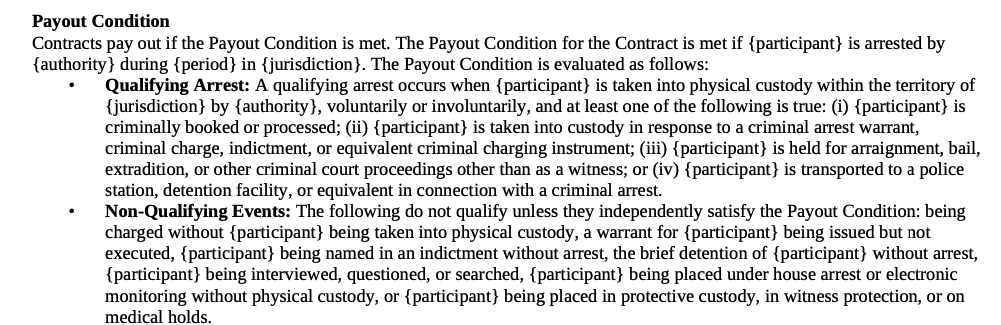
Deemed ineligible to trade on these markets are any “current or former prosecutor, law enforcement officials, and members of grand juries with advance knowledge of, or decision-making authority over, charging decisions, arrest warrants, or a planned or imminent arrest operation involving {participant} prior to public announcement.”
Enforcement and public confidence may be another matter, but those are the terms.
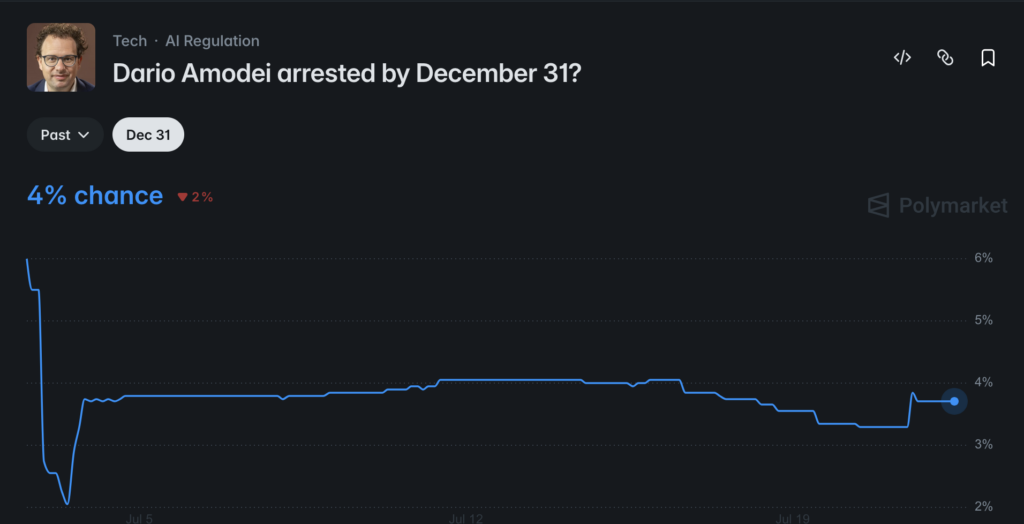
At least one of the arrest markets is already live, and the subject is Anthropic co-founder/CEO Dario Amodei, whose current odds for getting arrested before Dec. 31 are 4% yes.
Judge Grants Washington State Preliminary Injunction Against Kalshi
A King County Superior Court judge on Monday granted Washington state’s motion for a preliminary injunction against Kalshi, finding the prediction market operator conducts illegal gambling activities under state law.
Of note, the court ruled that the Commodity Exchange Act does not preempt Washington’s gambling statutes, a finding that cuts against Kalshi’s core legal defense in similar state-level challenges nationwide that the federal government has “exclusive jurisdiction” over swaps and derivatives trading. Per the Kalshi and Commodity Futures Trading Commission (CFTC) position, sports event contracts are encompassed within.
But keep in mind, this is on a motion for a preliminary injunction (oral argument was held July 10), which is not dispositive on all the issues. And Kalshi will appeal.
Kalshi recently lost a similar preliminary injunction battle on the other side of the country in New York state. The Washington ruling adds another front to Kalshi’s expansive litigation portfolio, which also involves CFTC-initiated actions, multiple state regulators, tribes, trade groups, and many others.
France Joins Growing List Of Countries Blocking Access To Polymarket
Amid continuing debates over the legality and governance of prediction markets in the U.S., and amid the very slow rollout of Polymarket’s U.S.-facing app and site, the prediction market giant keeps running into opposition overseas. As Reuters reported Friday, France is the latest country to block access to Polymarket, both because France’s National Gambling Authority views it as a form of gambling and because the regulator sees high potential for market manipulation.
“On July 16, 2026, the president of France’s National Gambling Authority ordered French internet service providers to block access to the Polymarket website,” the regulator posted. “The site, which attracts a particularly large audience, is promoting an illegal gambling and betting offering.”
France joins a list of countries that banned or blocked either Polymarket or prediction markets in general that includes Australia, Belgium, Belarus, Burundi, Central African Republic, the Democratic Republic of Congo, Cuba, Germany, Ethiopia, Iran, Iraq, Italy, North Korea, and the United Kingdom.
Polymarket officials did not respond to Reuters‘ request for comment.
Underdog CEO Shares Volume Numbers On CNBC, Says It’s No. 3 In US
One day after Underdog self-certified the first contracts for its in-house prediction market exchange, the operator kept itself in the news cycle Friday when its CEO, Jeremy Levine, appeared on CNBC, sharing its “volume flow” numbers publicly for the first time.
Based on the numbers Levine touted and that CNBC ran in its graphic (which were not necessarily independently verified), Underdog ranks third in U.S.-facing volume for prediction markets from last September to present, edging ahead of Polymarket, $6.49 billion to $6.48 billion. Both operators remain some distance behind leader Kalshi ($86.5 billion) and runner-up Robinhood ($32.5 billion).
Levine also pointed out the year-to-date gap between Underdog and DraftKings Predictions, which, according to Underdog, sees the former nearly quadrupling the latter, $4.4 billion to $1.2 billion.
Michigan AG Takes Issue With Feds
Michigan Attorney General Dana Nessel pushed back this week against federal regulators who blocked Kalshi from canceling sports prediction market trades placed by Michigan residents. It was the state’s first public response since the intervention.
“The State of Michigan has an obligation to protect its residents, and today’s action by the CFTC attempts to undermine states’ efforts to regulate online sports betting and uphold state tax law,” Danny Wimmer, press secretary for Nessel, said in a statement to Spectrum News. “Just as any other company that seeks to operate in Michigan, Kalshi should be required to follow the laws of Michigan.”
The Commodity Futures Trading Commission invoked emergency authority after Kalshi moved to void pending Michigan trades. The company was complying with an Ingham County judge’s temporary restraining order barring the company from offering sports event contracts in the state.
Michigan sued Kalshi this year, alleging its sports contracts are unlicensed betting. Kalshi calls them federally regulated derivatives.
Trump Teleprompter Operator Reportedly Under Investigation For Insider Mention Market Trades
The Commodity Futures Trading Commission (CFTC) is investigating a teleprompter operator for President Trump who is believed to have made more than $100,000 trading on what words the president will say during speeches, according to a report.
ABC News reports that Gabriel Perez, a technical advisor to the president, is being investigated for trades made on Kalshi on so-called “mention markets.”
On social media platform X, Kalshi Head of Enforcement Robert DeNault said the company flagged the suspicious trades to the CFTC.
Susquehanna Starts Making Markets For Perps Index Provider Paragon
Susquehanna International Group’s crypto arm has started making markets for prediction markets and perpetuals crypto index provider Paragon, the platform announced by press release Wednesday.
Paragon bundles groups of crypto prediction market and perpetual futures trades into single indices, which trade on perpetual futures platform hyperliquid.
Paragon said the added liquidity would help it move into new asset classes.
At the same time, UFO Holdings will invest in Paragon. UFO was founded by former Kalshi employees Adhi Rajaprabhakaran and Noah Zingler-Sternig, and this is its first publicly announced investment.
Stage Set For Another Prediction Markets Hearing In Congress
A House Subcommittee on Commodity Markets, Digital Assets, and Rural Development will hold a hearing on prediction markets Tuesday at 10 a.m. ET.
First reported by Dustin Gouker at The Closing Line, the hearing is titled “Examining Prediction Markets: Customer Protections and Market Integrity in Sports Event Markets.” The hearing, speakers undetermined or not yet publicly announced, will stream here:
There’s over a dozen bills circulating in Congress that would regulate or heavily restrict prediction markets in some way, among the more notable a bipartisan piece from Sen. Adam Schiff (D-CA), and Sen. John Curtis (R-UT) that would “prohibit Commodity Futures Trading Commission (CFTC) registered entities from listing any prediction contract that resembles a sports bet or casino-style game.”
The most recent congressional hearing on either prediction markets or sports betting took place on May 20 before the Senate Committee on Commerce, Science, and Transportation’s Subcommittee on Consumer Protection, Technology, and Data Privacy.
In the interim, the stakes have risen, the CFTC has certified more exchanges as designated contacts markets (DCMs), Kalshi’s valuation has nearly doubled, and World Cup action has sent Kalshi’s app downloads into orbit.
Kalshi World Cup Odds Integrated Into ChatGPT Via New ‘Partnership’
Kalshi odds are now being integrated into ChatGPT, with an infobox for World Cup matches showing team probabilities from the prediction market.
The New York Times, which first reported the integration, describes it as a “partnership” between Kalshi and ChatGPT parent company OpenAI.
ChatGPT queries about this week’s two World Cup semifinal matches result in an infobox featuring win probabilities that are attributed to Kalshi.
The infobox does not include a link to Kalshi.
An OpenAI help page says, “For queries related to the 2026 World Cup, ChatGPT may show predictive information sourced from Kalshi to provide timely context about upcoming matches. If and when this information appears, it will always be clearly labeled with ‘Source: Kalshi.’ This is for informational purposes only. You cannot place bets through ChatGPT, per our Usage Policies.”
ChatGPT is estimated to have over 1 billion monthly active app users globally.
New Google Policy Will Restrict Chrome Extensions That ‘Enable’ Prediction Market Transactions
Global technology behemoth and internet gatekeeper Google announced on July 1 an interesting new policy taking effect on Aug. 1. The memo concerns updates to the company’s Developer Program Policies and is intended to further its mission of creating a Chrome Web Store that’s a “high-quality, trusted, and secure ecosystem” for both developers and users.
The pertinent policy update:
Regulated Goods and Services: We are expanding our language to explicitly include predictive markets as prohibited products. Extensions that facilitate or enable real money transactions on predictive outcomes are not allowed.
Bad news for any developers who have already shipped extensions aimed at supplying tools to prediction market traders. Although, there may be some daylight between informing traders and “facilitating” or “enabling” real money transactions.
Chrome maintains a majority share among U.S.-based internet users, with the latest data showing a 52.8% browser share, a bit more than double that of Safari at 25.9% as of June 2026, according to StatCounter figures.
This policy change also comes about eight months after Google announced an integration with both Kalshi and Polymarket into Google’s own finance tools. Obviously, things are evolving quickly in this space.
Former CFTC Chair Nominee Quintenz Now Advisor To Coalition For Prediction Markets
Brian Quintenz, who was nominated last year to chair the Commodity Futures Trading Commission (CFTC) only to have his nomination pulled by President Donald Trump in October, has found a different role in the prediction market space. The Coalition for Prediction Markets (CPM) announced Wednesday morning that it has brought Quintenz aboard as a senior advisor.
The CPM is a prediction market advocacy group whose members include Kalshi, Crypto.com, Coinbase, Robinhood, and Underdog.
Quintenz is the former global head of policy at a16z crypto and a former CFTC commissioner, and he initially appeared well positioned to be confirmed as CFTC chair. But when his nomination was withdrawn, he accused crypto entrepreneurs Cameron and Tyler Winklevoss — most famous for their role in the rise of Facebook and Mark Zuckerberg as depicted in The Social Network — of influencing President Trump and derailing his confirmation.
Sean Patrick Maloney serves as president of the CPM, and Quintenz joins Patrick McHenry as one of the organization’s two senior advisors.
Michigan Gambling Regulator Bounces From NCPG, Citing Kalshi
Back in May, roughly a year ago at the prediction market pace, Kalshi joined and announced a $2 million investment into National Council on Problem Gambling (NCPG).
The NCPG, at one time a leading advocacy group for promoting public health in connection with regulated gambling, created a new subcategory for Kalshi’s membership, calling it the “Financial Services & Trading Subcategory.”
This partnership did not sit well with everyone, namely, the incumbent members and backers of the NCPG. Part of that dissatisfaction is that NCPG, by bringing Kalshi into the tent with some new category, is stamping its approval, pretty explicitly, on a controversial brand engaged in sprawling litigation that is in part a definitional battle.
Here’s the key paragraph from the Michigan Gaming Control Board (MGCB) letter to the NCPG:
“NCPG’s partnership with Kalshi also creates substantial confusion by suggesting to the public that Kalshi is subject to the same consumer protections, licensing requirements, and regulatory oversight as licensed sports betting operators. It is not. Any affiliation which blurs this distinction undermines the MGCB’s statutory responsibilities and jeopardizes the clarity of the regulatory framework which it enforces.”
And so, the MGCB, one of the more outspoken and active state regulators in the U.S., is out, announcing Thursday that it is formally withdrawing its membership from the group.
It probably won’t be the last.
On Heels Of WSJ Investigation, Consumer Advocates Sue Polymarket Over Deceptive Marketing
A lawsuit filed Friday in D.C. Superior Court accuses Polymarket and its top executives of running a sweeping deceptive marketing campaign targeting college-aged Americans, including paying social media influencers to place fake bets on a simulated version of the platform, then using a “clipping” operation, paying influencers based on the number of views, to make the allegedly staged content go viral.
NACA-v.-Polymarket-complaintThe complaint, brought by the National Association of Consumer Advocates under D.C.’s consumer protection law (D.C. Consumer Protection Procedures Act), names Polymarket CEO Shayne Coplan and CMO Matthew Modabber personally. It alleges Polymarket hired college-age creators, recruited fraternity chapters with cash incentives, and instructed paid promoters to disguise ads as organic content.
A Wall Street Journal analysis/investigation published on June 20 found that of 1,105 creator videos reviewed, 70% depicted a subject making a trade/bet, none of which were actually authentic. Polymarket told CBS News that the company was auditing its promotional content following the WSJ investigation.
The lawsuit seeks disgorgement of profits, restitution, and a permanent injunction.
Update:
Kalshi Sues Illinois Over Tax And License Requirements For PMs
Kalshi has sued Illinois in federal court over a law that would regulate and tax prediction markets.
The lawsuit, filed Wednesday in the U.S. District Court for the Northern District of Illinois, concerns SB 3019, the state budget bill. That bill includes requirements for prediction markets to be licensed and taxed at 1.75% for their first 5 million annual trades and 3.5% beyond that.
Kalshi-IL-lawsuitKalshi’s complaint says the law “impermissibly usurps the CFTC’s exclusive jurisdiction by barring DCMs from offering sports event contracts unless they obtain a state license (at a cost of millions of dollars) and comply with a range of intrusive state gambling regulations — including a requirement that their contracts be offered exclusively to Illinois residents.”
Kalshi is asking the court “to prevent Illinois officials from enforcing SB 3019 or any of Illinois’s other state gambling laws against Kalshi based on its operation of a federally regulated DCM.”
State attempts to pass laws that directly address prediction markets have all been met by lawsuits. Last month, the CFTC sued Minnesota for a bill banning prediction markets and this month it, alongside the Coalition for Prediction Markets, sued Kentucky for a bill taxing prediction markets. No court has ruled on the legality of these laws yet.
Report: Kalshi In Talks To Fundraise At $40 Billion Valuation
Kalshi reportedly is in talks to raise more funds at a valuation of $40 billion, which would make it worth $10 billion more than Flutter Entertainment and DraftKings combined.
The Financial Times reports that Kalshi has been in talks with prospective investors, only three months after it raised money at a $22 billion valuation. A year ago, Kalshi was worth $2 billion.
A $40 billion valuation would make Kalshi the most valuable company in the gambling industry, ahead of Asia-focused casino giant Las Vegas Sands, and dwarfing FanDuel owner Flutter Entertainment, valued at $17 billion, and DraftKings, at $12 billion.
CFTC Sues Kentucky Over Prediction Markets, Claims ‘Exclusive Jurisdiction’
Another day, another jurisdictional lawsuit on the prediction markets beat involving the Commodity Futures Trading Commission (CFTC).
The CFTC initiated this one in the Eastern District of Kentucky, with Kentucky Governor and potential 2028 presidential candidate Andy Beshear a named defendant. The federal agency, as in earlier cases brought against Arizona, Connecticut, New York, Wisconsin, and others, is seeking to block state enforcement actions and legislation targeting CFTC-regulated prediction markets.
OGC_KentuckyComplaint062326The complaint challenges three bills enacted by Kentucky’s legislature: HB 757 (a 14.25% excise tax on event contract transactions), HB 904 (bans a track or association from partnering with any entity that offers sports event contracts), and HB 869 (which bars state-licensed gaming operators from associating with prediction market platforms), arguing that the state action is preempted by the Commodity Exchange Act.
Kentucky filed state court enforcement actions on June 17 against Kalshi, Polymarket, Robinhood, and Coinbase. This is the CFTC’s seventh such preemption suit against a state but the first to challenge a targeted excise tax on prediction market activity.
Report: Meta Developing Prediction Market
Facebook and Instagram owner Meta is developing its own prediction market app, according to The New York Times.
The Times, citing two Meta employees, reported that Meta CEO Mark Zuckerberg recently dispatched a small team at his company to create a smartphone app similar to Polymarket and Kalshi.
Meta is internally calling the app Arena, and The Times reports that it’s a “top priority.” It is currently not planned to be a real-money app, and will instead use a points system, but the report said it could expand to real money in the future.
Kalshi Submits Sixth Circuit Brief, Via $3,250-An-Hour SCOTUS Lawyer Katyal
Kalshi this week submitted a response brief in its Sixth Circuit lawsuit against Tennessee, and its legal team may be readying for the case to reach the Supreme Court.
The Sixth Circuit case came about after Tennessee appealed a District Court decision to issue an injunction that protects Kalshi against enforcement from the state.
4b3215c5-5cc5-460a-8075-593fef37e9c8The brief makes many similar arguments to past Kalshi filings in other lawsuits. It points to the history of derivates trading being regulated as gambling in order to argue that it was always Congress’ intent to preempt state gaming laws when it wrote the Commodity Exchange Act.
However, it also pointed to the Commodity Futures Trading Commission’s rulemaking on event contracts, published June 10, to argue that the CFTC is actively regulating event contracts.
Meanwhile, in Kalshi’s case against Tennessee, also in the Sixth Circuit, the court denied the CFTC’s request to appear at oral arguments.
Unlike most of Kalshi’s past briefs, this one was filed by Neal Katyal, a Supreme Court litigator whose fees are believed to be as high as $3,250 an hour. That may be a sign that Kalshi is preparing for the case to reach the Supreme Court.
Federal Court Denies Polymarket Michigan Injunction
A federal court has ruled that the state of Michigan can enforce its laws against Polymarket, determining that prediction markets are not exempt from state sports betting laws.
The decision was filed in the U.S. District Court for the Western District of Michigan Wednesday.
CFTC_SEC_JointRFCSwapDefinitions061826In his opinion, Judge Paul L. Maloney said that Polymarket’s arguments on both fundamental questions in the case — whether the Commodity Exchange Act (CEA) preempts state gaming laws and whether sports event contracts could be classed as swaps — were unconvincing.
Maloney wrote that while there could be a way to read the definition of a swap broadly enough to include sports event contracts — particularly the inclusion of the definition of a swap in the post-global financial crisis Dodd-Frank reforms — context suggests this was not the intended definition.
“Congress had nothing like Plaintiff’s products in mind when it defined ‘swap,’ he wrote. “The primary issue it set out to solve had nothing to do with sports-related contracts. The universe of materials available to Congress would not have placed swaps and betting on sporting events in the same field of policy.
“The markets with which Congress was concerned were dominated by large financial institutions and did not involve individuals staking relatively small amounts of money on the outcome of a football game.”
Maloney added that even if sports contracts were swaps, Michigan law would not be preempted. He wrote that the CEA references state law, showing that the two were meant to coexist, rather than one overruling the other.
Polymarket has submitted its appeal to the Sixth Circuit. The Sixth Circuit is already hearing an appeal in Kalshi’s lawsuit against Ohio.
ProphetX Prediction Market Goes Live
ProphetX has officially launched to the public, after receiving CFTC approval last week.
The platform was approved as a designated contract market (DCM) last week and self-certified its first contracts Monday.
“At one of the most exciting moments in the sports calendar, ProphetX is now available nationwide for more American sports fans to trade on our faster, transparent, and fully regulated exchange where the market sets the price — not the house,” ProphetX CEO and co-founder Dean Sisun said.
ProphetX started as a sports betting exchange named Prophet Exchange in 2018, before winding down that operation and rebranding under the sweepstakes model. It applied with the Commodity Futures Trading Commission (CFTC) to be a DCM in January, meaning the turnaround from application to launch has been unusually fast.
More exchanges are likely to launch soon. Novig received CFTC approval Tuesday, while DraftKings’ DKeX self-certified its first contracts in May but has yet to launch to the public.
Polymarket Teams With Splash Sports For Record-Setting NFL Survivor Pool
In recent years, Circa has come to dominate the NFL Survivor Pool landscape. Just a few weeks ago, it announced the biggest Survivor contest in history, with a $20 million guaranteed prize pool.
In short: For $1,000 you get an entry, and each week you pick one NFL team to win. If it does, you move on. If it doesn’t, you’re done. If you’re alone as the last person standing, you win $20 million. Easy game.
The one hitch to the whole thing: Per Nevada rules, you have to register in person, though for the week-to-week picks you can use a proxy.
Welp, things have just changed in the Survivor Pool world, as upstart Splash Sports has teamed with Polymarket to offer a — wait for it — $21 million Survivor pool.
And you can do it all online without ever having to step foot in Vegas.
How does Polymarket enter the conversation?
“So you can trade markets right inside the app — hedge a shaky pick, or double down on one you love,” wrote Splash Sports founder TJ Ross on X.
The contest — at $1,000 an entry — opened for business Thursday morning, available in 35 states and Canada.
Coalition For Prediction Markets Sues Kentucky Over Tax On Fees
The Coalition for Prediction Markets has sued Kentucky over a new law that requires exchanges to pay a tax on prediction market fees, according to the Associated Press.
The coalition, made up of Kalshi, Crypto.com, Robinhood, and Underdog, submitted the filing in state court.
The Kentucky legislation, which also included a number of provisions for traditional forms of gambling, became law when the state’s General Assembly overrode the governor’s veto in April. It requires prediction markets to pay 14.25% of their fees in taxes.
The coalition argues that the state has no right to tax the industry, because it says only the CFTC can regulate event contracts.
“No State currently levies a State-specific excise tax of any kind on derivatives transactions that take place on a federally designated exchange, let alone the sort of specifically targeted and discriminatory tax that Kentucky has imposed here,” the coalition’s complaint says, according to the Associated Press.
The Kentucky law, which would come into force on Jan 1, 2027, is much less strict than some other states’ measures regarding prediction markets. Last month, Minnesota lawmakers passed a bill to ban the products entirely. That bill is being challenged in court by the Commodity Futures Trading Commission.
CFTC Sues New Mexico After State Filed Lawsuit Against Kalshi
The Commodity Futures Trading Commission (CFTC) sued New Mexico Friday, bringing the total to eight states that have faced a lawsuit from the commodities regulator over prediction markets.
The lawsuit was filed in the U.S. District Court for the District of New Mexico, and follows the state filing a lawsuit against Kalshi in state court on June 4 for violating New Mexico’s sports betting laws.
OGC_NewMexicoComplaint061226As in other lawsuits filed by the CFTC, the commission argues that it has “exclusive jurisdiction” over prediction markets, and therefore that the state is not allowed to enforce its sports betting laws against any registered designated contract market such as Kalshi.
The CFTC argues that it is injured by the state’s lawsuit because the state’s efforts to block sports event contracts “directly harm the federal government’s sovereign, legally protected interest in enforcing federal law.”
The regulator is calling for an injunction “holding that New Mexico gambling laws are preempted and unenforceable as applied to transactions listed, offered, or executed via CFTC regulated markets.”
“New Mexico is the latest state seeking to nullify black letter law and decades of judicial precedent by imposing state gaming laws on federally regulated derivatives exchanges subject to the CFTC’s exclusive jurisdiction,” CFTC Chairman Michael Selig said in a press release. “As I’ve said repeatedly, the CFTC has the expertise and responsibility to protect its exclusive jurisdiction over commodity derivatives, and that’s exactly what we’ll continue to do.”
The other seven states to have been sued by the CFTC are Arizona, Connecticut, Illinois, New York, Minnesota, Rhode Island, and Wisconsin.
Rush Street Applies To Add DCO To Predictions Portfolio
Rush Street Interactive’s potential prediction market foray is taking further shape.
A new CFTC filing (via PredictionMarketPulse) shows that Eventive IV, LLC (RSI’s clearinghouse entity) has applied for DCO registration (derivatives clearing organization), pending as of May 1. That would dovetail with the Eventive III DCM (designated contract market) application filed in late May, giving RSI both halves of a prediction market stack: the exchange and the clearing infrastructure.
Some aspiring entrants rely on third-party clearing. RSI is building its own, a sign the company is serious about standing up a fully integrated operation if or when it decides to go live. As InGame previously reported, RSI sees the DCM filing as something that gives the company the flexibility to respond to developments in the prediction market space.
Kalshi To Introduce Employer Disclosure Requirement
According to a Wall Street Journal report on Tuesday, Kalshi’s latest effort to curtail insider trading will result in a workplace disclosure requirement, after an advisory committee recommended tighter security measures to “combat potential insider trading and market manipulation.”
“Sensitive betting markets related to issues such as company performance and national security, including the war in Iran, are expected to require employment disclosure, according to a Kalshi official,” per the Journal.
Insider trading has become a flashpoint within the legal and public interest discourse around prediction markets, due to a steady trickle of high-profile cases involving suspicious six-plus-figure profits in markets based on military activity and warfare (Venezuela and Israel), as well as cases involving big public companies such as Google. A Google software engineer was recently charged with commodities fraud, wire fraud, and money laundering, for roughly $2.75 million in trades made on Polymarket on search position outcomes considered unlikely to occur.
According to the criminal complaint, Michele Spagnuolo, a software engineer at Google since 2014, accessed Google’s confidential internal Year in Search data on Oct. 15, 2025, using a tool whose interface, the FBI noted, “bore a banner that stated, in part, ‘Google Confidential’ in red text.” The next day, Spagnuolo reportedly placed his first Year in Search bets.
As a matter of practice, Kalshi would not verify the user-supplied data such as employer upon submission or account creation, but rather if trades by the user were later deemed suspicious. Which raises the question: How valuable is unverified user-supplied data? The answer is probably that it’s better to have the information (true or not) than to not have it.
The changes on Kalshi’s platform are expected to be rolled out in the coming weeks.
CFTC’s Proposed Prediction Market Rules Say Certain Sports Contracts Are Against Public Interest
The CFTC has published its new proposed rules on prediction markets.
NPRM_PredictionMarkets060926The proposed rules are subject to a 90-day review. They concern certain sports event contracts that could be considered to be against the public interest due to manipulation risks.
The rulemaking document identifies “player injury contracts,” “officiating outcome contracts,” “discrete outcome contracts based on specific participants,” and “pre-collegiate sports events” as likely to be against the public interest.
“The CFTC will protect the integrity of our regulated markets without standing in the way of responsible innovation,” CFTC Chairman Michael Selig said. “This proposal gives the Commission a durable, transparent framework to identify the contracts Congress directed us to scrutinize while letting legitimate markets move forward.”
The rules also define the word “involving” in the CFTC’s rule 40.11, which refers to a prohibition on “contracts involving gaming,” to mean the underlying event that is being bet on must be gaming, not the act of trading the contract itself.
Report: New CFTC Prediction Market Rules Coming Today
The CFTC is set to announce on Wednesday new rules for prediction markets, including restrictions on “micro-betting” types of markets, The Wall Street Journal reports.
According to the Journal, the rules “will include parameters that will continue to allow most sports-related bets while trying to avoid inviting obvious manipulation.” It cites bets on player injuries and specific pitches of baseball games as those likely to be restricted. So far, no CFTC-regulated prediction market has offered bets on those topics.
The new rules would also ban “virtually all bets on war, terrorism or assassinations,” where the rules are currently somewhat ambiguous.
New Mexico Sues Kalshi
New Mexico Attorney General Raúl Torrez has sued Kalshi in state court, contending the business “functions as a sportsbook.”
The lawsuit was filed Thursday in the State of New Mexico First Judicial District Court for the County of Santa Fe.
It is the latest state-level lawsuit against Kalshi, which has also been sued in Nevada, Wisconsin, Delaware, and Massachusetts and is facing criminal charges in Arizona.
NM-Kalshi“New Mexico has a longstanding and carefully balanced system for regulating gaming that protects consumers, ensures accountability, and respects tribal sovereignty,” Torrez said. “The only lawful gaming in New Mexico operates either under tribal-state gaming compacts, or under strict state regulations to ensure honest gaming free from corruption, and licenses gaming operators only after they explain how they plan to address compulsive gambling.
“Kalshi has ignored that framework entirely while offering online sports betting within the state. We are filing this lawsuit to protect the integrity of our laws, our regulatory system, and most importantly, consumers.”
The complaint says, “Despite looking like a sportsbook, acting like a sportsbook, and proverbially quacking like a sportsbook, neither Kalshi nor any of its subsidiaries have sought licensure from New Mexico’s Gaming Control Board.”
Kalshi is likely to sue to attempt to get the case moved to a federal court, but none of its attempts to do this in other states have been successful. Nevada, the only state to have successfully banned Kalshi’s sports contracts, did so by suing in state court.
A Curious Meeting
Punchbowl News is reporting an interesting item: The House Financial Services Committee is hosting a private, Republican-only meeting Wednesday with Kalshi’s founder and CEO Tarek Mansour, Polymarket Chief Legal Officer Neal Kumar, Robinhood’s JB Mackenzie, and Chris Cylke of the American Gaming Association. One of these things is not like the other.
NYC Bar Places $5,000 Hedge On Kalshi
A New York bar is using Kalshi to place a $5,000 hedge on the Knicks for a free drinks promotion, in what the prediction market says is “likely the first documented small or medium-sized business to hedge event risk using prediction markets” and “likely the first of many to come.”
As announced in a Kalshi press release, The Jeffrey on the Upper East Side will pay everyone’s tab if the Knicks win Game 1 of the NBA Finals against the Spurs Wednesday. The business then has a $5,000 bet on the Knicks to win. The Knicks have been trading at about 37% odds since the market on Game 1 went up, suggesting a payout of around $13,500. The press release said the payout if the Knicks win should “offset the loss” from the free drinks.
Kalshi-Jeffrey-Press-Release“If the Knicks lose, the bar collects abnormally high revenue from the promotion, having paid only a small premium for the peace of mind,” Kalshi added.
The promotion is similar to those offered by Houston furniture salesman Mattress Mack, who has used sportsbooks to hedge the risk of free furniture promotions based on sports outcomes.
Kalshi has attempted to highlight the hedging possibilities of its sports contracts. The Commodity Exchange Act says that swaps — the category of asset event contracts fall under — should have a “potential economic, financial, or commercial consequence.” The press release adds that hotels can also hedge against sporting outcomes, while a number of other businesses could hedge against other outcomes using different Kalshi markets.
Daily fantasy giants Underdog and PrizePicks have both used Kalshi to hedge sporting risk, as does sports-based insurance firm Game Point Capital. Kalshi offers fee rebates to sportsbooks and fantasy sports platforms that use it to hedge.
Kalshi Self-Certifies Fantasy Football ADP Contracts
Kalshi has filed to offer contracts related to fantasy football for the first time, having self-certified contracts on players’ average draft position (ADP) in Sleeper leagues.
Two fantasy football-related filings that were submitted to the Commodity Futures Trading Commission (CFTC) Monday say that the contracts could be offered at the close of the business day. Kalshi does not always list contracts on the date listed on its self-certification filings, and it sometimes does not list them at all.
The first contract asks which player will have the lowest ADP for a season, making them the consensus top pick in drafts. The second asks which out of two players will have a lower ADP.
The contracts use Sleeper’s single-QB point-per-reception redraft leagues as the sole source agency to determine ADP. In February, Sleeper started offering Kalshi’s sports event contracts.
The contract’s “trading prohibitions” — people who are not allowed to trade on the market due to insider trading risks — include “Any person with access to non-public ADP data feeds or pre-publication ADP snapshots” and “Any person who operates, coordinates, or can conduct or automate a material number of Sleeper drafts (including bot or mock-draft networks) sufficient to move the relative ADP ordering of the specified players — the primary manipulation vector,” as well as NFL players and staff.
Kalshi Approved To Launch Perps As It Tries To Be ‘Next-Gen Derivatives Exchange’
Kalshi has launched perpetual futures on Bitcoin, after becoming the first company to receive approval from the Commodity Futures Trading Commission (CFTC) to do so.
A perpetual future is a contract that allows the holder to buy a commodity at any date, without expiration. In contrast, traditional futures always have an expiration date, and must be “rolled over” onto a new contract if you wish to keep holding the position after expiration. They are most common in crypto and are widely available on non-CFTC-regulated crypto exchanges, where they are almost always traded on margin.
In a press release, Kalshi said the new product class would “reinforce the company’s position as a full-service financial exchange.”
“This marks Kalshi’s evolution from prediction market leader to next-gen derivatives exchange,” said Kalshi CEO Tarek Mansour. “Onshore, safe, and regulated perps will improve capital allocation and risk management for countless American businesses.”
Kalshi’s application for Bitcoin perpetuals was approved, rather than being self-certified as virtually all of its event contracts have been. The CFTC said “perpetual contracts that reference asset classes that are not contemplated” in its initial approval order should also be approved individually, rather than self-certified. Last week, InGame revealed that Kalshi had launched a demo environment for trading perpetuals on margin.
Kalshi Sues Minnesota Over Bill Banning Prediction Markets
Kalshi has sued Minnesota, joining the Commodity Futures Trading Commission (CFTC) in doing so, over the state’s bill to ban prediction markets.
Last week, the CFTC sued Minnesota within hours of Gov. Tim Walz signing a bill that bans prediction markets in the state. On Wednesday, Kalshi filed a similar lawsuit.
Kalshi says the new law “impermissibly usurps the CFTC’s jurisdiction.” It adds that it goes further than a ban on sports event contracts.
Kalshi-MN“Although any state effort to regulate transactions on a DCM would be impermissible under federal law, SF 3432 is notable for the breadth of contracts that it purports to ban,” Kalshi says.
“It goes well beyond what other states have argued (largely unsuccessfully) remains subject to state regulation—such as contracts referencing sports, elections, or popular culture—and includes vague and amorphous categories such as ‘events happening to a natural person,’ ‘legal actions,’ or ‘whether a person will make a particular statement,’ and defines ‘wager’ in a manner that could encompass all manner of ordinary contracts.”
Report: Pham’s CFTC ‘Mowed Down’ By Prediction Market Interests
The Commodity Futures Trading Commission (CFTC) in 2025 was “mowed down” by the “powerful business interests” of prediction market operators, according to a report in The New York Times.
The Times reported Sunday that in 2025, then acting chair of the CFTC Caroline Pham intervened in the commission’s processes to help Crypto.com, Polymarket, and Gemini “get what they wanted” after initial attempts by commission staff to scrutinize their businesses. Pham left the CFTC in December when Michael Selig became its new chair.
The report said that the CFTC had been looking into whether Crypto.com treated small bettors fairly when compared to large market makers, whether Polymarket’s attempt to work with intermediaries led to increased fraud risks, and whether Gemini’s application to be a designated contract market should be approved.
The report said that staff officials who raised questions about the commission’s processes were suspended.
Ninth Circuit Allows WA, NV Lawsuits Against Kalshi And Polymarket To Go Ahead
The U.S. Court of Appeals for the Ninth Circuit has allowed Nevada and Washington to go ahead with state-level cases against Kalshi and Polymarket, rejecting appeals for a stay.
041ccd9f-0369-49fd-b459-80b8d6c5eae0Both Washington and Nevada had sued Kalshi in state court, while Nevada also sued Polymarket. District courts had allowed those cases to go ahead rather than be moved to federal court.
Kalshi and Polymarket appealed, arguing that they operate on behalf of a federal agency by performing self-regulatory functions on their exchanges. However, the court rejected those arguments.
The Ninth Circuit is hearing seven prediction market cases. The most significant — concerning the legality of prediction markets offering sports event contracts in Nevada — still remains undecided, though oral arguments suggested that the judges were skeptical of the prediction markets’ arguments.
Kalshi Sends Cease-And-Desist To Website Accusing Business Of ‘Lies’
Kalshi sent a cease-and-desist letter to anti-prediction market group FairPredicts after the group set up a website called “KalshiLies.com,” which contains claims that the prediction market says are defamatory.
FairPredicts is led by former Acting White House Chief of Staff Mick Mulvaney, who also leads the similar group Gambling Is Not Investing. On Tuesday, it began promoting the KalshiLies website, ahead of a Senate hearing on sports betting Wednesday.
The website says that two statements by Kalshi — “We Aren’t the House” and “Traders meet on a neutral exchange” — are inaccurate, and adds that these are “the first of many lies.” The website says that Kalshi’s in-house market maker, Kalshi Trading, is “the house,” and that users’ counterparties are “not casual users,” but instead have access to “a Bloomberg terminal, a data science team, and an algorithm.”
Kalshi says that the information on the website is “false, misleading, defamatory, and commercially damaging.”
In its letter, Kalshi said that as of May 20, Kalshi Trading made up only 1% of volume on the site, and that it “operates at a negative p&l.”
The letter was first reported by The Hill and published by Dustin Gouker of The Closing Line.
Polymarket Gets Into Parlays
Polymarket is getting into the combinatoric athletic outcome contract business.
In English: They’ve filed with the CFTC to offer parlays on sporting events. Polylays, if you will.
The fine print of the filing, in case there was any confusion, reads as follows: “The Contract associated with each such event may be referred to as a leg.”
And from there, the rest of the filing is not hard to translate.
Polymarket US wants to offer a contract built from two or more sports outcomes. Each piece of the bet (trade) is the aforementioned leg. If every leg hits, the contract pays $1. If one leg misses, it pays zero.
The filing says Polymarket can list these contracts whenever it wants, that users have to put up the full amount they can lose, and that there are no formal position limits, though Polymarket can step in once a trader reaches $25,000 tied up in these contracts. It also says Polymarket can settle the contract early once a losing leg makes the final result obvious.
Current and former players, coaches, staff, certain event employees, owners, and their family or household members would be barred from trading on the contracts.
Parlays, alternatively known as “combos,” have become big business for Polymarket’s chief rival, Kalshi, since implemented in late 2025. They comprised an estimated 26% of all volume for the second full week of May.
Coalition For Prediction Markets Makes First Outside Lobbyist Hire
Prediction market lobbying group the Coalition for Prediction Markets has made its first outside hire in a group of lobbyists well-connected to Democrats in Congress.
As first reported by Politico, the coalition filed a disclosure report last week showing it had hired Invariant on April 1.
Invariant will lobby on “issues related to event contracts regulation and prediction markets.”
The Invariant team working with the coalition has a number of ties to D.C. Democrats. Invariant Chief of Staff Paul Nemetz previously worked for Rep. Josh Gottheimer, while Noah Marine and Kenny Roberts, who are also working on the account, worked for Rep. Ed Perlmutter and Hillary Clinton’s 2016 presidential campaign, respectively.
The Coalition for Prediction Markets is made up of Kalshi, Crypto.com, Robinhood, Coinbase, and Underdog.
AGA And IGA Pen Letter To Congress Urging Sports Event Contract Ban
The leaders of the American Gaming Association (AGA) and Indian Gaming Association (IGA) have written a new letter to Congress calling for a ban on sports or casino-style event contracts.
The letter from AGA President and CEO Bill Miller and IGA Chair David Bean, dated May 15 and addressed to all members of the House and Senate, claims that the Commodity Futures Trading Commission has “no intention of enforcing its longstanding rules that prohibit sports event contracts, nor will it defer to the courts to decide these matters.”
It says that prediction markets continue to expand their offering of these products.
“The harms presented by unchecked prediction markets are real and escalating, and momentum for congressional action is growing,” the letter said.
The letter said that “the time has come for Congress to provide unambiguous direction with cryptocurrency market structure legislation.” It called for that bill to include “explicit language to make it crystal clear that sports betting and casino-style gaming cannot be conducted nationwide through federally regulated platforms under the guise of ‘event contracts.’”
The AGA and IGA proposed an amendment in January to the cryptocurrency market structure bill that would have banned sports and casino-style event contracts. The bill has been long-delayed, mostly due to differing views between the crypto industry and traditional banks. That hold-up may have bought the gaming industry more time to get members of Congress on board with a possible sports event contract ban.
Polymarket Partners With Italy’s Famed Serie A
Another day, another high-profile prediction market partnership. This time on the eighth anniversary of the repeal of the Professional and Amateur Sports Protection Act, a 1992 U.S. law that had unconstitutionally commandeered states from legalizing sports betting if they so desired.
This partnership exists on the world stage: Polymarket has hooked up with the Italy-based Series A, one of the world’s most competitive soccer (futbol) leagues, home to Juventus, Inter Milan, and AC Milan, among other well-known clubs.
The nature, scope and terms of the partnership are not yet clear.
Earlier this week, InGame first reported that Polymarket US had dispensed with its waitlist for access to the U.S. platform, for iOS devices only so far, while its international site continues to operate globally and independently from the U.S. arm. The company is exploring avenues for eventually joining the two and centralizing operations.
Previously, Spain’s La Liga became the first European football organization to hook up with Polymarket, which is also partnered stateside with the National Hockey League and Major League Baseball.
Kalshi Files New Ninth Circuit Appeal Over Arizona Injunction
Kalshi has appealed the U.S. District Court for the District of Arizona’s decision not to grant the business an injunction.
The appeal, filed in the U.S. Court of Appeals for the Ninth Circuit, comes despite the district court granting an injunction requested by the Commodity Futures Trading Commission, which also protects Kalshi from prosecution in the state.
The full appeal brief has not yet been filed.
Kalshi’s own request for an injunction was denied due to a law that limits federal courts’ ability to stop state court proceedings.
Kalshi is already involved in an appeal in the Ninth Circuit after its sports contracts were banned in Nevada.
Kalshi Faces New Kentucky Class Action
Kalshi is facing a new class-action lawsuit in Kentucky, from users aiming to recover their losses on the platform under the state’s gambling loss recovery law.
The lawsuit, filed in the U.S. District Court for the Western District of Kentucky Monday, is the latest class action lawsuit against Kalshi.
usdc-kentucky-kalshi-class-action-lawsuitLike other class actions, the suit is attempting to use the state’s gambling loss recovery statute – in this case Section 372.020 of the Kentucky Revised Statutes – to recover losses that the plaintiffs argue are from “illegal gambling.”
“Kalshi’s ‘prediction market’ is nothing more than gambling, and it is untaxed, unregulated, and illegal in Kentucky,” the lawsuit said.
Kalshi has generally argued that it should be immune from these types of lawsuits because it is regulated under the federal Commodity Exchange Act, which it and the CFTC say preempts state gambling laws.
DraftKings Launches Prediction Market Parlays
DraftKings has started offering “combos,” or parlays, on its prediction market app.
In an emailed release, a spokesperson said the new product allows “customers to bundle multiple individual contracts into a single position for greater flexibility and more dynamic engagement across sports, including the NBA Playoffs.”
Based on the rules page for combos, the contracts appear to be offered by Crypto.com.
Multi-leg bets have made up an increasing share of volume on leading prediction market Kalshi, with parlay volume now regularly exceeding $150 million per day, according to an InGame analysis.
Volume for parlays can be inflated compared to sports betting handle, though. Prediction market volume counts both the taker and market maker side of the bet, and for parlays the market makers are usually professional operations rather than typical bettors.
DraftKings Predictions Cuts Fees On Overwhelming Favorites And Longshots With New Stepped System
DraftKings Predictions has changed its fee structure to a stepped system, with lower fees for bets on overwhelming favorites or longshots.
The new fee schedule was published on the DraftKings Predictions website and app and sent to users via email Monday.
“We’re moving from a flat commission structure to a variable fee based on contract price,” the email said. “This change is designed to better align fees with contract value.”
DraftKings, which previously charged a flat two-cent fee for every one-dollar contract traded, has reduced fees to one cent for contracts priced between $0.01 and $0.19, or those between $0.97 and $0.99. Each cent of a contract’s price equates to one percentage point of implied probability.
The previous fee structure meant that the vig on bets on distant longshots could exceed 100%, while bets on overwhelming favorites would be guaranteed to lose money even if the bet hit.
The change comes with DraftKings planning to launch parlays on its prediction market. CEO Jason Robins said on an earnings call Friday that parlays would launch in the coming weeks. The flat two-cent fee would have meant most parlays would come with disproportionately high fees.
Under the previous system, one cent from each contract went to DraftKings and one cent went to the exchange — either CME or Crypto.com.
In the new fee schedule, DraftKings notes that “Total Fees include all applicable IB commissions and Exchange Fees.” It is not clear whether the reduction in fees will be eaten by DraftKings, the exchanges or both.
Kalshi Becomes ‘Official Prediction Market Partner’ Of Madison Square Garden
Kalshi is now “an Official Prediction Market Partner” of Madison Square Garden, its first major partnership with a sports arena, in a deal that will include naming rights for a concourse of the New York City arena.
Kalshi announced the partnership by press release Friday. Madison Square Garden is home to the NBA’s New York Knicks and NHL’s New York Rangers. It also hosts the Big East Men’s Basketball Tournament in college basketball, and regularly hosts major boxing matches and UFC events, as well as non-sporting events like concerts.
“As leaders in live entertainment, we are always searching for opportunities to partner with forward-thinking brands on innovative partnerships, and as such, are proud to welcome Kalshi as the first prediction market partner of Madison Square Garden,” MSG Entertainment, executive vice president for global sports & entertainment partnerships Doug Jossem said in a press release. “By bringing The World’s Most Famous Arena together with Kalshi, we are providing fans with a unique way to experience both brands, and we look forward to exploring how our companies can collaborate through this exciting new partnership.”
As part of the deal, the sixth-floor concourse at MSG will be renamed the Kalshi Concourse. Kalshi said it would “create interactive digital activations on the concourse.”
DraftKings’ ‘Consumer Volume’ On Prediction Markets Hit $85 Million In April
DraftKings has published its first figures on the performance of its prediction market product, and it appears to be beating sportsbook rival FanDuel.
The figures came in the company’s first-quarter results, published Thursday.
The business said annualized predictions “consumer volume” exceeded $1 billion and annualized total volume traded for the month exceeded $2.3 billion, increases of 38% and 43% month-over-month, respectively.
Consumer volume strips out market makers to present a figure that is closer to — though still not a perfect comparison for — sportsbook handle.
That would mean that the business processed around $85 million in “consumer volume,” or a little over $190 million in total volume, in April. In March, these figures would have been $62 million and $134 million.
That looks to be more than FanDuel. The Flutter-owned sportsbook did not report prediction market volume during its own results Wednesday, but it currently only offers access to contracts on CME — though it has plans to change that. CME typically reports around $1.5 million per day in volume, meaning that even if all of that was from FanDuel, DraftKings would still come out comfortably ahead.
DraftKings offers access to contracts on both CME and Crypto.com.
DraftKings also revealed in its results that its costs of acquiring new prediction market customers had fallen by 80% during April.
High Roller Applies For NFA Membership
Online casino business High Roller Technologies has taken a major step toward launching its prediction market product, having applied for introducing broker status with the National Futures Association (NFA) Wednesday.
An introducing broker — the status held by DraftKings Predictions and Fanatics Markets — can direct its customers to prediction market contracts bought and sold on a designated contract market, like Kalshi, Polymarket US, or Crypto.com.
All introducing brokers must register with the NFA, with the Commodity Futures Trading Commission essentially delegating licensing of introducing brokers to the industry body.
The registration was first reported by PredictionMarketPulse.
High Roller announced in January that it planned to offer prediction markets and last month revealed that it planned to offer its users access to Crypto.com’s event contracts.
In February, High Roller CEO Seth Young told the Business of Betting podcast that he was confident prediction markets have solid legal grounding, but acknowledged that there is controversy around their rise.
“It’s such an interesting legal thing in the United States,” he said. “Just because something is legal doesn’t mean it’s not controversial. This is very objectively legal but it’s such an interesting thing politically.”
Court Shields Kalshi From Arizona Prosecution With New Injunction
A federal judge has granted an injunction, requested by the Commodity Futures Trading Commission (CFTC), that shields Kalshi from criminal prosecution in Arizona.
The U.S. District Court for the District of Arizona made the decision on Tuesday. It had earlier handed down a temporary restraining order, after the CFTC sued the state. That order granted Kalshi similar protection while the court decided on the injunction.
The injunction means that Arizona’s criminal charges against Kalshi — for alleged violations of the state’s gambling laws — cannot proceed while it is in effect.
Kalshi’s own request for an injunction had initially been rejected due to a law that limits federal courts’ ability to stop state court proceedings. That law does not apply if a federal regulator sues.
“The court concludes that federal law preempts state gambling laws insofar as they seek to regulate derivatives exchanged on markets regulated by the Commodity Futures Exchange Commission,” Judge Michael T. Liburdi wrote.
Liburdi pointed to the phrase “exclusive jurisdiction” in the Commodity Exchange Act to find that state laws were preempted.
gov.uscourts.azd_.1483385.96.0_141 State AGs Tell CFTC To ‘Recognize The Limits Of Its Power’ And Leave Sports Betting To States
A coalition of 41 state attorneys general, led by New Jersey Attorney General Jennifer Davenport, urged the Commodity Futures Trading Commission (CFTC) in a letter published Monday to recognize state authority over sports event contracts.
The letter comes as the CFTC sues states that are attempting to enforce their gambling laws against sports event contracts.
2026-4-30-CFTC-Comment-Letter“The CFTC should recognize the limits of its power and affirm that states have the expertise, experience and tools to regulate sports betting as they have for more than a century,” the letter says.
It argues that not only is sports betting regulation a historic power of states, but also that states are better equipped to regulate the practice and its potential negative externalities than the commodities regulator would be.
“Prediction markets have no right to offer sports gambling in New Jersey in violation of the bedrock rules that other wagering operations follow,” Davenport said in a press release. “States have had longstanding authority to oversee all gaming within their borders, which is important to protect residents from gambling addiction and deter insider trading. We call on the CFTC to stop their federal power grab and recognize this authority belongs with the States.”
The states whose attorneys general did not sign were Florida, Missouri, Montana, Georgia, New Hampshire, North Dakota, Texas, Washington, West Virginia, and Wyoming.
Seven Senators, One Congressman Call On CFTC To Ban Election And Sports Contracts
Seven senators and one representative have called on the Commodity Futures Trading Commission (CFTC) to crack down on prediction markets and ban contracts on elections, sports, and “government actions without a valid economic hedging interest.”
Sens. Jeff Merkley, Richard Blumenthal, Chris Van Hollen, Sheldon Whitehouse, Martin Heinrich, Jacky Rosen, and Tina Smith, as well as U.S. Representative Jamie Raskin, wrote the letter, addressed to CFTC Chair Michael Selig. It came as part of the CFTC’s public comment process on potential prediction market rulemaking.
26.04.30-CFTC-Event-Contract-LetterThe lawmakers also called for a ban on war contracts — which are addressed in a “prohibition” in the CFTC rules, but there has been some debate over whether this is an outright ban — and to crack down on insider trading.
“We strongly encourage you to use your authority to preserve the intent of prediction markets, and congressional intent behind the Commodity Exchange Act, by issuing a rule that prevents insider trading and corruption in the market and prohibits event contracts on the outcome of elections, war and military actions in the U.S. or abroad, sports, and government actions without a valid economic hedging interest,” the lawmakers wrote.
The letter listed examples of government-related markets currently being offered that it said did not provide a hedging purpose. These included “What [words] will Karoline Leavitt say in the next press briefing?,” “Will members of Congress be banned from trading stocks?,” and “How many Gold Cards will Trump issue before May?”
Report: Polymarket Working On Marrying International, US Platforms
After initially missing on its timeline to return home to the U.S. in 2025, and subsequently operating in a waitlisted “beta” platform state in the U.S. for almost six months, Polymarket now appears to be getting closer to bringing its full-fledged product back to the states.
Based on recent Bloomberg reporting, that would entail the marrying of its international, crypto-centered platform with the Commodity Futures Trading Commission (CFTC)-regulated, designated contract market (DCM) exchange. Something like combining the “primary exchange’s operations and blockchain-based technology with the domestic exchange’s licenses,” per Bloomberg.
The move would require a formal commission vote, though it could be streamlined given that Chairman Michael Selig is currently the sole commissioner with four seats vacant. But the timing is fraught.
On April 23, the CFTC filed its first-ever insider trading complaint on event contracts, charging a U.S. Army sergeant with using classified intelligence about the Nicolas Maduro operation in Venezuela to profit more than $400,000. Internationally, an Israeli Air Force major was indicted for leaking strike briefings to guide Polymarket bets. Countries like Portugal and the Netherlands have since moved to ban prediction markets outright.
Meanwhile, the CFTC is collecting comments for one more day on forthcoming public rulemaking for prediction markets that will address insider trading matters in some capacity.
CFTC Sues Wisconsin After AG Filed Prediction Market Lawsuits
The Commodity Futures Trading Commission (CFTC) has sued the state of Wisconsin, after the state’s attorney general filed lawsuits against five prediction market businesses.
The lawsuit is the fifth filed by the CFTC against a state, after it sued New York, Illinois, Connecticut, and Arizona.
It follows Wisconsin Attorney General Josh Kaul’s lawsuits against Kalshi, Robinhood, Coinbase, Polymarket, and Crypto.com, filed in state court April 23.
ENFWisconsinComplaint042826“States cannot circumvent the clear directive of Congress,” CFTC Chairman Michael Selig said in a press release. “Our message to Wisconsin is the same as to New York, Arizona, and others: if you interfere with the operation of federal law in regulating financial markets, we will sue you.”
In the complaint, the CFTC made similar arguments to those made in its other lawsuits against states, which are also similar to the arguments made by Kalshi in its own complaints against states. The CFTC argues that state gambling laws are preempted by the Commodity Exchange Act (CEA), and therefore cannot be applied to prediction markets. It pointed to the history of states attempting to regulate traditional derivatives as gambling as evidence of this.
“Prompted by the evolution of national financial markets and repeated conflicts with state law, Congress enacted the CEA, granting the CFTC exclusive jurisdiction to regulate those markets and enacting a comprehensive federal regulatory framework that preempts state laws that attempt to ban the operation of, or transactions on, CFTC-regulated exchanges,” the complaint said. “This comprehensive federal regulatory scheme preempts Wisconsin law as applied to event contracts traded on federally regulated exchanges.”
Ohio Has Room To Take Action Against Kalshi As Sixth Circuit Denies Immediate Injunction
Ohio may sue Kalshi in state court this week, after the U.S. Court of Appeals for the Sixth Circuit denied Kalshi an immediate injunction while it appeals a March District Court ruling that went against the business.
26-3196_DocumentsKalshi is currently not protected by any kind of injunction or stay in Ohio, meaning that the state would be free to take action against the prediction market. Suing in state court appears to offer a quicker path to a ban, with Nevada being the only state so far to successfully force Kalshi to block its sports contracts in the state.
The court determined Friday that both sides had similarly strong arguments on the merits, but that the public interest in the state enforcing its laws while the case was being decided was more important than the interest in keeping Kalshi’s sports contracts available.
While it said Kalshi raised some questions on the merits, it also noted that sports betting is a traditional power of the states, and so it said a “presumption against preemption” should be in place. That means that a federal law would only overrule those powers if it was explicit in doing so.
The appeal will be expedited, with Kalshi’s first brief due May 4.
CFTC Sues New York In Latest Jurisdiction Fight
The Commodity Futures Trading Commission (CFTC) sued New York on Friday, escalating the prediction market turf war in a battle that is sprawling throughout state and federal courts across the country.
The CFTC’s complaint, filed in the Southern District of New York, seeks a declaratory judgment and permanent injunction blocking the state from enforcing its gambling laws against CFTC-registered exchanges. The lawsuit names Gov. Kathy Hochul, Attorney General Letitia James, and every sitting member of the New York State Gaming Commission as defendants.
The suit follows New York’s April 21 enforcement actions against Coinbase and Gemini, which AG James accused of operating unlicensed gambling platforms. New York is the fourth state the CFTC has sued directly, following Arizona, Connecticut, and Illinois.
In October 2025, the New York State Gaming Commission sent Kalshi a cease-and desist letter asserting that “offering events contracts based on sporting events” within New York state “without a sports gaming licensed violated New York law” and demanded that Kalshi “cease and desist immediately from illegally advertising, promoting, administering, managing, or otherwise making available sports wagering and/or a mobile sports wagering platform in New York.”
Coinciding with the CFTC filing on Friday, CFTC Chairman Michael Selig said, “We will not allow overzealous state governments to undermine the agency’s longstanding authority over these markets.”
Earlier in April, a Third Circuit case involving New Jersey produced a 2-1 split ruling in which the judges ruled that New Jersey cannot regulate Kalshi through state gambling laws, finding that sports-related event contracts are “swaps” under the CEA and that the CFTC has exclusive jurisdiction over them.
Oral arguments on April 16 in the Ninth Circuit appeared to signal a ruling that will favor the states.
Wisconsin Sues Kalshi, Robinhood, and Coinbase In State Court
Wisconsin is the latest state to sue prediction markets in state court, with its Department of Justice filing a lawsuit Thursday against Kalshi, Robinhood, and Coinbase for what it calls “illegal sports betting.”
The lawsuits were filed in the State of Wisconsin Circuit Court, Dane County Branch.
Kalshi, Robinhood, and Coinbase must respond to the lawsuit within 20 days.
press-release-sports-betting“Defendants make money from the illegal betting they facilitate, just like the operator of an illicit poker game who takes a cut of each pot,” the state’s complaint said.
The state is requesting a declaration that sports event contracts are illegal sports betting, a preliminary and permanent injunction banning the platforms’ sports contracts from the state, and “any other relief that the court deems just and proper.”
If the case follows the pattern of other state lawsuits, the prediction markets will attempt to have it heard in federal court. However, no such attempt has been successful yet.
Kalshi Bans Three Political Candidates For Insider Trading
Kalshi has banned three political candidates from trading after the prediction market found that they all bet on markets for the elections in which they are running.
Kalshi agreed to settlements with Matt Klein and Ezekiel Enriquez and fined Mark Moran, the business announced Wednesday.
Klein is running for the Democratic nomination to represent Minnesota’s 2nd Congressional District in Congress, Enriquez lost the Republican primary for Texas’ 21st Congressional District, and Moran is running for Virginia’s Senate seat as an independent after initially declaring his candidacy as a Democrat.
The prediction market found that Klein and Rodriguez bet on the markets for the elections they were running in after declaring their candidacies. It added that the pair cooperated with its investigations.
Moran, meanwhile, bet on himself in a “Who will run for public office this year?” market before announcing his candidacy and then in the Virginia Democratic Senate nominee market after becoming a candidate.
“The following day, during a phone call with Kalshi compliance and legal departments, Moran acknowledged that these trades were improper and in violation of the Kalshi exchange rules,” Kalshi said. “However, Moran repeatedly refused to resolve this matter via settlement and stopped responding to further correspondence from the compliance department.”
All three candidates were banned from Kalshi for five years. Klein will pay $539.85, Enriquez $784.20, and Moran $6,229.30 “plus disgorgement of any profits that resulted from the trading connected to this action.”
Kalshi did not reveal when the trades took place. Last month, the business announced that it started “preemptively” blocking political candidates from trading on election markets.
NY Sues Coinbase And Gemini Over Predictions Markets
The state of New York Monday sued Coinbase and Gemini for offering sports event contracts in the state.
State Attorney General Letitia James brought the lawsuits in the Supreme Court of the State of New York.
451604_2026_People_of_the_State_of_v_People_of_the_State_of_PETITION_1-1The state’s complaint said that each business “accepts wagers from members of the public as a gambling business in New York in flagrant disregard of New York’s state constitution, penal laws, and other statutes.”
The state is seeking a permanent injunction banning the companies’ sports contracts from the state, plus a $100,000 fine for every bet placed from New York using the platform. The state said that the damages from Coinbase would exceed $2.2 billion. It is also seeking a temporary restraining order that would allow for a quicker ban while the merits of the full case are being decided.
Coinbase offers its users access to Gemini contracts, while Gemini operates its own exchange.
Kalshi sued New York in October, after the state issued a cease-and-desist. The state agreed not to enforce its gambling laws against Kalshi while the court considered whether to grant an injunction in that case.
Kalshi Adds Tool For Parents To Check If Children Are Using Their IDs
Kalshi is launching a new tool that allows parents to submit their IDs to make sure their children are not using their identities to sign up for the prediction market.
Kalshi CEO Tarek Mansour, speaking at the Semafor World Economy conference in Washington, D.C., said the business was ramping up its efforts to ensure that children do not use the platform. The minimum age on Kalshi is 18.
“We are launching a portal for parents to basically submit their identification, even if they don’t want to be users of Kalshi, to see if someone is using it. Because then they can see if their children are using their ID and police it,” Mansour said.
In addition, he said Kalshi is “launching this kind of notion of family accounts where people can track each others’ activity.”
“How do we kind of create a sort of accountability structure amongst friends and families for people to be like, ‘Hey, you might be doing a little too much here,’” he continued. “We want this to be a tool for good, not a tool for excessive behaviors.”
Fanatics Markets Adds Parlays (Combos)

Fanatics Markets on Thursday launched “combos” for NBA, MLB, NHL, soccer, NFL and NCAA football, boxing, MMA, and tennis. More sports are promised soon.
Combos are prediction market parlance for parlays. Kalshi launched NFL combos in September.
Combo-able markets include:
- Player props
- Winning team
- Point spreads
- Totals “across sports, games or within one game into one new contract,” according to a release.
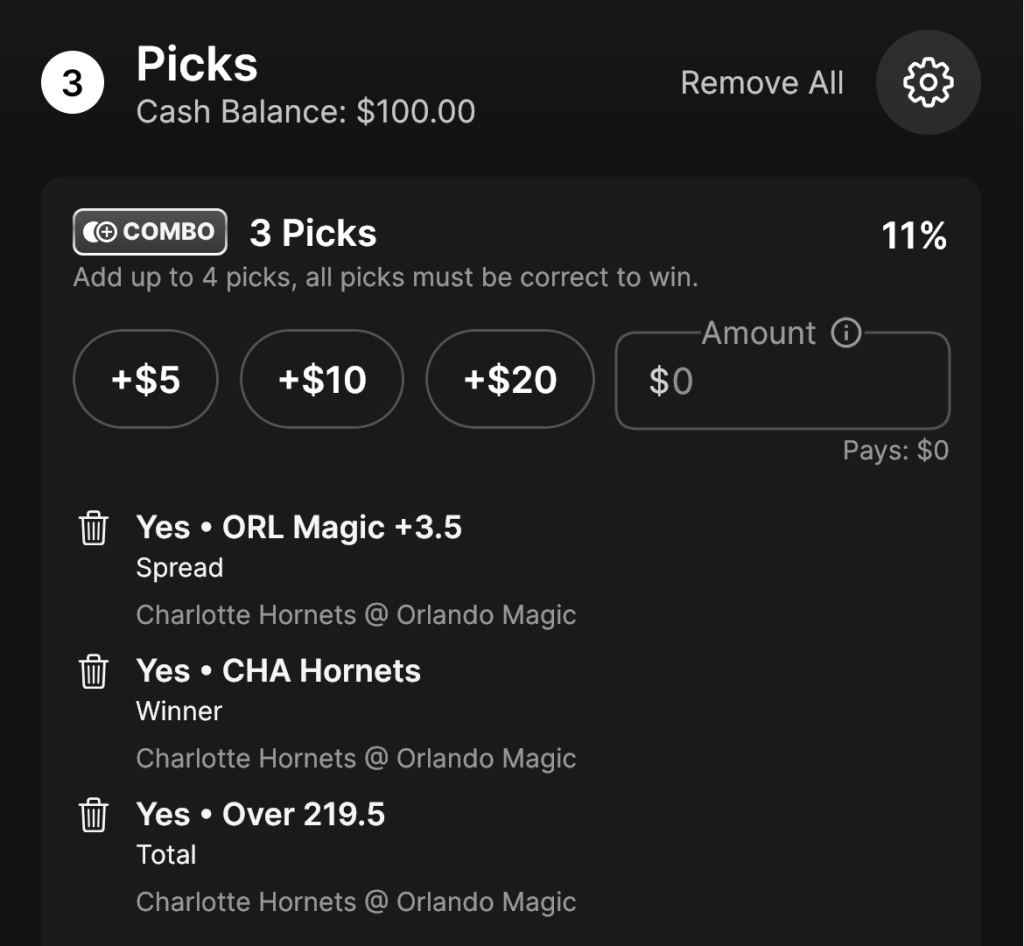
CFTC Chair Selig Speaks Before House Committee
CFTC Chair Michael Selig is speaking before the House Committee on Agriculture.
“I want to be very clear to anyone who engages in fraud, manipulation, or insider trading in any of our markets: We will find you, and the full force of our law will come to bear,” he said in his opening remarks.
He also added that the CFTC is “working to provide explicit guidelines and further investor protections for prediction markets, which fall under the exclusive jurisdiction of the commission.”
Trump Fed Pick Warsh Indirectly Owns Polymarket Stake
Kevin Warsh, President Donald Trump’s pick to lead the Federal Reserve, indirectly owns a stake in Polymarket, ethics disclosure documents reveal.
The Office for Government Ethics published Warsh’s Public Financial Disclosure Report Tuesday, and it outlines all of the prospective Fed chair’s assets and income streams.
Warsh, through a series of investment funds, owns shares in hundreds of tech companies.
Through the fund DCM Investments 10 LLC, Warsh owns a stake of unknown size in Polymarket, as well as in Melange, a “decentralized prediction market platform.”
The name of the fund is due to its links to DCM Ventures, a venture capital fund, rather than a reference to designated contract markets. Warsh’s investment at the fund is valued at between $250,001 and $500,000. Given that the fund itself is made up of shares of hundreds of companies, the stake in any individual company is likely to be small.
Warsh would be the latest senior figure associated with the Trump administration to have links to prediction markets. The president’s son, Donald Trump Jr., is an advisor to both Polymarket and Kalshi, and his investment fund owns a stake in Polymarket.
The Office of Government Ethics’ comment on the disclosure says that Warsh would be compliant with ethics rules if he divested certain assets, but not the indirect Polymarket stake. This means he may be able to continue to benefit from Polymarket’s growth as Fed chair.
Federal reserve decisions are among the most popular non-sports markets on prediction markets.
NEXTPredict.io Launches
NEXT.io is making the jump into prediction markets, announcing Wednesday the launch of a standalone media brand, NEXTPredict.io, as well as what it is calling “the world’s prediction markets summit.”
NEXTPredict Summit NYC will be held Oct. 22-23 at Convene, Hudson Yards in New York City.
The website will produce daily prediction market coverage and will operate separately from NEXT.io.
“The prediction markets industry is being formed in real time. What’s been missing is a central platform — a place where leaders, investors and operators come together to shape its future,” Pierre Lindh, co-founder and managing director of NEXT.io, said in a release. “With NEXTPredict, we’re building that home. A media platform that informs the market daily, and a summit that brings together the people driving it forward. We’ve spent more than a decade building trusted media and events businesses through NEXT.io. Now we’re applying that same DNA to a new industry that demands credibility, clarity and high-level connection.”
As for the summit, the plan is to bring executives, founders, investors, and policymakers to New York for “business-focused networking and content.”
Among others, Underdog CEO and co-founder Jeremy Levine, Sporttrade CEO Alex Kane, and Betr founder Joey Levy will be speaking at the event.
District Court Bars Arizona From Kalshi Criminal Enforcement
The United States District Court for the District of Arizona on Friday granted a temporary restraining order at the request of the Commodity Futures Trading Commission (CFTC) that barred Arizona officials from “continuing to pursue criminal charges against CFTC-regulated designated contract markets,” according to a release.
Arizona Attorney General Kris Mayes filed 20 charges against Kalshi on March 17, claiming the site was violating state betting and election wagering laws.
The CFTC has recently begun to aggressively attempt to shield prediction markets like Kalshi from and assert its authority against state-level regulation, joining these sites in insisting that they are regulated at the federal level. On Wednesday, the CFTC filed its request for the temporary restraining order in Arizona and issued similar complaints against Connecticut and Illinois.
“The CFTC appreciates the court’s careful consideration of these important legal questions and the court’s decision to preserve the status quo,” said CFTC Chairman Michael Selig. “Arizona’s decision to weaponize state criminal law against companies that comply with federal law sets a dangerous precedent, and the court’s order today sends a clear message that intimidation is not an acceptable tactic to circumvent federal law.”
CFTC Announces Innovation Task Force Staff
The Commodity Futures Trading Commission on Friday afternoon announced the initial roster for its Innovation Task Force (ITF), which will be charged with developing a “clear regulatory framework for innovators focused on crypto assets and blockchain technologies; artificial intelligence and autonomous systems; and prediction markets and event contracts.”
A senior advisor to Commissioner Michael Selig, Michael J. Passalacqua, formerly an attorney at Simpson Thacher & Bartlett LLP, will lead the ITF. As announced Friday, the five initial members are Hank Balaban, Sam Canavos, Mark Fajfar, Eugene Gonzalez IV, and Dina Moussa. More about each of them can be found at the CFTC’s website.
White House Warns Staff Against Prediction Market Bets
The White House last month warned all of its staff against using inside knowledge to make bets on prediction markets and the futures market, according to a report.
According to The Wall Street Journal, the White House Management Office sent a staff-wide email on March 24 warning employees against using information obtained in their roles to place bets on prediction markets.
The Wall Street Journal did not quote directly from the letter itself.
The day before the email was sent, President Trump announced a five-day pause on military strikes targeting Iranian energy infrastructure, following what he described as “productive” talks.
Just before the pause was announced, a handful of Polymarket users placed bets on a ceasefire and one oil futures trader took out a $950 million short position on the price of the commodity, which proved to be highly profitable.
Some commentators have speculated that the oil futures bet may have been an observer who noticed potential insider activity on prediction markets like Polymarket, rather than actually having insider information. Any trader taking such a large position on the regulated oil futures market would have to pass various know-your-customer checks with their broker or exchange, meaning that they could easily be identified if the trades were investigated. On crypto-based Polymarket, on the other hand, individual traders’ identities are not known even by the exchange.
Since the warning was sent, more potentially suspicious bets have been made concerning the war in Iran. According to the Associated Press, a group of around 50 new accounts on Polymarket placed bets — just before a ceasefire was announced — on whether the U.S. and Iran would reach such a deal on April 7. One user bet $72,000 and cashed out for a profit of $200,000. The identities of these users are not known.
Underdog Now Offering Kalshi Contracts
Underdog has started offering access to Kalshi’s event contracts alongside those of Crypto.com, the daily fantasy operator’s website shows.
A help page on Underdog’s website shows that Underdog offers access to Kalshi contracts as a futures commission merchant (FCM), UDM LLC, while continuing to offer Crypto.com’s contracts as a tech provider, via a partnership that started in September. The top of the page notes that it was “last updated over two weeks ago.”
The change was first reported by PredictionMarketPulse.
The page says that users “cannot switch between account types.”
UDM LLC was approved by the National Futures Association and Commodity Futures Trading Commission to act as an FCM on Jan. 9.
Last month, Underdog announced that it was buying Aristotle Exchange’s designated contract market (DCM) and derivatives clearing organization (DCO) wings. Aristotle is currently awaiting approval to be a DCM like Kalshi or Crypto.com.
An Underdog spokesperson did not immediately respond to a request for comment.
Polymarket To Upgrade Trading Engine, Launch New Stablecoin
Polymarket is overhauling its exchange infrastructure with a “rebuilt trading engine” and a change in the crypto token used for payments on its global site, it announced via social media post Monday.
Polymarket will launch its own stablecoin, Polymarket USD, to replace USDC.e as the main currency on the site. Both tokens are pegged to the dollar.
Polymarket will announce a “short maintenance window” at a to-be-determined date, during which all existing order books will be cleared. In a post on social media site X, Polymarket said the new trading engine “Optimizes and simplifies the Order struct[ure]” and “Optimizes matching orders.”
Fox Is Latest Media Giant To Integrate Kalshi Odds
Kalshi and Fox Corporation have confirmed that they will team up, with odds from the prediction market appearing across Fox News, Fox Business Network, Fox Weather, and the Fox One streaming platform.
The deal, reported by Front Office Sports last week and confirmed by press release Tuesday, is the latest prediction market media interaction, following partnerships between Kalshi and CNN and between The Wall Street Journal owner Dow Jones and Polymarket.
The press release announcing the newest partnership stated that Kalshi’s odds may be of interest to many people who have no intention of actually betting.
“Millions of people come to Kalshi each month, primarily, in fact, to see the forecasts,” it said. “Roughly 70% of people who visit Kalshi use the site to check market odds, while just 30% of people use it to trade.”
According to The Hollywood Reporter Senior Editor Alex Weprin, Fox News will not use Kalshi data for its election coverage.
CFTC Beefs Up Legal Team
The Commodity Futures Trading Commission (CFTC) is beefing up its legal team by naming two deputy general counsels, it announced by press release Friday. a day after it sued three states over prediction markets
Stephen D. Andrews will be deputy general counsel for regulation and M. Jordan Minot will be deputy general counsel for litigation.
“Stephen and Jordan will help enable the general counsel’s office to meet this significant moment as the CFTC engages in vital rulemaking and litigation to preserve and defend its regulatory authority,” Chairman Michael S. Selig said.
Andrews was general counsel to Senator Josh Hawley before joining the CFTC, while Minot worked in the Virginia Attorney General’s Office and previously clerked on the Seventh Circuit for then-Judge Amy Coney Barrett.
Utah Governor Says He’s Coming After Prediction Markets
There’s little need for nuance as a Utah politician dealing with gambling. All forms of it are banned by the state constitution.
Gov. Spencer Cox therefore came out in the 21st century version of guns blazin’ on the topic on Thursday, with a saucy tweet and a well-edited X video targeting prediction markets. The Republican hit on some legitimate points in the one-minute video, particularly the inherent dangers these platforms can pose to young adults with scant financial experience or impulse control. But his reliance on old bromides like “casino in every pocket” and the platforms “making billions off trying to destroy our kids” rang more like an opportunity to score easy political points.
Kalshi Deemed Itself A Gambling Platform In Trademark Application
Democratized revealer of truth?
Crowd-sourced investment marketplace?
Kalshi executives like CEO Tarek Mansour have described the prediction market operator as basically anything but a gambling platform in the past year, even as its sports events contracts — which very much resemble sports bets — have provided most of its business. And most of the controversy.
Turns out Mansour had an inkling what Kalshi was from the beginning. According to reporting by Sportico, Kalshi’s application to the Patent and Trademark Office in November 2025 requested that its intellectual property protection apply to the entire gambling industry.
Kalshi’s application indicated it was involved in the financial trading software, financial exchange services, and communication services industries. Company spokesperson Elisabeth Diana told Sportico that the gambling industry was included in order to be thorough.
She told Sportico:
“This is particularly important as companies in adjacent categories look to expand into prediction markets. A broader filing allows us to meaningfully protect the space and ensure that key terms are not used in ways that could blur distinctions between different products. This is not a characterization of our business as anything other than prediction markets.”
Blumenthal Appalled By MLB-Polymarket Deal
U.S. Sen. Richard Blumenthal isn’t enjoying his peanuts and Cracker Jacks at the old ballgame right now, as he has come out as a staunch opponent of the MLB-Polymarket deal.
“It is astonishing and appalling that Major League Baseball would, in effect, be complicit in this,” Blumenthal told Front Office Sports.
Blumenthal, a Connecticut Democrat, is putting his money where his mouth is, by introducing (along with N.J. Sen. Andy Kim) the Prediction Markets Security and Integrity Act back on March 11. It’s one of at least eight federal bills making the rounds right now concerning prediction markets. It would establish rules around insider trading and market manipulation and restrict certain types of markets. It would also classify sports event contracts as traditional sports betting.
“This is part of the public health crisis,” Blumenthal said. “It’s a concentrated and purposeful effort to circumvent state rules and laws that provide guardrails on sports betting.”
As for the Commodity Futures Trade Commission?
“The CFTC shouldn’t be regulating this,” Blumenthal said. “What does the CFTC know about sports betting? What they’ve done is taken the format of sports betting and just put it in a new app where there are less rules, and it’s allowing younger people in. It’s a form of what I have begun calling an ‘addiction conspiracy.’”
Blumenthal is also the co-author of the SAFE Bet Act, which was first introduced in 2024 and re-filed last year. That bill would severely curtail the ways sports betting companies could promote and operate their product.
Chase Might Offer Prediction Markets
If a prediction market wasn’t offering contracts on sports or politics, would anyone care?
That’s the question JPMorgan Chase CEO Jamie Dimon might be finding out, as he told CBS Evening News anchor Tony Dokoupil that he’s considering doing just that.
“It’s possible one day we’ll do something like that,” Dimon said. “We’re not gonna be in sports. We’re not gonna be in politics. There’s a bunch of stuff we won’t do. And obviously, we have strict rules around insider information.”
Then, Dokoupil asked the $64,000 question (or, according to Kalshi’s latest round of funding, the $22 billion question): Are prediction markets gambling, or investing?
“I think for the most part, it’s more like gambling,” Dimon said. “But there are areas where you could say, ‘No, it’s investing’: You are deeply knowledgeable. You’re taking the other side of a bet. And you think … you know better than the other person.”
Dimon made clear he’s also not against gambling.
“People have been gambling forever. … Every country I’ve ever been in, people gamble,” he said. “I’m against it if it’s an addiction that ruins your life type thing. I’m a little bit of a libertarian. You have the right to do what you want, the way you want. You know, just take care of yourself.”
Federal Court: Kalshi May Not Be Eligible For Arizona Relief Due To Anti-Injunction Act
A federal court in Arizona says Kalshi may not be eligible for an injunction to block its criminal charges in the state due to a law limiting federal courts’ abilities to enjoin ongoing state court actions.
The court is currently considering a request by Kalshi for an injunction that would stop authorities in Arizona from taking action against the business. State Attorney General Kris Mayes on March 17 filed criminal charges against the prediction market, making Arizona the first state to do so.
The court issued an order Saturday that says “the Anti-Injunction Act may bar this Court from providing the injunctive relief Plaintiff requests.”
804e3437-041f-4d62-87c6-bfc104d79dd2The Anti-Injunction Act says that a federal court cannot issue an injunction against ongoing state court proceedings unless it is either “expressly authorized” to do so by Congress, issuing the injunction is “necessary in aid of its jurisdiction,” or it must do so “to protect or effectuate its judgments.”
If the court rules that none of these three exceptions apply, it would not be able to issue Kalshi the injunction that it is seeking.
Both parties will submit briefs of up to five pages by Tuesday outlining their position on whether the Act applies, or if the case meets one of the three possible criteria for an exemption. They may then respond to the other party’s brief by Thursday.
NFL To Prediction Platforms: Please Punt Easily Rigged Markets
The NFL on Sunday asked prediction market platforms including Kalshi and Polymarket to refrain from offering sports event contracts that could be easily manipulated or where the outcome is determined in advance, according to ESPN.
This would include mention markets involving broadcasters or attendees at events such as the NFL Draft.
Commodity Futures Trading Commission (CFTC) Chairman Michael Selig, who has allowed prediction markets to further explore the amount of sports markets offered, told ESPN that he’d be amenable to considering the NFL’s concerns.
“If a league is telling us that a contract is going to be readily susceptible to manipulation and an exchange is still trying to certify that, of course we’ll evaluate the risks there,” Selig told ESPN. “But the leagues are very well positioned to make those calls and so we are going to afford a lot of deference to the leagues on these types of issues.”
Kalshi Secures License For Margin Trading
Kalshi on Friday secured a futures commission merchant (FCM) license through affiliate Kinetic Markets LLC, clearing the way for margin trading on the platform. CEO Tarek Mansour previously said a margin product is coming soon, noting that capital efficiency for institutional traders is the priority.
For any retail traders wondering if they can start trading on margin: not yet, and probably not anytime soon, if ever. This deal is aimed at hedge funds and brokerage clients. The indirect benefit for regular traders is better liquidity and tighter spreads as institutional money deepens Kalshi’s order books.
This announcement comes on the heels of Thursday’s news of further institutional adoption:
The lawsuits and the federal bills that would add guardrails or outright prohibitions, meanwhile, continue to pile up alongside all the deals and Kalshi’s growing valuation.
Sen. Murphy: NBA, NFL Affiliations With Prediction Markets Would Corrupt Them
United States Sen. Chris Murphy took to the Pablo Torre Finds Out podcast on Thursday to decry the explosion of gambling in this country in general and the rise of prediction markets specifically.
Murphy’s commentary wasn’t necessarily revolutionary, but noteworthy considering his national profile.
The Connecticut Democrat earlier this week co-introduced the BETS OFF Act, which would “ban wagering on government actions, terrorism, war, assassination, and events where an individual knows or controls the outcome” on prediction markets.
Much of Murphy’s criticism focused on prediction markets, however, and their commoditization of so many aspects of society and sports. This, he said, is having a corrosive effect on responsible-gambling measures, particularly for young males.
A week after MLB announced an exclusive partnership with Polymarket — joining the NHL in that type of pact — he warned the holdouts in the remaining big four American pro leagues to consider their reputations before following suit.
“If the NBA and NFL get in bed with these prediction markets, they are knowingly corrupting the sport,” he said.
Murphy lamented what he considered a loss of the purity of sports caused by the legal sports betting industry, which is live in his home state, and the way in which, in his opinion, gambling has consumed the experience, saying, “You can’t enjoy something for the sake of it.”
“SportsCenter is just a betting show now,” he said. “I’ve stopped watching it, in part, because it doesn’t seem for me any longer.”
PREDICT Act, Aimed At Political Insider Trading, Introduced
Another day, another prediction market bill dropped.
This one is the cleverly titled Preventing Real-time Exploitation and Deceptive Insider Congressional Trading Act (PREDICT Act), and it’s a bipartisan effort from Republican Rep. Adrian Smith of Nebraska and Democrat Rep. Nikki Budzinski of Illinois.
The act would ban senior government officials from trading in any political event prediction markets. This would include the president and vice president, Congress, political appointees, members of the judiciary, and countless others who may be attached to the above, such as spouses, dependent children, and people with fiduciary duties.
As to what constitutes a political event? That’s a little fuzzy in the bill, leaving the decision in the hands of the “supervising ethics office” which would “issue interpretive guidance.”
“Serving the American people is a privilege, not a pathway to profit,” Smith said in a press release. “Our commonsense, bipartisan bill will give Americans confidence that the decisions of their elected officials are guided by merit, not personal profit. I am proud to partner with Representative Budzinski to ensure that government officials do not profit from the sensitive information entrusted to them.”
Budzinski echoed the comments.
“The American people are tired of politicians using their influence for personal gain, and the rise of prediction markets has made those concerns even more relevant,” she said. “In recent months, we’ve seen instances of little-known traders making massive profits on events ranging from war with Iran to how long a government shutdown will last, raising necessary questions about the use of inside information. I am excited to be working with Representative Smith to close that loophole and ensure that those with access to sensitive information cannot profit from it.”
According to the text of the bill, violations of the act would result in forfeiture of profits as well as a civil penalty equal to 10% of the value of the transaction.
Polymarket To Start Charging Fees
Polymarket will start charging fees on its global exchange, with a structure that depends on both market category and price, but can hit as high as 1.8%.
The changes were announced by the business Monday, and will come into effect on March 30.
Polymarket had previously operated on a fee-free model. It then introduced fees on its short-resolving crypto markets, which are dominated by bots, but now has rolled out fees more widely. Geopolitics contracts will be the only category without fees.
Contract fees will be priced on a curve depending on their odds, similar to Kalshi’s fee structure, with fees as a percentage of contract value peaking at 50% odds and being lower for big favorites or longshots.
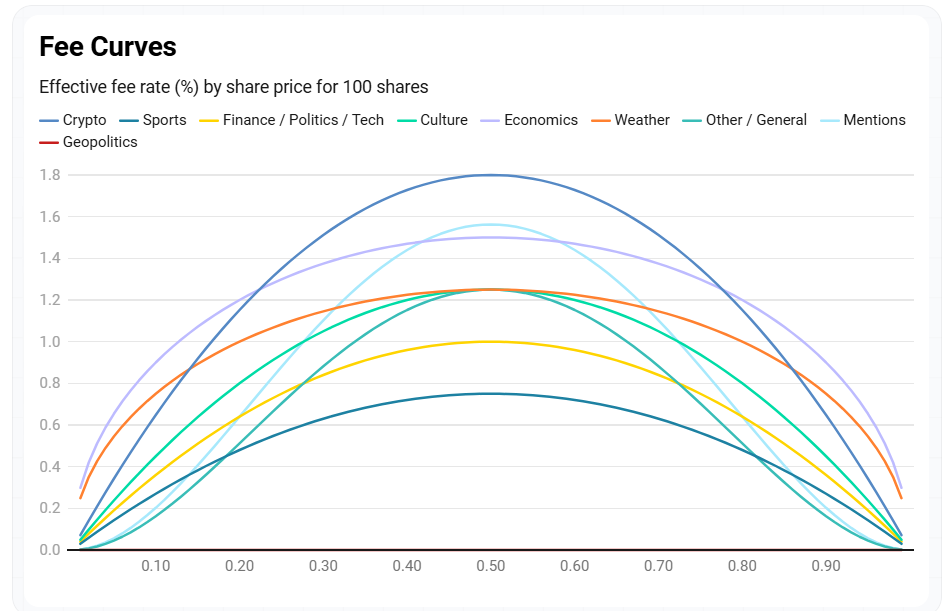
However, unlike Kalshi, the curve will also include a coefficient that changes depending on the contract’s category, while some categories also include an exponent to change how quickly the fee curve rises and falls as odds change.
Crypto contracts have the highest coefficient at 0.072, while weather contracts are lowest at 0.025. For sports contracts it will be 0.03. Mention markets and markets classed as “other/general” will have steeper-than-average curves, meaning that fees for contracts close to 50 cents will be higher and fees for contracts close to one cent or 99 cents will be lower, while economics and weather markets will be less steep.
For comparison, all Kalshi contracts have a coefficient of 0.07, meaning Polymarket fees will be lower for most categories.
The highest possible fee is 1.8%, for a crypto contract bought at 50% odds.
Kalshi To ‘Preemptively’ Block Political Candidates And Athletes
Kalshi will now “preemptively” block political candidates and athletes from trading on markets about their actions.
The new measures were announced in a blog post Monday by Kalshi Head of Enforcement Bobby DeNault.
Kalshi’s rules already banned political candidates and athletes from betting on their own markets, but it was only able to deal with insider trading after the fact.
With the rule change, these bettors should now not be able to bet in the first place.
Kalshi said it already uses preemptive blocking for users that are elected officials, but it is not expanding that to candidates for office.
The athlete blocking comes after “months of collecting and developing screening lists for both collegiate and professional sports leagues, and in partnership with our partners at IC360,” the post said. Alongside athletes themselves, referees and team employees will be blocked too.
“The guardrails we built use state-of-the-art technology and screening lists, but no screening system is perfect, and motivated bad actors consistently try to find a way,” it added. “To that end, we are also adding a whistleblower functionality straight in our market page, which makes it easier for our community to flag potential violations as they go through our public trading data.”
Rahm Emanuel Backs Government Prediction Market Ban
Former Chicago Mayor and White House Chief of Staff Rahm Emanuel is reportedly working on a bill to ban government employees from trading on prediction markets.
According to The Associated Press, Emanuel shared a proposal that would ban leaders and employees across the executive, legislative, and judicial branches of the federal government, as well as their families, from trading on prediction markets.
Emanuel — who was also U.S. ambassador to Japan from 2022 until 2025 — is not currently a member of Congress, and so cannot introduce a bill himself.
The proposal appears to be similar to a bill introduced by U.S. Sens. Jeff Merkley and Amy Klobuchar earlier this month. That bill is one of seven that have already been proposed in the House or Senate this year. On Monday, Sen. Adam Schiff and Sen. John Curtis proposed a bill to ban sports contracts on prediction markets.
Polymarket Adds New Insider Trading Rules
Polymarket has introduced new rules designed to clamp down on insider trading, the company announced in a press release Monday.
The rules will apply not only to Polymarket’s U.S. exchange, but also to its global blockchain-based platform, which has processed several trades that have been widely noted as suspicious, related to such events as the war in Iran and the capture of Nicolas Maduro.
“Markets thrive on clarity,” said Neal Kumar, chief legal officer for Polymarket. “These rule enhancements make our expectations abundantly clear for every participant across both platforms and highlight the compliance infrastructure we have already built. As Polymarket continues to scale, we will build on our foundation with clear communication to Polymarket’s users to ensure our markets do what they do best — surface truth.”
The rules list three categories of prohibited insider trading:
- “Trading on stolen confidential information — Participants may not trade on any contract if they possess confidential information about the outcome or likely outcome of the underlying event, where using that information would violate a preexisting duty or obligation of trust or confidence owed to another person or entity.
- “Trading on illegal tips — Participants may not trade on confidential information passed to them by someone who owed a preexisting duty of trust or confidence to someone else, if they know or have reason to know that the person who shared the information would be prohibited from trading on it themselves.
- “Trading by those who can influence the outcome — Participants may not trade on any contract if they hold a position of authority or influence sufficient to affect the outcome of the underlying event.”
While those changes are not significantly different from the existing rules for Polymarket’s U.S. exchange, which is subject to CFTC insider trading rules, it is a change from how its global exchange has operated. On the blockchain-based exchange, market manipulation is against the rules, but most forms of insider trading were permitted until this latest change.
The press release added that the global platform’s on-chain format “provides built-in transparency,” because individual trader activity is public.“ When Polymarket or the community identifies unusual or potentially questionable trading activity, Polymarket may initiate a review and pursue disciplinary action, including banning wallet addresses and referring the user and matter to law enforcement,” the release said.
Polymarket Buys Crypto Wallet Provider Brahma
Polymarket has acquired Brahma, a cryptocurrency wallet provider, the businesses announced Wednesday.
The deal will help Polymarket, which is built on the Polygon blockchain, expand its cryptocurrency infrastructure. Brahma has built real-time execution and settlement technology for cryptocurrency trades, and Polymarket is likely to incorporate that technology into the trading and settlement process for its event contracts.
Brahma will phase out its general-use products, in favor of building its products for Polymarket specifically. In an announcement of the deal, Brahma’s leadership team said it would now “dedicate itself to evolving Polymarket’s stack and product suite.”
Fortune first reported the acquisition.
Report: Fox Corporation And Kalshi Negotiating Partnership Deal
Kalshi and Fox Corporation are in what Front Office Sports described on Wednesday as “serious” discussions for a “significant partnership.”
Kalshi entered deals in December with CNN and CNBC to integrate betting data for political, economic, and news markets into their content. According to FOS, this pact would involve Fox News and Fox Weather. With prediction markets embroiled in defending the legality of sports event contracts, the partnership, according to FOS, would not touch sports programming.
Arizona Files Criminal Charges Against Kalshi
Arizona’s Attorney General Kris Mayes has filed criminal charges against Kalshi, making the state the first to do so.
The state announced Tuesday that it had charged Kalshi with 17 counts of violating the state’s laws on betting and wagering and three counts of violating its election wagering laws.
Other states such as Nevada and Massachusetts have brought civil proceedings against Kalshi, but none has brought criminal charges.
The charges come despite Kalshi suing Arizona in federal court on March 12 to prevent the state from enforcing its sports betting laws against the business. Kalshi is seeking an injunction and temporary restraining order to pause enforcement while the court considers the case, but the judge has not yet made a decision on whether to issue those orders, allowing Arizona an opportunity to file charges.
“Kalshi is making a habit of suing states rather than following their laws. In the last three weeks alone, the company has filed lawsuits against Iowa and Utah, and now Arizona,” Mayes said via press release. “Rather than work within the legal frameworks that states like Arizona have established, Kalshi is running to federal court to try to avoid accountability.”
Argentina Bans Polymarket
Polymarket has been prohibited from doing business in Argentina, a nation of more than 46 million, after the ruling of a Buenos Aires court. The news was first reported by The Buenos Aires Times.
Judge Susana Parada determined that the prediction market constituted an illegal gambling platform.
Internet service providers are now under order to block access to the site and Google and Apple are mandated to at least limit access. Polymarket has been under particular scrutiny in Argentina because of activity on a market tied to the country’s release of inflation data.
Senators Submit CFTC Rulemaking Response, Call For End To ‘US Adversary Out Of Office’ Markets
Sens. Jack Reed and John Hickenlooper have written to CFTC Chair Michael Selig, calling for a ban on contracts that “predict whether a U.S. adversary will no longer be in office,” due to the likelihood that they would ultimately be resolved by acts of war.
Reed and Hickenlooper were the first parties to submit a response to the CFTC’s proposed rulemaking notice on event contracts. Their letter was published by the CFTC Monday, though it was dated March 5.
114070United-StatesSenatorsThe notice included more than 150 questions, covering almost every area of event contract rules.
The senators focused on event contracts on war. CFTC rules reference a “prohibition” on contracts involving war, terrorism, or assassination. The CFTC hasn’t always treated the rule in question as an outright ban, but no regulated prediction market offers contracts on direct acts of war.
The letter from the two senators said that “this category includes event contracts that predict whether a U.S. adversary will no longer be in office, such as Ayatollah Khameini in Iran, Nicolas Maduro in Venezuela, or Miguel Diaz-Canel in Cuba.”
“Because these leaders are so entrenched and protected by vast military forces, their continued leadership is perceived to be completely insulated from removal except by armed intervention,” it said. “As a result, event contracts referencing their ouster ‘involve or relate to’ war.
“These contracts are so dangerous to the national security of the United States and so offensive to U.S. values that they far outweigh any legitimate risk-management purpose.”
The letter added that the CFTC’s insider trading rules for prediction markets need to be stronger.
“Insiders face little risk of penalty under the CFTC’s current enforcement program,” it said. “The insider trading laws for commodities markets are underdeveloped compared to analogous laws in securities markets. To date, the CFTC has not brought a single enforcement case involving prediction markets. All the CFTC has done is issue a press release highlighting two minor infractions that were addressed internally under Kalshi’s own terms and conditions, one involving $246.36 in illicit profits and another involving $5,397.58. That signals a lax oversight regime and will not deter insider trading.”
Kalshi Adds First Non-Sports Market To Parlay Builder
Kalshi has added contracts on the price of Bitcoin into its combo builder product, meaning that users of its app can create a parlay of sports and non-sports outcomes for the first time.
Users can now parlay whether the price of Bitcoin falls below $70,000 tomorrow with outcomes such as Luka Doncic’s points total or whether the Kentucky’s basketball team beats Missouri by more than 3.5 points.
Daily Bitcoin price markets are currently the only non-sports market in the combo builder.
In November, Kalshi self-certified parlays that would be made up entirely of politics or economics contracts, but it does not appear to have offered these widely.
CFTC And SEC Announce MOU To Avoid ‘Turf War’
The Commodity Futures Trading Commission (CFTC) and Securities and Exchange Commission (SEC) announced a new memorandum of understanding in order to prevent what they call “a ‘turf war’ mentality that would plague collaboration.”
SEC_CFTC_MOU031126The agreement, announced Thursday morning, is the latest sign of collaboration between the two major financial regulators. That collaboration has increased under CFTC Chair Michael Selig, who previously worked at the SEC.
The memorandum was light on specifics but it said that the two regulators would meet regularly to discuss “issues of regulatory interest to either or both parties,” share data, and notify one another of proposals to trade novel products.
“This Memorandum of Understanding solidifies the agencies’ commitment to harmonize regulatory frameworks to provide comprehensive and seamless financial market oversight,” Selig said in a press release. “By working together, we’ll eliminate duplicative, burdensome rules and close gaps in regulation for the benefit of all Americans and usher in a Golden Age of American finance.”
CFTC-registered prediction markets have offered some contracts on company earnings or stock indices like the S&P 500, but have so far held off on offering contracts related to individual stocks, which might get closer to SEC territory.
Judge In Kalshi Vs. Ohio: Sports Event Contracts Gambling, States’ Purview
U.S. District Court Judge Sarah Morrison on Monday refused an injunction request by Kalshi that would have prevented the Ohio Casino Control Commission from taking action against the prediction market for offering sports event contracts, which it considers illegal, unlicensed gambling.
Morrison swatted back Kalshi’s claims that these contracts are a form of swaps that are and should remain regulated at the federal level by the Commodity Futures Trading Commission (CFTC).
Morrison countered that swaps are “understood as a transaction involving financial instruments and measures that traditionally and directly affect commodity prices. … Currency exchange rates, the weather, and energy costs all do that. The number of points scored in the Huskies-Bobcats game does not.”
“This conclusion is further supported by the Court’s obligation to avoid absurdity,” Morrison added. “Ohio argues that absurd results would flow from defining a ‘swap’ to include a sports-event contract. The Court agrees.”
Ohio Attorney General Dave Yost was pleased.
Michigan Judge Denies Polymarket Temporary Restraining Order
Polymarket’s request for a temporary restraining order (TRO) that would have allowed it to continue offering sports event contracts on its prediction market in Michigan was denied on Tuesday by U.S. District Judge Paul L. Maloney.
Polymarket filed a lawsuit in the U.S. District Court for the Western District of Michigan last week attempting to keep the state from enforcing its position that sports event contracts constitute unlicensed gambling.
While Polymarket’s suit and TRO request were to prevent, it claimed, “unlawful state overreach, preserve the integrity of the federal regulatory framework, and avert imminent harm that cannot be remedied after the fact,” Maloney was unswayed that enforcement would produce ““immediate and irreparable injury.”
Jake Paul’s Betr To Offer Polymarket Contracts
Betr, the “social sportsbook” and daily fantasy platform founded by Jake Paul and Joey Levy, is set to launch Polymarket’s event contracts through its app as part of a “multi-year deal,” the business revealed Wednesday.
In a press release, Betr announced that it would offer event contracts “across sports, politics, culture, and more.” Currently, Polymarket’s U.S. site only includes sports contracts. The press release did not mention a launch date besides that the partnership would be “beginning in 2026.”
“Since starting Betr, we have built our business entirely around serving the modern sports fan at scale,” said Levy, founder and CEO of Betr. “Launching Predictions is an important step toward our vision of creating the first true nationwide real-money gaming and financial super app, integrating a category projected to reach $1 trillion in annual volume into the same seamless experience as Picks, Sportsbook, Casino, and Arcade.
“There is no better partner than Polymarket to power this expansion, given their category leadership and deep connectivity across the sports ecosystem.”
As first reported by InGame, Betr applied to the National Futures Association (NFA) for introducing broker status — the same status as DraftKings and Fanatics — under the name Betr Predictions last year. However, the application has not yet been approved.
Polymarket founder and CEO Shayne Coplan said: “Prediction markets are becoming a foundational tool for understanding the future, and scale is what brings them into the mainstream.
“Betr has built one of the most engaged sports audiences in the country, and their ability to engage millions of users makes them the ideal partner to bring prediction markets to a massive new audience. This partnership allows us to scale our infrastructure and continue bringing the power of prediction markets into the daily experience of sports fans across the country.”
CFTC Submits New Prediction Market Rules To White House
The CFTC has submitted advanced notice of new rules for prediction markets for review by the White House.
The White House Office of Information & Regulatory Affairs (OIRA) listed a CFTC rule change titled “prediction markets” among its executive order submissions under review Wednesday. The filing shows the rule change was received Monday and is pending review.
Details of the rule change are not yet available. The OIRA filing simply says, “This rule has not been published in a Unified Agenda.”
In January, CFTC chair Michael Selig said he was directing the agency to write new rules for prediction markets, but did not reveal what they might include.
Associated Press To Provide Election Data To Kalshi
The Associated Press (AP) will provide its election results data to Kalshi, allowing Kalshi users to see vote counts from the AP as they come in, and race calls when they are made, the media agency announced via press release Monday.
The integration is the latest between a media outlet and a prediction market, but this one will mean information from the AP appears on Kalshi’s website, as opposed to prediction market odds appearing on a media platform such as CNN or Substack.
“The Associated Press for nearly two centuries has played an essential role in the American democracy as the most authoritative source for accurate results on election night,” AP Elections Vice President David Scott said. “We’re pleased to be working with Kalshi as we work to expand the reach of AP’s trusted elections data, meeting audiences where they are with reliable information about who voters have chosen to lead their country and communities.”
The partnership comes ahead of the primaries for the 2026 midterm elections. Voting for primaries in Texas, North Carolina, and Arkansas will take place Tuesday, with more primaries to follow through the year.
Kalshi Head of Politics Jaron Zhou said: “This collaboration will further Kalshi’s goal of being the premier destination to experience elections, combining AP’s trusted vote results with our transparent, market-based forecasts, creating a more complete picture of election night.
“Kalshi’s election forecasts help campaigns and everyday citizens track market expectations for election outcomes, and integrating AP’s live vote count data enhances Kalshi’s election night experience by bringing together real-time vote tallies and market activity.”
CFTC Chairman Selig Adds Three Senior Staffers
Commodity Futures Trading Commission (CFTC) Chairman Michael Selig announced three senior staff appointments on Monday.
Alan Brubaker was appointed to serve as director of the Office of Legislative and Intergovernmental Affairs, bringing experience from the House Oversight Committee under Kentucky Congressman James Comer, who serves as chairman. Brubaker has also served as vice president of external affairs for Prudential Financial.
Selig also tapped Mel Gunewardena as director of the Office of International Affairs and Senior Markets Advisor to the Chairman, returning to the CFTC after leadership roles at Goldman Sachs, Deutsche Bank, and the UK Financial Conduct Authority.
“I am honored to join Chairman Selig’s senior leadership team to advance his pro-innovation agenda and to lead the Commission’s international engagement initiatives,” said Gunewardena. “I am committed to helping ensure the United States, as the world’s largest commodities and derivatives market, remains the most competitive and attractive marketplace as it serves the interests of farmers, ranchers, drillers, miners, and commercial and institutional participants. In my role as senior markets advisor to the Chairman, I look forward to delivering data-driven, forward-looking insights on market structure and risk management, and providing guidance during periods of uncertainty.”
In addition, Selig has installed David I. Miller as director of Enforcement. Miller joins the CFTC from private practice, having served as a litigation partner at two global law firms, Greenberg Traurig and Morgan Lewis.
Anti-Prediction Market Advocacy Group Launches, Calls On Platforms To Follow State And Tribal Laws
President Trump’s former chief of staff and a group of conservative advocacy groups have teamed up to form a new anti-prediction-market coalition named Gambling Is Not Investing.
Gambling is Not Investing is led by Congressman Mick Mulvaney, who was the acting White House chief of staff from 2019 to 2020.
Its members are Consumer Action for a Strong Economy, Frontiers for Freedom, the Hispanic Leadership Fund, and Moms for America.
“Gambling products — regardless of what you call them — must follow established state and tribal laws,” Mulvaney said. “Rebranding sports wagering as ‘trading’ or ‘investing’ or ‘predicting’ misleads consumers, undermines responsible gaming protections, and weakens the state and tribal systems built to protect the public and fund vital community services.”
Flutter CEO Jackson: Prediction Markets Aren’t Taking Revenue From Sportsbooks
Peter Jackson, CEO of FanDuel owner Flutter Entertainment, says the company has reviewed whether prediction markets are cannibalizing sportsbook revenue, and determined that they are not taking significant revenue away.
In the company’s 2025 full-year earnings announcement that was shared Thursday, he wrote: “We undertook a comprehensive review of potential cannibalization from prediction markets and we have not identified any evidence of any meaningful impact,” he said. “The review combined industry channel checks, third party data analysis of deposits, actives, and app download trends, and detailed analysis of FanDuel customer trends.
“Based on this robust analysis, we estimate the potential handle growth impact to be in the low single digits percentage points and we are confident that the prediction markets have not been a significant driver of the moderating customer and handle trends we have observed.”
Jackson added that prediction markets were a significant opportunity for FanDuel, and said he believed they will accelerate sports betting legalization. He added that FanDuel was looking into market making on its prediction market platform.
CFTC Says Kalshi Inside Traders ‘Potentially Violated’ Commodity Trading Laws
After Kalshi revealed the results of two insider trading investigations, the Commodity Futures Trading Commission (CFTC) issued an advisory on the cases Wednesday.
It said the politician who bet on himself “potentially violated” Commodity Exchange Act (CEA) rules about market manipulation, while the employee for a YouTube channel – reportedly an editor for MrBeast – “potentially violated” rules around trading based on insider knowledge in breach of a pre-existing duty.
The Commission did not say whether it was taking any action, but it said it “has full authority to police illegal trading practices occurring on any DCM, including those described above related to prediction markets.”
Kalshi Fines, Temporarily Bans Two Insider Traders
Kalshi revealed Wednesday it has fined and temporarily banned two users for violating its insider-trading rules, the first time it has publicly revealed the results of investigations.
The prediction market announced the disciplinary actions via a press release.
The first case “concerns a candidate who traded about $200 on his own candidacy for governor of California, then posted about it on social media.” Kalshi said the trades occurred in May. Kalshi’s announcement did not name the candidate, but that month, longshot Kyle Langford bet on himself to be governor of California.
The user was banned for five years and will pay a financial penalty 10 times the bet size, or $2,000.
The second case was “an insider who traded about $4,000 on YouTube streaming markets.” This user will be banned for two years and receive a financial penalty five times the initial bet size, or $20,000.
“In both of these cases, our systems flagged the trades and our surveillance team froze the traders’ accounts,” Kalshi said. “Neither trader withdrew any profits. These penalties are not indicative of future penalties — everything depends on the case, including amount traded and rules violated.”
Kalshi also reported both cases to the Commodity Futures Trading Commission (CFTC), though from the details provided, it is not clear whether they would violate the CFTC’s own intentionally narrow, insider-trading rules.
Court Filing From Ex-Fanatics Exec: Operator Has Agreed To Buy DCM, And Founder Rubin Invested In Kalshi
Fanatics has reportedly agreed to terms to buy an exchange of its own, and its founder Michael Rubin and CEO for Betting and Gaming Matt King both invested in Kalshi, according to a court filing in a case concerning the company’s attempt to stop Chief Business Officer Ari Borod from leaving Fanatics for Polymarket.
Polymarket announced Thursday that it had hired Borod from Fanatics, but a lawsuit filed in Florida shed some light on details behind the scenes. Details of the lawsuit were first reported by Front Office Sports.
After Borod agreed to leave Fanatics, the operator sued him in a Florida court on Jan. 12, arguing that he had violated a noncompete agreement by moving to a competitor.
Fanatics’ complaint was filed under seal, but a Jan. 29 response from Borod, where he makes the case that Polymarket is not a direct competitor to Fanatics, is public.
That filing contains a number of notable claims about Fanatics’ involvement in the world of prediction markets. It says that Borod was of the understanding that Rubin and King had invested in Kalshi before the launch of Fanatics Markets.
In addition, it says a team at Fanatics has agreed to purchase a designated contract market (DCM), which would allow it to run its own exchange rather than directing customers to contracts made available on an existing exchange. Fanatics Markets currently directs customers to Crypto.com’s contracts. The filing suggests that Fanatics had revealed its deal with an existing DCM in its initial complaint.
“I was genuinely unaware, prior to this lawsuit, that FMX had agreed to terms with a target exchange,” the filing said. “To date, I still do not know the principal financial and commercial terms of the deal, or the name of the target exchange.”
Filings show that Fanatics and Borod agreed earlier this month to settle the lawsuit.
A Fanatics spokesperson told InGame: “The parties have reached an out-of-court resolution of their dispute and have no further comment.”
Novig Exchange Announces $75 Million Series B Investment Round
Novig on Wednesday announced the close of a $75 million Series B investment round, a month after the sweepstakes-based, peer-to-peer, betting exchange applied to become a designated contract market (DCM) with the Commodity Futures Trading Commission.
The investment round was led by Pantera Capital, according to a release, with further support from Multicoin Capital, Makers Fund, Edge Equity, and existing investors Forerunner, Perceptive Ventures, and NFX.
Novig has now raised in excess of $105 million after proclaiming a tenfold trading-volume increase in 2025. The company claims an annualized trading volume of more than $4 billion, with the majority coming on sports events contracts.
“Novig is proving that prediction markets can fundamentally reshape sports betting by removing the exploitative middleman,” Paul Veradittakit, managing partner at Pantera Capital, said in a release. “Their peer-to-peer exchange delivers what traditional sportsbooks can’t: better odds, fairer market structure, and alignment between platform success and user profitability. When 23% of users are profitable compared to 2% on traditional platforms, it’s clear this is a foundational change to the industry. We’re excited to lead this round and support Jacob, Kelechi, and the team as they build a sports prediction market that actually puts bettors first.”
Kalshi Denied Administrative Stay In Nevada Lawsuit
The U.S. Court of Appeals for the Ninth Circuit on Tuesday denied Kalshi an administrative stay that would have allowed the prediction market to keep offering sports contracts in Nevada, though it may still be able to remain active if it receives a regular stay.
An administrative stay is a short-term order to pause enforcement while a court considers a regular motion for a stay.
On social media site X, Andrew Kim, a Partner at Goodwin Law who has followed the various prediction market litigations but is not directly involved, wrote that it was too soon to comment on the significance of the decision because Kalshi’s main motion for a stay is still pending.
“Until the Ninth Circuit acts on the main stay motion, it’s hard to tell what, if anything, to make of this,” he wrote. “Could be that the panel just thought the administrative stay was unnecessary, in light of whatever it’s going to say about the main motion.”
Kalshi is seeking a stay from the Ninth Circuit after the U.S. District Court for the District of Nevada dissolved a previously granted injunction that had prevented the state of Nevada from enforcing a cease-and-desist against the business.
Also in the Ninth Circuit, the Commodity Futures Trading Commission (CFTC) today filed an amicus brief in support of Crypto.com, which was denied a similar injunction last year, according to a social media video from CFTC Chair Michael Selig. That brief is likely to appear on the public docket for the case tonight.
Netherlands, New Zealand Ban Prediction Markets
Officials in both the Netherlands and New Zealand this week announced that prediction markets constitute illegal gambling according to local laws.
The gaming authority Kansspelautoriteit (‘KSA’) in the Netherlands said Tuesday that if Polymarket did not cease activity there, regulators would impose a penalty payment of €420,000 ($498,000) per week, with a maximum of €840,000. In New Zealand, regulators are taking a lighter touch at the moment.
“We prioritize contacting websites that actively market themselves to New Zealanders, or which have conspicuous New Zealand elements on their sites (e.g. pre-populating sign-up forms with New Zealand as country of origin and setting the default currency to NZD),” Department of Internal Affairs gambling director Vicki Scott told Newsroom. “Neither Kalshi or Polymarket do that. However, we intend to send them a notification for the sake of clarity.”
The website added that Kalshi has added New Zealand to its list of blocked countries as of Tuesday, while it is unclear if Polymarket has taken the same action.
Ella Seijsener, director of permits and supervision at the KSA, said: “Prediction markets are on the rise, also in the Netherlands. This type of business offers bets that are not allowed in our market anyway, not even by licensees. In addition to the social dangers of this type of prediction (e.g. the possible influence of elections), we find that this is illegal gambling. Those who do not have a license from the KSA have nothing to do with our market. The same goes for these kinds of new gambling platforms.”
Regulators in about 33 jurisdictions across the world have banned Polymarket, while Kalshi has self-blocked in roughly 50, and their maps overlapping substantially. Both companies are currently restricted in Australia, Belgium, Canada, France, Italy, Poland, Singapore, and the United Kingdom.
Selig Says In New Video CFTC Has Filed Ninth Circuit Amicus
Commodity Futures Trading Commission (CFTC) Chair Michael Selig defended the CFTC’s jurisdiction over prediction markets in a new social media video and said the regulator had filed an amicus brief arguing that states do not have the authority to regulate the products.
In a video posted to social media site X Tuesday, Selig said that the regulator has filed a “friend of the court,” or amicus curiae, brief “to defend its exclusive jurisdiction over these derivative markets.”
“To those who wish to challenge us in this space, let me be clear — we will see you in court,” Selig said.
On Monday, the CFTC chair penned an op-ed in the Wall Street Journal outlining a similar sentiment. In that op-ed, he said the amicus brief would be filed in Crypto.com’s lawsuit against Nevada in the U.S. Court of Appeals for the Ninth Circuit. That appeals court case followed a judge’s decision to deny the business an injunction that would have allowed it to keep offering sports contracts in the state of Nevada. The amicus brief is not yet available on the public docket for the case.
Selig’s video does not specifically mention sports event contracts — which have been the subject of all the state lawsuits — at any point. Instead, he referenced contracts on weather and current events.
Last month, Selig said the CFTC would make its voice heard in prediction market lawsuits.
Update: Utah Governor Spencer Cox publicly responded to Selig’s challenge, and he did not mince words.
DraftKings’ Robins Says Predictions Are Not Cannibalizing Sportsbooks
DraftKings CEO Jason Robins says the company’s sportsbook offering is not being cannibalized by prediction markets at this point.
In his letter to shareholders accompanying DraftKings’ annual results Thursday, he noted that adoption was high in Missouri, which launched legal sports betting in December, despite the rise of prediction markets.
“To date, we are not seeing a discernible impact from Predictions on our revenue,” Robins wrote. “In our newest Sportsbook state, Missouri, adoption of our offering was higher than in any state launch in our history through the first two months, and activity per customer has been strong.
“In the fourth quarter, our overall Sportsbook handle growth accelerated to 13% year-over-year. In January, our Sportsbook handle increased 4% year-over-year, even after two consecutive months of sportsbook-friendly outcomes and as our parlay handle mix continued to surge.”
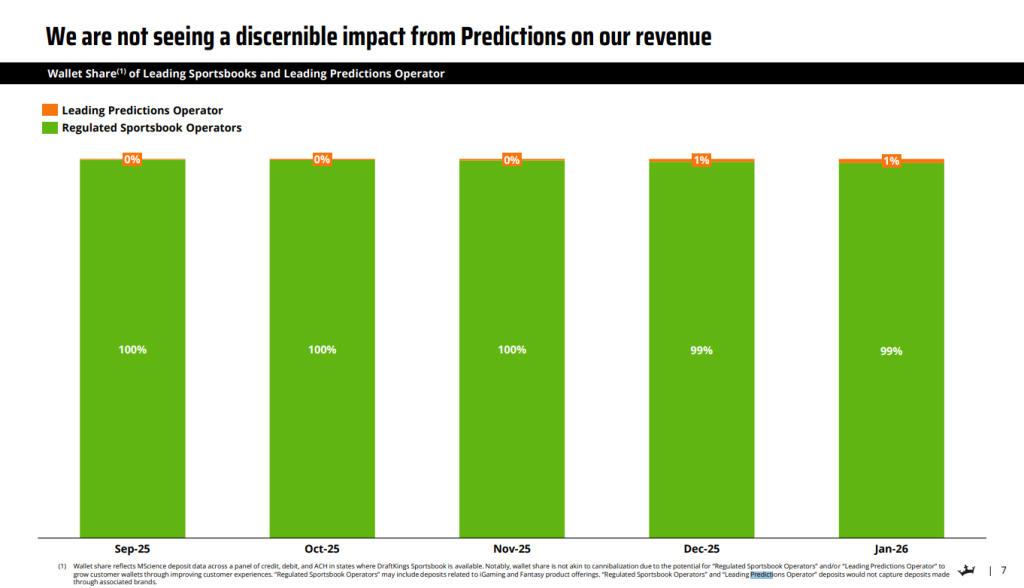
Robins also backed Commodity Futures Trading Commission (CFTC) Chair Michael Selig’s plan, announced last month, to write new event contract rules.
“We support the CFTC’s engagement on event contracts and the advancement of a more defined and durable regulatory framework,” he wrote. “The CFTC Chair recently directed agency staff to establish clear standards for event contracts to provide certainty for market participants. We view this direction as constructive.
“Clear rules should reward operators with strong compliance and responsible engagement infrastructure, and support the expansion of sports-related Predictions over time.”
DraftKings Will Spend Big To ‘Acquire Millions Of Customers’ For Prediction Market
DraftKings CEO Jason Robins said Thursday that the business is going to spend big on acquiring customers for its prediction market, and that the vertical will generate “hundreds of millions in annual revenue” in the years ahead.
In a letter to shareholders accompanying DraftKings’ annual results, Robins said the company was going to “deploy growth capital” in the space, but did not reveal how much it would spend. Last year, FanDuel owner Flutter Entertainment said it expected to post a $200 million loss from its own prediction market in 2026, suggesting its spending would be well above the $200 million mark.
“Predictions is rapidly developing into a massive, incremental opportunity, and we are moving with urgency,” Robins wrote. “We expect to emerge as the leader in this nascent category.
“We plan to deploy growth capital to build the best customer experience in Predictions and acquire millions of customers. This year, we anticipate significant step-function improvements to our Predictions offering including the integration of Railbird and launch of our market-making division.
“We are targeting hundreds of millions in annual revenue for DraftKings Predictions in the years ahead, and we believe there is much more upside over the long-term.”
He added, however, that the company is still months away from launching its fully-owned exchange, Railbird, which it bought in October. Currently, DraftKings’ prediction market offers users access to contracts from Crypto.com and CME instead. Robins said Railbird will go live “near the middle of this year.”
Robins added that DraftKings would offer parlays on its prediction market too at some point in the future.
“Over time, we also intend to introduce exclusive combination trading options that may become a major differentiator as the customer experience evolves,” he wrote.
Robins also confirmed that DraftKings will start making markets on both its own exchange and others. InGame reported last week that DraftKings was hiring for this team.
Israeli Authorities Arrest Two For Polymarket Bets
Israeli authorities have arrested two people for allegedly making bets on Polymarket using “classified information.”
The Israeli Defense Ministry (IDF), police, and the Shin Bet domestic security agency issued a joint statement saying that two people — an army reservist and a civilian — had been arrested in connection with bets placed on Polymarket.
The bets concerned “the occurrence of military operations, based on classified information to which the reservists were exposed as part of their military duties.”
The statement added that insider bets based on classified information create “a real security risk to IDF activities and state security.”
The insider bets in question were not identified, but in June of last year observers noted a number of suspicious bets related to Israeli military activity. Israel’s Public Broadcasting Corporation noted last month that one account had made a profit of around $150,000 by betting on markets such as “Israel military action against Iran before Friday?” and “Israel strike on Iran on June 24?”
The identities of those involved cannot be revealed due to a gag order.
In his Secure Stakes newsletter, security and sports integrity expert Matthew Wein noted that he believed this to be “the first case in the world of someone being charged criminally for insider trading on a prediction market.”
Offshore Sportsbooks And Prediction Markets Are Converging
Behold, some evidence via Dustin Gouker of the launch of “MyBookie Predictions,” located in Costa Rica and serving (illegally) customers across the United States.
Apparently, the company is co-opting the lexicon of prediction markets — if it is not going further and seeking a DCM license via the Commodity Futures Trading Commission to operate within the the U.S. Given the agency’s current laissez-faire posture around sports events contracts, I would not entirely eliminate the possibility of MyBookie Predictions gaining entry stateside.
NCPG Calls On Prediction Market Operators To Promote Problem Gambling Helpline
The National Council of Problem Gambling (NCPG) has called on prediction market operators to promote its National Problem Gambling Helpline.
In a resolution published Monday, the NCPG noted, “The buying and selling of futures contracts via prediction markets carries substantially similar levels of risk to the consumer as traditional sports betting, including risks associated with chasing losses, impulsive behavior, financial harm, and the development or escalation of gambling-related harm.”
It added that prediction market users “may not recognize their activity as functionally gambling.”
As a result, it called on prediction market operators to include “clear, prominent, and ongoing promotion,” of the National Problem Gambling Helpline.
The NCPG launched its new helpline number, 1-800-MY-RESET, last month, after it lost the rights to 1-800-GAMBLER last year.
Congresswoman Titus Introduces Bill To Ban Sports Event Contracts
House Rep. Dina Titus tweeted Tuesday that she introduced a bill that would ban CFTC-registered sports event contracts from offering contracts on sports or casino gaming.
In a post on social media site X, she said the bill – the Fair Markets and Sports Integrity Act – would prevent prediction markets from being able to “circumvent state gaming laws.”
Kalshi Sets Volume Record During Super Bowl
Kalshi set a new single-day record for trading volume and fees taken in on Super Bowl Sunday.
The total amount traded on the day came to $870 million, easily breaking the previous record of $543 million set during the conference championship games.
Kalshi made around $7.7 million in taker fees on the day of the game.
In total, just over $500 million was traded on the Super Bowl winner market, though this included more than $300 million traded before the day of the game. The market was open through the entire NFL season.
Markets on the Super Bowl halftime show also combined for well over $100 million in volume, with tens of millions staked on ads during the game.
Polymarket Brings New Suit In Massachusetts Following Order Against Kalshi
Add one more to the legal docket. Polymarket has filed a federal lawsuit against Massachusetts after the state moved to enforce its sports gambling laws against other prediction-market platforms, following a ban on Kalshi’s sports event contracts.
Although Polymarket is not yet fully live in the U.S. as it remains in a beta phase, only available to members being rolled off a waitlist, the platform argues that it faces imminent enforcement and penalties. It says federal regulation of derivatives, via the Commodity Exchange Act and Commodity Futures Trading Commission, should preempt state action.
“Polymarket US now faces a real and imminent risk of identical enforcement, exposing it to civil penalties, potential criminal liability, forced cessation of operations within Massachusetts, and severe collateral consequences to its nationwide operations,” the company says in the lawsuit.
But Massachusetts officials have been on the offensive to this point. Last Friday after a judge denied Kalshi’s motion for a stay in a similar dispute initiated by the state, Attorney General Andrea Joy Campbell said:
“Today’s court order affirms Massachusetts’ right to enforce our gambling laws and hold all operators who wish to offer sports wagers in in our state accountable. Massachusetts is the first state to prevail in these legal claims against Kalshi, and we will continue to work to mitigate the serious public health consequences associated with unregulated gambling.”
DraftKings Adds Crypto.com Contracts, Including Player Props
DraftKings will offer access to Crypto.com’s event contracts, as it expands its prediction market offerings, the company announced Friday.
DraftKings Predictions previously only offered access to contracts offered by commodities giant CME, which also offers FanDuel contracts. DraftKings is registered as a broker, which allows it to partner with registered exchanges.
As part of the partnership, DraftKings Predictions will offer player props for the first time. Other new markets include soccer, MMA, golf, boxing, tennis, and the Winter Olympics.
“We’re continuing to build momentum behind DraftKings Predictions by leveraging our expertise across sports and technology and integrating additional CFTC-regulated exchanges like Crypto.com,” DraftKings Predictions Senior Vice President and General Manager Jeanine Hightower-Sellitto said. “This collaboration meaningfully expands customer access to trade on sports and a broader range of prediction markets and also reinforces our focus on delivering a more comprehensive and engaging experience as the product continues to evolve.”
DraftKings also bought Railbird Exchange in October, and is expected to launch its contracts in the “coming months.”
DraftKings Predictions is available in 38 states, with sports contracts in 17 states.
Kairos Raises $2.5 Million For Prediction Market Tool
Kairos, which founders Jay Malavia and Zayd Alzein envision as a trading terminal for savvy patrons of multiple prediction markets, announced a $2.5 million capital raise backed by a16z crypto on Tuesday.
Geneva Trading, the University of Illinois, and other angel investors led the seed round, according to Fortune.
Kairos, which is currently in beta phase, will integrate offerings from Kalshi and Polymarket, the dominant players in the United States prediction market environment.
“This is the opportune time to reshape an industry and give the power back to the people,” Malavia told Fortune. “In trading, it is all about the right time.”
NBA’s Giannis Antetokounmpo Becomes Kalshi Shareholder
Two-time NBA MVP Giannis Antetokounmpo is now a Kalshi shareholder. The Milwaukee Bucks star posted a message on social media site X Friday revealing that he was now a shareholder in the business.
It is not clear whether the investment comes as part of a larger funding round.
Antetokounmpo is the first athlete in a major U.S. league known to have a stake in Kalshi. NFL running back Saquon Barkley is an investor in rival Polymarket.
Sleeper Wakes Up To An Increasingly Crowded Space
Fantasy sports platform Sleeper has unveiled a new partnership with Kalshi, further expanding Kalshi’s reach while putting Sleeper on the prediction market train. Sleeper in 2025 had sued the CFTC for allegedly stalling on its application to become a futures commission merchant with the National Futures Association. Eventually, on Jan. 14, its application was approved, and now this partnership will crystallize just in time for the Super Bowl.
Fanatics Exec Borod Reportedly Heading To Polymarket
A high-ranking executive at a leading regulated online sportsbook is reportedly on the move to a leading prediction market operator, the latest sign of the changing times in U.S. sports betting.
Front Office Sports wrote Monday that Fanatics Chief Business Officer Ari Borod is headed to Polymarket in an “executive role.” Neither Fanatics nor Polymarket were willing to give a comment to Front Office Sports, and, reached by InGame on Thursday, Borod also declined to comment at this time. But, as Eilers & Krejcik noted in a Thursday morning newsletter, Borod is no longer listed on the “leadership” page on Fanatics’ website, a strong suggestion that he has indeed left the company.
Borod has been with Fanatics Betting & Gaming since 2021, and prior to that, served as an executive at FanDuel and then at The Action Network.
Kalshi v. Maryland Oral Arguments Will Not Take Place Until May
Oral arguments in Kalshi’s Fourth Circuit appeal against the state of Maryland won’t take place until May, almost nine months after the appeal was filed.
The hearing will take place at some point between May 5 and May 8.
Kalshi is appealing the U.S. District Court for the District of Nevada’s decision not to grant the business an injunction that would have prevented it from enforcing a cease-and-desist against the business.
The Fourth Circuit was the second circuit court to hear an appeal involving Kalshi, after the decision by the U.S. District Court for the District of New Jersey was appealed to the Third Circuit.
However, the Fourth Circuit hearing will take place after oral arguments in the Ninth Circuit, where Kalshi is appealing a decision by the U.S. District Court for the District of Nevada to dissolve an injunction that Kalshi had previously won.
Many legal commentators expect lawsuits over sports event contracts to eventually reach the Supreme Court, but that court usually doesn’t take a case unless two circuit courts disagree.
Financial App Plus500 To Offer Kalshi Event Contracts
Financial trading app Plus500 will offer its users access to Kalshi’s prediction markets, the business announced Tuesday.
In a filing to the London Stock Exchange, Plus500 said its U.S. arm would offer contracts on “economic indicators, financial events, geopolitical developments and other measurable real-world outcomes.” It did not mention sports.
“Leveraging the Group’s proprietary technology, established clearing capabilities and advanced risk-management infrastructure, the new offering provides US retail customers with a transparent and accessible way to engage in event-based trading,” the announcement said.
The announcement boosted Plus500’s share price by 6.7% on a day where most stocks were down, adding £214 million ($293 million) to the company’s market cap, as of market close in London on Tuesday.
Plus500 also provides clearing services — moving money and handling paperwork behind the scenes for the actual buying and selling of contracts — for CME’s prediction market.
Read More About Crypto.com Launching Trading On Margin
Crypto.com To Let Users Place Bets On Margin
Crypto.com will allow prediction market traders to make trades on margin, allowing users to bet more than they deposit, via a new predictions-only app, the business announced via press release Tuesday.
The exchange is launching OG, a new app that is focused on predictions, with contracts on sports as well as financial, political, cultural, and entertainment events.
The app will also allow users to trade on margin. It would be the first prediction market to allow this feature.
In margined trading, a trader borrows funds from a broker to purchase an asset. By betting on margin, traders can be exposed to higher payouts, but also are at risk of greater losses.
“OG also plans to provide access to CDNA’s margin prediction contracts offering through Crypto.com’s federally licensed futures commission merchant,” the press release said. “This will be the first prediction markets platform to offer margin trading.”
The business submitted a proposed rule change to the CFTC concerning users’ position limits Monday. That rule change, which appears to be necessary to allow margined trading, is subject to a 10-working-day review.
New York AG Warns Residents Of Prediction Market ‘Risks’
New York State Attorney General Letitia James sent a message on social media warning residents of the state against using prediction markets.
On social media site X, James wrote that prediction markets offering sports wagering violated New York’s gambling laws.
In October, Kalshi sued New York after the state sent a cease-and-desist order to the prediction market.
Today, Kalshi is running a promotion in New York, offering to give away $50 of groceries to each customer at a Manhattan grocery store.
CFTC Adwards Xchange Alpha DCM Designation
Scottsdale, Arizona-based Xchange Alpha LLC was granted designated contract market (DCM) status on Monday by the Commodity Futures Trading Commission (CFTC).
The process was a brisk one for Xchange Alpha — 204 days — as other companies like Railbird waited more than three years.
As a DCM, Xchange Alpha is licensed to offer the same type of exchanges as competitors Kalshi and Polymarket.
Bella Rozenberg, a senior counsel for Xchange Alpha, said in a LinkedIn post Monday that “As a fully intermediated futures exchange, we will list traditionally structured futures contracts. We anticipate launching in late summer 2026.”
The post did not reference sports events contracts.
Kalshi Takes Bets On Super Bowl Ads
Kalshi’s contracts on Super Bowl advertisements have raised new questions about potential insider trading on the platform.
As of Monday morning, users had staked more than $2 million on a market named “Which brands will advertise during the Big Game 2026?” featuring companies like OpenAI, Netflix, and Allstate. Another market asks, “Who will appear in a big game ad before Feb 9, 2026?” with options including celebrities such as Tom Brady, Timothee Chalamet, and Snoop Dogg. That market has been much less active, with around $16,000 in volume.
CNBC noted that these markets, like many that have appeared on prediction markets in recent months, could have an especially high risk of insider trading. “There are likely hundreds, if not thousands, of employees who know whether their company is planning to run a Super Bowl commercial,” CNBC Sport newsletter’s Alex Sherman wrote.
Insider trading on prediction markets is technically allowed by the CFTC in many circumstances, though Kalshi’s house rules prohibit all forms of trading with material non-public information.
Prediction markets themselves are not allowed to advertise during the Super Bowl, as the products appear on the NFL’s “prohibited list,” according to Front Office Sports.
Kalshi often publishes a list of “trading prohibitions” — people who would be banned from trading, typically due to their roles giving them potential access to material non-public information — for contracts, but its rules for the two Super Bowl advertisement contracts do not include prohibitions.
Coinbase Prediction Market Goes Live With Kalshi Contracts
Coinbase has launched its prediction market offering, offering users access to Kalshi’s event contracts.
Coinbase’s prediction market, which went live Wednesday, offers trading on sports events like the Super Bowl and NBA games, including point spreads and prop bets, as well as non-sports events like the next Federal Reserve chair.
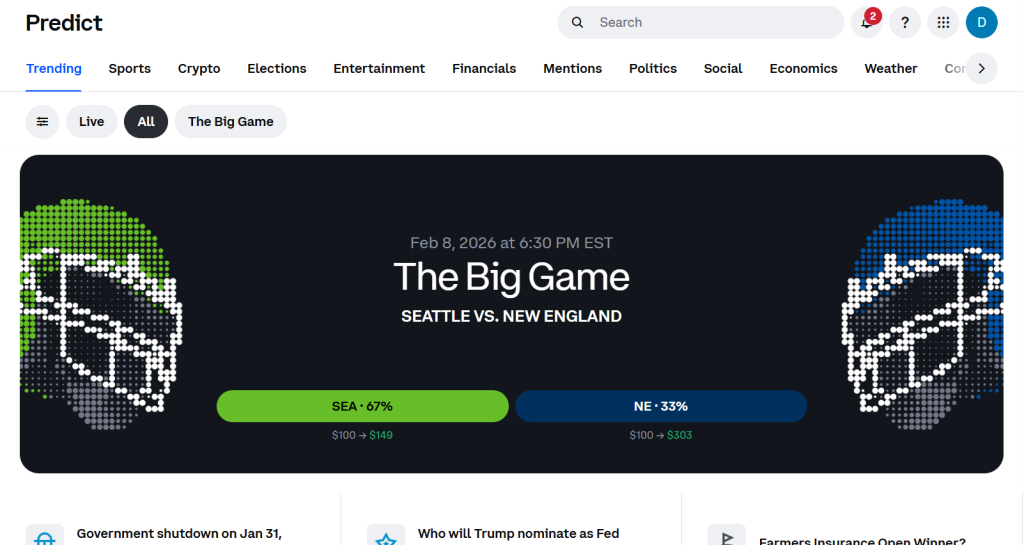
The crypto trading app had long been expected to get involved with prediction markets before it announced a partnership with Kalshi in December. Immediately after announcing that deal, the business sued authorities in Connecticut, Michigan, and Illinois.
Coinbase acts as a futures commission merchant (FCM), meaning that it allows users to buy and sell contracts from a designated contract market (DCM) like Kalshi and receives commission for doing so.
Prediction Markets Trade Group Unveils Full-Page Ad In ‘Opening Salvo’
The Coalition for Prediction Markets, led by Kalshi and Crypto.com, and including Coinbase, Robinhood, and Underdog, unveiled a full-page ad in The Washington Post on Wednesday to underscore some distinctions between regulated and unregulated prediction market platforms.
And there will be a lot more where this comes from. Per Business Insider, quoting a spokeperson for the group, “the coalition plans to spend seven figures in the coming months in coordination with its government relations outreach.”
The coalition was announced in December 2025 and has turned its attention to the issue of insider trading in response to alarm about a new trader on Polymarket (not yet a part of this trade group) who invested $30,000 into a market involving the potential capture of since-captured Venezuelan President Nicolás Maduro, shortly before he was indeed detained by U.S. forces. The identify of this trader is not (yet) publicly known.
In response to that trade, which gained substantial mainstream and social media attention, Congressman Ritchie Torres (NY-15) introduced H.R. 7004 with 39 co-sponsors, the Public Integrity in Financial Prediction Markets Act of 2026.
The scope of the bill, which now resides in the Committee on Oversight and Government Reform, is somewhat limited, though, applying to “an elected official of the Federal Government; a political appointee [or] an employee of an Executive agency.” That would mean it still wouldn’t apply to other individuals who might also have insider knowledge but do not work directly for the federal government.
Meanwhile, all prediction markets registered with the Commodity Futures Trade Commission (CFTC) include house rules that prohibit the use of “material non-public information” to trade. However, as InGame’s Daniel O’Boyle noted previously: “These are all house rules, with the CFTC’s own rules on insider trading being narrow by design. Trading with material non-public information is permitted by the regulator, as long as that information was obtained legally and the market isn’t being manipulated.”
Massachusetts Judge: Kalshi Can Have 30-Day Grace Period Before Injunction
The judge in the lawsuit between Massachusetts and Kalshi says that any injunction against the prediction market should include at least a 30-day grace period to allow it to set up geolocation services.
However, he did not give any indication of whether he might grant Kalshi a stay that would prevent the injunction from going into effect.
MA-judge-contoursJudge Christopher Barry-Smith wrote an order Tuesday explaining his “preliminary views” on the “contours” of the injunction against Kalshi, which he granted earlier this month.
One key decision the judge says he intends on taking is allowing a 30-day period for the injunction to take effect. Massachusetts’ proposed injunction had called for a seven-day period, while Kalshi asked for 90 days.
With a 30-day pause, Kalshi would remain active in Massachusetts until at least March.
The judge also said Kalshi must use technology, such as geolocation, to block all users located in Massachusetts from placing sports bets, rather than simply using users’ residency information. Kalshi uses residency information to block users living in certain countries from accessing its platform, meaning that U.S. users within those countries can still trade.
Barry-Smith added that users in Massachusetts should be allowed to trade out of their active bets, but should not be allowed to add to them.
He also said the injunction would not need to ban Kalshi from marketing itself nationally, as banning users within the state from buying sports event contracts should mean that this marketing would not cause any users in the state to participate in trading the contracts.
Both parties will submit their arguments on whether Kalshi should get a stay by Feb. 4, after which the judge will make a decision on that matter.
Polymarket Partners With Major League Soccer
Major League Soccer (MLS) has become the latest sports league to partner with a prediction market, signing a partnership deal with Polymarket.
Polymarket will be an “official partner” of MLS, and the deal will include “new fan experiences” that are intended to increase “second-screen engagement” for fans.
The agreement also includes independent monitoring of Polymarket trading activities in order to “protect the integrity” of matches. The deal also applies to the Leagues Cup, a competition between MLS teams and clubs from Mexico’s Liga MX.
MLS followed the NHL in partnering with a prediction market. The NHL partnered with both Kalshi and Polymarket last year.
“As soccer’s audience continues to grow and evolve in the U.S., fans are looking for new ways to engage more deeply with the game,” Polymarket founder and CEO Shayne Coplan said in a press release. “Through our partnership with MLS and Leagues Cup, we can surface real-time collective sentiment around key moments, matches, and season-long storylines, giving fans a more interactive, data-driven way to experience the game and engage with the world’s most popular sport.”
Polymarket US Raises Fees, But Keeps Them Well Below Rivals
Polymarket has upped its fees for its U.S. site, though they still remain much lower than the competition.
A rulebook update filing with the Commodity Futures Trading Commission (CFTC) shows that Polymarket U.S. will now charge one cent in fees for every $10 staked, up from one cent in fees for every $100 staked.
The new fee works out as 0.1% of the amount staked.
Even with this tenfold increase, those fees are much lower than such rivals as Kalshi or Crypto.com. Kalshi’s fees vary depending on the odds, but average out at around 1.2%. Crypto.com effectively charges a flat 2% fee for most contracts. Sportsbooks have generally held between 7% and 12% of stakes during 2025.
Because the price is based on the amount staked, rather than the number of contracts purchased, the fee per contract changes, depending on the odds at which the contract is traded. For example, the fee to buy 100 contracts at five cents each is lower than the fee to buy 100 contracts at 10 cents each. This avoids distortions for contracts purchased at extremely long or short odds.
Polymarket U.S. is still not available to all customers and is instead rolling users off of a waitlist. A date for a full launch has not yet been announced.
Last week, Polymarket put fees on its global site for the first time, though only on 15-minute cryptocurrency price markets. On those fast-moving markets, activity is often driven by trading bots.
Prediction Markets Maybe, But Sports Contracts No, Says Schwab CEO
Schwab CEO Rick Wurster told Bloomberg Businessweek Daily on Jan. 22 that he is amenable to the financial-services firm eventually launching a prediction market as a hedging tool, but would not support a foray into sports event contracts.
“We’ll leave the sports gambling … to the gambling houses — to the FanDuels, the DraftKings and the Robinhoods,” he said.
Wurster said he sees a distinction between prediction markets and gambling. His view has been consistent and clear. At the Schwab IMPACT conference in Denver in November, he said, “I hope as an industry, we’re able to tell the story to clients about the difference between gambling and investing. I just don’t want young people in our country that think that betting on the Monday Night Football game is equivalent to being invested for the long term in stocks and bonds.”
Massachusetts Court Delays Decision On Letting Kalshi Sports Contracts Ban Take Effect
A Massachusetts judge who was set to decide on whether to let an injunction banning Kalshi from the state come into effect instead kicked the can down the road Friday, seemingly ensuring that the prediction market will remain available in the Commonwealth until after the Super Bowl.
The hearing Friday followed a decision on Tuesday to grant an injunction that would have banned Kalshi from offering sports event contracts in the state. In the Friday hearing, Judge Christopher Barry-Smith was set to decide whether to grant Kalshi a stay to prevent enforcement of the injunction.
Kalshi Seeks Emergency Stay Before Massachusetts Ban Takes Effect
Kalshi on Friday morning filed for an emergency stay that would allow the prediction market to keep offering sports event contracts in Massachusetts.
searchresultsThe Superior Court for Suffolk County in Massachusetts approved an injunction on Tuesday that would ban Kalshi’s sports contracts from the state. The court will decide whether to issue the stay during a hearing at 12 p.m. ET Friday. If not, the injunction will go into effect once the meeting ends.
Kalshi is also seeking a stay from the Massachusetts Appeals Court. The emergency stay would take effect until the Appeals Court makes its own decision.
Massachusetts is the first state to issue an injunction to ban Kalshi’s sports event contracts from its jurisdiction. In two other states – Nevada and Maryland – courts have denied Kalshi injunctions that would have prevented those states from enforcing cease-and-desist letters, but Kalshi appealed both of those decisions and remains active in both states while courts consider those appeals.
On Tuesday, Robinhood, which offers access to Kalshi contracts, filed for an order in federal court to prevent Massachusetts from enforcing the planned injunction against its business as well.
show_multidocs-5Bill Proposed In Iowa To Regulate Prediction Market Activity Overseen By CFTC
As legal tensions flare in multiple jurisdictions between state regulators and the leading prediction market platforms, a new bill in Iowa has emerged that would authorize the state’s department of revenue to oversee — and tax — event contracts on those platforms.
The bill is Senate File SF2085 and it would require operators to obtain a permit and pay a fee of $10 million. It would also levy a tax on operator adjusted revenues on event contracts including: “sporting activities, elections, legislative actions, and economic indicators.” That 20% rate stands out against the existing 6.75% applicable to gross revenue for sports betting licensees.
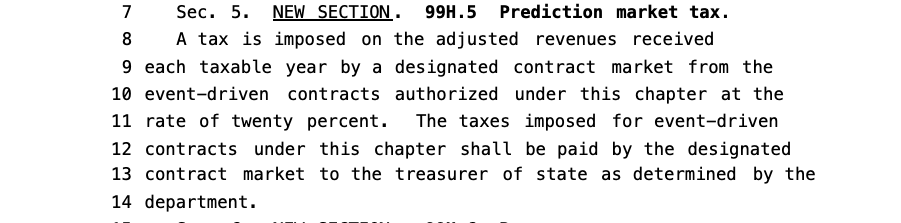
On balance, this bill cuts to the heart of the prediction market debate with questions around federalism, preemption, and state sovereignty. Does Iowa, New York, or any state have authority to regulate this activity, which is also regulated at the federal level via the Commodity Futures Trading Commission and the Commodity Exchange Act?
That is ultimately the question that stakeholders are debating in the multitude of lawsuits underway, including in Massachusetts, where Attorney General Andrea Campbell sued Kalshi, arguing that it was flouting state law with certain contracts. So far, Campbell has won a preliminary injunction, effective on Friday.
Wrote Superior Court Justice Christopher Barry-Smith in the order:
“Rather, consistent with its litigation strategy in other states that have challenged its operation, Kalshi argues that the Commonwealth’s attempt to regulate its exchange through the state’s Sports Wagering Law is preempted by federal law. As explained below, I disagree.”
CFTC Chair Selig Discusses Prediction Markets In ‘Future-Proofing’ Thread
In a thread on social media site X, CFTC chair Michael Selig talked about his goals to “future proof” the agency.
He also directly mentioned prediction markets for the first time in public comments since taking the role.
Read More On Massachusetts Court Banning Kalshi Sports Contracts
When granting an injunction to ban Kalshi from the state, a Massachusetts judge cited arguments that resembled prior decisions against the prediction market in federal lawsuits.
Suffolk County Superior Court Judge Barry-Smith said the Commodity Exchange Act did indeed preempt state law, but only in the field of futures trading. The preemption, he said, did not extend to state wagering laws.
“While it would make sense for Congress to displace a state’s targeted attempt to regulate a derivative market, for example, or to clarify the roles of separate federal agencies [..] that logic does not suggest Congress intended to displace traditional state police powers, such as gambling regulation – particularly in the absence of the express language so stating,” he wrote.
He also noted that the CEA does specifically say that state gaming laws are preempted for certain types of contracts, but Kalshi’s contracts do not fall under any of the types of contract listed in that passage.
DraftKings And Flutter Shares Jump On Kalshi-Massachusetts Decision
How much is Tuesday’s Massachusetts injunction decision worth to FanDuel and DraftKings? Maybe somewhere around a combined $1.2 billion, according to share price moves.
Both companies had started the day down significantly, thanks to a combination of factors including wider uncertainty across the entire stock market, sports results over the weekend, and the continued rise of prediction markets, but shares jumped as news of the court decision came out.
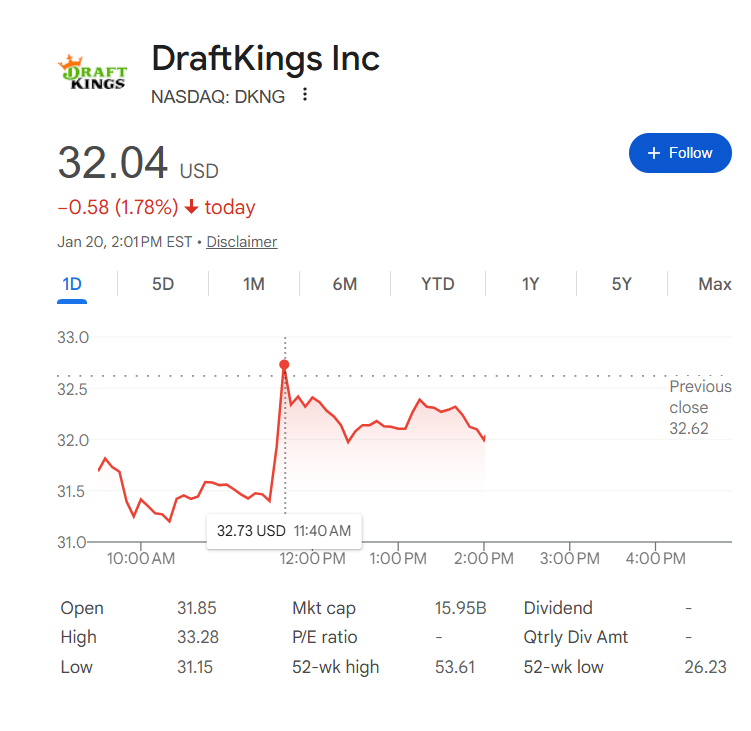
At 11:30 a.m. ET, before news of the Massachusetts decision was public, DraftKings shares were trading at $31.40. Just 10 minutes later, they rose to $32.73, slightly higher than their closing price Friday. That’s a rise of 4.2%, adding more than $650 million to the company’s market cap.
Shares in FanDuel owner Flutter also rose during the same 10-minute period, by 1.8% to $185.60. That would suggest an increase in value of around $580 million. As Flutter is a larger global business, U.S. events usually have a less dramatic effect on its share price than that of DraftKings.
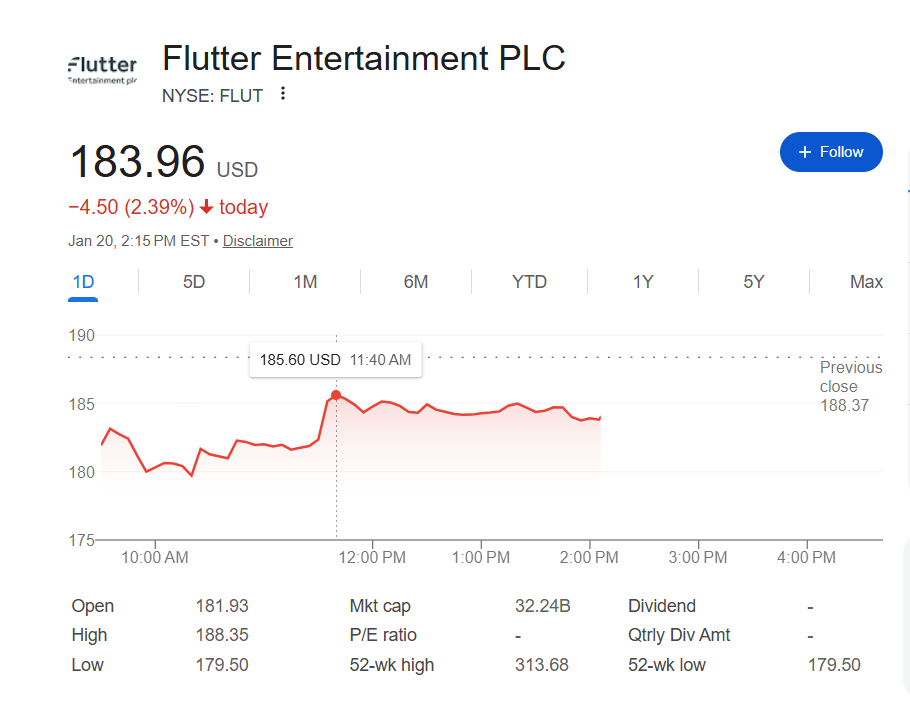
However, shares in both companies quickly slipped back off their highs. As of 2:15 p.m. ET, DraftKings was trading at $32.02 and Flutter at $184.00.
Kalshi-MA Injunction Won’t Go Into Force Until Friday
Court Grants Order Banning Kalshi In Massachusetts
A state court in Massachusetts granted an injunction Tuesday morning that will block Kalshi from operating in the state.
Massachusetts Attorney General Andrea Campbell sued Kalshi in September, the first time a state had sued Kalshi in state court, and requested an injunction to block the platform. Following a hearing in December, that injunction has been granted.
The order reads:
“For the forgoing reasons, the Commonwealth’s motion for a preliminary injunction is ALLOWED. Kalshi’s motion to dismiss is DENIED.
“The Commonwealth is entitled to a preliminary injunction prohibiting Kalshi from offering sport-related event contracts in the absence of the required license under the Sports Wagering Law. At the hearing both parties discussed, but did not resolve, certain details of the Commonwealth’s requested injunction, including how to prohibit new contracts without impacting already existing contracts.
“For that reason, I will enter a preliminary injunction consistent with this decision on the following schedule: i) not later than January 21, 2026 at 4:00 p.m the Commonwealth shall submit a proposed preliminary injunction consistent with this decision; ii) not later than January 23, 2026 at 10:00 a.m, Kalshi may submit a response to the Commonwealth’s proposed order; iii) if either side requests to be heard or if I determine a hearing is necessary, a hearing will take place on Friday, January 23, at 12:00 noon, after which I will enter a preliminary injunction. Any motion to stay may also be raised in this time period. If both parties wish to confer with respect to the terms of the preliminary injunction and request to extend these deadlines, they may notify the clerk and I will respond promptly to any such joint request. SO ORDERED.”
CFTC Chair Selig Appoints Two Ex-Colleagues As Senior Advisors
New Commodity Futures Trading Commission (CFTC) Chair Michael Selig has appointed two former colleagues to assist in his running of the agency that regulates prediction markets.
Michael Passalacqua and Cal Mitchell will both be senior advisors to Selig, the CFTC announced via press release Tuesday.
Before joining the CFTC, Passalacqua was a lawyer working for Simpson Thacher & Bartlett LLP, where he focused on cryptocurrency regulation. He previously worked at Wilkie, Farr & Gallagher, alongside Selig, from 2022 until 2025.
Mitchell was previously a special advisor in the Office of Legislative Affairs at the U.S. Department of the Treasury. He had also been a personal aide to Sen. Bill Hagerty. Selig had worked at the Treasury from January up until his appointment to lead the CFTC.
Selig is currently the only commissioner at the CFTC, which typically operates with five commissioners.
X Outage Affecting Polymarket Reaction Times?
Commodities Market Making Giant DRW Hiring For New Prediction Market Desk
DRW, one of the biggest market makers in traditional commodity trading, is hiring for a “dedicated prediction markets desk,” according to a report.
The Financial Times reported Wednesday that DRW is looking for a trader who will be paid a base salary of up to $200,000 to “monitor and trade active markets in real time” on Polymarket and Kalshi, as part of a “dedicated prediction markets desk.” The report added that “strict risk controls” would mean these businesses would probably be less likely to place “direct bets” on specific outcomes and more likely to arbitrage between different markets.
In a podcast appearance in September, DRW founder Don Wilson said sports contracts were “not necessarily a natural fit, but I don’t necessarily have a religious opposition to it.”
DRW would join rivals Susquehanna International Group and Jump Trading in getting involved in prediction markets.
The posting follows Goldman Sachs CEO David Solomon saying on Thursday that his business has a team “looking at” prediction markets.
High Roller Will Offer Crypto.com’s Event Contracts
High Roller Technologies has become the first primarily online casino business to get into the world of prediction markets, through a partnership with Crypto.com, the business announced via press release Wednesday.
Like other deals involving Crypto.com, High Roller will act as a technology service provider to the business, rather than being registered with the National Futures Association as a futures commission merchant or introducing broker.
High Roller Technologies operates the brands High Roller and Fruta. Neither site is currently active in the U.S. The High Roller website currently teases the prediction market offering, reading, “Trade on outcomes. Roll with us. A market-based predictions app developed in collaboration with High Roller Technologies and Crypto.com. Built around data, probabilities, and responsible play.”
“We’re thrilled to bring High Roller to the USA through this strategic partnership with Crypto.com,” High Roller CEO Seth Young said. “Pairing the massive appeal of prediction markets with our strong distribution capabilities is an incredibly exciting opportunity, and we’re looking forward to introducing our premium experience to consumers across the country.”
The product is expected to launch this quarter.
“Crypto.com is a leader in prediction markets and we are thrilled to expand access to event contracts through innovative partnerships, including with High Roller,” Crypto.com Global Head of Predictions Travis McGhee said.
High Roller is listed on the New York Stock Exchange. When the partnership was announced, its shares surged, by more than 900% to $33.68. That would value the business at more than $250 million.
The shares dipped from those highs and closed at $23.75 Thursday.
Goldman CEO: We Have A Team ‘Looking At’ Prediction Markets
Investment banking giant Goldman Sachs has a team “looking at” prediction markets, Chief Executive David Solomon revealed.
Speaking on an earnings call Thursday, Solomon called prediction markets “super interesting,” and said he had met with “the two big prediction market companies,” likely referring to Kalshi and Polymarket.
“We have a team that are spending time with them and are looking at it,” he said. “I can certainly see opportunities where these cross into our business and we’re very focused on understanding that, understanding the regulatory structure, that’s going to develop around that.”
Solomon did not reveal whether Goldman would be looking more at trading or market making on prediction markets itself or to act as an intermediary that allows clients to make trades.
Polymarket Banned In Ukraine
Ukraine banned Polymarket last month, accusing the prediction market platform of offering unlicensed gambling in the country.
An order issued by the country’s government in December banned 198 websites, mostly traditional online casino or sports betting sites, but Polymarket was also included on the list. Internet service providers in the country have been ordered to stop allowing customers to access the website.
693854776c5cf817636376Polymarket’s global site blocks customers from 33 countries, but not Ukraine. The site offers a number of contracts related to the War in Ukraine.
Kalshi’s terms and conditions already ban users from Ukraine, though the platform has allowed U.S. residents in blocked countries to place bets if “temporarily located” there.
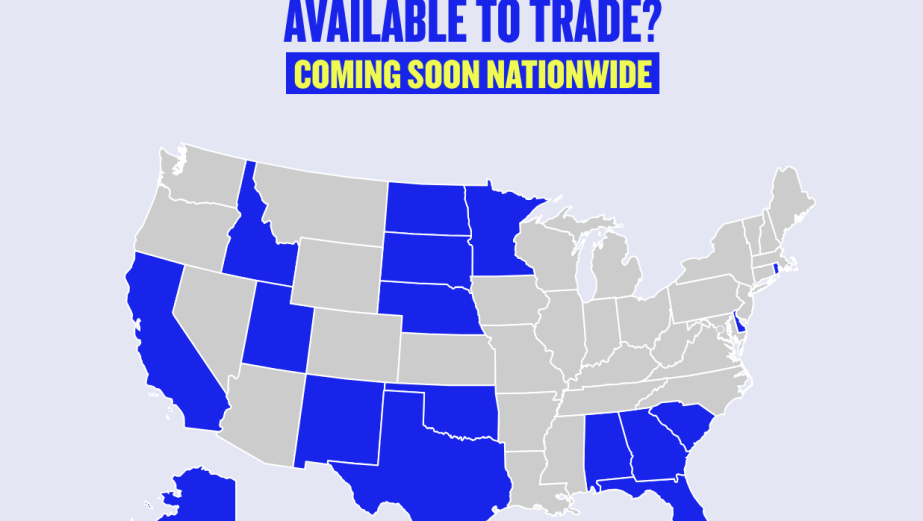
Report: FanDuel Predicts Expands, Now In 18 States
FanDuel Predicts, the prediction market platform from FanDuel, expanded its U.S. footprint to 18 states on Wednesday, per a report from The Closing Line.
FanDuel Predicts, which is operated in partnership with derivatives marketplace CME Group, initially launched on Dec. 22 in just five states: Alabama, Alaska, North Dakota, South Carolina, and South Dakota.
This expansion adds some large — and controversial — population centers, including California, Georgia, Florida, and Texas. Of those, only Florida already allows legal sports betting, though limited in scope as only Hard Rock Bet from the Seminole Tribe is permitted to offer online sports wagering. Here is what a menu in Florida shows as of Wednesday afternoon:
The platform’s presence in California, in particular, seems likely to heighten tensions with tribal groups that believe prediction markets represent an encroachment on their gaming compacts with the state.
Draft Text Of Federal Bill Language To Ban Sports Event Contracts Reported
A draft of the text that gaming industry groups aim to insert into a bill in order to ban sports event contracts has emerged.
The American Gaming Association (AGA) and Indian Gaming Association (IGA) have been lobbying to amend a planned crypto market structure bill, currently under consideration with the House Agriculture Committee, to include language banning sports event contracts. Industry newsletter The Closing Line reported Tuesday the draft language that could be inserted into the bill.
The text is below:
SEC. XXX. PROHIBITION ON CERTAIN EVENT CONTRACTS INVOLVING SPORTS AND CASINO-STYLE GAMES.
(a) Amendment to the Commodity Exchange Act.—Section 5c(c)(5)(C) of the Commodity Exchange Act (7 U.S.C. 7a–2(c)(5)(C)) is amended by adding at the end the following:
“(v) Prohibition on Sporting and Casino-Style Event Contracts.—
(1) No agreement, contract, or transaction relating to any Sporting Event or Athletic Competition or any Casino-Style Game may be listed or made available for clearing or trading on or through a registered entity.
(2) In this section:
(A) The term ‘Sporting Event or Athletic Competition’ means any live or virtual contest involving physical activity or skill in which individuals or teams compete, and performance determines an outcome or statistical result, including amateur, collegiate, or professional sports.
(B) The term ‘Casino-Style Game’ means any game traditionally found in casinos, including but not limited to, slot machines, video poker, blackjack, roulette, craps, and other casino style-table games, bingo, lottery, or any simulation thereof.
(b) Effective Date.—The amendments made by this section shall apply to any agreement, contract, or transaction not approved by final written order of the Commission on or before the date of enactment.
The AGA and IGA Monday wrote a letter to representatives encouraging them to use the crypto market structure bill as an opportunity to ban sports event contracts.
While the two gaming industry groups argue that sports event contracts are already illegal, the language above would appear to remove any ambiguity by explicitly banning the contracts in federal law.
The crypto market structure bill, officially named the Digital Asset Market Clarity Act of 2025, mostly concerns regulation of cryptocurrency exchanges.
Two Ex-Congressmen Join Coalition For Prediction Markets
Two former congressmen will join prediction market lobbying group the Coalition for Prediction Markets.
Kalshi Head of Corporate Development Sara Slane posted on social media site X Tuesday morning that Sean Patrick Maloney and Patrick McHenry will both join the Coalition.
Maloney represented New York’s 18th congressional district from 2013 to 2023, while McHenry represented North Carolina’s 10th congressional district from 2005 to 2025 and was speaker pro tempore of the House for three weeks in 2023.
Maloney served on the House Committee for Agriculture, which oversees the Commodity Futures Trading Commission (CFTC), while McHenry was chair of the Committee on Financial Services.
The Coalition for Prediction Markets was set up in December to lobby for platforms offering event contracts. Its members are Kalshi, Crypto.com, Coinbase, Robinhood, and Underdog.
Kalshi Sues Tennessee After Receiving Cease-And-Desist
Kalshi has filed its lawsuit against the state of Tennessee, after receiving a cease-and-desist letter from the state.
Kalshi-TNThe case was docketed Monday, having been filed Friday, the same day that the prediction market received a cease-and-desist.
Like in other lawsuits, Kalshi argues that the state has no authority to shut down its sports event contracts, as it is subject to the “exclusive jurisdiction” of the Commodity Futures Trading Commission (CFTC).
“Kalshi is a federally designated derivatives exchange, subject to the CFTC’s exclusive jurisdiction. It offers consumers the chance to trade in many types of event contracts, including, as relevant here, sports-event contracts,” the filing says. “These contracts are subject to exclusive federal oversight, and—critically—they are lawful under federal law.”
The prediction market has asked for a preliminary injunction and temporary restraining order to prevent the state from enforcing its cease-and-desist until the full matter is decided on the merits. Again, this mirrors other lawsuits, such as those in New Jersey — where Kalshi won an injunction – Maryland — where it failed to win an injunction — and Nevada — where it won an injunction, only to have it dissolved.
Tennessee also sent cease-and-desist letters to Polymarket and Crypto.com Friday, but a search for those businesses in the relevant court does not show any lawsuits filed by either company.
Several Prediction Market CEOs Nominated To New CFTC Committee
Commodity Futures Trading Commission (CFTC) Chairman Michael Selig on Monday launched the Innovation Advisory Committee (IAC) and, in a release, said he intends to tap several prediction market heads already serving on the CEO Innovation Council as its charter members.
Most members of the group represent companies in some stage of offering prediction market speculation or invest in or support them with technology.
Current members of the CEO Innovation Council:
- Shayne Coplan, Polymarket
- Craig Donohue, Cboe Global Markets
- Terry Duffy, CME Group
- Tom Farley, Bullish
- Adena Friedman, Nasdaq
- Luke Hoersten, Bitnomial
- Tarek Mansour, Kalshi
- Kris Marszalek, Crypto.com
- David Schwimmer, LSEG
- Arjun Sethi, Kraken
- Jeff Sprecher, Intercontinental Exchange
- Tyler Winklevoss, Gemini
“A wide range of novel technologies are enabling the creation of entirely new products, platforms, and businesses and transforming the financial markets landscape,” Selig said in a release. “Innovators are harnessing technologies such as artificial intelligence, blockchain, and cloud computing to modernize legacy financial systems and build entirely new ones. Under my leadership, the Commission will develop fit-for-purpose market structure regulations for this new frontier of finance. The Innovation Advisory Committee will play a critical role in advising the Commission on the commercial, economic, and practical considerations of emerging products, platforms, and business models in the financial markets so that it can develop clear rules of the road for the Golden Age of American Financial Markets.”
According to the IAC charter, the council’s objective will be to “provide advice and recommendations to the Commission. The IAC will assist the Commission in identifying and understanding and by providing advice on the impact and implications of technological innovation in the financial services, derivatives, and commodity markets.”
Kalshi Files To Introduce ‘Fractional Shares’
Kalshi changed its rules Monday to allow for “fractional shares,” meaning that users could be able to buy one cent worth of contracts.
Fractional-sharesKalshi says that the change allows “order fills to always be possible in whole dollar amounts,” ensuring that users can bet the amount they intend to, instead of having a partially filled order.
An amendment to Kalshi’s rulebook, filed with the Commodity Futures Trading Commission (CFTC), reads: “The minimum unit of trading is one hundredth of one Contract, unless otherwise specified in a Contract’s terms and conditions or on the Contract’s market page.”
In a letter to the CFTC accompanying the rule change, Kalshi explained why it may be relevant.
“For example, if a trader wants to purchase $5.00 of a given position, but the contract is trading at $0.60, the trader would previously purchase eight contracts at $0.60 each,” Kalshi wrote. “This would in turn only deploy $4.80 of the trader’s intended capital. Under the new rule, the trader would be allowed to deploy all of their intended capital and manage their positions as they see fit.”
The same line previously set the minimum at one contract. Each contract is valued at one dollar.
The rule change is subject to a 10-day review by the CFTC, and can then come into effect once the review period is over. The review period only counts working days, meaning the rule could go into effect starting Jan. 27.
Tennessee Sends Cease-And-Desists To Kalshi, Crypto.Com, Polymarket
Tennessee has become the latest state to send a cease-and-desist letter to prediction markets, ordering Kalshi, Crypto.com, and Polymarket to stop offering sports contracts in the state.
On Friday, the regulator sent a letter to Kalshi CEO Tarek Mansour, Polymarket U.S. Chief Compliance Officer Matt Childers, and Crypto.com Chief Compliance Officer Kevin Dan, arguing that the platforms are in violation of the state’s Sports Wagering Act. The news was first reported by lawyer Daniel Wallach on social media site X.
“The sports events contracts offered on Kalshi’s exchange are wagers under the Act and are being offered illegally in violation of Tennessee law and regulations,” the letter to Kalshi said. The letters to Crypto.com and Polymarket contained similar statements.
The Tennessee Sports Wagering Council told the platforms to cease offering sports event contracts “immediately,” and said it would fine them if they did not.
Wallach reported that “lawsuits have been filed,” but none appear in the relevant court’s docket yet.
Rep. Titus Questions Polymarket CEO On ‘Insider Trading’
U.S. Rep. Dina Titus has written a letter to Polymarket CEO Shayne Coplan asking about the prediction market’s “ability, and willingness, to comply with CFTC regulations.”
Titus, who represents Nevada, noted that Polymarket in July purchased a CFTC-regulated exchange and has since reentered the U.S., but Titus said there were “significant questions about whether the platform was adopting “safeguards consistent with CFTC rules.”
Polymarket’s global site still blocks users with U.S. IP addresses, and so it does not appear that the site has a legal obligation to follow CFTC rules.
Titus cited trades made on Polymarket’s global site on the capture of Venezuela’s President Nicolas Maduro, which were made before the public was aware of the raid to capture him.
“While it is unclear whether these wagers constituted insider trading, their timing raises significant questions,” Titus wrote.
Insider trading is technically permitted under CFTC rules, as long as the information in question is not misappropriated, and there is no market manipulation involved. In practice, CFTC-regulated prediction markets ban insider trading under their house rules but if one chose not to, that would not be inconsistent with CFTC rules. Unlike it’s CFTC-regulated U.S.-site, Polymarket’s global site’s rules do not include an insider trading ban.
She also raised questions of market manipulation, citing Coinbase CEO Brian Armstrong’s recent decision to list off several words from a prediction market contract on what words he would say during the company’s earnings call.
Titus asked Coplan about Polymarket’s rules to prevent insider trading, surveillance tools, how many accounts it had suspended due to insider trading or market manipulation and Polymarket’s compliance with the CFTC’s core principles.
Polymarket Becomes ‘Exclusive Prediction Market Partner’ Of Golden Globes
Polymarket has announced its third partnership of the week, teaming up with the Golden Globes to become its “exclusive prediction market partner.”
Polymarket announced the deal via a post on social media site X, and it is not immediately clear what the partnership entails.
The exchange announced a partnership with Dow Jones, which owns the Wall Street Journal, and a deal with the NHL’s New York Rangers earlier this week.
Kalshi Hit With ‘Statute Of Anne’ Class Action Lawsuit
Kalshi is the subject of another class-action lawsuit, this one filed in federal court and invoking Illinois’ “Statute of Anne” laws.
The Statute of Anne, which originated in Britain in 1710, permits gamblers to sue for illegal gambling losses. The plaintiffs in this case argue that Kalshi is a form of illegal gambling.
gov.uscourts.ilnd_.492527.1.0The initial filing claims that while Kalshi advertises itself as a prediction market, it “in reality offers illegal, unregulated wagers.”
Illinois’ Statute of Anne is a state law, and Kalshi has generally argued that it is not subject to state gambling laws. It is likely that if needed, it would employ the same defense in this case.
A number of class-action lawsuits based on Statute of Anne laws were filed in state courthouses across the country last year. Kalshi has filed for many of those, including one in Illinois, to be moved to federal court, but progress in those lawsuits has been slow.
Users of the prediction market filed a class-action against Kalshi in the Southern District of New York in November. That case received a great deal of attention, but has had little progress since it was filed.
Gemini Launches Sports Event Contracts
Gemini has now launched spots event contracts, becoming the latest entrant into the rapidly growing market, as first reported (to our knowledge) by Next Event Horizon.
The exchange founded by the Winklevoss twins launched its prediction market last month, soon after the CFTC approved its application to become a designated contract market (DCM).
Unlike other prediction markets, Gemini is using official NFL team logos on its prediction market webpage. The NFL has opposed the rise of sports event contracts through prediction markets, has not partnered with any exchange, and usually polices unapproved uses of its team marks.
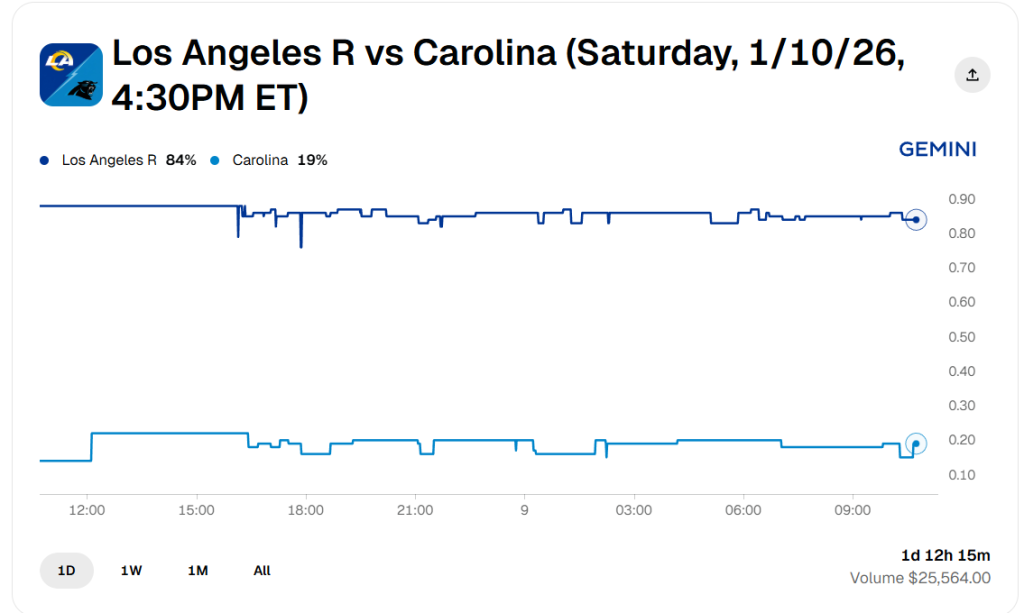
The top markets — Friday’s Peach Bowl between Indiana and Oregon, and Saturday’s NFL playoff game between the Rams and the Panthers — have received tens of thousands of dollars in volume. Other NFL playoff games have volume in the four digits, while volume for NBA games is minimal.
Bitnomial Gets Closer To Prediction Market Launch With No-Action Letter
Bitnomial looks to be closer to launching a prediction market in the U.S. following its receipt of a no-action letter from the Commodity Futures Trading Commission (CFTC) concerning reporting rules.
26-01Bitnomial has been registered as a designated contract market (DCM) since 2020, and used that status to offer cryptocurrency futures and options. It said in a press release last month that it had received approval from the CFTC to operate a prediction market as well.
No-action letters mean the CFTC will refrain from enforcing certain rules against a particular business.
The letter itself only concerns rules about reporting data — allowing Bitnomial to report event contract data as if the contracts were binary options, instead of swaps — but is typically one of the final steps before a prediction market that is already licensed can go live. For example, Gemini received a no-action letter on Dec. 11, and then launched its prediction market on Dec. 16.
Before launching, Bitnomial will also have to self-certify the markets it wishes to offer.