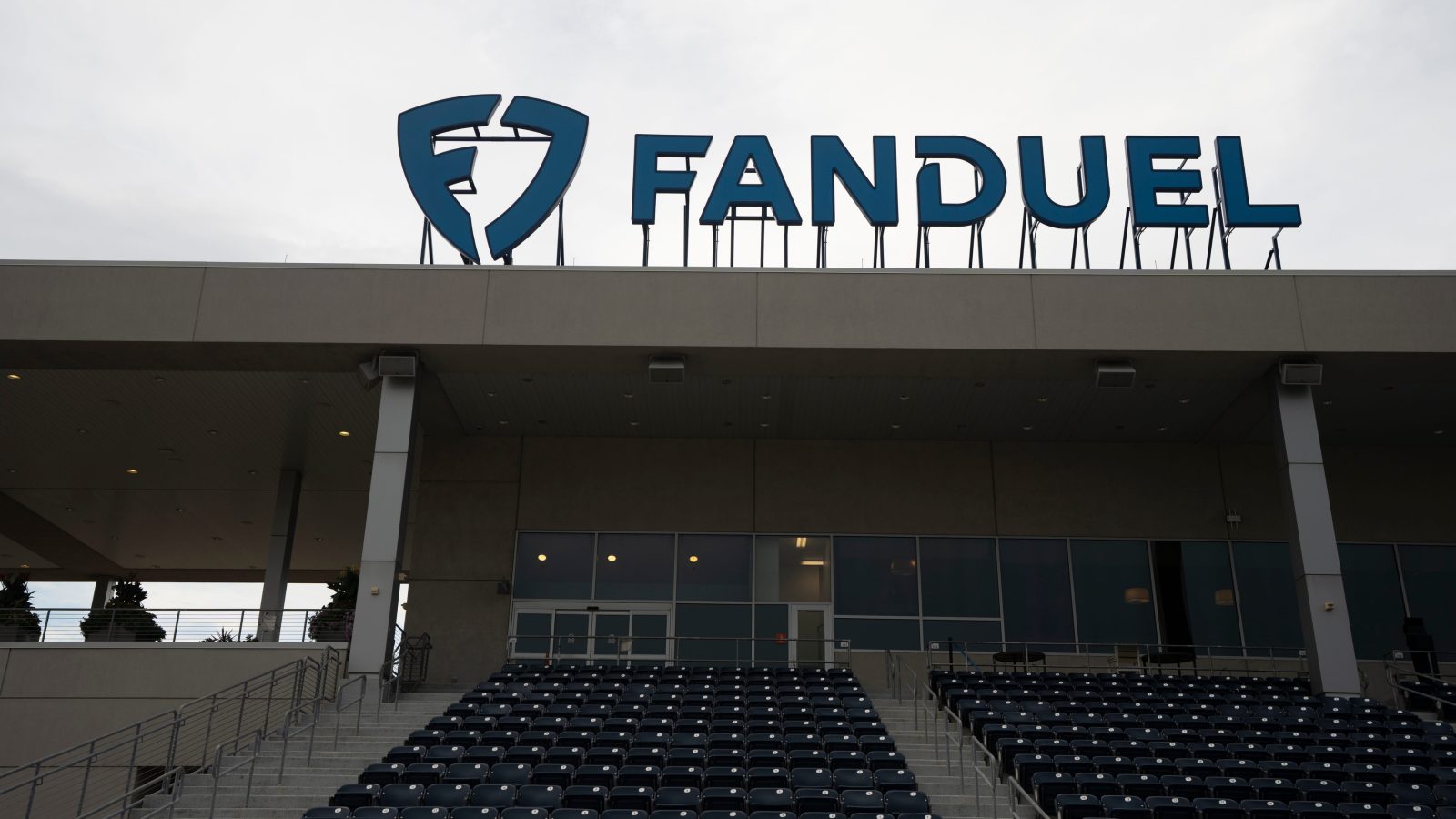
FanDuel has filed to create a new futures commission merchant (FCM) to offer prediction market contracts from a registered exchange. Unlike its existing FCM FanDuel Predicts, the new entity appears to have no CME Group involvement.
New Ventures III, owned by FanDuel, filed with the National Futures Association (NFA) on April 9. The filing was first observed by PredictionMarketPulse.
FanDuel already owns a registered FCM, FanDuel Predicts, but it is tied to one exchange: CME.
FanDuel Predicts is 49% owned by the betting giant and 51% owned by CME. It covers contracts offered on the FanDuel Predicts app and traded on CME’s exchange. The new FCM lists FanDuel as the only entity owning a 10% or greater share in it, and it lists only FanDuel employees among its principals.
This new FCM would be wholly owned by FanDuel with no CME involvement. An FCM can partner with designated contract markets (DCMs), offering its users access to contracts traded on the DCM’s exchange. Kalshi is by far the largest DCM, while Polymarket US, Crypto.com, and ForecastEx are among the others in the space.
The new registration, if and when approved, may simply give FanDuel some optionality without necessarily indicating it intends to move away from the joint venture with CME.
FanDuel Predicts performance so far
Currently, the CME-FanDuel joint venture appears to represent a tiny share of the event contracts market. Peter Jackson, CEO of FanDuel parent company Flutter, has highlighted the second half of 2026 as when he expects to see more liftoff. It is not clear what the targets, if any, may have been for the first four months of 2026.
“Consistent with our product roadmap, we expect customer engagement and activity to be heavily skewed to the second half of 2026 and our investment will therefore reflect a similar profile,” Jackson wrote in a letter to shareholders accompanying Flutter’s 2025 results. “Our priority is to build value for the future, while also maintaining the flexibility to accelerate investment. We believe this will position FanDuel to deliver future growth and harness the long-term opportunities for our business.”
FanDuel expects spending on prediction markets in 2026 to be in the $250-$300 million range. It spent $50 million on the product in 2025. In the company’s February earnings call, Jackson said Flutter “reserves the right” to spend even more than that if the product seems to be delivering results. The business does not currently include any prediction market revenue in its 2026 projections.
While the second half of the year is set to be the focus, FanDuel did make a promotional push for FanDuel Predicts around the NCAA basketball tournament. This led to a clear surge in downloads, with FanDuel Predicts topping the app charts for sports. But volume remains low, leaving a large gap to close if FanDuel wishes to contend with the leaders in prediction markets.
CME volume compared to Kalshi, Polymarket US
All of FanDuel’s contracts are traded on CME’s exchange, meaning volume on FanDuel by definition cannot exceed volume on CME. DraftKings Predictions also offers users access to CME contracts, alongside Crypto.com contracts.
While full data for CME is more limited than Kalshi or Polymarket US, data viewed by InGame shows the exchange typically only reporting around $1.5 million in volume per day, compared to hundreds of millions for Kalshi.
CME does not publish daily data for weekends. Instead, it combines Saturday-to-Monday data on Mondays. This makes its daily volume for Mondays, especially April 6, which included the NCAA national championship game as well as a full weekend, much higher than other days.
However, when these numbers are compared to three-day periods on other prediction markets, again CME is a long way behind.
A recent analysis by Bank of America analysts found that Kalshi has a 91% share of the US-regulated event contract market. CME’s market share in the analysis rounded to 0%.
FanDuel Predicts vs Coinbase
While FanDuel Predicts does not publish its own daily volume, it does publish the market value of open contracts at the end of each day. This cannot be directly translated to volume, but it can be compared to other FCMs.
By this measure, FanDuel is not just a long way behind the long-established Robinhood, which would be expected, but also a long way behind Coinbase, which went live — via a partnership with Kalshi — slightly later than FanDuel.
This comparison may not be truly like-for-like. Coinbase users, more inclined to trade on cryptocurrency, may have more contracts that remain open overnight than FanDuel Predicts users, who are more likely to bet on sports events.
However, the scale of difference suggests that another FCM has still seen more growth in a similar time frame.
One issue that may be affecting volume, likely heightened during the first two rounds of The Masters, is that FanDuel Predicts’ fee formula discourages bets on longshots or big favorites. The prediction market charges a flat 2 cents on every contract, shared evenly between itself and CME. DraftKings Predictions has the same formula.
In practice, this can lead to skewed odds for certain bets. A bet at 1-cent odds has a vig of well over 100%, while a bet at 99-cent odds is guaranteed to lose money, even if it wins. Before and during the early stages of a golf major, even the favorites’ odds are below 20%. In addition, bettors may intend to eventually trade out of their positions, which would mean paying fees a second time, rather than holding them until settlement.
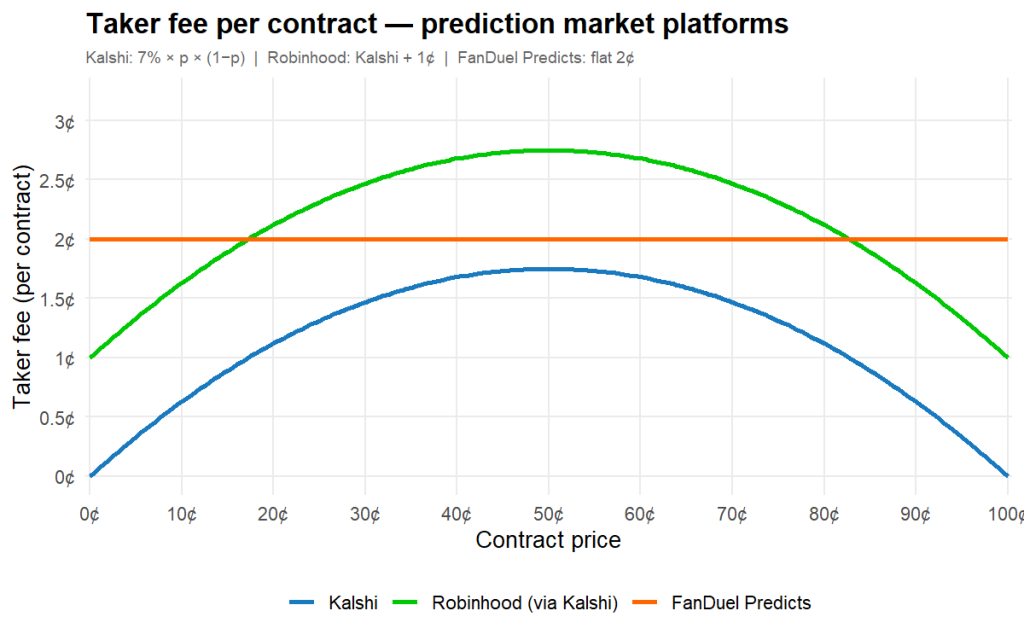
Despite the formula resulting in very high fees for certain contracts, the overall amount FanDuel has taken in fees appears to be low. At 1 cent per contract, even if FanDuel made up 100% of the volume on CME, it would still only be bringing in around $15,000 per day in fee revenue. Kalshi makes upwards of $4 million per day.