

Kalshi at a glance
| Platform | Kalshi |
| Founded | 2021 (by Tarek Mansour and Luana Lopes Lara, New York City) |
| Regulator | CFTC (Designated Contract Market, original DCM license) |
| U.S. Availability | 49 states + DC (restricted only in Nevada as of April 2026) |
| Markets | Sports, politics, economics, weather, crypto, pop culture, and more |
| Trading Fees | 7% taker coefficient (max ~1.75¢/contract at $0.50); maker fees ~1.75% coefficient or $0 |
| Interest on Balance | ~3-4% APY (including funds in open positions) |
| Deposit Methods | Debit card, bank transfer (ACH), wire, USDC |
| Mobile App | iOS (4.7/5, 23K+ reviews) & Android (4.4/5, 3K+ reviews) |
| Welcome Bonus | Trade $25 and get $25 with promo code INGAMEPRO |
| Valuation | $22 billion (March 2026 funding round) |
| Legal Age | 18+ |
Try Kalshi with Code INGAMEPRO: Trade $25 and Get $25 at Kalshi →
Disclaimer: Certain limitations apply. The offer is available to new users only, subject to the terms and conditions at kalshi.com. 18+ only. Restrictions and eligibility requirements apply. Event contract trading involves significant risk and is not appropriate for everyone. Please carefully consider if it is appropriate for you in light of your personal financial circumstances. Kalshi products are not available in all jurisdictions. See kalshi.com/regulatory for more information. See legal section below.
The short version: is Kalshi worth using?
I’ve been trading on Kalshi since the fall of 2024. I’ve deposited real money, won some, lost some, and have spent enough time on the platform to have strong opinions about what it does well and where it falls short.
Kalshi is the most accessible prediction market in the United States right now. No waitlist, no crypto wallet necessary, live in 49 states, with a market selection that ranges from NFL player props to whether the Fed will cut rates next quarter. If you’re curious about prediction markets and want to try one today, Kalshi is where you start.
That said, “most accessible” and “best” aren’t the same thing. Kalshi’s fees are a bit higher than Polymarket’s. Its settlement process has generated some controversy, including an approximately $77 million dispute over the Khamenei market that’s heading to court. The legal landscape is chaotic, with a dozen states either suing Kalshi or being sued by the CFTC on Kalshi’s behalf. And the platform’s relationship with institutional market makers means the “peer-to-peer exchange” framing doesn’t tell the full story of who’s on the other side of your trades.
I’d recommend Kalshi to anyone who wants to trade event contracts in the U.S. I would not recommend treating it as a way to make consistent money. The average Kalshi contract has a negative expected return after fees, according to academic research. Treat it like entertainment with an information edge, and you’ll have a good time.
What Kalshi actually is (and isn’t)

Kalshi is a federally regulated exchange where users trade event contracts. Each contract is a yes/no proposition on whether something will happen in the real world: Will the Knicks win tonight? Will inflation exceed 3% this quarter? Will it snow more than six inches in Chicago this weekend?
Contracts are priced between $0.01 and $0.99, reflecting the market’s collective probability estimate. Buy a “Yes” contract at $0.65 and you’re saying there’s a better-than-65% chance the event happens. If you’re right, the contract pays $1.00. If you’re wrong, it expires at zero.
Kalshi calls itself a “peer-to-peer exchange,” and that’s technically accurate. Every trade has a counterparty on the other side. The platform matches buyers and sellers and collects a fee. It is not a sportsbook, it is not the house. This distinction matters for regulatory purposes and somewhat matters for pricing dynamics, though in practice, the counterparty on popular markets is often an institutional market maker rather than another retail trader. More on that below.
The CFTC license as a Designated Contract Market (DCM) is what makes Kalshi work in the U.S. It classifies event contracts as financial instruments, not gambling products, which is why the platform operates in states that have no legal sports betting. That classification is also the source of Kalshi’s biggest legal headaches, because a growing number of states disagree with it.
How Kalshi works
I’ll use a real example. In March 2026, I bought 50 “Yes” contracts on “Lakers to make the NBA Playoffs” at $0.42 each. Total cost: $21.00 (plus about $0.53 in taker fees). I thought the market was underpricing the Lakers at 42%, given their schedule.
Two weeks later, the Lakers clinched a play-in spot and the contract price moved to $0.71. I had a choice: hold to resolution and hope for the full $1.00 payout, or sell at $0.71 and lock in the profit. I sold 30 contracts at $0.71 and kept 20. Net profit on the 30 I sold: about $8.17 after fees. The remaining 20 resolved at $1.00 when the Lakers won their play-in game. Total profit on the trade: roughly $18.40.
That flexibility, the ability to exit a position at any point before resolution, is the single biggest structural difference between Kalshi and a sportsbook. On DraftKings (Sportsbook), that Lakers bet locks in at the odds you took (barring a cash-out offer). On Kalshi, you’re holding a tradeable asset.
Every contract settles based on pre-specified resolution criteria and data sources filed with the CFTC. For sports, this is typically the official league result. For economics markets, it’s usually the relevant government data release. For more unusual markets, the resolution sources get more interesting, and more important to read carefully.
Makers, takers, and the liquidity question
If you’ve used a stock brokerage, the maker-taker model will feel familiar. If you’re coming from sportsbooks, this is new territory.
A taker buys or sells at the current market price. Your order fills instantly. You’re removing liquidity from the order book, and Kalshi charges you for facilitating the transaction. Taker fees follow a parabolic formula: 0.07 × Price × (1 – Price), per contract. At $0.50, that’s about 1.75 cents per contract. At $0.90, about 0.63 cents.
A maker places a limit order that rests on the book, waiting for someone to take the other side. You’re adding liquidity, which Kalshi wants, so fees are lower: a 1.75% coefficient, which works out to roughly one-quarter of the taker rate. On many markets, maker fees are zero.
The difference adds up fast. On 100 contracts at $0.50, a taker pays about $1.75 in fees. A maker pays about $0.44. If you’re trading actively, learning to use limit orders is the single most impactful thing you can do to reduce costs.
Liquidity itself is the bigger issue. On major NFL, NBA, and election markets, you’ll find tight spreads and fast execution. On a Tuesday afternoon weather market or a niche political race, the spread can be wide enough that entering and exiting eats into your edge more than the posted fee does. I’ve seen spreads of $0.06-$0.10 on lower-volume markets. That’s effectively a hidden 6-10% cost on top of everything else.
Who you’re actually trading against
This section doesn’t appear on most Kalshi reviews. It should.

Kalshi markets itself as a peer-to-peer exchange (see above). When you buy a contract, another user sells it to you. That’s true in the literal sense. But on popular markets, the user on the other side is often not another casual trader. It is frequently an institutional market maker like Susquehanna International Group (SIG), one of the largest quantitative trading firms on the planet.
These firms post resting orders on both sides of a contract, profiting from the spread. They use sophisticated data models, react to information faster than retail traders, and operate at scale that individual users can’t match. Kalshi maintains that market makers “react to pricing” rather than set it. That distinction matters to regulators. It matters less to a retail trader who keeps getting filled at the worse side of the spread.
A George Washington University research paper found that the expected return on the average Kalshi contract after fees was negative 20%. That number incorporates the spread costs driven partly by institutional participation.
Kalshi also has affiliated for-profit market-making arms that participate on the exchange. This is disclosed, but it adds a structural wrinkle: The exchange operates as both marketplace and participant. Additionally, Kalshi’s Combo (parlay) product only allows retail users to act as odds takers, not makers. On Combos, the exchange model looks a lot more like a sportsbook.
None of this makes Kalshi a scam. It makes it a financial exchange with professional participants, which is exactly what you’d expect on a CFTC-regulated platform. But if you’re going in thinking you’re trading against other fans in a friendly marketplace, adjust your expectations.
Getting started on Kalshi
Account creation took me about four minutes. You’ll need a government-issued ID (driver’s license or passport) and a smartphone for the identity verification scan. Kalshi uses standard KYC compliance, same as any regulated financial platform.
The basic steps: Visit Kalshi and sign up with Google, Apple, or email. Enter your personal info and phone number for a confirmation code. Scan your ID (front and back). Fund your account via debit card, bank transfer, USDC, or wire. Enter promo code INGAMEPRO during registration for the current Trade $25, Get $25 offer.
Fund your account with enough to place the qualifying $25 in trades if you’re trying to unlock the current offer. Debit card deposits are instant. Bank transfers take 1-3 days. Your balance starts earning interest (around 3-4% APY) as soon as funds land in your account, which is a genuine advantage over every sportsbook I’ve used.
For details on the promo code, terms, and a step-by-step walkthrough, see our Kalshi promo code and bonus page.
Markets and contract types
Market breadth is Kalshi’s strongest feature. No other fully live, CFTC-regulated platform comes close (as of present) to the range of events you can trade on.
Sports
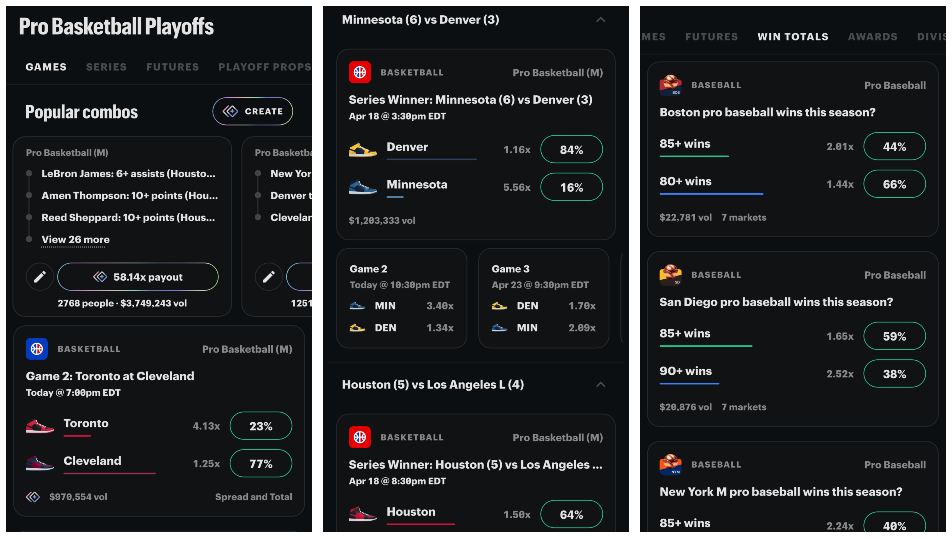
Sports is the fastest-growing category. What started as simple moneyline yes/no contracts now includes:
- Spreads
- Over/unders
- Player props
- Combos (Kalshi’s parlay product)
Available sports/leagues:
- NFL
- NCAA football
- NBA
- NCAA basketball
- MLB
- NHL, soccer (worldwide leagues and MLS)
- Tennis
- Golf
- Motorsports
- MMA
- Chess
- eSports, and more depending on the season.
Kalshi debuted single-game NBA markets during the 2024-25 playoffs and has since expanded player props to the NFL and other leagues.
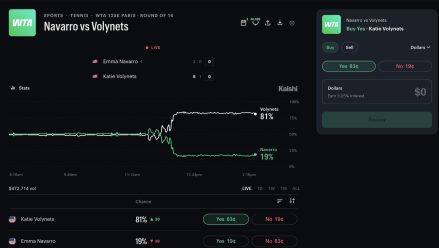
The critical differentiator from Polymarket: Kalshi supports live in-game trading (see below). You can buy and sell contracts while a game is happening, reacting to momentum shifts, injuries, or weather. Polymarket US does not offer this as of May 2026. (The international site is a separate and distinct entity that is not accessible to U.S. users without a workaround.)
Beyond sports
Politics is Kalshi’s signature non-sports category and went mainstream during the 2024 presidential election.
With 2026 midterm elections approaching, there are dedicated sections for: House, Senate, and governor’s races across all 50 states.
Beyond politics:
- Economics (inflation, Fed decisions, employment data, GDP)
- Crypto (Bitcoin and Ethereum price targets)
- Weather (temperature, hurricanes, snowfall)
- Companies (CEO changes, layoffs, product launches)
- Financials (NASDAQ levels, currency rates, treasuries)
- Pop culture (awards shows, box office, music), and world affairs

Each market is a different animal. The popular categories have tight spreads and real liquidity. Some of the more creative markets, like whether a specific tech CEO will tweet about a particular topic, can have spreads wide enough to make profitable trading difficult. Browse before you commit.
Kalshi fees
Kalshi is not the cheapest prediction market. It is not the most expensive. The fee structure rewards patient traders who use limit orders and punishes anyone who exclusively hits “buy now” at the market price.
| Fee Type | Rate | Example at $0.50 Contract |
|---|---|---|
| Taker fee | 0.07 × Price × (1 – Price) | ~1.75¢ per contract |
| Maker fee | 0.0175 × Price × (1 – Price) | ~0.44¢ per contract (many markets: $0) |
| Debit card deposit/withdrawal | ~$2 per transaction | – |
| ACH / wire / USDC | Free (from Kalshi’s side) | – |
The parabolic formula means fees are highest on contracts priced near $0.50, where uncertainty is greatest, and lowest near the extremes ($0.01 or $0.99). This is smart design: A flat per-contract fee would be prohibitively expensive relative to the price on near-certainty contracts.
But fees per contract don’t capture the full cost. The spread, the gap between the best buy and sell prices, functions as an additional charge every time you enter or exit. I’ve tracked my own trades over about six months and found that the effective all-in cost (fees plus spread) on NFL moneylines averages about 2.5-3%, while niche markets can run 8-12%. That’s better than the 4.5-5% vig on a sportsbook for the popular stuff, but not the bargain that the posted fee schedule might suggest.
One genuine offset: Your deposited balance earns 3-4% APY interest, including money tied up in open positions. No sportsbook does this, and no other prediction market matches it. If you keep $500 on the platform, that’s roughly $15-20/year back in your pocket.
Live trading: buying and selling in real time

The ability to trade in and out of positions before resolution is the feature that most clearly separates Kalshi from a sportsbook. It changes how you think about every trade.
I bought “Yes” on the Chiefs winning a regular season game at $0.55. They went down 10-0 in the first quarter and the contract price dropped to $0.31. On a sportsbook, that’s dead money unless Kansas City comes back. On Kalshi, I could sell at $0.31 and cut my loss to $0.24 per contract, or hold and hope. I held. They won. But the option to exit was real, and I’ve used it plenty of other times to lock in profits or limit damage, based on game flow and my sense of things.
You can execute trades two ways. A market order fills instantly at the best available price (taker fees apply). A limit order lets you set your price and wait for someone to take the other side (lower or zero maker fees). During fast-moving live events, market orders give you speed. In calmer periods, limit orders save money.
The trade-off compared to sportsbook live betting is liquidity. A sportsbook will always give you a price on an in-play bet because the book is the counterparty. On Kalshi, you need someone on the other side. During Sunday night football or a Game 7, liquidity is solid and trades execute fast. During a mid-week college baseball game, you might post an order and wait.
Settlement disputes: what can go wrong
This is the section I wish I’d read before I started trading on Kalshi. Contract settlement, the process of determining outcomes and paying winners, has been the source of the platform’s most serious controversies.
How settlement works
Every market lists resolution criteria and source agencies in its contract terms, filed with the CFTC. When an event concludes, Kalshi determines the outcome based on those pre-specified rules. Settlement typically happens within a few hours.
The structural issue: Kalshi controls the entire process. The company writes the contract rules, chooses the resolution data source, decides when to close trading, and determines whether the outcome was “Yes” or “No.” There is no independent third-party arbitrator and no formal appeals process for users who disagree with a settlement. Of course, they are incentivized to get it right and resolve markets fairly and equitably, but in markets where there’s not a clear yes/no or some room for interpretation, things can get a little murkier.
The Khamenei market
This one cost people real money. Kalshi offered a market on whether Iran’s Supreme Leader Ayatollah Ali Khamenei would be “out of office” by a specified date. When Khamenei died on February 28, 2026, traders holding “Yes” contracts expected a $1.00 payout. Instead, Kalshi invoked a “death carveout” buried in the contract rules, a provision excluding death as a qualifying event for “out of office.” The market was frozen and settled at the last traded price. Approximately $77 million in expected winnings went unpaid.
Kalshi’s CEO said the rules were published from the outset and no trader ended net-negative after fee reimbursements. A class action lawsuit was filed in California. Kalshi subsequently filed a CFTC rulebook amendment codifying how it handles contracts when a subject dies.
In this case, the rules were technically there. People need to read them, carefully. Sometimes, they don’t! But the broader point stands: When the contract language is ambiguous or counterintuitive, the entity resolving the ambiguity is the same entity that wrote the contract.
Other settlement issues
The 2025 Oscars viewership market settled based on preliminary overnight ratings showing a decline, even though final consolidated ratings (released hours later) showed viewership had exceeded prior years. Users who held the correct position based on final data lost money. Kalshi staff told traders on Discord that the resolution was “legal and correct” and the only review process is one “Kalshi initiates at its sole discretion.”
NFL contract settlements in January 2026 reportedly paid some winning users only their original stake rather than the full contractual payout.
The practical lesson: Read the full contract rules before trading, especially on anything beyond major-sport moneylines. Pay attention to the resolution source, the resolution criteria, and any carveouts or edge cases. The rules are there. They’re just not always intuitive.
Deposits, withdrawals, and banking
Use ACH or USDC. That’s the short answer. The debit card option exists for convenience but charges about $2 per transaction, which is a bad deal if you’re moving money in and out regularly.
| Method | Deposit | Withdrawal | Fees | Speed |
|---|---|---|---|---|
| Debit Card (Visa/Mastercard) | ✅ | ✅ | ~$2 per transaction | Instant deposit; 1-2 days withdrawal |
| Bank Transfer (ACH) | ✅ | ✅ | No fee | 1-3 days |
| Crypto (USDC only) | ✅ | ✅ | No fee from Kalshi | Minutes |
| Wire Transfer | ✅ | ❌ | Bank fees may apply | Same day |
If you’re depositing more than $50, use ACH or USDC to avoid the debit card fee. The $2 per transaction adds up if you’re making frequent deposits and withdrawals. I use ACH for deposits and USDC for withdrawals, which keeps costs at zero on both sides.
The interest on your balance (3-4% APY) applies to your entire deposited amount, including funds locked in open positions. This is unusual for any trading or betting platform and genuinely useful if you maintain a balance. It won’t make you rich, but it’s free money that partially offsets trading costs.
Kalshi app review
| Apple App Store Rating | 4.7/5 (23K+ reviews) |
| Google Play Store Rating | 4.4/5 (3K+ reviews) |
| Latest Version | V.9.9.22 (February 2026) |
The iOS app is good. Not the fastest prediction market app I’ve used (Polymarket’s iOS app is quicker), but the market browsing experience is well organized, trades execute cleanly, and I’ve had no crashes in months of daily use. Push notifications for market movements and resolution updates work reliably. Two-factor authentication is available and worth enabling.
Android trails iOS in both polish and user reviews. A 4.4 on Google Play is respectable but below the iOS version, and the complaint pattern in reviews, slower performance, occasional UI glitches, is consistent with what I’ve heard from other Android users.
The web version works well on both desktop and mobile browsers, and the full trading experience is available. The dedicated app is smoother, but you’re not missing core functionality if you prefer the browser.
Safety, security, and trust
The credibility case starts strong. Kalshi holds an CFTC Designated Contract Market license for event contracts in the U.S., meaning it passed the same regulatory bar as futures exchanges. Customer funds are held in segregated accounts, separate from Kalshi’s operating capital. The platform has SOC 2 Type II security certification and uses SSL encryption.
In practical terms: if Kalshi goes bankrupt, your deposited funds should be protected. Contracts are guaranteed to settle per their published terms. This level of consumer protection is meaningfully stronger than what you get on an unregulated prediction market or an offshore sportsbook.
Kalshi’s estimated annualized revenue reached $1.3 billion as of February 2026, and it raised over $1 billion at a $22 billion valuation in March 2026. Major partners include Coinbase (which rolled out prediction markets nationwide through Kalshi in January 2026), Robinhood, CNN, and CNBC. NBA star Giannis Antetokounmpo is a shareholder. Golfer Bryson DeChambeau was reportedly its first pro athlete partnership. This is not a startup operating out of a garage.
Is Kalshi legal? The state-by-state mess
Yes, with a significant asterisk.
Kalshi is federally regulated by the CFTC as a Designated Contract Market. Under the Commodity Exchange Act, the CFTC claims “exclusive jurisdiction” over event contracts traded on a registered exchange. This federal authorization is why Kalshi is available in states that don’t allow online sportsbooks. Its contracts are classified as financial instruments, not gambling products.
A growing number of states disagree with that classification. Here’s where things stand as of April 2026:
Nevada is the only state where Kalshi is currently restricted. A state court issued a temporary restraining order in March 2026, and the Nevada Gaming Control Board filed a civil enforcement action.
In all other states, including those with active litigation, Kalshi remains operational. But “operational” and “legally settled” are different things. As of this writing, states with active lawsuits or regulatory challenges include Arizona (criminal charges filed, Kalshi won a federal injunction), Connecticut, Illinois, Maryland, Massachusetts, Michigan, Montana, New Jersey (Third Circuit ruled in Kalshi’s favor in April 2026), New York, Ohio (federal judge ruled Kalshi’s products constitute gambling; Kalshi is appealing), Utah, Washington, and Tennessee.
The Trump administration’s CFTC and Commissioner Michael Selig have escalated aggressively, filing lawsuits against Arizona, Connecticut, and Illinois to block state enforcement. A group of 34 states filed an amicus brief opposing the federal position. Most legal observers expect this to reach the Supreme Court.
For a full state-by-state breakdown, litigation table, and detailed legal analysis, see our Kalshi bonus page. For broader context, read our coverage of the states vs. federal prediction markets battle.
What this means for you: if you’re in a state with active litigation, you can trade today. But sports-specific markets may be limited in certain jurisdictions, and if your state’s attorney general wins in court, access could change. Keep an eye on it.
Responsible gambling on Kalshi
Kalshi took a meaningful step in April 2026 by becoming the first prediction market to integrate IC360’s SelfExclude tool, which lets users voluntarily self-exclude across multiple exchange-betting platforms. That’s a genuine positive and more than Polymarket currently offers (which has no responsible gambling tools at all).
Beyond SelfExclude, Kalshi’s responsible gambling features are limited. There are no deposit limits, no session time alerts, and no cooling-off periods built into the platform. The academic research on average returns (that -20% expected value number from the George Washington University paper) is relevant here: this is a negative-expectation activity for most users, and the platform doesn’t do much to remind you of that.
If you or someone you know is struggling with gambling-related issues, the National Council on Problem Gambling and 1-800-GAMBLER offer confidential support.
Kalshi vs. Polymarket
Kalshi wins on access and breadth. Polymarket wins on cost. That’s the split between the two CFTC-regulated prediction markets in the U.S., and the right choice depends on what you prioritize.
| Kalshi | Polymarket | |
|---|---|---|
| U.S. Status | Live | Available in 49 states; Nevada excluded |
| Taker Fee | 7% coefficient (~1.75¢ at $0.50) | 5% coefficient (~1.25¢ at $0.50) |
| Maker Fee | 1.75% coefficient (many markets: $0) | -1.25% (rebate to makers) |
| Interest on Balance | ~3-4% APY | No |
| Live In-Game Trading | Yes | Yes |
| Parlays / Combos | Yes (Combos, launched late 2025) | Not yet |
| Market Breadth | Sports, politics, economics, weather, crypto, culture | Sports, economics, elections (U.S.); crypto, geopolitics (international) |
| Deposit Methods | Card, ACH, wire, USDC | Card, bank transfer, USDC |
| Welcome Bonus | Trade $25 and get $25 (Promo code INGAMEPRO) | Deposit $10+, Get a $25 Trading Bonus* |
| Brand Partnerships | Robinhood, Coinbase, CNN, CNBC | NHL, UFC, MLB, La Liga, PrizePicks |
| Regulator | CFTC (original DCM license) | CFTC (via QCEX acquisition) |
*18+ Only. Restrictions and eligibility requirements apply. Not available in all jurisdictions. Trading is risky. 100% loss can occur. See polymarket.com/tos for more information. The Polymarket US App serves as an independent software provider and affiliate of Polymarket US and Polymarket Clearing, the CFTC-regulated exchange and clearing organization.
Choose Kalshi if you want to start trading today without a waitlist, you value live in-game sports trading, you want the widest market selection available, you keep a meaningful balance and want interest on it, or you’re in a state without legal sports betting and want a regulated alternative.
Choose Polymarket if you want lower trading fees (especially the maker rebate), you prioritize pre-game sports trading with tighter spreads, or you’re more interested in elections and economics than live sports action.
There is no reason to choose only one. I use both. For a detailed look at Polymarket, see our Polymarket review.
Kalshi vs. traditional sportsbooks
Kalshi and DraftKings are not interchangeable products, despite the fact that you can bet on the same NFL game on both. The structural differences are real and they change how you should think about each trade. (Note that DraftKings and FanDuel both have prediction platforms, too).
| Traditional Sportsbook | Kalshi | |
|---|---|---|
| Who sets the price? | The house (bookmaker) | The market (other traders + market makers) |
| Your counterparty | The sportsbook | Other users (often institutional) |
| Exit before resolution? | Sometimes (limited cash-out) | Yes, always (trade on the exchange) |
| House edge | ~4.5-5% (vig/juice) | ~2.5-3% effective (fees + spread on popular markets) |
| Regulator | State gaming agencies | Federal CFTC |
| Non-sports markets | No | Yes (politics, economics, weather, culture, more) |
| Interest on balance | No | ~3-4% APY |
| Promotions | Extensive (daily boosts, profit boosts, insurance) | Smaller than sportsbooks; current offer is trade $25 and get $25 |
The biggest practical win for sports bettors on Kalshi is the ability to trade out of a position at any time. If you bought “Yes” on the Knicks to win the NBA title at $0.12 in October and the price is $0.35 by the playoffs, you can sell for a profit without waiting for a championship outcome. That flexibility is closer to trading options than placing a bet.
Where sportsbooks win: depth of game-level markets per event (more props, more lines, more derivatives per game), promotional value (daily boosts and insurance adds up), and guaranteed liquidity on in-play bets. If you’re a high-volume sports bettor who wants maximum selection per event and doesn’t care about non-sports markets, a sportsbook is still the better tool. Kalshi is for people who want the exchange model, the non-sports markets, or live in states where sportsbooks aren’t legal.
For a deeper comparison, see our guide on prediction markets vs. sportsbooks.
What we like and don’t like
👍 What works
- Available today. Kalshi is live in 49 states. If you want to try prediction markets in the US, this is the best option.
- Nothing else covers as many categories. Sports, politics, economics, weather, pop culture, crypto. No other regulated U.S. platform comes close on market breadth.
- Your balance earns interest. 3-4% APY on deposited funds, including money in open positions. No sportsbook does this, and Polymarket doesn’t either.
- Live in-game trading. You can react to events unfolding during a game, buying and selling as the score changes. Polymarket can’t do this yet.
- The exchange model lets you exit anytime. Sell your position before resolution to lock in profit or cut losses. More flexible than any sportsbook cash-out feature.
- Real consumer protection via CFTC regulation. Segregated funds, guaranteed settlement, compliance standards that unregulated platforms don’t match.
- Works in states without legal sports betting. Texas, California, Georgia: Kalshi operates where DraftKings (Sportsbook) can’t.
👎 What doesn’t
- Fees run higher than Polymarket’s. 7% taker coefficient versus Polymarket’s 5%. That’s about 40% more per trade at typical prices. The interest on deposits partially offsets this, but only partially.
- You’re often trading against institutional market makers. The “peer-to-peer” framing understates the role of professional firms like SIG on popular markets. The average Kalshi contract has a -20% expected return after fees.
- Niche markets have thin liquidity. Popular markets trade smoothly. Less-trafficked ones can have spreads of 6-10 cents, which functions as a heavy hidden cost.
- The promotional calendar is sparse compared to sportsbooks. Kalshi currently offers Trade $25, Get $25, but it does not have the same volume of recurring boosts and promotions you may see at sportsbooks.
- Customer support could be better. Email ([email protected]), a chat function for funded accounts during limited hours (8 AM to 3 PM ET), and social media. No 24/7 phone line.
- Legal uncertainty is real. Active litigation in 12+ states. Nevada is already restricted. More could follow depending on how the courts rule.
Frequently asked questions
Can I use Kalshi if my state has active litigation against the platform?
Yes, in all states except Nevada. States like Arizona, Massachusetts, New Jersey, and Ohio have filed lawsuits or regulatory actions, but Kalshi remains operational in all of them while the cases play out. Sports-specific markets may be limited in some jurisdictions.
How do Kalshi fees compare to Polymarket?
As of April 2026, Kalshi uses a 7% taker coefficient versus Polymarket’s 5%, making Polymarket about 29% cheaper per trade at typical prices. Polymarket also pays makers a rebate, while Kalshi charges makers on most markets. Kalshi offsets some of this with 3-4% APY interest on deposits, which Polymarket does not offer.
Can I lose more than I invest?
No. Every Kalshi contract costs between $0.01 and $0.99. Your maximum loss is the amount you paid for the contract. There is no margin, no leverage, and no possibility of being called for additional funds. This is structurally simpler than most derivatives products.
Does Kalshi have an app?
Yes. iOS (4.7/5, 23K+ reviews) and Android (4.4/5, 3K+ reviews). The full trading experience is available on both the app and the web version.
Where is Kalshi currently restricted?
Only in Nevada, where a temporary restraining order was issued in March 2026. In all other states, including those with active lawsuits (AZ, CT, IL, MA, MD, MI, MT, NJ, NY, OH, UT, WA, TN), Kalshi remains operational. Sports-specific markets may be limited in some jurisdictions. See our full state-by-state guide.
Related InGame coverage
- Kalshi promo code: “Trade $25, and get $25” bonus with code INGAMEPRO
- Polymarket review: is it legal, how it works, and what you can trade
- Polymarket promo code: Deposit $10+, Get a $25 Trading Bonus
- Kalshi vs. Polymarket: which prediction market is better?
- U.S. prediction markets: a modern timeline
- Prediction market vs. sportsbook: what’s the difference?
- Peer-to-peer sports betting: how does it work?
- States rights vs. federalism: can prediction markets be kept at bay?
- Massachusetts puts Kalshi on the defensive, sues in state court
- Best prediction market sites for sports betting in 2026
- Two papers show prediction markets are pretty good at what they do
Try Kalshi with Code INGAMEPRO →
Disclaimer: Certain limitations apply. The offer is available to new users only, subject to the terms and conditions at kalshi.com. 18+ only. Restrictions and eligibility requirements apply. Event contract trading involves significant risk and is not appropriate for everyone. Please carefully consider if it is appropriate for you in light of your personal financial circumstances. Kalshi products are not available in all jurisdictions. See kalshi.com/regulatory for more information.