Last updated: September 3, 2026 | Last verified: September 3, 2026
Kalshi Promo Code at a Glance
| 💰 Welcome Bonus | Trade $25 and get up to $500 |
| 🎟️ Promo Code | INGAMEPRO |
| 💵 Minimum Trade | $25 |
| 📊 Trading Requirement | Trade at least $25 in event contracts |
| 🔞 Legal Age | 18+ |
| 🌎 Availability | Most U.S. states + DC (see excluded states below) |
| 📱 Mobile App | iOS (4.7/5 ⭐) & Android (4.4/5 ⭐) |
| ⏰ Offer Expiry | Ongoing |
| 🏛️ Regulator | CFTC (Designated Contract Market) |
Claim Up to $500 Kalshi Trading Bonus →
Certain limitations apply. The offer is available to new users only, subject to the terms and conditions at kalshi.com/tc/500. 18+ only. Restrictions and eligibility requirements apply. Event contract trading involves significant risk and is not appropriate for everyone. Please carefully consider if it is appropriate for you in light of your personal financial circumstances. Kalshi products are not available in all jurisdictions. See full state availability below.
Kalshi Promo Code & Welcome Bonus
I’ve been trading on Kalshi since early 2025, back when the sports markets were still barebones and most of the action was on politics and weather. The platform has changed dramatically since then, and the current welcome offer is the best entry point I’ve seen for someone who wants to test the waters.
Our Kalshi promo code INGAMEPRO unlocks the current new-customer offer: trade $25 and get up to $500. Sign up, enter the code during registration if prompted, fund your account, and place at least $25 in event-contract trades to start qualifying for the bonus.
When I first tested Kalshi, I put $25 into a handful of NBA moneylines and a Fed rate decision contract just to see how the order book worked. That is still the right way to think about the current offer: use the qualifying trades to learn how pricing, fees, and limit orders actually feel before you size up.
How to Claim the Kalshi New Customer Offer
Opening a Kalshi account takes about five minutes. I timed it.
- Visit Kalshi and click “Sign Up.” Use our link to ensure the promo is pre-loaded. You can register with your Google or Apple account or create a new account using your email address.
- Enter your personal information. This includes your birth date, phone number (you’ll receive a 4 or 6-digit confirmation code), and a password.
- Verify your identity. You’ll need a smartphone and a government-issued ID (driver’s license or passport). Kalshi’s verification partner will scan the front and back of your ID. This is standard KYC (Know Your Customer) compliance, the same process used by every regulated financial platform.
- Fund your account. Choose from debit card, bank transfer, USDC crypto transfer, or wire transfer. If you’re chasing the current welcome offer, fund your account with enough to place at least $25 in qualifying trades. One nice perk: your balance earns interest (currently around 3-4% APY), including funds tied up in open positions.
- Enter promo code INGAMEPRO if prompted during registration.
- Start trading. Browse Kalshi’s markets (sports, politics, economics, weather, and more) and place at least $25 in event-contract trades. Even if your positions are still pending, the trading volume counts.
- Track your welcome offer. Once you’ve hit the $25 trading threshold, check your account for the bonus credits tied to the current promotion.
Sign Up at Kalshi with Code INGAMEPRO →
Promo Code Terms & Conditions
Before you sign up, here are the key terms attached to the Kalshi welcome bonus:
- Must be 18 years or older with a legal U.S. residential address.
- Available in 49 states + DC. Currently restricted only in Nevada. Active litigation exists in AZ, CT, IL, MA, MD, MI, MT, NJ, NY, OH, and other states, but Kalshi remains operational in all of them (see state availability).
- Must be physically located in an eligible state at the time of registration and trading.
- Promo code INGAMEPRO should be entered during registration.
- Requires identity verification (photo of government ID + selfie).
- Must place at least $25 in qualifying event-contract trades.
- Must trade at least $25 in event contracts to qualify for the offer.
- Bonus amount and eligibility depend on the current promotion terms
- This is an ongoing offer. No expiration date has been announced.
- One bonus per customer. First-time users only.
Kalshi vs. Polymarket vs. Robinhood: Promo Comparison
Kalshi now has the strongest welcome offer among the major U.S. prediction markets. Deposit $25 and get up to $500 in bonuses. Polymarket offers $20, trading bonus with a $10 deposit, while Robinhood’s free stock is worth between $5 and $200, though approximately 99% of users receive the minimum $5 reward.
| Kalshi | Polymarket | Robinhood | |
|---|---|---|---|
| Welcome Bonus | Trade $25 and get up to $500 | Deposit $10 & get a $20 trading bonus | Up to $200 in Free Stock |
| Bonus Type | Trade & Get | Trading bonus credits | No-Deposit Stock Reward |
| Promo Code | INGAMEPRO | INGAME | None required |
| Min. Deposit | $25 | $10 | $0 (link bank account) |
| Regulator | CFTC | CFTC-regulated U.S. exchange and clearing entities | CFTC (via Kalshi partnership) |
| U.S. Availability | 49 states + DC | All 50 states (waitlist in effect) | Most states + DC |
| Sports Markets | ✅ Extensive | ✅ Growing | ✅ Via Kalshi |
| Non-Sports Markets | ✅ Politics, economics, weather, culture | ✅ Politics, crypto, geopolitics, culture | ✅ Politics, economics, weather, culture |
| Trading Fees | ~1% per trade | Taker fees on select markets | $0.01/contract |
| Mobile App | iOS & Android | iOS (Android coming soon) | iOS & Android |
🔑 Bottom Line: Robinhood offers a free gift stock worth between $5 and $200, but approximately 99% of users receive the minimum $5 reward, and it can’t be used directly on event contracts. Polymarket offers a $20 trading bonus with a $10 deposit. Kalshi currently has the strongest welcome offer: deposit $25 and get up to $500 in bonuses.
18+ Only. Restrictions and eligibility requirements apply. Not available in all jurisdictions. Trading involves high risk and may result in loss of your entire investment. See polymarket.us/tos for more information. The Polymarket US App serves as an independent software provider and affiliate of Polymarket US and Polymarket Clearing, the CFTC-regulated derivatives exchange and clearing organization.
What Is Kalshi?
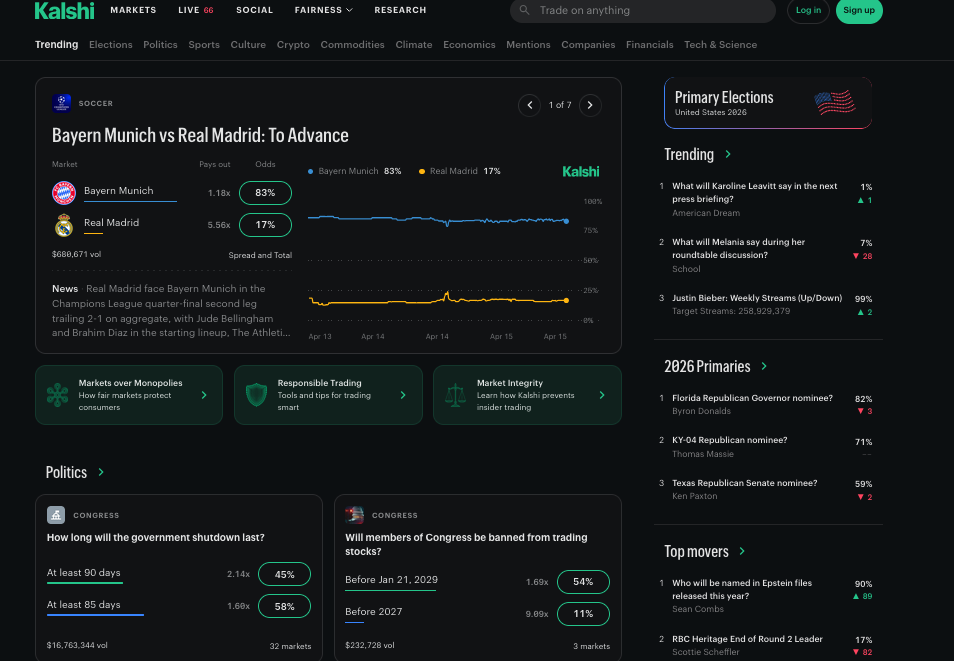
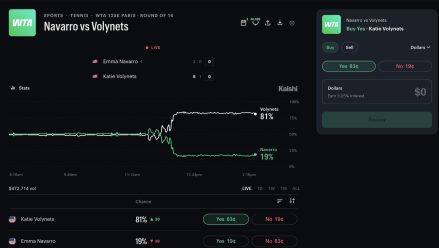
Kalshi is a federally regulated platform where users trade event contracts: simple yes/no propositions on real-world outcomes. Think of it as a stock exchange, but instead of buying shares in a company, you’re buying a position on whether something will happen. Will the Lions win the Super Bowl (been waiting a while)? Will inflation exceed 3% this quarter? Whether it snows in Denver this week?
Each contract is priced between $0.01 and $0.99, reflecting the market’s collective estimate of the probability that the event will occur. If you buy a “Yes” contract at $0.65, you’re effectively saying there’s a better-than-65% chance the event happens. If you’re right, the contract pays out $1.00, a profit of $0.35. Wrong, and the contract expires at $0.00.
The key difference between Kalshi and a sportsbook is that you’re not betting against the house. Every contract has a counterparty, another user taking the opposite side. Kalshi operates the exchange, matching buyers and sellers and collecting a small fee for its services. Prices move based on supply and demand, just like stocks. (Though as I’ll cover in the institutional traders section below, that “other user” is often a sophisticated trading firm, not some guy on his couch.)
Kalshi is regulated by the U.S. Commodity Futures Trading Commission (CFTC) as a Designated Contract Market (DCM). This federal oversight means your funds are held in segregated accounts, all contracts are guaranteed to settle, and Kalshi must meet the same compliance standards as futures exchanges.
Kalshi vs. Traditional Sportsbooks: Key Differences
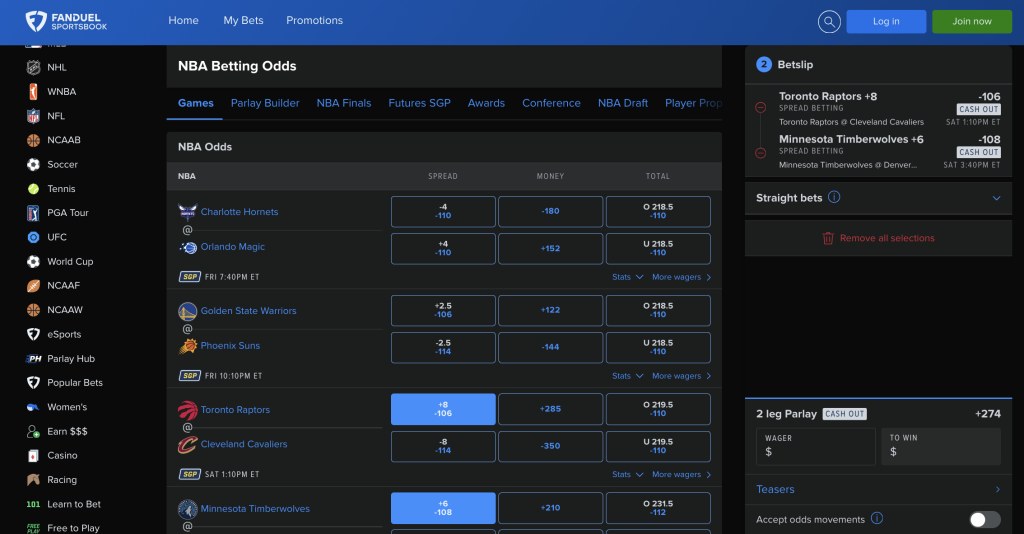
If you’re coming from the sports betting world, Kalshi will feel familiar in some ways and alien in others. The comparison below oversimplifies things. Kalshi’s “small exchange fee” doesn’t account for wider spreads on lower-liquidity markets, and sportsbooks’ “house edge” varies wildly depending on the sport and market type. But directionally, this is right:
| Traditional Sportsbook | Kalshi | |
|---|---|---|
| Who sets the odds? | The house (bookmaker) | The market (other traders) |
| Who are you trading against? | The sportsbook | Other users on the exchange (who might be sophisticated) |
| Can you exit early? | Sometimes (cash out, where offered) | Yes. Buy/sell anytime before resolution |
| House edge | Built into the odds (vig/juice) | Small exchange fee (~1%) |
| Regulator | State gaming commissions | Federal CFTC |
| Available markets | Sports only | Sports, politics, economics, weather, culture, and more |
| Balance earns interest? | No | Yes (~3-4% APY) |
The biggest practical difference for sports bettors is the ability to trade out of a position at any time. If you bought a “Yes” contract on the Knicks to win the NBA title at $0.12 back in October and the price has risen to $0.35 by the playoffs, you can sell for a profit without waiting for the season to end. That flexibility, closer to trading options than placing a bet, is often what makes prediction markets appealing to a different kind of user. I’ve locked in profits on NBA futures mid-season more times than I can count, something that’s basically impossible on DraftKings.
We’ve written a full breakdown of prediction markets vs. sportsbooks if you want the deeper comparison.
Is Kalshi Legal?
Sure is, but the legal picture is more nuanced than Kalshi’s marketing might suggest.
Kalshi is federally regulated by the CFTC as a Designated Contract Market, which means it operates under the same regulatory framework as futures and derivatives exchanges. This federal authorization is why Kalshi is available in many states that don’t allow online sportsbooks. Its event contracts are classified as financial instruments, not gambling products.
However, the state-level legal landscape is complex and evolving. Several states have challenged Kalshi’s right to operate, arguing that sports-related event contracts are functionally indistinguishable from sports bets and should be subject to state gambling laws. As of April 2026:
- Kalshi is currently restricted only in Nevada, where a temporary restraining order was issued in May 2026. In all other states, including those with active litigation, the platform remains operational.
- The CFTC has publicly declared it will defend its “exclusive jurisdiction” over event contracts.
- A federal court in Tennessee granted Kalshi a preliminary injunction in February 2026, finding that sports event contracts are likely “swaps” under the Commodity Exchange Act and that federal law likely preempts state gambling regulations.
- Massachusetts won a state court ruling that sports contracts are subject to state gaming laws, but the injunction was stayed on appeal.
- Nevada filed a civil enforcement action, which Kalshi removed to federal court.
The jurisdictional battle is far from settled. InGame covers these legal developments extensively. For the latest, see our Kalshi litigation coverage and our broader analysis of the states vs. federal prediction markets battle, and check the news section for regular updates.
Where Is Kalshi Legal? State-by-State Guide
Because Kalshi is federally regulated, it is available nationwide. The only state where the platform is currently restricted is Nevada, where a court issued a temporary restraining order in March 2026. In all other states, including those with active litigation from attorneys general or gaming commissions, Kalshi remains operational, though specific sports markets may be limited in certain jurisdictions. The table below reflects the current landscape as of April 2026.
States Where Kalshi Is Currently Available
| Alabama | Alaska | Arizona* | Arkansas |
| California | Colorado | Connecticut* | Delaware |
| Florida | Georgia | Hawaii | Idaho |
| Illinois* | Indiana | Iowa | Kansas |
| Kentucky | Louisiana | Maine | Maryland* |
| Massachusetts* | Michigan* | Minnesota | Mississippi |
| Missouri | Montana* | Nebraska | New Hampshire |
| New Jersey* | New Mexico | New York* | North Carolina |
| North Dakota | Ohio* | Oklahoma | Oregon |
| Pennsylvania | Rhode Island | South Carolina | South Dakota |
| Tennessee | Texas | Utah* | Vermont |
| Virginia | Washington* | Washington, D.C. | West Virginia |
| Wisconsin | Wyoming |
*States marked with an asterisk have active litigation or regulatory challenges against Kalshi. The platform remains operational in these states, but sports-specific markets may be restricted in some jurisdictions. See the litigation table below for details.
States With Active Litigation or Regulatory Challenges
| State | Status | Details |
|---|---|---|
| Nevada | 🔴 Restricted | Preliminary injunction issued; 9th Circuit heard oral arguments April 16, ruling expected within 60-120 days |
| Arizona | ⚠️ Available (litigation pending) | Criminal charges filed March 2026; Kalshi won federal injunction; CFTC sued state in April |
| Connecticut | ⚠️ Available (litigation pending) | Cease-and-desist order; Kalshi sued in federal court; CFTC sued state in April |
| Illinois | ⚠️ Available (litigation pending) | Regulatory action; CFTC filed federal suit challenging state enforcement in April |
| Massachusetts | ⚠️ Available (litigation pending) | State court injunction stayed on appeal; expected to reach MA Supreme Judicial Court |
| Maryland | ⚠️ Available (litigation pending) | Cease-and-desist order; state agreed to pause pursuit of punitive action during proceedings |
| Michigan | ⚠️ Available (litigation pending) | AG filed enforcement action; Kalshi removed to federal court and is opposing remand |
| Montana | ⚠️ Available (litigation pending) | Cease-and-desist letter; Kalshi filed federal suit in April 2026 |
| New Jersey | ⚠️ Available (litigation pending) | Third Circuit ruled April 2026 that NJ cannot regulate Kalshi through gambling laws |
| New York | ⚠️ Available (sports markets may be limited) | Federal lawsuit filed by Kalshi Oct. 2025; sports-specific markets may be restricted |
| Ohio | ⚠️ Available (litigation pending) | Federal judge ruled March 2026 that Kalshi products constitute gambling; Kalshi appealing |
| Utah | ⚠️ Available (enforcement threatened) | State notified Kalshi of planned enforcement; Kalshi revived preliminary injunction request April 2026 |
| Washington | ⚠️ Available (litigation pending) | State filed lawsuit March 2026; Kalshi removed to federal court |
⚠️ Watch Out: Nevada is the only state where Kalshi is currently restricted. In all other states listed above, Kalshi remains operational despite active litigation or regulatory challenges. However, availability (particularly for sports-specific markets) could change as court rulings come down. For the most up-to-date access, check Kalshi’s website directly.
Why States Are Fighting Kalshi: Federalism, Tax Revenue, and the Future of Sports Betting Regulation
The legal battle over Kalshi is one of the most significant federalism disputes in the gambling industry since the Supreme Court struck down the federal sports betting ban in Murphy v. NCAA (2018). It’s also the one most likely to affect whether you can still use the platform a year from now.
The Core Constitutional Question
The Kalshi dispute boils down to a single question: who gets to regulate this activity, the federal government or the states? Kalshi’s argument is fairly straightforward. It is registered with the CFTC as a Designated Contract Market, and the Commodity Exchange Act (CEA) grants the CFTC “exclusive jurisdiction” over transactions on federally regulated exchanges. Under this theory, state gambling laws are preempted entirely, and Kalshi can operate nationwide without seeking 50 different state licenses.
States see it very differently. Their position is that Kalshi’s sports event contracts are functionally indistinguishable from sports bets. A user risks money on whether a team wins or loses, just like on DraftKings or FanDuel. Maryland’s cease-and-desist letter put it bluntly: “the purchase of the contract is indistinguishable from the act of placing a sports wager.” From the states’ perspective, a federal agency shouldn’t be able to override decades of state police power over gambling just by labeling a sports bet a “swap.”
Federal courts are deeply split on this question. A Tennessee federal judge sided with Kalshi in February 2026, finding that sports event contracts are likely “swaps” under the CEA and that federal law preempts state regulation. The Third Circuit Court of Appeals ruled in April 2026 that New Jersey cannot regulate Kalshi through state gambling laws. But an Ohio federal judge reached the opposite conclusion in March 2026, ruling that Kalshi’s products amount to gambling under state law. A group of 34 states filed an amicus brief supporting New Jersey’s position in the Third Circuit case, signaling broad state-level opposition. Legal observers widely expect this issue to eventually reach the U.S. Supreme Court.
Follow the Money: The Tax Revenue Problem
Beyond constitutional principle, there is a very concrete financial motivation behind the state pushback. The American Gaming Association (AGA) estimates that states have lost more than $600 million in tax revenue (and counting) from wagers placed on prediction markets that bypass state gaming tax structures.
Here’s why that number matters. When a state legalizes sports betting, it imposes a tax on operator gross gaming revenue, with rates ranging from about 10% in states like Nevada up to 51% in New York. That revenue funds state programs: education, addiction treatment, infrastructure, and more. For example, North Carolina collected over $132 million in gambling tax revenue in 2025 alone, funding everything from the state Department of Health and Human Services to university athletics programs.
Kalshi, by contrast, operates under federal CFTC oversight and pays no state gaming taxes. In states without a corporate income tax (Nevada, Ohio, South Dakota, Texas, Washington, and Wyoming), prediction market companies pay essentially zero state taxes on their revenue. Even in states with corporate income taxes, the rates are a fraction of gaming taxes. North Carolina’s 2.25% corporate income tax rate, for instance, is vastly lower than its 18% sports betting operator tax.
The traditional sportsbook industry (DraftKings, FanDuel, Fanatics, and bet365) has taken notice. These operators have collectively poured $48 million into a super PAC called “Win for America” aimed at advancing sports betting legalization in states like Texas and Georgia, in part to establish regulated markets before prediction platforms capture those users permanently.
Of course, they’re playing both sides at the same time: their own prediction market products (DraftKings Predictions, FanDuel Predicts, Fanatics Markets) operate in states where their traditional sportsbooks are banned, while they lobby for state licensing frameworks that would include gaming taxes.
The CFTC Enters the Fight
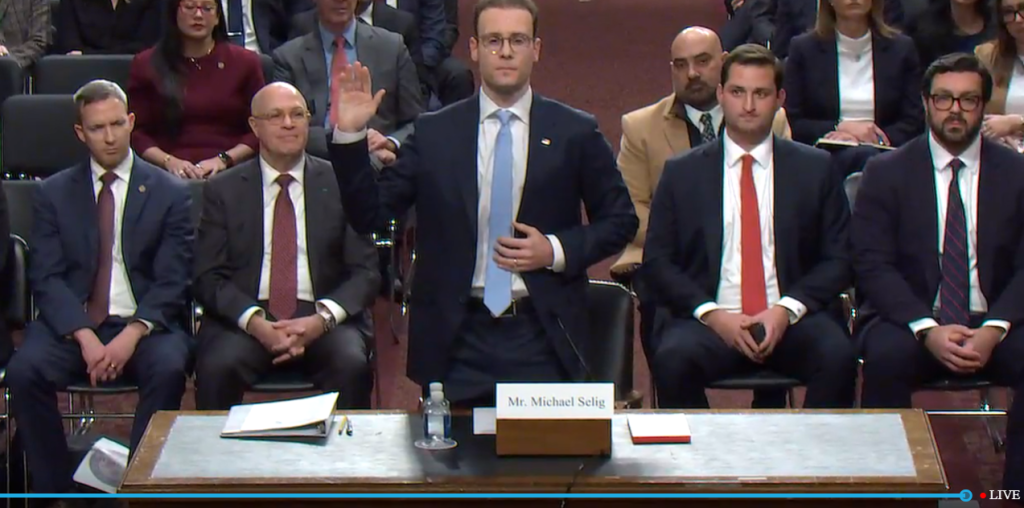
The Trump administration’s CFTC has dramatically escalated the conflict. Under Chairman Michael Selig, who replaced the Biden-era leadership that was far more cautious about prediction markets, the CFTC has publicly declared it will defend its “exclusive regulatory authority” over event contracts. In April 2026, the CFTC took the unprecedented step of suing three states (Arizona, Connecticut, and Illinois) to block their enforcement actions against Kalshi and other federally regulated prediction market operators.
CFTC Chairman Selig framed the issue as preventing a “fragmented patchwork of state regulations” that would lead to “weaker consumer protection and an increased risk of fraud and manipulation.” Critics see the federal suits as the government putting its thumb on the scale for a politically connected industry. Kalshi board member Brian Quintenz was the initial nominee to lead the CFTC under the Trump administration, and Donald Trump Jr. serves as an advisor to both Kalshi and Polymarket.
What This Means for Kalshi Users
For everyday users, the practical takeaway is that Kalshi is currently available in 49 states, but the legal ground is shifting under the platform. If your state’s attorney general or gaming commission wins in court, you could see sports-specific markets disappear from Kalshi in your jurisdiction. Worst case, the platform itself could be forced to exit your state. The $600 million tax gap also creates political pressure for state legislatures to pass laws explicitly addressing prediction markets, which several states are already considering. Stay informed, and follow InGame‘s prediction markets coverage for the latest developments.
Markets Available on Kalshi
Your Kalshi promo code bonus works on any available market, and the catalog is wider than most people expect.
Sports
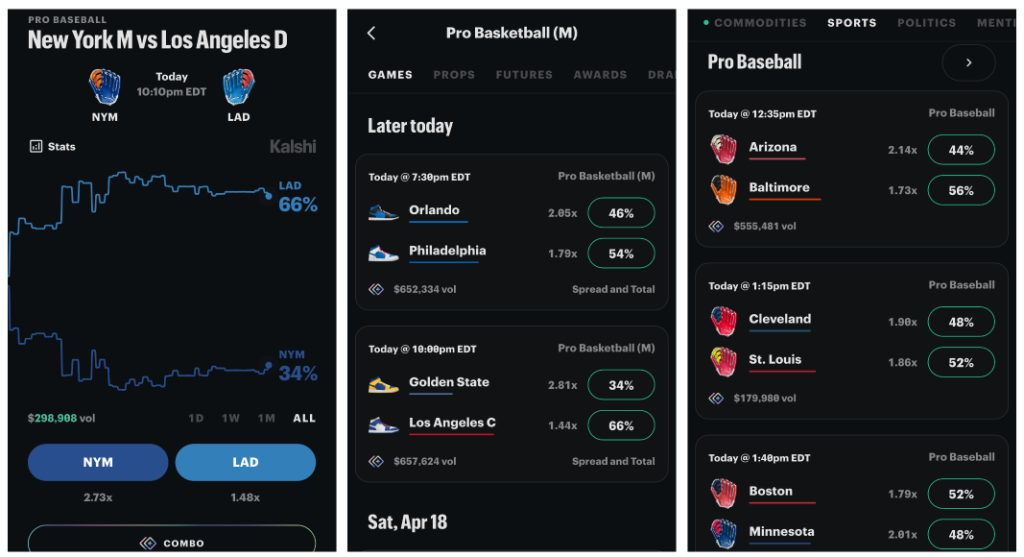
Sports is a rapidly growing category on Kalshi. What started with simple moneyline-type yes/no contracts has expanded to spreads, over/unders, player props, parlays (called “Combos”), and futures. Available sports include: NFL, NCAA Football, NBA, NCAA Basketball, MLB, NHL, worldwide soccer leagues, tennis, golf, motorsports, chess, esports, and more depending on the time of year.
Kalshi debuted single-game NBA markets during the 2024-25 NBA Playoffs and has since expanded individual player prop markets to the NFL and other leagues. Combos (Kalshi’s version of parlays) allow you to bundle multiple outcomes into a single trade for higher potential payouts.
Beyond Sports
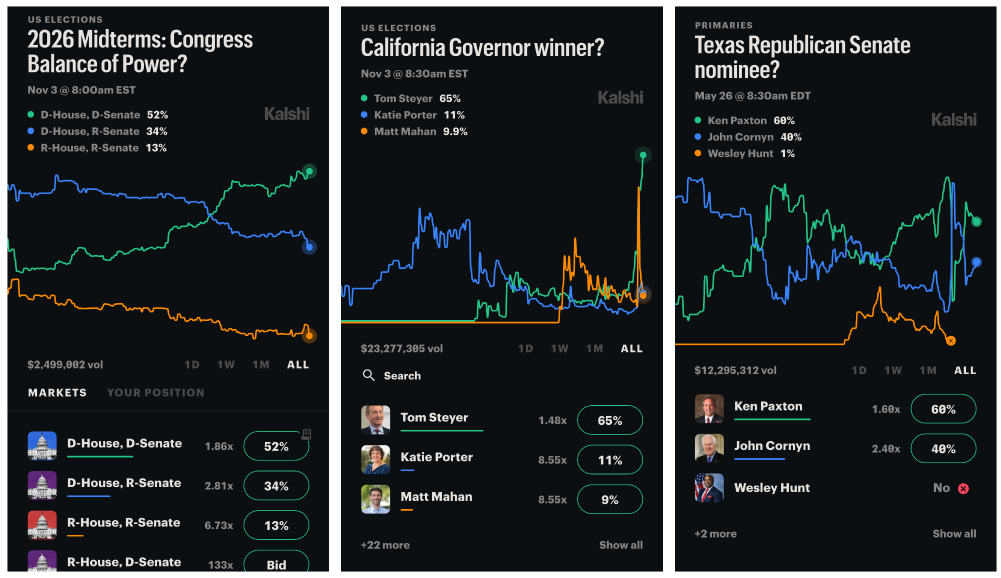
The non-sports market catalog is where Kalshi leaves sportsbooks in the dust. Categories include: politics (elections, legislation, government actions), economics (inflation, interest rates, employment data, GDP), crypto (Bitcoin and Ethereum price targets), climate and weather (temperature forecasts, hurricanes, snowfall), companies (CEO changes, layoffs, product launches), financials (NASDAQ levels, currency exchange rates, treasuries), tech and science (AI developments, space launches), health (disease tracking), pop culture (awards shows, movie box office, music), and world affairs (foreign elections, international politics).
Politics is Kalshi’s most popular non-sports category and became mainstream during the 2024 presidential election. With 2026 midterm primaries approaching, Kalshi has built dedicated sections for House, Senate, and governor’s race predictions across all 50 states. In April 2026, Kalshi also expanded its commodities offerings significantly, adding contracts for corn, coffee, soybeans, wheat, sugar, copper, nickel, lithium, diesel, and natural gas alongside existing markets for oil, gold, and silver.
Kalshi App Review
Kalshi offers native apps for both iOS and Android. I’ve used the iOS version daily for months and it’s legitimately good. Fast, clean, and the order book is easy to read at a glance. The Android version has caught up considerably since its rocky early days.
| Apple App Store Rating | 4.7/5 ⭐ (23K+ reviews) |
| Google Play Store Rating | 4.4/5 ⭐ (3K+ reviews) |
| Latest Version | V.9.9.22 (February 2026) |
The app provides the same full market catalog, payment options, and trading functionality as the desktop experience. It includes push notifications for market movements and resolution updates, two-factor authentication, and a mobile-optimized interface for quick trades. The web browser version also works well on mobile, though the dedicated app offers a smoother experience overall.
You can enter the promo code INGAMEPRO during mobile registration just as easily as on desktop.
Understanding Kalshi’s Maker & Taker Fees
Kalshi uses a maker-taker fee model borrowed from traditional financial exchanges. If you’ve used a stock brokerage or crypto exchange, this structure will feel familiar. If you’re coming from the sportsbook world, it’s a different animal than the vig/juice you’re used to, and it directly affects your cost of trading.
What Is a Taker?
A taker is someone who executes a trade at the current market price. You’re “taking” liquidity off the order book, buying or selling a contract that someone else has already posted. This is the equivalent of hitting “buy now” on an e-commerce site. Taker orders fill immediately.
Taker fees on Kalshi follow a parabolic formula: 0.07 × Price × (1 – Price), applied per contract. This means fees are highest on contracts priced near $0.50 (maximum uncertainty) and lowest on contracts near $0.01 or $0.99 (near-certainties). At a $0.50 contract, the maximum taker fee is approximately 1.75 cents per contract. At a $0.90 contract, the fee drops to about 0.63 cents. This structure is intentional. It keeps trading affordable on extreme-probability contracts where a flat fee would be prohibitively expensive relative to the price.
What Is a Maker?
A maker is someone who places a limit order that doesn’t fill immediately. It “rests” on the order book, waiting for another trader to take the other side. By posting a resting order, you’re “making” liquidity, which benefits the overall market. Kalshi rewards this with lower fees.
Maker fees, when they apply, use a coefficient of 0.0175 instead of 0.07, exactly one-quarter of the taker rate. On many markets, maker fees are zero. There is no fee for canceling an unmatched resting order.
Why This Matters for Your Trading
The practical implication: if you’re willing to be patient and set limit orders rather than buying at the current price, you’ll pay significantly less in fees. On a $0.50 contract, the difference is roughly 1.75 cents (taker) vs. 0.44 cents (maker) per contract, a 75% savings. Over hundreds of trades, that adds up. For new users testing the platform through the welcome offer, taker fees are still a small part of the learning curve. But once you’re trading with real size, learning to use limit orders is the single most important thing you can do to protect your margins.
Fee Comparison Across the Prediction Market Ecosystem
Fee structures across prediction markets are a mess. Every platform calculates costs differently, which makes apples-to-apples comparisons harder than it should be. I’ve traded on all four of these platforms and the table below is my best attempt at a fair breakdown:
| Platform | Taker Fee | Maker Fee | Deposit/Withdrawal Fees | Interest on Balance |
|---|---|---|---|---|
| Kalshi | 7% coefficient (max ~1.75¢/contract at $0.50) | 1.75% coefficient (many markets: $0) | 2% on debit card; free ACH/wire/USDC | ~3-4% APY |
| Polymarket (U.S.) | 5% coefficient | $0 | No Polymarket fee; third-party fees may apply | No |
| Robinhood | $0.01 per contract | $0.01 per contract | Free ACH | Yes (via cash sweep program) |
| Traditional Sportsbook | Built into odds (vig/juice, typically ~4.5-5%) | N/A | Varies; many free options | No |
The hidden cost to watch: Fees per contract don’t tell the whole story. Kalshi’s spreads (the gap between the best “buy” and “sell” prices) tend to run wider than Polymarket’s on comparable markets, largely because Polymarket’s zero-maker-fee policy attracts more passive liquidity providers. Wider spreads effectively function as an additional cost. You pay more to get in and receive less when getting out. On popular, high-volume markets (NFL moneylines, major elections), Kalshi’s spreads are reasonably tight. On niche or lower-volume markets, the spread can eat into your edge more than the posted fee.
One offsetting advantage: Kalshi pays interest on your deposited balance (including funds in open positions), currently in the 3-4% APY range. If you maintain a meaningful balance on the platform, that interest partially offsets the fee disadvantage relative to zero-fee competitors. No sportsbook and no other major prediction market currently matches this feature.
Live Trading: Buying & Selling Positions in Real Time
The ability to trade in and out of positions at any time before a contract resolves is what separates Kalshi from every sportsbook on the market. This isn’t just a theoretical benefit; it fundamentally changes how you can approach sports and event predictions.
How It Works
When you buy a contract on Kalshi, you’re not locked in. The contract is a tradeable asset, like a stock. If you bought a “Yes” contract on the Chiefs winning Sunday’s game at $0.55 and the Chiefs go up 14-0 in the first quarter, the market price for that contract might rise to $0.78. At that point, you can sell your contract to another user at the higher price, locking in a $0.23 profit per contract, without waiting for the game to finish.
Conversely, if the Chiefs fall behind and the contract price drops to $0.30, you can sell to cut your losses at $0.25 per contract rather than riding it to a $0.55 loss if the contract expires worthless.
Limit Orders vs. Market Orders
Kalshi offers two ways to execute trades. A market order fills immediately at the best available price. You’re a taker, and you pay taker fees. A limit order lets you set the price you’re willing to pay or accept. It rests on the order book until someone takes the other side. You’re a maker, and you pay lower (or zero) fees. During fast-moving events, market orders provide speed; during slower periods, limit orders save money.
Live Trading During Events
Kalshi allows contracts to be traded in real time during live events. For sports, this means you can react to game flow (an injury, a momentum shift, a weather delay) by adjusting your positions. This is similar to live/in-play betting on sportsbooks but with a key structural difference: on a sportsbook, you’re accepting the book’s in-play odds (which typically carry a wider margin). On Kalshi, you’re trading against other users at market-determined prices.
The trade-off is liquidity. Sportsbooks will always offer you a price on in-play bets because they’re the counterparty. On Kalshi, you need someone on the other side. During high-profile events (NFL primetime games, major election nights), liquidity is robust and trades execute quickly. During less popular events, you may have to wait for a match or accept a less favorable price.
Institutional Traders & Market Makers on Kalshi
Most promo code reviews skip this entirely, but it matters more than the bonus itself: institutional traders and professional market makers are active on Kalshi, and they’re often on the other side of your trade.
Who’s on the Other Side of Your Trade?
Kalshi markets itself as a peer-to-peer exchange where users trade against other users. That’s technically true, but the reality is more nuanced. Major institutional players, most notably Susquehanna International Group (SIG), one of the largest quantitative trading firms in the world, operate as market makers on the platform. These firms quote prices on both sides of contracts (buy and sell) and profit from the spread between them, providing the liquidity that allows retail users to execute trades quickly.
As Sportico has reported, these institutional market makers use sophisticated data models to drive pricing decisions, and while Kalshi maintains that market makers “react to pricing” rather than set it, the distinction can feel academic to a retail user who is consistently trading against firms with vastly superior analytical resources.
How This Differs From Sportsbooks, and How It Doesn’t
Kalshi’s defenders argue this structure is fundamentally different from a sportsbook, where the house takes the opposite side of every bet. On Kalshi, market makers face price competition from other participants and take risk on outcomes just like everyone else. Proponents say this competition benefits retail users by tightening spreads and improving prices relative to what a monopoly bookmaker would offer.
Critics, including some state regulators and industry analysts, counter that the practical difference is smaller than Kalshi suggests. When a retail user places a market order on a popular NFL contract, the counterparty is often an institutional market maker, not another casual fan. The dynamic is closer to a retail options trader executing against a professional market-making desk than it is to two friends making a bet. A George Washington University research paper found that the expected return on the average Kalshi contract after fees was negative 20%, not dissimilar from the house edge on many casino games.
Kalshi’s Own Affiliated Trading Operations
Adding another layer: Kalshi has affiliated for-profit market-making arms that participate in the exchange. While these operations are disclosed, they raise structural questions about whether the exchange truly functions as a neutral intermediary. Kalshi’s parlay (Combo) product is also worth noting. In-app retail users can only act as odds takers on Combos, not makers, which more closely resembles the sportsbook model than the exchange model.
None of this means Kalshi is a bad product, but going in with clear eyes about the competitive dynamics is important. If you’re trading casually with small positions and using the platform for entertainment, institutional market makers are mostly a background feature that provides you with liquidity. If you’re trying to trade professionally and generate consistent profits, you should understand that you’re competing against some of the most sophisticated trading operations in finance.
Common Disputes: How Kalshi Settles Contracts
Contract settlement, the process of determining outcomes and paying winners, can be frustrating at times in cases that aren’t clear-cut or binary. Kalshi has faced several high-profile controversies that prospective users should understand before depositing a dollar.
How Settlement Works
Every Kalshi market lists specific “Source Agencies” and resolution criteria in its contract terms, which are filed with the CFTC as part of the exchange’s self-certification process. When an event concludes, Kalshi determines the outcome based on these pre-specified sources and rules. Settlement typically occurs within a few hours of resolution.
Critically, Kalshi controls the settlement process. The company writes the contract rules, determines the resolution data source, decides when to close trading, and determines whether the outcome was “Yes” or “No.” There is no independent third-party arbitrator.
Notable Settlement Controversies
The Oscars Viewership Dispute (2025): Kalshi offered a market on whether the 2025 Oscars would exceed prior years’ viewership. The platform settled the contract based on preliminary overnight ratings, which showed a decline. Hours later, final consolidated ratings showed the Oscars had actually exceeded prior years’ numbers. Users who held the correct position based on final ratings lost money. When traders raised the issue on Discord, Kalshi staff told them the resolution was “legal and correct” based on available data at the time, and the only review process is one “Kalshi initiates at its sole discretion.”
Kalshi’s market on the removal of Ali Khamenei as supreme leader of Iran ended last weekend with the company taking a $2.2 million loss after a messy series of conflicting rule “clarifications.” For many traders, it raised questions about how the exchange handles large,…
— InGame (@InGameHQ) March 4, 2026
The Iran/Khamenei Market (February-March 2026): This was Kalshi’s largest and most damaging settlement controversy. The platform offered a market on whether Iran’s Supreme Leader Ayatollah Ali Khamenei would be “out of office” by a specified date. When Khamenei died on February 28, 2026, many traders expected their “Yes” contracts to pay out. Instead, Kalshi invoked a “death carveout” in the contract rules (a provision that excluded death as a qualifying event for “out of office” resolution) and froze the market, settling at the last traded price rather than $1.00. Approximately $77 million in expected winnings went unpaid. Kalshi’s CEO stated that the rules were published from the outset and no trader ended net-negative after fee reimbursements, but the incident triggered a potential class action lawsuit (filed in California federal court) and widespread criticism of Kalshi’s market-design transparency.
NFL Settlement Issues (January 2026): Users who held correct positions on certain NFL contracts were reportedly only repaid their original stake rather than the full contractual payout. We couldn’t confirm whether Kalshi has publicly addressed the specifics of these cases or offered restitution beyond the initial stake refunds.
What Users Should Know
The common thread across these disputes is that Kalshi operates as judge, jury, and enforcement mechanism for its own contracts. Unlike Polymarket’s international platform (which uses a decentralized oracle system where users can post bonds to dispute resolutions), Kalshi has no formal, independent dispute process available to users. If you disagree with how a contract was settled, your recourse is limited to emailing support or posting on Discord. There is no arbitration mechanism, no independent review board, and no appeals process.
⚠️ Watch Out: Read the full contract rules before trading, especially on novel or geopolitical markets where edge cases are more likely. Kalshi has expanded its operations and compliance team in response to these incidents, but the fundamental structural issue (centralized settlement by the exchange itself) remains unchanged.
Kalshi Banking Options & Fees
Kalshi offers four ways to move money in and out of your account. The short version: ACH and USDC are free, debit cards cost about $2 per transaction, and wire transfers are deposit-only.
| Method | Deposit | Withdrawal | Fees | Speed |
|---|---|---|---|---|
| Debit Card (Visa/Mastercard) | ✅ | ✅ | ~$2 per transaction | Instant deposit; 1-2 days withdrawal |
| Bank Transfer (ACH) | ✅ | ✅ | No fee | 1-3 days |
| Crypto (USDC only) | ✅ | ✅ | No fee from Kalshi | Minutes |
| Wire Transfer | ✅ | ❌ | Bank fees may apply | Same day |
💡 Pro Tip: Your Kalshi balance earns interest (currently around 3-4% APY), including funds tied up in open positions. No sportsbook offers this. If you maintain a meaningful balance, it partially offsets any fee disadvantage relative to zero-fee competitors.
For withdrawals, USDC crypto and debit card are the fastest options. Bank transfers can take up to four business days.
Kalshi Ongoing Promotions
Beyond the welcome bonus, Kalshi runs a handful of ongoing programs. Compared to what DraftKings and FanDuel throw at users daily, the promo calendar is thin. That’s the trade-off for an exchange model. The margin structure doesn’t support constant giveaways.
Refer-a-Friend Program: Once you’ve traded $10 or more on the platform, you can invite friends using a custom referral link. If they sign up and trade, you both receive a $10 credit. No cap on referrals.
Kalshi’s Volume Incentive Program is more niche. It rewards users who trade in lower-liquidity markets by distributing a share of a reward pool based on volume contributed. Each qualifying trade earns a small reward credit. Think of it as Kalshi paying you to provide liquidity in markets that need it.
Kalshi also runs event-based promotions around tentpole events: Super Bowl, March Madness, NBA Playoffs, election season. These are limited-time and promoted through the app and email.
Tips for New Kalshi Traders
If you’re new to prediction markets, a few principles to consider…
Start small and explore. The current welcome offer is best used as a way to place a few low-cost contracts, learn how prices move, and get comfortable with the order book before committing larger sums.
The hardest mental shift for sportsbook users is thinking in probabilities instead of odds. A contract priced at $0.70 means the market thinks there’s a 70% chance that event happens. If you think the true probability is higher, buy “Yes.” If lower, buy “No.” There’s no vig obscuring the implied probability. What you see is what the market actually believes.
Use the sell button. Unlike a sportsbook bet that locks you in, you can sell a Kalshi contract at any time the market is open. If your position has gained value and you want to lock in a profit, or if new information changes your outlook, sell. Don’t just hold everything to resolution.
Liquidity matters more than most beginners realize. In popular markets (major sports, high-profile elections), you’ll find tight spreads and easy execution. Less active markets can have wide spreads, which means you could overpay to enter or underpay when exiting. Always check the order book depth before trading.
Diversify across categories. Spreading positions across sports, politics, economics, and weather helps manage risk and takes advantage of what makes Kalshi different from a sportsbook in the first place.
And the same bankroll rules apply here as everywhere else. Don’t put everything on a single event. Set a budget, stick to it.
What We Like & Don’t Like About Kalshi
✅ What We Like
- Available in states without legal sports betting. If you’re in Texas, California, or another state without mobile sportsbooks, Kalshi is one of the few legitimate options for trading on sports outcomes. This alone justifies the platform’s existence for millions of Americans.
- The interest on your balance (currently 3-4% APY on deposited funds, including money in open positions) is a genuine differentiator. No sportsbook does this. It’s the kind of quiet advantage that compounds over time.
- Federal regulation provides real consumer protection. CFTC oversight means segregated customer funds, guaranteed contract settlement, and compliance standards that ought to improve further through the CFTC rulemaking process over the coming months.
- Ability to exit positions anytime. The exchange model lets you sell contracts before they resolve, giving you flexibility no sportsbook cash-out feature can match.
- The breadth of non-sports markets is staggering. Politics, economics, weather, pop culture. If you have a view on almost anything, there’s probably a Kalshi market for it.
- Clean, intuitive mobile app. Well-designed and highly rated on both app stores.
❌ What We Don’t Like
- Fewer ongoing promotions than sportsbooks. If you’re used to daily odds boosts, profit boosts, and parlay insurance from DraftKings or FanDuel, Kalshi’s promotional calendar is sparse.
- The sports market depth still lags behind mature sportsbooks. Growing quickly, yes, but Kalshi offers fewer game-level and prop markets per event than what you’d find on FanDuel or DraftKings. Not close, actually.
- Customer support needs work. Email-only support ([email protected]) with no live chat or phone line on the site, though a chat function is reportedly available to funded accounts during limited hours. Social media DMs on Discord, X, or Instagram may be faster in practice.
- That ~$2 debit card fee on every transaction adds up if you’re making frequent withdrawals. Use bank transfer or USDC to avoid it.
- Legal uncertainty in some states. The ongoing jurisdictional battle means availability could change. If your state’s attorney general decides to challenge Kalshi, access to sports markets (or the entire platform) could be disrupted.
- Low liquidity on niche markets is a real problem. Popular markets trade smoothly, but less-trafficked contracts can have spreads wide enough to wipe out your edge entirely.
Kalshi Customer Support
If you have trouble claiming the Kalshi promo code or encounter any issues with your account, here are your options:
| [email protected] | |
| Phone | 332-205-9910 |
| Live Chat | Available 8 AM – 3 PM ET (funded accounts only) |
| Help Center | help.kalshi.com |
| Discord | discord.gg/kalshi |
| X (Twitter) | @Kalshi |
| @kalshi_official | |
| TikTok | @kalshi_markets |
| Kalshi on LinkedIn |
Tip: If email is slow, try DMing Kalshi on Discord or X. Users report faster response times through social channels.
Recent Kalshi News & Updates
Bookmark this page and check back for the latest Kalshi developments. InGame covers Kalshi extensively across our prediction markets section.
Apr. 29, 2026: Utah notifies Kalshi it intends to commence enforcement proceedings under state anti-gambling laws. Kalshi revives its preliminary injunction request in federal court, arguing it faces an “impossible choice” between ceasing operations or risking criminal liability.
Apr. 22, 2026: Kalshi fines and suspends three political candidates for trading on their own races during primary campaigns, the platform’s most significant insider trading enforcement action to date. Suspensions last five years.
Apr. 21, 2026: Bloomberg reports Kalshi is planning to launch perpetual crypto futures, its first product category beyond event contracts. The move would pit Kalshi directly against crypto exchanges.
Apr. 16, 2026: A three-judge Ninth Circuit panel hears oral arguments in consolidated Nevada cases involving Kalshi, Crypto.com, and Robinhood. Judges appeared skeptical of the platforms’ arguments but a ruling is expected within 60 to 120 days. This case could deepen the circuit split and accelerate a path to the Supreme Court.
Apr. 15, 2026: Kalshi expands its commodities markets significantly, adding contracts for corn, coffee, soybeans, wheat, sugar, copper, nickel, lithium, diesel, and natural gas alongside existing oil, gold, and silver markets.
Apr. 14, 2026: Kalshi petitions a federal court in Montana to block state officials from enforcing gambling laws against the platform, the latest in an expanding map of state-by-state lawsuits.
Apr. 11, 2026: Kalshi becomes the first prediction market to integrate IC360’s SelfExclude responsible trading tool, enabling users to voluntarily self-exclude across multiple exchange-betting platforms.
Apr. 6, 2026: The Third Circuit Court of Appeals rules against New Jersey, affirming that the state cannot regulate Kalshi through gambling laws or the state constitution. A major win for federal preemption.
Apr. 2, 2026: The Trump administration’s CFTC files lawsuits against Arizona, Connecticut, and Illinois to block state enforcement actions against prediction market operators, a dramatic escalation of the federal-state conflict.
Mar. 27, 2026: Washington state files a lawsuit against Kalshi alleging violations of state gambling laws. Kalshi immediately files a notice of removal to federal court. Separately, Kalshi raises over $1 billion at a $22 billion valuation.
Mar. 20, 2026: A Nevada state court issues a 14-day temporary restraining order barring Kalshi from offering event contracts in the state, making Nevada the only state where Kalshi is currently restricted.
Mar. 17, 2026: Arizona Attorney General Kris Mayes files 20 criminal misdemeanor charges against Kalshi. The first criminal charges ever filed against a prediction market company.
Mar. 9, 2026: An Ohio federal judge rules that Kalshi’s products constitute gambling and should fall under the Ohio Casino Control Commission’s jurisdiction. Kalshi pledges to appeal.
Mar. 3, 2026: Kalshi files a CFTC rulebook amendment codifying settlement rules for markets involving a subject’s death, following the Khamenei market controversy. A potential class action is filed in California.
Feb. 25, 2026: Kalshi penalizes ex-California governor candidate Kyle Langford and MrBeast employee Artem Kaptur for violating its insider information policy.
Feb. 24, 2026: Kalshi files a federal lawsuit in Utah seeking to prevent expected state enforcement tied to anti-gambling laws.
Feb. 20, 2026: A Tennessee federal judge grants Kalshi a preliminary injunction, finding that sports event contracts are likely swaps under the Commodity Exchange Act and that federal law likely preempts state gambling regulations.
Feb. 18, 2026: The Nevada Gaming Control Board files a civil enforcement action against Kalshi, arguing sports event contracts constitute unlicensed wagering under state law.
Feb. 16, 2026: NBA commissioner Adam Silver says the league views prediction markets like sports betting operators. Separately, Kalshi’s estimated annualized revenue reaches $1.3 billion.
Feb. 6, 2026: NBA star Giannis Antetokounmpo announces he is a Kalshi shareholder. An unprecedented move for an active player.
Feb. 5, 2026: Kalshi announces a major overhaul of its surveillance and enforcement structure, splitting its integrity program into three pillars: detect, investigate, and enforce.
Jan. 29, 2026: Coinbase rolls out prediction markets nationwide through its partnership with Kalshi.
Jan. 14, 2026: Kalshi reportedly lands its first pro athlete partnership with golfer Bryson DeChambeau.
Kalshi Promo Code FAQ
Related InGame Coverage
- U.S. Prediction Markets: A Modern Timeline
- Prediction Market vs. Sportsbook: What’s the Difference?
- Peer-to-Peer Sports Betting: How Does It Work?
- Polymarket Review: Is It Legal, How It Works, and What You Can Trade
- Massachusetts Puts Kalshi on the Defensive, Sues in State Court
- States Rights vs. Federalism: Can Prediction Markets Be Kept at Bay?
Claim the Kalshi “Trade $25 and Get Up to $500” Offer with Code INGAMEPRO →
Disclaimer: Certain limitations apply. The offer is available to new users only, subject to the terms and conditions at kalshi.com/tc/500. 18+ only. Restrictions and eligibility requirements apply. Event contract trading involves significant risk and is not appropriate for everyone. Please carefully consider if it is appropriate for you in light of your personal financial circumstances. Kalshi products are not available in all jurisdictions. See kalshi.com/regulatory for more information.
🛡️ Responsible Trading Resources: If you or someone you know has a gambling problem, call 1-800-GAMBLER or visit the National Council on Problem Gambling. Prediction market trading carries real financial risk. Never trade more than you can afford to lose.