Last updated: September 2, 2026 | Last verified: September 2, 2026
Kalshi is the better choice for most people right now. It’s fully live in 48 states, has the widest market selection in U.S. prediction markets, supports live in-game sports trading, and pays 3-4% interest on your balance. Polymarket might become the better product, with lower fees (5% vs. 7% taker coefficient) and a faster app, but it’s still relatively new to the US and doesn’t have as many markets as Kalshi. I’ve been trading on both platforms since January 2026. I deposited $50 on Kalshi on January 2nd and $50 on Polymarket a week later. What follows is a current comparison based on hands-on usage.


⚖️ Kalshi vs. Polymarket at a glance
| Kalshi | Polymarket (U.S.) | |
|---|---|---|
| U.S. Availability | 49 states + DC | 49 states + DC |
| Regulator | CFTC (original DCM license) | CFTC (DCM via QCEX acquisition) |
| Trading Fees (Taker) | 7% coefficient | 5% coefficient |
| Trading Fees (Maker) | 1.75% coefficient | 1.25% rebate (makers get paid) |
| Interest on Balance | ✅ ~3-4% APY | ❌ No |
| Live In-Game Trading | ✅ Yes | ❌ Not yet |
| Markets (U.S.) | Sports, politics, economics, weather, culture, crypto | Sports, economics, elections (as of April 2026) |
| Deposit Methods | Debit card, bank transfer, wire, Apple/Google Pay | Debit card, bank transfer, USDC |
| Withdrawal Fee | $2 (bank transfer) | Free |
| Welcome Bonus | Trade $25 and get up to $500! (code INGAMEPRO) | Deposit $10 to get a $20 trading bonus (code INGAME) |
| Min. Deposit | $1 | $2 |
| Mobile App | iOS (4.7/5) & Android (4.4/5) | iOS live; Android coming soon |
| Legal Age | 18+ | 18+ |
Get up to $500 at Kalshi →
Get $20 at Polymarket →
Disclaimer: Certain limitations apply. The offer is available to new users only, subject to the terms and conditions at kalshi.com/tc/500. 18+ only. Restrictions and eligibility requirements apply. Event contract trading involves significant risk and is not appropriate for everyone. Please carefully consider if it is appropriate for you in light of your personal financial circumstances. Kalshi products are not available in all jurisdictions. See kalshi.com/regulatory for more information.
Disclaimer: 18+ Only. Restrictions and eligibility requirements apply. Not available in all jurisdictions. Trading involves high risk and may result in loss of your entire investment. See polymarket.us/tos for more information. The Polymarket US App serves as an independent software provider and affiliate of Polymarket US and Polymarket Clearing, the CFTC-regulated derivatives exchange and clearing organization.
Which one should you use?
My actual recommendation? Open accounts on both. The bonuses stack, and having access to both order books gives you better pricing on any given market. I bounce between them depending on which has better liquidity for the contract I want.
But if you’re only opening one account, here’s what to consider:
Kalshi is the right starting point for most people. You can sign up today, deposit a dollar, and start trading in minutes. No waitlist, no invite codes required (though trading $25 and using code INGAMEPRO can get you up to $500 in bonus trades). The market selection is the broadest in the space, the app works, and you earn interest while your money sits there. It’s the more complete platform today.
Polymarket is the pick for fee-conscious or high-volume traders. The 5% taker coefficient saves roughly 29% per trade compared to Kalshi’s 7%. Makers actually earn rebates instead of paying fees. The app is faster on iOS. The main access limitation right now is device support. Polymarket US is live for eligible iPhone users, while Android is still coming soon and is not broadly available yet.
🔑 Bottom Line: Kalshi is more complete. Polymarket is catching up fast and has structural fee advantages. If you’re only opening one account, start with Kalshi. If you’re serious about prediction markets, open both.
💰 Fees compared
Fees used to be the clearest differentiator between these two platforms. It’s more nuanced now.
Until April 2026, Polymarket charged a flat 0.10% taker fee, which made Kalshi look expensive by comparison. That changed on April 3, 2026, when Polymarket switched to a parabolic coefficient model: a 5% taker coefficient with a 1.25% maker rebate. The gap with Kalshi’s 7% taker / 1.75% maker coefficient narrowed considerably.
What does that actually mean in dollars? Here’s a concrete example I calculated on both platforms:
| Scenario | Kalshi Fee | Polymarket Fee | Difference |
|---|---|---|---|
| 100 contracts at $0.50 (taker) | ~$1.75 | ~$1.25 | $0.50 |
| 100 contracts at $0.50 (maker) | ~$0.44 | -$0.31 (rebate) | $0.75 |
| 500 contracts at $0.75 (taker) | ~$6.56 | ~$4.69 | $1.87 |
Polymarket is still cheaper. But the old “Polymarket is basically free and Kalshi is expensive” framing is toast. We’re talking about $0.50 to $1.87 in savings per trade at typical sizes. Over hundreds of trades, that adds up. But for a casual user making 5-10 trades a month, the difference is a few bucks.
Kalshi has one counter that Polymarket can’t match: interest on your balance. Kalshi pays roughly 3-4% APY on uninvested funds. If you keep $1,000 sitting in your account, that’s $30-40 a year in passive interest. Polymarket pays nothing. For users who keep meaningful balances and trade patiently with limit orders, Kalshi’s interest plus maker pricing can offset the taker fee gap entirely.
💡 Pro Tip: If you’re placing market orders (taker), Polymarket saves you money. If you’re placing limit orders (maker) and keeping a balance on the platform, the math tilts toward Kalshi once you factor in interest and the different maker fee structures. For the full breakdown of each platform’s fee model, see our Kalshi review and Polymarket review.
🏆 Markets and sports coverage compared
Kalshi has the deeper catalog. That’s not a close call right now.
As of April 2026, Kalshi offers contracts on sports (NFL, NBA, MLB, NHL, golf, college football, college basketball, MMA, soccer, and more), politics, economics, weather, crypto prices, pop culture, and a rotating set of novelty markets. The breadth is genuinely impressive, and I’ve found tradeable markets on events I didn’t expect to see listed.
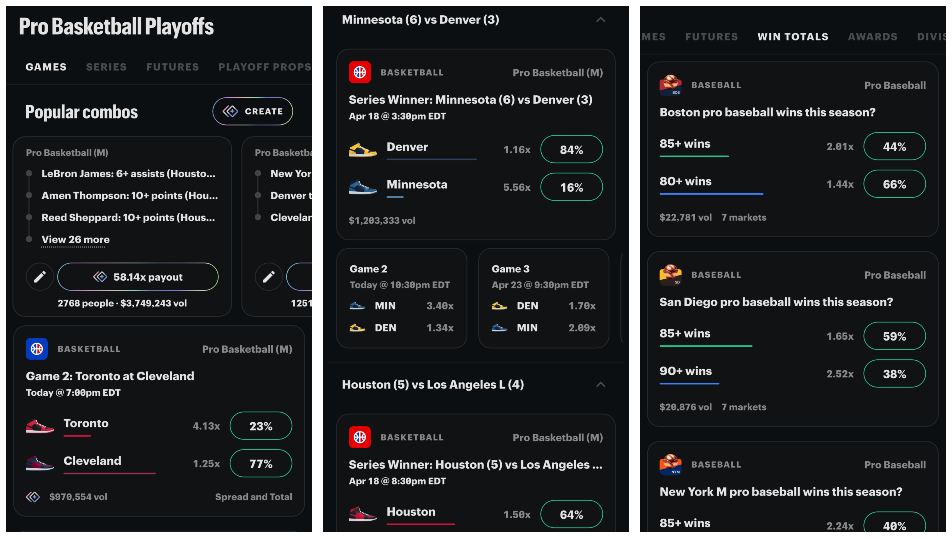
Polymarket’s U.S. platform launched with sports only and expanded to economics and elections markets in April 2026. The sports coverage is solid across major leagues, and they also list tennis, golf, motorsports, esports, cricket, and chess. But the non-sports catalog is still thinner than Kalshi’s, and some markets I can find on Kalshi simply don’t exist on the Polymarket U.S. side yet.
For a deeper look at how both platforms compare to traditional sportsbooks, we have a dedicated breakdown. And if you’re interested in the peer-to-peer sports betting model that prediction markets use, that’s worth reading too.
⚠️ Remember: The international version of Polymarket has far more markets than the U.S. version. If you’ve seen screenshots or videos showing a massive market catalog on Polymarket, that’s likely the international platform. U.S. users can view those markets in “observer mode” but can’t trade on them.
📱 Access and availability
This is the single biggest practical difference between the two platforms in April 2026, and it’s not even about features.
Kalshi is open to anyone 18+ in 49 states plus DC. The only state where you can’t use it is Nevada, where a court issued a temporary restraining order in March 2026. Nine other states have active litigation against Kalshi (Arizona, Illinois, Massachusetts, Maryland, Michigan, Montana, New Jersey, Ohio, and Connecticut), but the platform remains fully operational in all of them. You can sign up, verify your identity, deposit, and trade within minutes. No waitlist. For a full state-by-state breakdown, see our Kalshi bonus page.
Polymarket US is live for eligible users through its iOS app. Android is still coming soon and is not broadly available yet. The U.S. product is separate from Polymarket’s international platform, and eligible users can currently deposit $10 and get a $20 trading bonus.
Disclaimer: 18+ Only. Restrictions and eligibility requirements apply. Not available in all jurisdictions. Trading involves high risk and may result in loss of your entire investment. See polymarket.us/tos for more information. The Polymarket US App serves as an independent software provider and affiliate of Polymarket US and Polymarket Clearing, the CFTC-regulated derivatives exchange and clearing organization.
If you use an iPhone, Polymarket US is available to eligible users now. Android users will need to wait for broader availability or use Kalshi instead.
💳 Banking and deposits compared
Kalshi operates like a traditional exchange. Deposit with a debit card, bank transfer (ACH), wire transfer, Apple Pay, Google Pay, or crypto. Withdrawals go back to your linked bank account, subject to a $2 fee and a processing window of a few business days. Your funds sit in a centralized, custodied account. It works the way DraftKings or FanDuel would.
Polymarket’s history is crypto-native, and that used to be a barrier. The international version still requires USDC on the Polygon blockchain and a crypto wallet. But the U.S. version, which is what matters here, lets you deposit with a debit card or bank transfer. No wallet setup, no buying stablecoins manually. The platform handles the fiat-to-USDC conversion behind the scenes.
Withdrawals on Polymarket U.S. go back to your original payment method with no fee. That’s a small but real advantage over Kalshi’s $2 withdrawal charge, especially for users who move money in and out frequently.
📲 App experience compared
I use both apps daily on iOS, and Polymarket’s is faster. Navigating markets, executing trades, checking positions: everything loads quicker and the UI feels a bit cleaner. The iOS app holds a 4.8/5 rating, which tracks with my experience.
Kalshi’s iOS app (4.7/5) isn’t bad, but it’s denser. There’s more information on every screen, which is both a strength (more markets visible at a glance) and a weakness (the learning curve is steeper for new users). I’ve also noticed occasional lag when switching between market categories during high-traffic events, like NFL Sundays.
Android is a different story. Kalshi currently has an Android app, while Polymarket’s Android app is still coming soon and is not broadly available yet.
Kalshi offers desktop trading through its web platform. Polymarket US currently centers its trading experience on the iOS app, while Android remains coming soon. I actually prefer Kalshi on desktop because the wider screen lets me see order books and price charts without scrolling.
🏛️ Trust, regulation, and settlement
Both platforms are regulated by the CFTC as Designated Contract Markets (DCM). That’s the same regulatory tier as major futures exchanges. Customer funds are held in segregated accounts, and contracts are guaranteed to settle per their published terms. This is a meaningful level of consumer protection that you don’t get from offshore prediction markets or unregulated crypto platforms.
Kalshi holds the original CFTC DCM license for event contracts. Polymarket got its license through the $112 million acquisition of QCEX in July 2025. Both are legitimate.
Just keep in mind there are, from time to time, settlement disputes. This happens at sportsbooks, too, a function of terms and conditions and in some cases, ambiguity). Both platforms at issue here have had them. Kalshi faced controversy over its Khamenei market, an Oscars dispute, and various NFL settlement complaints where users felt contracts were resolved unfairly. Polymarket’s international platform has had its own disputes, particularly around ambiguous contract language and resolution criteria.
The structural issue is the same on both: the exchange writes the contract rules, interprets them, and enforces the resolution. There’s no independent arbiter, although the CFTC could step in, in certain cases. Kalshi restructured its integrity program in February 2026 into three pillars (detect, investigate, enforce), and in April 2026 became the first prediction market to integrate IC360’s SelfExclude tool. Those are positive moves, but the fundamental “judge and jury” dynamic hasn’t changed.
Customer support reviews lean slightly in Kalshi’s favor. Both platforms offer email and live chat, but Kalshi users generally report faster response times. Polymarket’s U.S. support structure is still developing alongside the newer U.S. product.
I haven’t been involved a market that had a settlement dispute on either platform in three months of active trading. But I’ve read enough complaints from other users to know that when one happens, the experience can be frustrating on both sides. For deeper coverage of how each platform handles disputes, see our Kalshi review and Polymarket review.
⚖️ The legal landscape
Prediction markets exist in a legal gray zone between federal financial regulation and state gambling law. Both Kalshi and Polymarket are federally authorized by the CFTC, but a growing number of states argue that event contracts (particularly sports contracts) are gambling products subject to state regulation.
Kalshi is in the crosshairs more than Polymarket right now, mainly because it’s fully live and actively operating in states that object. Nevada is the only state where Kalshi has actually been blocked (temporary restraining order, March 2026). Eight other states have filed lawsuits, cease-and-desist orders, or regulatory actions, but Kalshi remains operational in all of them while the litigation plays out. InGame covers these legal battles extensively. For the latest, see our Kalshi litigation coverage and our broader analysis of the states vs. federal prediction markets battle.
Polymarket faces its own evolving regulatory landscape as its U.S. product expands. The iOS app is already live for eligible users, while Android remains coming soon. The legal trajectory of U.S. prediction markets is genuinely uncertain, and I wouldn’t be surprised if the regulatory landscape looks very different by mid-2027.
🛡️ Responsible gambling
Neither platform is great at this. Not everyone is thrilled that both platforms are available for persons 18+, as opposed to 21+ for most U.S. state-regulated sportsbooks.
Kalshi has taken the most visible steps in this arena. In April 2026, it became the first prediction market to integrate IC360’s SelfExclude responsible trading tool, which lets users self-exclude across platforms. That’s genuinely positive and more than anyone else in the space offers. Beyond SelfExclude, though, Kalshi doesn’t have deposit limits, session time alerts, or cooling-off periods.
Polymarket has none of those features yet. No self-exclusion tools, no deposit limits, no activity alerts, no session reminders. For a platform backed by a $2 billion investment from the company that owns the NYSE, the absence of basic responsible gambling infrastructure is a real gap.
Academic research suggests that the average prediction market trader has a negative expected return (a George Washington University paper estimated -20% on average). This is a negative-expectation activity for most participants. Both platforms could and should do more to remind users of that fact.
The rise of social media influencers promoting prediction markets to young audiences makes the absence of guardrails on both platforms more concerning. If you need external limits to manage your activity, set them yourself before you start.
🛡️ Responsible Gambling Resources: If you or someone you know is struggling with gambling-related issues, contact the National Council on Problem Gambling or call 1-800-GAMBLER for confidential support.
Kalshi: what works and what doesn’t
👍 What works
- Available right now, no waitlist. Sign up, verify, deposit, and trade in one sitting. 49 states plus DC.
- Deepest market selection in the U.S. Sports, politics, economics, weather, crypto, culture. I’ve found markets here I couldn’t find anywhere else.
- Live in-game sports trading. If you want to react to a game in progress, Kalshi is the only CFTC-regulated option that supports it.
- Interest on your balance. Roughly 3-4% APY on uninvested funds. Polymarket pays zero.
- First prediction market to adopt SelfExclude for responsible trading.
- Strong institutional partnerships: Coinbase, Robinhood, CNN, CNBC. NBA star Giannis Antetokounmpo is a shareholder.
👎 What doesn’t
- Higher fees than Polymarket. The 7% taker coefficient is 40% more expensive than Polymarket’s 5%. Over hundreds of trades, that adds up.
- Settlement disputes remain a sore spot. The Khamenei market, Oscars, and NFL complaints have eroded some user trust, even after the integrity program overhaul.
- The app can feel cluttered and slow during high-traffic events.
- $2 withdrawal fee. Small but annoying, especially for users who move money frequently.
- Responsible gambling features beyond SelfExclude are minimal (no deposit limits, no session alerts).
Polymarket: what works and what doesn’t
👍 What works
- Lower fees. The 5% taker coefficient saves about 29% per trade compared to Kalshi. Makers actually earn a rebate (1.25% coefficient), which is better than Kalshi’s maker structure.
- Fastest app in the space. The iOS experience is noticeably snappier than Kalshi. Clean, intuitive UI.
- No crypto wallet needed for U.S. users. Deposit with a card or bank transfer. The platform handles the crypto conversion behind the scenes.
- Free withdrawals. No fee to take your money out.
- Better coverage of point spreads and totals for sports handicappers.
- Institutional backing: $2 billion from ICE (NYSE’s parent), partnerships with MLB, NHL, UFC, and La Liga.
👎 What doesn’t
- Android access is still pending. Polymarket US is live for eligible iPhone users, but Android is still coming soon and is not broadly available yet.
- Fewer markets than Kalshi. U.S. market selection expanded in April 2026 (economics, elections) but still trails Kalshi’s catalog.
- No interest on deposits. Your idle cash earns nothing.
- Zero responsible gambling tools. No self-exclusion, no deposit limits, no session alerts. Worse than Kalshi on this front.
🔑 Bottom line: which should you pick?
Choose Kalshi if: you want immediate access without a waitlist, you value live in-game sports trading, you want the widest market selection available in the U.S., or you keep a meaningful balance and want to earn interest on it. Kalshi is the more complete platform today. Use promo code INGAMEPRO for up to a $500 bonus when you trade $25.
Choose Polymarket if: you prioritize lower trading fees, you place a lot of limit orders (the maker rebate structure is genuinely attractive), or you want the fastest mobile app in the space. Use invite code INGAME to claim the deposit $10 to get a $20 trading bonus.
There’s no reason to pick just one. Both accounts can be opened, and the bonuses (up to $500 from Kalshi + $20 from Polymarket) are independent of each other. Having both gives you access to more markets and better pricing options. That’s what I do, and it’s what I’d recommend.
For the full individual reviews, see our Kalshi review and Polymarket review. And if you’re curious about how prediction markets compare to DraftKings, FanDuel, and other traditional sportsbooks, we cover that in our prediction market vs. sportsbook comparison. For a look at another option in the space, our Kalshi vs. Robinhood comparison is worth a read too.
Claim up to $500 at Kalshi (Code INGAMEPRO) →
Claim $20 at Polymarket (Code INGAME) →
Disclaimer: Certain limitations apply. The offer is available to new users only, subject to the terms and conditions at kalshi.com/tc/500. 18+ only. Restrictions and eligibility requirements apply. Event contract trading involves significant risk and is not appropriate for everyone. Please carefully consider if it is appropriate for you in light of your personal financial circumstances. Kalshi products are not available in all jurisdictions. See kalshi.com/regulatory for more information.
Disclaimer: 18+ Only. Restrictions and eligibility requirements apply. Not available in all jurisdictions. Trading involves high risk and may result in loss of your entire investment. See polymarket.us/tos for more information. The Polymarket US App serves as an independent software provider and affiliate of Polymarket US and Polymarket Clearing, the CFTC-regulated derivatives exchange and clearing organization.
Frequently Asked Questions
Which has lower fees, Kalshi or Polymarket?
Polymarket charges a 5% taker coefficient; Kalshi charges 7%. On a 100-contract trade at $0.50 pricing, that’s roughly $1.25 vs. $1.75. Polymarket also pays makers a rebate (1.25% coefficient), while Kalshi charges makers 1.75%. However, Kalshi pays 3-4% APY on uninvested balances, which can offset the fee difference for users who keep money on the platform.
Is Polymarket available in the U.S.?
Yes. Polymarket US is live for eligible users through its iOS app. The Android app is still coming soon and is not broadly available yet.
Can I use both Kalshi and Polymarket?
Yes. There’s no exclusivity requirement. Both accounts are free to open, and the welcome bonuses (up to $500 at Kalshi, $20 at Polymarket) are independent of each other.
Are Kalshi and Polymarket legal?
Both are regulated by the CFTC as Designated Contract Markets. Kalshi is available in 49 states plus DC (restricted only in Nevada as of April 2026). A number of states have filed legal challenges arguing that event contracts are gambling products, but both platforms remain operational while litigation continues. The legal landscape is genuinely uncertain and could change.
Do I need a crypto wallet to use either platform?
No. Kalshi accepts debit cards, bank transfers, wire, and crypto. Polymarket’s U.S. version accepts credit/debit cards and bank transfers without requiring a wallet. The international version of Polymarket does require a crypto wallet and USDC, but U.S. users should use the regulated U.S. platform.
🛡️ Responsible Gambling Resources: Prediction markets are a negative-expectation activity for most participants. Set personal limits before you start trading. If you or someone you know needs help, contact the National Council on Problem Gambling or call 1-800-GAMBLER for free, confidential support available 24/7.