Robinhood set another record for event contract volume in January, but its share of volume on Kalshi — where the overwhelming majority of event contracts purchased through the stock-trading app are purchased — appears to be significantly declining.
Robinhood users traded a monthly record of $3.4 billion worth of event contracts in January, it revealed in its annual results Tuesday. The app is registered as a futures commission merchant (FCM), meaning it allows users to buy contracts on a registered exchange. Robinhood offers access to contracts from Kalshi and ForecastEx, with the vast majority of its contracts being traded on Kalshi.
Robinhood charges a one-cent fee on every event contract purchase, on top of the fees paid to Kalshi, meaning event contracts made Robinhood $34 million during the month.
Declining share of Kalshi volume
That was a record month for the stock trading app. However, it also represents a significantly smaller share of Kalshi’s overall volume than in past months.
In total, Kalshi users traded $9.55 billion worth of event contracts during January, meaning that Robinhood users were responsible for slightly under 36% of volume. In contrast, Robinhood had been responsible for 59.4% of Kalshi’s volume in September, and more than 50% every quarter since it launched its “predictions hub” in March.
That suggests that Kalshi has experienced rapid growth either in terms of users on its site or app or via other third parties, such as PrizePicks or companies that offer “tokenized predictions,” and is no longer as reliant on Robinhood as a driver of volume as it once was.
During the fourth quarter of the year, Robinhood was responsible for $8.5 billion worth of event contract trades, worth $85 million in revenue to the business.
Those figures mean that Robinhood was responsible for almost exactly half of Kalshi’s volume during the fourth quarter of the year.
The growth of event contracts in the fourth quarter of the year ensured that Robinhood’s overall revenue increased from quarter to quarter. Without event contracts, it would have declined.
For the year as a whole, Robinhood users traded $12 billion worth of event contracts, worth $120 million in fees to the business.
As most of the costs of running the exchange are borne by Kalshi, it is likely that a very large share of that $120 million flowed straight through to profit for Robinhood.
Event contracts are a 2026 priority
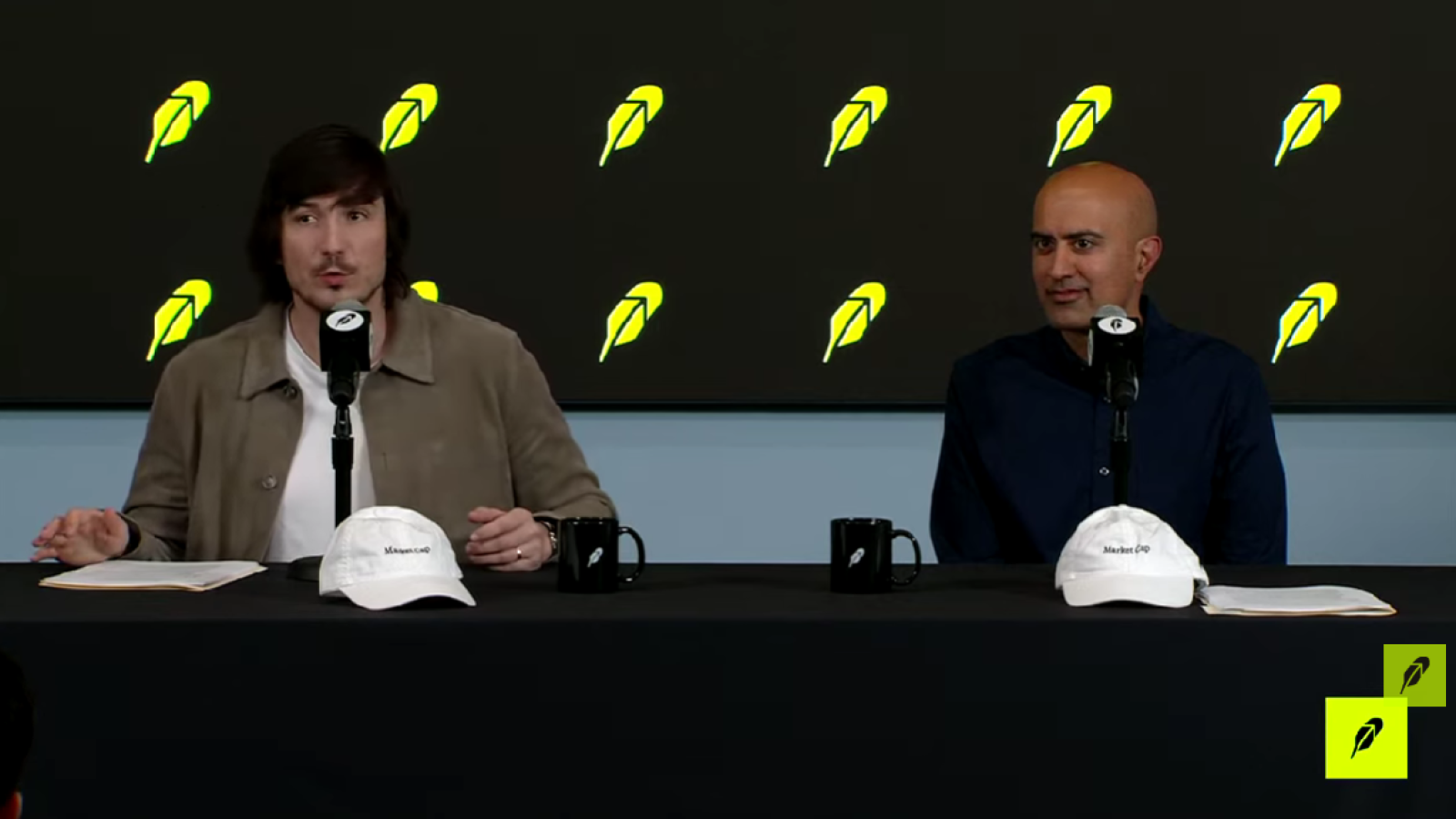
On the company’s earnings call, CFO Shiv Verma said the business was processing more volume in February than at the same point in January in all categories, which would include prediction markets. However, February prediction market figures may be disproportionately driven by the Super Bowl, and so volume would be expected to be higher in the first nine days of February than January.
CEO Vlad Tenev added that he believes the business will continue to see plenty of prediction market activity even after the end of the NFL season.
“I think there were questions industry-wide about what would happen as the NFL season comes to a close, but what we’re actually seeing is surprising us,” Tenev said. “In January, for example, NBA contracts exceeded NFL contracts on our platform. And we’re also seeing significant volume on non-sports platforms.
“Even though it’s now largely sports, prediction markets are more than sports. As we refine the prediction markets platform, more and more contracts will appeal to our traders.”
Tenev also listed prediction markets as Robinhood’s top priority for 2026.
“I think we’re just at the beginning of a prediction market supercycle that could drive trillions in volume,” he said. Also listed among the priorities was Robinhood’s new “social” feature, where he said prediction markets had recently been added, “and it’s looking really good.”
He added that Robinhood was working to integrate prediction markets further with its traditional offering of stock options and related securities.
”If you’re considering investing in an equity, you’ll get the whole picture — not just the options contract but the predictions that are connected to that,” he said.
Robinhood set to launch own exchange
Robinhood is set to launch its own prediction market exchange so that it does not need to go through a business like Kalshi to offer event contracts.
In November, the business announced a joint venture with Susquehanna International Group — also a Kalshi market maker — to purchase MIAXdx, which is already registered as a designated contract market with the Commodity Futures Trading Commission, to exist as its own prediction market. The new prediction market will be rebranded as Rothera.
At the time, a Robinhood spokesperson told InGame that Robinhood would not abandon Kalshi after it launches its own exchange.
Tenev reiterated that point on the earnings call.
“Our primary north star is how to deliver the best product experience to our customers,” he said. “So we do anticipate that a significant portion of our volume will migrate to Rothera, but that’s not our north star. Our north star is giving our customers the best experience.”
He added that one benefit of owning an exchange is that other companies registered as FCMs of introducing brokers (IBs) can then direct their own customers toward Robinhood’s exchange. Sportsbook giants FanDuel, DraftKings, and Fanatics are all registered as FCMs or IBs.
“And by the way, we’re also going to be open to other futures commission merchants,” Tenev said. “We’ll also be competing for that business. We want to build a compelling proposition for getting other firms access to our marketplace.”
Robinhood shares fall amid ‘crypto winter’
Robinhood shares fell in after-hours trading by as much as 8.1% to $78.68, valuing the business at $71.36 billion.
The shares have struggled over the last three months, with the downturn largely coinciding with a decline in cryptocurrency prices. The latest decline would leave the shares down almost 50% from the all-time high reached in October.