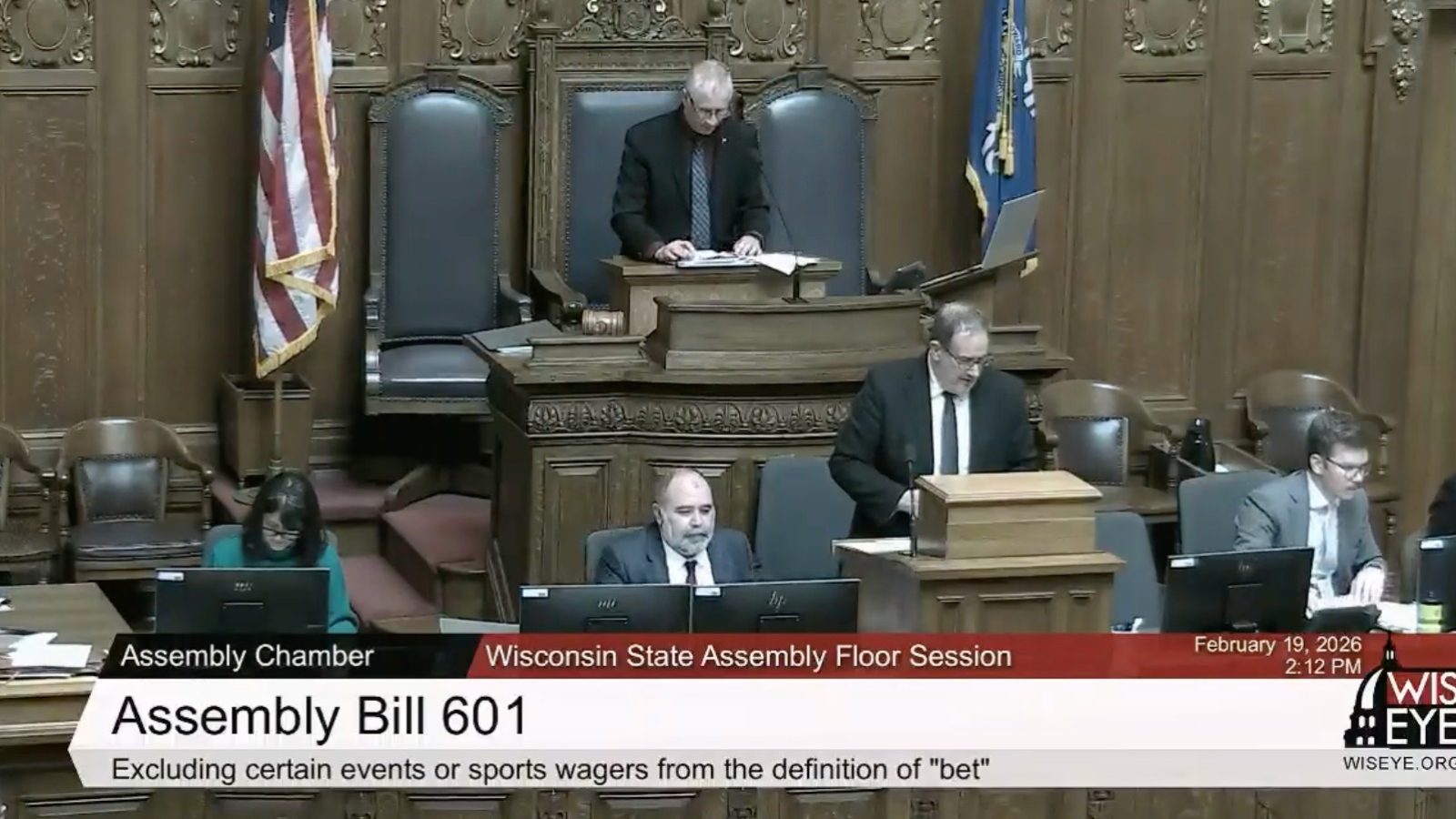
Wisconsin’s House on Thursday passed a bill that would allow for statewide online sports betting, after Indian Country in November had put the brakes on the bill and its Senate counterpart due to heavy opposition by the commercial industry.
Using a “special order of business,” General Assembly Speaker Robin Vos called the lightly amended HB 601 on the final day of the regular session, and it passed through second and third readings. All votes were by voice, and there was no discussion. The bill was set to immediately be sent to the Senate.
The General Assembly is set to adjourn Friday, leaving little time for the Senate to react, though a “last general floorperiod” session is set for March 17-19, and a “limited business floorperiod” is set April 14-16, so it’s possible that the issue could come up during one of those sessions.
Should the Senate take up the bill — its version was also put on hold in the fall — and Gov. Tony Evers sign it, the state’s tribes would have exclusivity for online sports betting. The bill allows for any bet placed in the state of Wisconsin to be considered made on tribal land if it flows through a server in Indian Country. The only other tribe in the U.S. with such an agreement is Florida’s Seminole Tribe, which has a monopoly on online sports betting in the Sunshine State.
In November, Potawatomi Hotel & Casino CEO and General Manager Dominic Ortiz told the audience of a tribal podcast that the Wisconsin tribes pulled the bill from a floor vote after a heated hearing during which Sports Betting Alliance (SBA) lobbyist Damon Stewart testified against the bill, saying, “This bill won’t get the job done because national brands cannot operate.”
Concern from the commercial industry stems from a requirement in the Indian Gaming Regulatory Act (IGRA) that requires a revenue share of 60% to the tribes and 40% to the operator for a partnership agreement. In Wisconsin, tribes are the only qualified wagering license holders, and companies like bet365, BetMGM, DraftKings, Fanatics Sportsbook, or FanDuel — all SBA members — would have to partner with one for market access. The split would mean that operators would pay a partner tribe 60% of revenue — a number higher than any state tax rate in the U.S.
If passed, Wisconsin would be unique
In Florida, the same situation exists, and the Seminoles have been live with their Hard Rock Bet platform since November 2023. While the tribe and Hard Rock have indicated that they are open to partnerships, no other commercial operator has entered the state, likely due to the cost from the IGRA-required split.
Ortiz in November said that the commercial industry is “paddling against Niagara Falls in a canoe” due to the rights afforded state-compacted tribes under IGRA. In Wisconsin, the tribes have long had control of Class III gambling via compact, and in 2021, the Oneida Nation was the first to renegotiate its compact to add in-person sports betting.
Each tribe in the state has a “Me-Too Clause” in its compact, meaning that if one tribe renegotiates a new situation, others can follow when their compacts are opened. Since 2021, other tribes in the state have added retail sports betting. The current legislative proposal would apply to all tribes.