TEMECULA, Calif. — The biggest question looming over the legal gambling industry is whether or not prediction markets — specifically sports event contracts — will eventually be deemed to be gambling or financial tools. If the ultimate decision is that the contracts will remain under federal regulation as financial tools, neither Kalshi nor Polymarket will be the biggest winners, a tribal lawyer said Thursday.
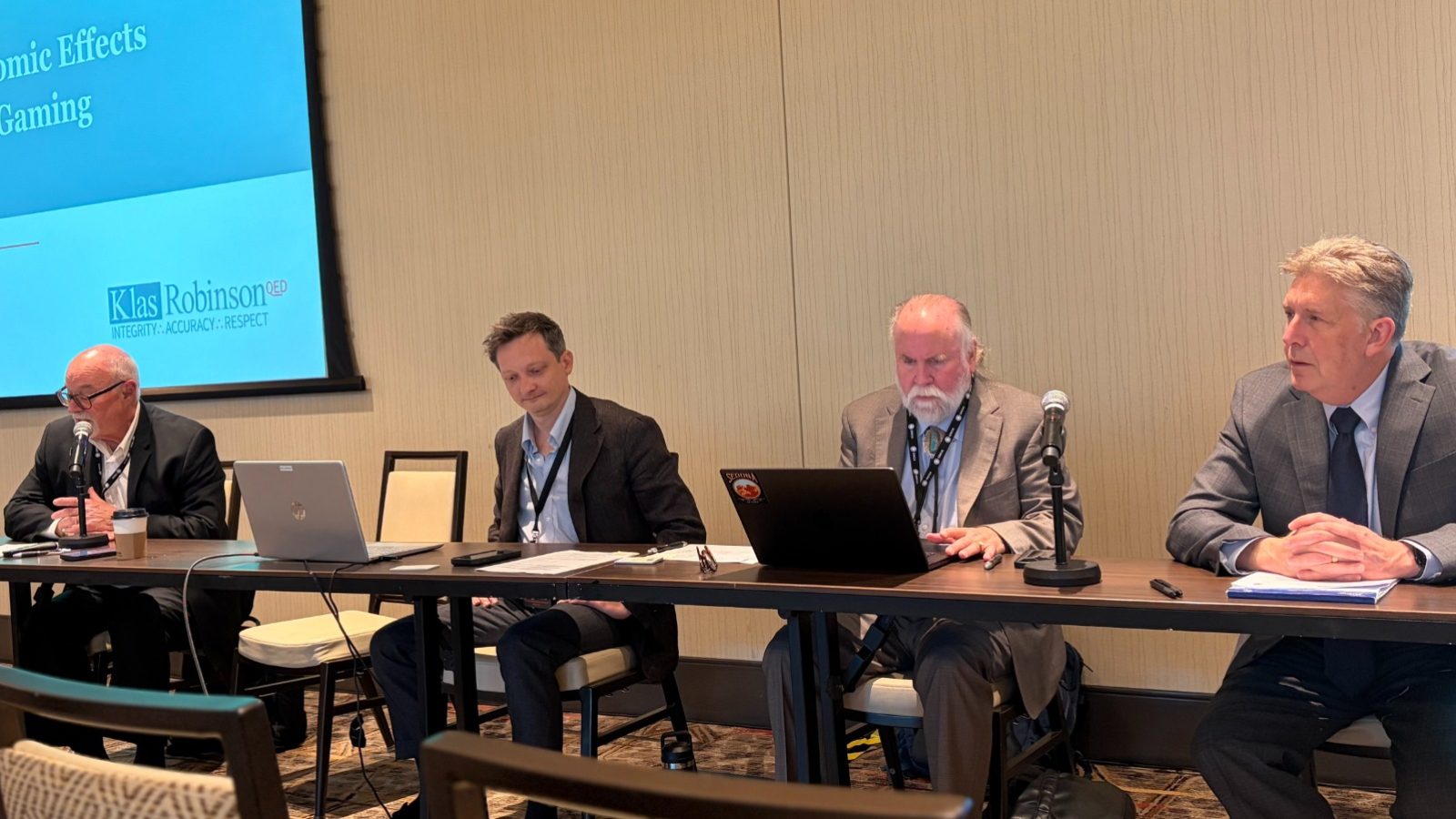
“Let me be clear that if prediction markets become legal [as derivatives], no one is going to have heard of Kalshi in 10 years. It’s going to be Caesars, DraftKings, FanDuel, and MGM operating without state regulation and that is why it is an existential threat to states and tribes,” tribal gaming attorney Scott Crowell (pictured second from right above) said at the Western Indian Gaming Conference at the Pechanga Casino Resort.
Existing sports betting and gambling companies have more experience, brand loyalty, and reach vs. new companies like Kalshi and Polymarket. And if sports event contracts are considered derivatives, they’ll be able to offer their products with few costs and controls. That could ultimately cost states and tribes tens, if not hundreds, of millions in revenue and tax dollars, because state regulation would no longer be necessary.
Most in the gambling industry expect the question of whether or not sports event contracts are gambling will be determined by the courts or Congress, where Nevada Rep. Dina Titus has filed a bill to ban sports betting and casino-style contracts.
Tech-first vs. legacy casinos
DraftKings, Fanatics Betting & Gaming, and FanDuel are already offering prediction products. Caesars and MGM are on the sidelines. The rise of prediction markets has created a rift within the gaming industry, as the tech-first companies have embraced the concept, while land-based casino operators have not.
A key reason that land-based casino operators have stayed on the sideline is the threat from some regulators over licenses. About 10 state regulators, Arizona among them, have sent cease-and-desist letters to prediction markets, including Kalshi and Polymarket, and letters warning licensees off offering or partnering with prediction markets. While the tech-first companies seem willing to move forward despite the warning letters, the legacy casino companies have not been.
The three major sports betting companies that added prediction markets to their repertoires in the last six months are not live with that product in Arizona. They have also been selective about what markets they do enter, focusing on states where online gambling is illegal, including some retail-only and smaller markets.
“Offering or selling event contracts to persons located within Arizona without a license from the Department violates Arizona law,” Arizona Dept. of Gaming (ADG) Director Jackie Johnson wrote in September. “If an Arizona operator chooses to offer, enable, or sell event contracts to persons in this state through their own DCM or FCM (or those under common ownership or operated by a related entity) without a license or decides to associate, coordinate, or otherwise partner directly or indirectly with persons or entities offering or facilitating offering, enabling, or sale of event contracts in Arizona without a license, the Department will consider that conduct as it evaluates the continued suitability for that person or entity to maintain a license.”
Johnson also wrote that operators who “offer, enable, or sell event contracts” in other U.S. states or jurisdictions may also be at risk.
Attorney: States must focus within borders
So far, no state has revoked any gambling company’s license over prediction markets, but in Nevada, FanDuel relinquished its license and DraftKings withdrew a license application. Neither was licensed for online sports betting or gaming in the state. The companies acted after the Nevada Gaming Control Board last fall sent a Notice to Licensees that read, in part, “It has been made clear to the Board that Flutter Entertainment/FanDuel and DraftKings intend to engage in unlawful activities related to sports event contracts. This conduct is incompatible with their ability to participate in Nevada’s gaming industry.”
ADG in late December appeared poised to pull Underdog’s fantasy license, because the company was also offering a prediction markets. The agency reportedly informed Underdog that it considers Underdog’s prediction partnership with Crypto.com “illegal gambling.” The companies have partnered to offer these markets in 24 states.
Underdog Markets is not available in Arizona, and according the company website, it still offers daily fantasy contests in the state, and per the ADG website, the company remains a licensee.
Jim Stipe, of the law firm Burch and Cracchiolo, which works with ADG and gaming tribes, said that the state regulator’s focus is what’s going on within its borders.
“I can tell you in Arizona, here’s how we’ve drawn the line,” he said. “DraftKings is not operating its prediction market in Arizona. Let’s say you have a daily fantasy sports operator partnering with prediction markets that is offering a prediction market in states that haven’t taken a stance, then we are not going to be the super regulator and take action there, but if they are operating in Arizona, we’ll take action.”
Stipe’s explanation crystalized one of the key issues facing states as they try to keep prediction markets out: Each state has its own gambling regime, complete with its own set of laws and rules. No two are exactly the same, and within the confines of those laws and rules, enforcement agencies, including gambling regulators, must determine what their own goals — and tolerances — are.
But Crowell says that narrow focus is not enough, and that states and tribes must band together to eliminate the prediction market threat to state regulation.
Arizona has been active
Arizona has 10 retail and online sports betting licenses available for tribes, and seven are currently partnered with gaming companies to offer event wagering. There are also seven professional sports teams/venues partnered with operators. In addition, Arizona regulates and taxes fantasy sports operators.
Stipe explained that ADG and other states can only work within the confines of state laws and regulations, but also must consider federal law. In the current landscape, sports event contracts are legal under federal law. The platforms are regulated by the Commodity Futures Trading Commission (CFTC), which in recent months has announced moves to promulgate rules around them. The agency earlier this month also inserted itself into the Ninth Circuit case, in which Kalshi sued the state of Nevada for the right to operate, by filing an amicus brief in support of Kalshi.
That case is one of about a dozen in which prediction markets are embroiled. In most cases, Kalshi or other prediction markets have sued a state after receiving a cease-and-desist letter. This week, Kalshi sued a state preemptively for the first time when it filed against Utah, writing that state authorities have plans to prohibit prediction markets for violating its gambling bans. The company has been sued by the state of Massachusetts and tribes in California and Wisconsin.
Arizona is not among the states in court with Kalshi, as judges grapple with whether or not the contracts are financial tools or gambling. Much of the gambling industry says the products mimic sportsbooks and should be regulated by gambling regulators or banned. The prediction markets themselves say they offer derivatives, or financial tools, and already answer to the CFTC.
“In Arizona, if it’s determined in courts that this is not legal, then Arizona would take action,” Stipe said. “But we are not going to look to other states and judge their rules.”
Crowell takes a hard line
Tribal attorney Scott Crowell, who has been working on some cases brought by tribes against prediction markets, said the fact that companies like DraftKings, Fanatics, or FanDuel are offering prediction markets in some legal gambling jurisdictions, and currently offer or previously offered daily fantasy sports in some unregulated markets, should be enough for states to take action.
“I think state regulators need to revisit the super regulator policy,” he said.
Crowell pointed to California, where state Attorney General Rob Bonta last July released an opinion saying that daily fantasy sports are illegal. Many operators, including DraftKings, FanDuel, PrizePicks, and Underdog, continue to operate in the state. All four are also offering prediction market products, while the Sports Betting Alliance (of which DraftKings and FanDuel are members) are at the same time continuing to lobby tribes to find a way to come to an agreement on what legal sports betting should look like.
Crowell said some operators left California after the opinion was released, “but for those who said, ‘We’re just going to full speed ahead’ and even upped their marketing, to me, on a suitability determination, that’s a big red flag.
“DraftKings and FanDuel would answer questions about these things before Bonta offered his DFS opinion” by saying that it was unregulated, Crowell said. “But have they stopped offering those? The message should be that no matter how big you are, if you’re involved in illegal gaming, you should not be allowed in. You are not suitable.”
But pending a court or Congressional decision that favors prediction markets, those companies may win in the end.