California lawmakers are attempting to keep the pressure up on non-state regulated gambling platforms. Democratic assembly members Mia Bonta and Pilar Schiavo Tuesday stripped a marijuana bill and replaced the text with the “Protecting Kids from Online Gambling Act.” The proposal would ban advertising by daily fantasy operators, prediction platforms, sports betting operators, and more.
Such advertising would be banned on any “public or semipublic internet website, online service, online application, or mobile application accessible in this state, including, but not limited to, a social media platform.” The bill is aimed at protecting those under the age of 18, and would also require platforms to collect only the minimally necessary information to complete age verification, ban operators from using the information for any other purpose, and require operators to delete the information as soon as age verification is complete.
AB 2617 comes on the heels of a statewide ban on dual-currency sweepstakes platforms, which went into effect Jan. 1, and a July 2024 attorney general’s opinion that all forms of daily fantasy sports (DFS) contests are not legal in the state. DFS platforms are not regulated in the state, and so far, the attorney general’s office has not taken enforcement action.
Gambling in California is limited to Indian reservations and horse racetracks, and no form of online sports betting or gambling is permitted.
The bill was referred to the Government Relations Committee. It is the second in the state taking aim at prediction markets — AB 1840, which would ban betting trading on prediction markets for California public officials, employees, and lobbyists is set for a hearing in the Government Operations Committee March 25.
In other news …
Here’s a look at the status of other active bills around the U.S.:
Colorado: SB 131, a bill that would prevent online sports betting operators from accepting more than five deposits in a 24-hour period, limit the number and amount of deposits, and ban some push notifications, passed out of the Senate Committee on Finance, 5-4, Tuesday, but was not considered by the Appropriations Committee Friday, the crossover deadline, meaning it likely won’t move forward unless an existing bill is stripped and language from SB 131 is inserted.
The Finance Committee had amended the bill to include new limits on advertising, including banning social media, television, and in-person advertising by wagering operators in a situation where 30% or more of the audience would likely be under the age of 21. Several states have explored or passed such limitations, however, the call to ban certain television advertising has been found to be difficult in practice for national media broadcasts.
Illinois: The bill that would reduce the cost of a stand-alone online sports betting license from $20 million to $15 million is set for a hearing in the House Gaming Committee Wednesday at 4 p.m. local time. HB 5034 would set the application fee at $250,000 and each license would require renewal every four years. HB 5142, which would add prediction markets to the definition of sports betting, will also be among the gaming bills on the agenda.
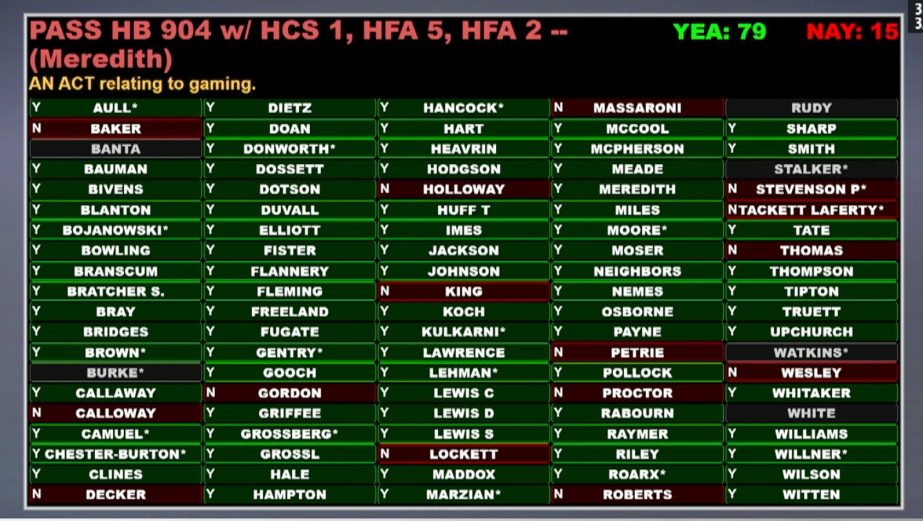
Maryland: HB 518, which would require the creation of a voluntary exclusion list, passed out of the House, 132-0, Thursday, four days ahead of the crossover deadline, and has been assigned to the Senate Committee on Budget and Taxation. Maryland’s general assembly is set to adjourn April 13.
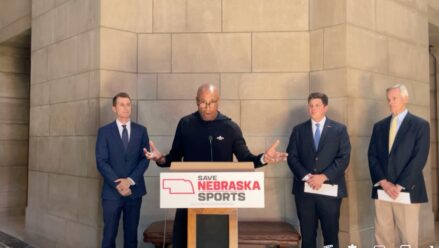
Nebraska: A pair of petitions that would send the decision to legalize online sports betting and put a framework around it are circulating in Nebraska. Last Friday, Lance Morgan, CEO of Warhorse Casino, told First Alert 6 “I don’t think it will be any trouble getting it passed. Our polling shows it’s somewhere around 70 percent approval rating.” But the intiatives must get on the ballot first.
The petitions were approved for circulation in the middle of February, and proponents have until early July to gather qualified signatures from 7% of registered voters for an initiative and 10% for a constitutional amendment. In addition, qualified signatures from 5% of registered voters in 39 of the state’s 93 counties are required. According to the SOS site, 1,254,120 voters were registered in the state as of Jan. 1. Morgan said the aim is to collect 300,000 signatures.
New Jersey: S2160, the bill that would ban microbetting, is set for its first hearing Monday in the State Government, Wagering, Tourism, and Historic Preservation Committee. A microbet is defined as a “proposition bet which is wagered live, while a sport or athletic event is ongoing, and concerns the outcome of the next play or action occurring in the sport or athletic event.” Other propositions are not addressed in the bill.
New York: A bill that would explicitly ban the use of proxies and ban any bettor who acts as a proxy to be banned, advanced to third reading in the general assembly Thursday. AO 9584 would also make changes to the KYC process. The full general assembly next meets Monday.