
New Jersey’s Senate State Government, Wagering, Tourism, and Historic Preservation Committee Monday morning advanced a first-of-its-kind bill that would ban microbetting in the state. S 2160 now moves to the Senate floor for consideration.
In the last two years, some types of proposition bets have been banned in some states, in part as a response to the NCAA calling for a ban on college-player proposition bets. Lawmakers in Louisiana, Maryland, Ohio, and Vermont prohibited such bets, while other states, including Massachusetts, legalized with bans in place. Still others, like Minnesota, have plans to build a college-player prop-bet ban into their legalization process.
But no U.S. jurisdiction has yet made microbetting illegal.
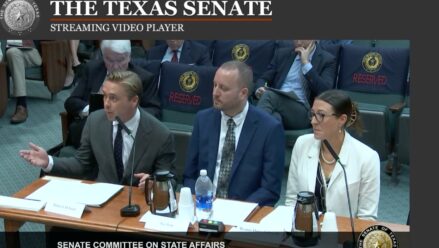
Proponents and opponents passionately testified for and against the proposal, including problem-gambling advocate Harry Levant, who said state lawmakers are “uniquely in a position to pull people out of the river before they need saving … you can prevent them from falling in.” Levant, a recovering gambling addict turned addiction counselor, argued that banning microbets would take away one of the most addictive parts of online sports betting.
In response, Zachary Kahn, on behalf of the Sports Betting Alliance (SBA), testified that banning microbets would “strip consumer protections from bettors, [and] push them someplace where there are no protections.” He said removing certain bets would send bettors to the illegal market, where there are no responsible- or problem-gambling tools.
Levant argued that such tools are industry code for “let us regulate ourselves,” and that there is something “fundamentally missing” from regulation that allows microbets. New Jersey was among the first states to launch legal online sports betting after the Professional and Amateur Sports Protection Act was overturned in 2018, in a case in which New Jersey was the plaintiff. The state’s regulator is considered — and was referred to Monday — as the “gold standard.” Levant appealed to the committee to consider its position among legal betting states.
Ban could have financial consequences
The proposal defines microbets as “a proposition bet which is wagered live, while a sport or athletic event is ongoing, and concerns the outcome of the next play or action occurring in the sport or athletic event.” As an example, a microbet would be a wager on the next pitch in a baseball game or, as Levant testified, the next shot in a college basketball game. Wagering on college sports that take place within the state or involve a New Jersey team is already prohibited.
In introducing the bill, sponsor Paul Moriarty likened microbetting to a bar approaching “someone with a drinking problem and inviting them to come in for their favorite drink.”
While much of the discussion centered around the morality of allowing microbetting, one senator also pointed to the potential economic impact. In New Jersey, online sports betting platforms must be tethered to land-based casinos or racetracks.
Sen. Vincent Polistina said that in not allowing in-person microbets at Atlantic City casinos, those casinos would be at a disadvantage in relation to their peers in Philadelphia, where microbetting is legal.
“It troubles me that you would have people not able to do something that they can do 45 minutes up the road,” he said.
Levant responded by saying that he would instead consider New Jersey to be a “public-health leader.”
Kahn, and Tim Murphy on behalf of DraftKings, outlined the economic impact online sports betting has in New Jersey. DraftKings, along with bet365, BetMGM, Fanatics Betting & Gaming, and FanDuel, are SBA members and all have platforms in New Jersey.
Kahn said SBA members represent 89% of New Jersey sports betting revenue and account for 2,000 jobs in the state. Murphy said his company has sent out 44 million responsible-gaming messages, conducted 92,000 investigations into suspected cases of problem gambling, and that the company’s responsible gaming center has been visited more than 58 million times. In addition, Murphy said DraftKings has seen a 52% increase in bettors using tools that would limit their wagering, like time and deposit caps.