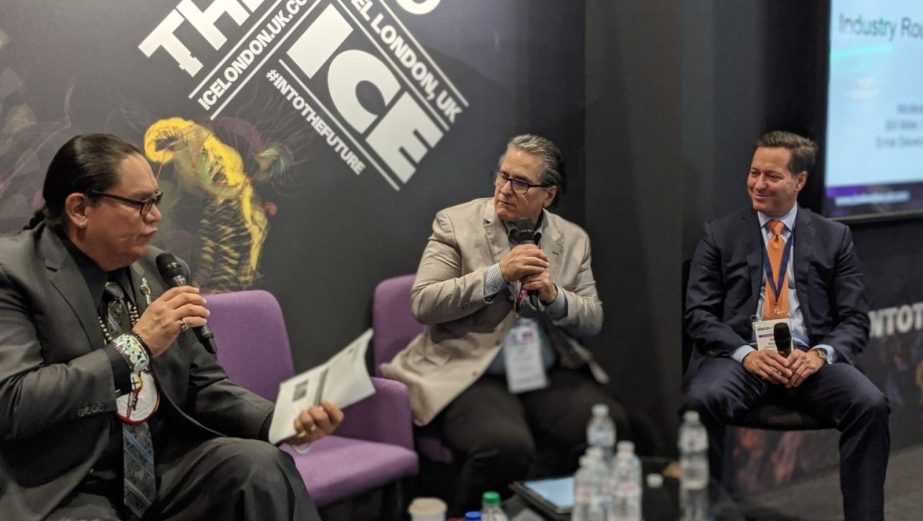
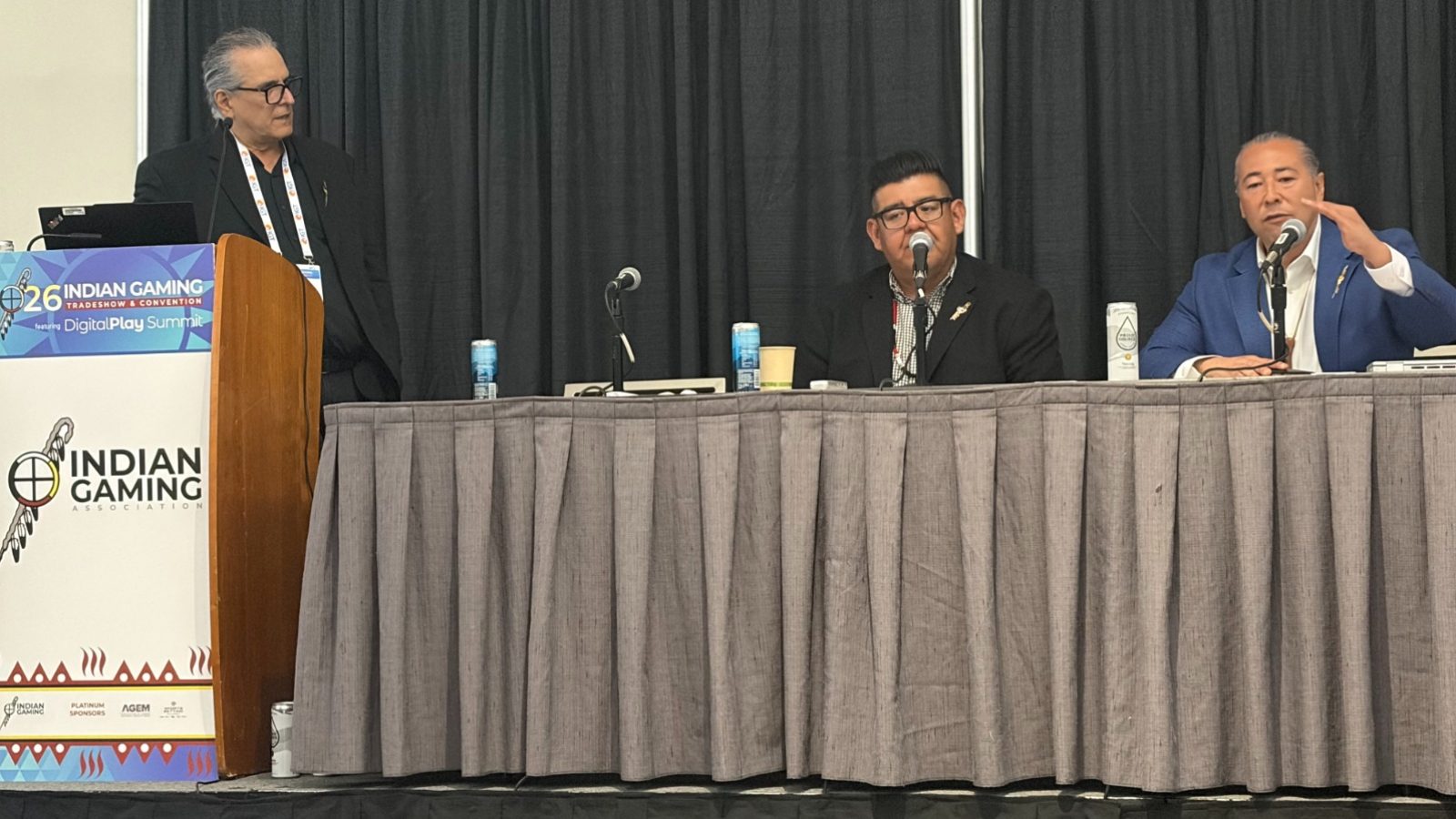
SAN DIEGO — The first four panel sessions at the Indian Gaming Association’s annual conference Monday had the feel of a rally or protest. Conference Chair Victor Rocha’s (pictured above, left) plan was to use the back-to-back-to-back-to-back sessions to set the tone and give an overview of why the rise of sports events contracts may be the biggest threat in the history of tribal gaming.
Given the amount of raised voices, waving hands, and outright cheering at some points, he succeeded in mobilizing and engaging Indian Country.
During the final panel of the day in a packed room, California Nations Indian Gaming Association Chair James Siva (pictured above, center) shared that during a Zoom call with Commodity Futures Trading Commission (CFTC) Chair Michael Selig, it quickly became clear that Indian Country won’t win a battle with the agency. To use a colloquialism, the tribes might lose that battle, but they have every intention of winning the war.
The next action will come Tuesday when the Tribal Amici will file their 19th amicus brief, said tribal attorney Joe Webster of Hobbs, Straus, Dean & Walker, LLP. That brief will be in one of the two pending cases in Arizona. Kalshi sued the state March 12, and five days later the Arizona attorney general became the first to file criminal charges against Kalshi. Following that, the Tribal Amici continue to consider how and in what venue to file a case against the CFTC, which so far has not been a named defendant.
“One of the things we have been looking at is what’s going to be the right case?” said tribal attorney Scott Crowell of Crowell Law Office – Tribal Advocacy Group. “The first action? The criminal action? We’re going to bring action against the CFTC, and we believe we have a good solid legal theory as to how to bring that about and bring it about now.”
But Crowell said it’s not clear what case will ultimately be heard by the Supreme Court — there are currently federal cases against Kalshi in the Third, Fourth, and Ninth Circuits, and more than a handful of district courts. It is paramount, Crowell said, that the Tribal Amici select the “best developed” case, and the group is willing to wait as more complaints are filed and it can refine its argument.
“Making a case against the CFTC is the proper move to get the proper case in front of the Supreme Court,” he said. Crowell, Webster and Michael Hoenig, counsel for Yuhaaviatam of San Manuel Nation in California, are key figures in tribal actions against Kalshi.
Said Hoenig: “I think there is some concern that if you try to go after some Coinbases here, some Kalshis there, it’s like Whac-A-Mole …. So if we can go after the CFTC, it kind of lops the head off, ends things at a one-stop shop.”
The IGA board of directors during a meeting late in the day codified its ongoing actions against the CFTC when it approved a resolution in opposition of the agenda allowing and regulating sports event contracts.
Selig using ‘misregulation and deregulation’
CFTC regulations include a prohibition on contracts involving terrorism, assassination, war, gaming, or unlawful activities. But Siva said that in his conversation with Selig, it was clear that there is no “misinterpretation” of the regulations or law. Rather, Selig and his agency have every intention of killing those guidelines by “misregulation and deregulation.”
That realization led Siva to believe “we are not going to win on that battlefield. And I know there is some pessimism in this room … but we will not lose, not this issue, not this day.”
That declaration was met with a round of applause, and the moment is what sets the IGA conference apart from other industry gatherings. The ultimate goal is education and bringing the nation’s 500-plus tribes into alignment on the issue of the day. That’s previously been daily fantasy sports or sweepstakes, but not since the passage of the Indian Gaming Regulatory Act in 1988 has an issue galvanized this group so completely.
Multiple panelists said that despite the dozen bills related to prediction markets currently circulating in Congress, that the ultimate decision will be made in the courts. They pointed to the possibility of a Supreme Court decision, likely in 2028.
Though the expectation is that SCOTUS will be the final arbiter, so far three states have taken Kalshi to state court, where gaming attorney Dan Wallach believes they can “adjudicate if these [sports event contracts] are legal, and the federal court sideshow won’t.” He pointed to the Arizona criminal case against Kalshi in particular, saying the goal there is to invoke the Younger Abstention Doctrine, which prevents federal courts from hearing constitutional challenges to state law if there are active cases in state courts.
The Younger Abstention Doctrine traces its roots to federalism and calls for state courts to rule on issues that are significant to a state.
With more than a dozen state and tribal cases currently in progress in federal and state courts — and decisions beginning to swing in states’ favor — the pressure is mounting for prediction markets, particularly Kalshi.
Issue has made strange bedfellows
There was also plenty of finger pointing at the CFTC as a rogue agency that “should not be in the business of regulating gaming.” The silver lining from the rise of prediction markets is that states and tribes are now standing together against the federal government.
IGA Chair David Bean (pictured above, right) said the prevalence of prediction markets has created a unique opportunity for Indian Country to partner not just with states, but some commercial gaming operators, including the American Gaming Association and MGM Resorts. Asked why the tribes can’t fight alone, he said, “This is bigger than Indian Gaming, and it’s not just about protecting tribal sovereignty, but state sovereignty, too.”
Bean and Siva pointed to callous treatment by the CFTC, which has referred to Indian Country as a “special interest,” and has not acknowledged it as a critical player in the game.
Swaps, NIGC inaction, more
Over four hours, lawyers and tribal leaders covered myriad other issues surrounding the threat of prediction markets to Indian Country:
- When asked how Indian Country would be affected if sports event contracts are determined to be “swaps” — a type of financial instrument traditionally used for hedging risk — tribal attorney Elizabeth Homer of Homer Law said, “It takes the tribes out of the picture. It leaves tribes and states in the same place [they’re currently in] with no taxation and no benefit in a stolen marketplace.” Said Rocha: “It’s about erasure … all that money you’ve put into marketing, it’s gone. It’s just like taking the gold out of your land, the water out of your land, it’s the same thing.”
- Tribal leaders expressed frustration at the National Indian Gaming Commission (NIGC) remaining silent on the issue of prediction markets, saying that it falls within the agency’s jurisdiction. But the lawyers involved with the cases say the NIGC isn’t sitting idly by. The CFTC has claimed it has sole jurisdiction, but the expectation is the NIGC is waiting for the appropriate time to act. “The implication there is that the NIGC does not have jurisdiction over this gambling that is happening on tribal lands,” said Hoenig, formerly general counsel for the NIGC. “I do think it would be very helpful and in the agency’s best interest — even if they just stand up and say ‘Hey, this is happening on Indian lands, and we have a problem with it.’ Right now, the CFTC is just at the stage of exploring potential rules … in the next stage, other agencies could comment.”
- Ron Allen, tribal chair of Washington State’s Jamestown S’Klallam Tribe since 1977, said he believes the “CFTC is drawing outside the lines of its authority,” but also that tribes need a blueprint to take when lobbying.
- IGA Executive Director Jason Giles noted that Republicans seem reticent to broach the issue of prediction markets. Bean said “Republicans are not going to take on the [Trump] Administration. But it’s a steep hill, and it gets steeper every day by the billions.”
No action will result in ‘scorched earth’
As the session wound down, the tone ramped up. From the audience, Allen called for fellow tribal leaders to “Keep hitting [Congress], keep it fresh in their minds.”
Bean quantified the problem for Indian Country, saying “Kalshi is now partnering with online gaming companies … everything is at risk. Our children are at risk. Any child with a smartphone can access this. It’s going to be scorched earth if we don’t act now.”
And Rocha wondered if the tribes were too committed to “playing by the rules. [Prediction markets] are playing by different rules. This is the kind of fight our great grandparents were in” when they fought for recognition and the return of tribal lands.
To tribes not yet in the gaming marketplace, he said, “If you want to enter the marketplace, will someone already be in your bed before you get there?”