SAN DIEGO — In the last 24 months, California’s tribes have had reason to flex.
Consider:
In February, Attorney General Rob Bonta released new regulations that would change how the state’s cardrooms can offer certain games, including blackjack, which the tribes have long said encroach on their exclusivity. The new rules came about 18 months after Gov. Gavin Newsom signed a law allowing the tribes a one-time exception to sue the cardrooms in state court.
On Jan. 1, a ban on sweepstakes platforms went into effect after the state legislature last fall, with the backing of the tribes, made them illegal.
Last July, Bonta released an opinion that all forms of daily fantasy sports are illegal.
These actions follow a $250 million “anti” campaign that killed a commercial sports betting initiative in 2022.
Next up? Prediction markets.
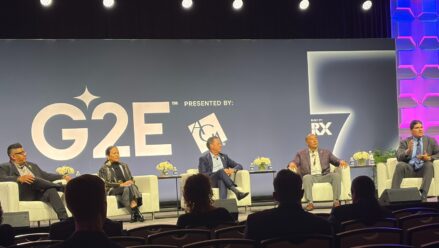
This week at the Indian Gaming Association annual convention, Indian Country has been dissecting the issue and discussing how to move forward. California’s tribes have been at the forefront of the conversation. Besides figuring out a strategy in relation to prediction markets, California Nations Indian Gaming Association Chair James Siva reiterated that the state’s tribes are aiming to bring a legal sports betting initiative in 2028.
The sports event contracts offered by prediction markets mimic sports betting, which, while not legal in California, represent what the tribes say is an unregulated form of Class III gambling. The platforms offering the contracts — including Kalshi, Crypto.com, DraftKings, and FanDuel — are regulated by the federal Commodity Futures Trading Commission (CFTC), though that regulation has come under fire from tribes and states.
Tribes have exclusivity
California is the biggest tribal gaming state in the U.S. with more than 100 tribes and 65 land-based casinos. The tribes, under the Indian Gaming Regulatory Act and compacts with the state, have exclusivity for gaming. They say any gaming not licensed by tribes on their lands — or anywhere in the state — is a violation of their exclusivity and sovereignty. And they will do whatever it takes to defend their sovereignty from prediction markets, as well.
“Spending a quarter of a billion dollars on this in 2022 wasn’t enough?” Indian Gaming Association (IGA) Conference Chair Victor Rocha asked during the opening set of panel discussions.
At least one California member of Congress is in alignment with the tribes on prediction markets. Sen. Adam Schiff is co-author of a bipartisan anti-prediction market bill. He called the sports event contracts wagering “with a different name.”
Said Michael Hoenig, counsel for Yuhaaviatam of San Manuel Nation: “Sports betting is not legal in California, but these companies are advertising as legal in all 50 states. Even if [sports betting] is legal in your state, these companies are doing it outside of the [state] rules. In 2022, California voters struck the issue down, and then these companies came in and just started doing it. It’s just an affront to the tribes after the voters said no.”
‘Our word is everything’
Among the companies that were part of that initiative attempt were DraftKings and FanDuel, both of which — along with Fanatics Sportsbook — are offering prediction markets in California. At the 2025 IGA conference, a DraftKings representative clearly said his company would not enter California with a prediction product. Yet a year later, DraftKings Predictions launched in California.
The decision to do so doesn’t sit well with Siva.
“So the word you gave to tribes and told tribal leaders you said you would not do … they are now saying ‘market conditions changed,'” Siva said. “It is purely about the money and their money does not mean anything. For us, how we operate here, is our word is everything.”
California’s tribes have deep war chests. Rocha relayed a conversation he’s had with Dan Little, chief intergovernmental affairs officer for the Yuhaaviatam of San Manuel Nation. The tribe is one of the richest — if not the richest — gaming tribes in the state.
“DraftKings and FanDuel asked Dan Little if [the tribes] are willing to spend $100 million per time immemorial to keep exclusivity,” Rocha said. “And Dan said, ‘Yes, but it won’t cost that much money next time.'”
San Manuel contributed $103 million to quash the 2022 initiative attempt.
In 2022, the tribes prevailed in killing the commercial initiative by a historic margin — nearly 83% of voters said no. Along the way, the tribes let Prop. 26, an outdated proposal that was originally aimed at the 2020 ballot and would have legalized in-person sports betting, languish. Any expansion of gaming in the state must go to the people.
In 1998 and 2000, Props. 5 and 1A gave the tribes the exclusive right to Class III gaming and required the governor to negotiate compacts. No entity has been able to convince the people to change that.
“That’s been our time frame for a while, but this adds another level of complication, and there is no way to ignore that these companies that say they want to do business with us are offering prediction markets,” Siva said. “I hope that all of my tribal leaders in California remember that.”