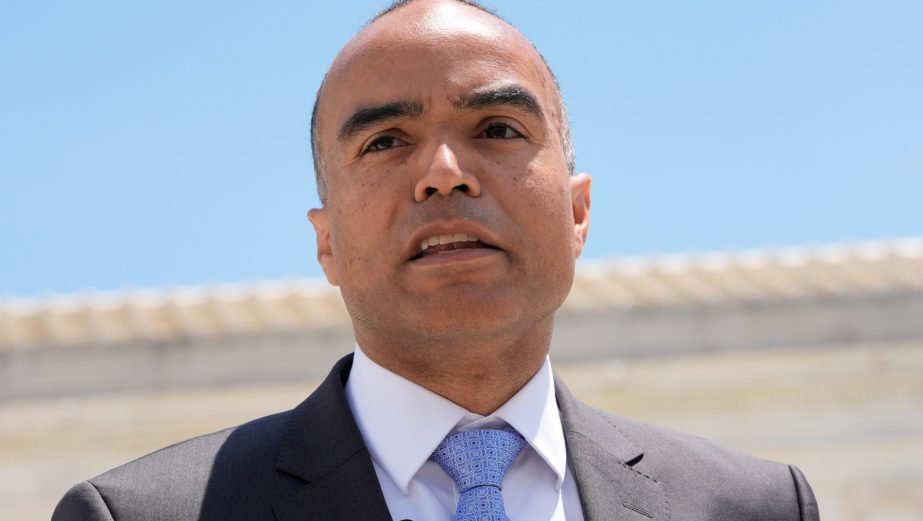

The federal government and Commodity Futures Trading Commission (CFTC) have sued the states of Arizona, Connecticut, and Illinois over the states’ attempts to stop prediction markets from offering sports contracts, marking a new kind of legal fight over the status of the product.
The lawsuits, listing the government itself and the CFTC as plaintiffs, were filed Thursday in the U.S. District Court for the Northern District of Arizona, the U.S. District Court for the District of Connecticut, and the U.S. District Court for the Northern District of Illinois.
e287b071-931c-4f4f-91b7-b82ce552b48fIn a social media post, former CFTC General Counsel Rob Schwartz called the lawsuits “unprecedented.”
In a press release announcing the lawsuits, CFTC Chair Michael Selig called the states “overzealous.”
“The CFTC will continue to safeguard its exclusive regulatory authority over these markets and defend market participants against overzealous state regulators,” said CFTC Chairman Michael S. Selig. “This is not the first time states have tried to impose inconsistent and contrary obligations on market participants, but Congress specifically rejected such a fragmented patchwork of state regulations because it resulted in poorer consumer protection and increased risk of fraud and manipulation.”
Cease-and-desists and criminal charges
Both the Illinois Gaming Board (IGB) and the director of gaming for the Connecticut
Department of Consumer Protection last year sent cease-and-desist letters to Kalshi, Robinhood, and Crypto.com. The IGB also sent a cease-and-desist letter to Polymarket U.S.
Arizona, meanwhile, is the only state so far to have filed criminal charges against Kalshi.
The Illinois letters argued that the recipients were “engaging in unlicensed sports wagering in violation of the Illinois Sports Wagering Act and Illinois Criminal Code.”
“No person or entity may engage in a sports wagering operation or activity in Illinois unless licensed by the IGB,” the letter said.
It added that failure to comply may result in “civil or criminal penalties.”
In Connecticut, the letters said the businesses were engaged in “unlicensed online gambling, more specifically sports wagering.”
CFTC claims interference with its job
The CFTC’s complaints in Illinois and Connecticut said that the letters in Connecticut and Illinois and the criminal charges in Arizona make it impossible for it to fulfill its role as the regulator for DCMs such as Kalshi, Crypto.com, and Polymarket U.S. The Arizona complaint is not yet available on the docket for the case.
“Defendants’ attempt to regulate these DCMs interferes with Plaintiffs’ exclusive authority to uniformly regulate and monitor this congressionally defined market,” the Illinois complaint said. “The entire point of the CEA is to create a uniform and predictable nationwide market for futures trading, and the CFTC oversees that market via its certification process of DCMs and its requirements for DCMs to comply with the self-certification or submission certification requirements before listing event contracts. Defendants’ letters and threatened legal actions would undermine that uniformity, thwart Congress’s scheme, and intrude on Plaintiffs’ exclusive jurisdiction by subjecting CFTC-regulated DCMs to regulation in all 50 states.
“Defendants’ approach makes it much more difficult for the CFTC to regulate, advise, and enforce its authority over the DCMs, wasting resources and subverting CFTC’s congressionally mandated authority.”
The Connecticut complaint made similar arguments.
Feds-sue-CTBoth available complaints stated, “In order to provide additional clarity in the marketplace, the CFTC is in the process of writing and revising its rules applicable to event contracts and prediction markets.”
The CFTC also claimed that it is impossible for the offering of a contract by a federally regulated DCM to violate state law.
“Offering event contracts on a DCM cannot, in and of itself, be an activity that is unlawful under any state law because such an application of state law would conflict with the CEA,” they said.
Same arguments as Kalshi
The CFTC’s arguments in the lawsuits are more or less the same as the arguments Kalshi has made when it has sued states.
The CFTC argues that it has “exclusive jurisdiction” over trading that occurs on designated contract markets, and that state laws — including state wagering laws — are preempted by the federal Commodity Exchange Act (CEA).
It pointed to the history of states, including Illinois, attempting to regulate traditional futures trading as a form of gambling to argue that the CEA was specifically meant to overrule state gambling laws.
The complaint adds that the CEA was intended to prevent a “patchwork” of state-by-state rules for DCMs, and that allowing state gambling laws to apply would cause such a patchwork to exist.
The CFTC also claimed that any DCM that does not offer its contracts in certain states violates its rules on “impartial access.” This is despite the fact that all major federally regulated prediction markets restrict their offering in at least one state. Kalshi, Polymarket U.S., and Crypto.com are all complying with bans on sports event contracts in Nevada, while DraftKings’ and FanDuel’s prediction markets do not offer sports contracts in any states in which the businesses operate a state-licensed sportsbook.
“Complying with both state regulations and the CEA is impossible because a DCM is required by federal law to provide ‘impartial access’ to all eligible participants nationwide,” the complaints said. “If a state bans the contract, the DCM cannot fulfill its federal mandate to provide impartial national access.”
Kalshi has not sued Illinois, but it did sue Connecticut in December. Coinbase, which offers access to Kalshi contracts, sued Illinois that same month. Kalshi sued Arizona on March 12, just before the state filed its criminal charges.
New ground
The lawsuits are the first filed by the federal government or CFTC against a state in defense of prediction markets. The CFTC had previously filed an amicus brief in support of Crypto.com in the U.S. Court of Appeals for the Ninth Circuit.
The CFTC has become much more active in defending prediction markets as part of its jurisdiction under chair Michael Selig, who took over the role in December.
Illinois, Connecticut, and Arizona are not the only states to issue cease-and-desist letters or take other similar action against prediction markets — at least eight other states have done so. Therefore, it appears that more states could be at risk of facing similar lawsuits.