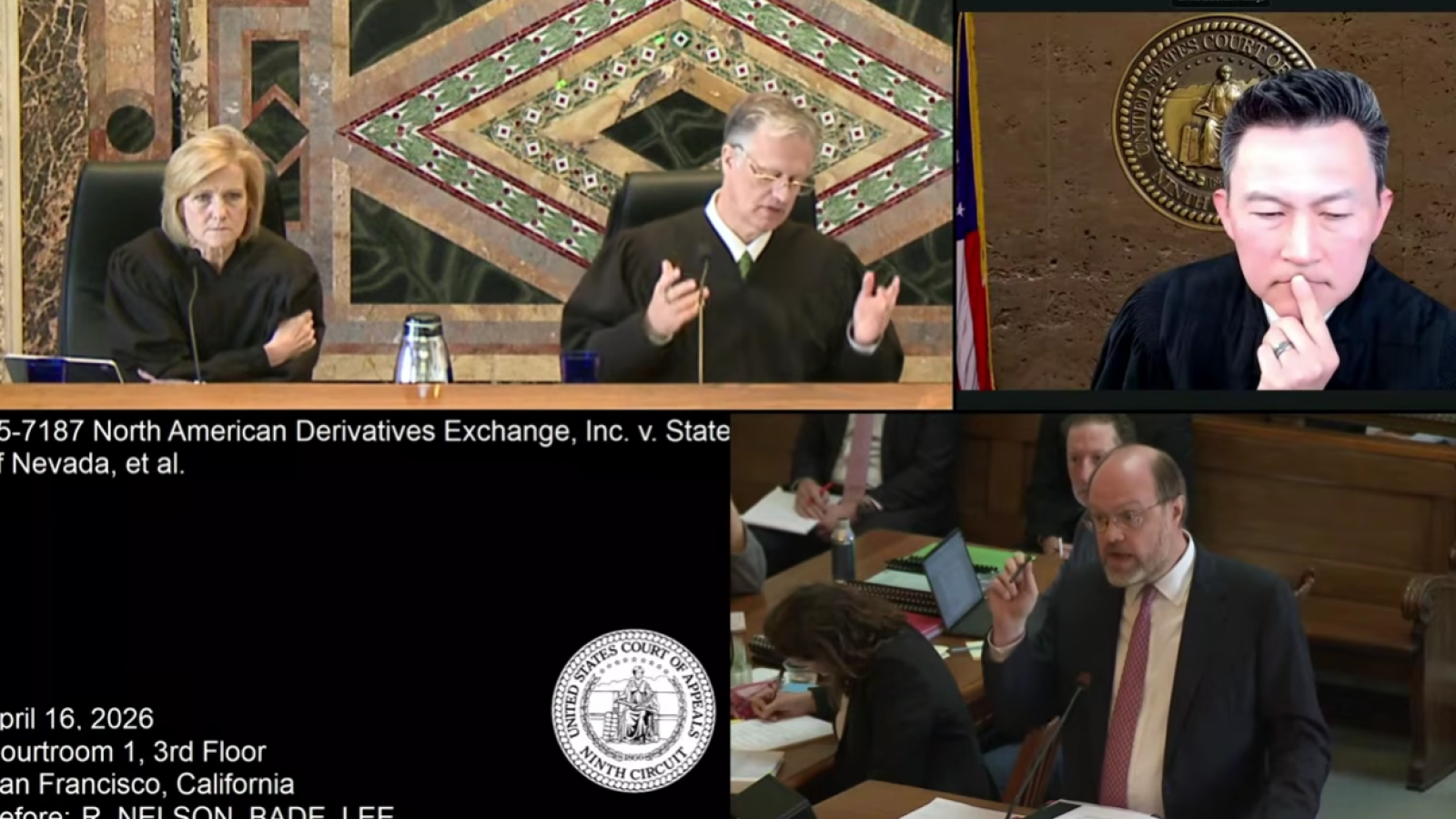
As federal appellate judges grilled lawyers for three prediction market companies during oral arguments Thursday, it appeared the Ninth Circuit judges may be leaning toward allowing states to ban sports event contracts. One Commodity Futures Trading Commission (CFTC) rule in particular seemed to be a major sticking point for one of the three judges on the panel, who largely stripped away arguments about preemption, outcomes, occurrences, and financial consequences to home in on the point that CFTC rules appear to prohibit gaming contracts.
The Ninth Circuit heard oral arguments in Kalshi’s, Robinhood’s, and Crypto.com’s cases against the state of Nevada. Though the cases remain separate, the oral arguments were combined.
Lawyers for the prediction markets all argued for why Nevada’s state gambling laws should be preempted by the federal Commodity Exchange Act (CEA) and therefore not applicable. The state argued that its laws are not preempted. The CFTC, after submitting an amicus brief last month, also made shorter arguments.
The arguments were heard by judges Ryan D. Nelson, Bridget Bade, and Kenneth Kiyul Lee.
While two of the judges asked pointed questions, Nelson asked the majority of them and appeared to express the strongest views. He repeatedly challenged the prediction markets’ lawyers and expressed doubts about their interpretation of the laws.
CFTC gaming ‘prohibition’
One topic more than any other seemed to define Nelson’s view of the case: the wording of the CFTC’s Rule 40.11.
The rule refers to a “prohibition” and says that exchanges “shall not list” contracts that involve assassination, terrorism, war, or gaming:
40.11 Review of event contracts based upon certain excluded commodities.
(a) Prohibition. A registered entity shall not list for trading or accept for clearing on or through the registered entity any of the following:
(1) An agreement, contract, transaction, or swap based upon an excluded commodity, as defined in Section 1a(19)(iv) of the Act, that involves, relates to, or references terrorism, assassination, war, gaming, or an activity that is unlawful under any State or Federal law; or
(2) An agreement, contract, transaction, or swap based upon an excluded commodity, as defined in Section 1a(19)(iv) of the Act, which involves, relates to, or references an activity that is similar to an activity enumerated in § 40.11(a)(1) of this part, and that the Commission determines, by rule or regulation, to be contrary to the public interest.
(b) [Reserved]
(c) 90-day review and approval of certain event contracts. The Commission may determine, based upon a review of the terms or conditions of a submission under § 40.2 or § 40.3, that an agreement, contract, transaction, or swap based on an excluded commodity, as defined in Section 1a(19)(iv) of the Act, which may involve, relate to, or reference an activity enumerated in § 40.11(a)(1) or § 40.11(a)(2), be subject to a 90-day review. The 90-day review shall commence from the date the Commission notifies the registered entity of a potential violation of § 40.11(a).
Prediction markets such as Kalshi have argued that subsequent lines of the law, as well as CFTC practice, suggest that this is not an outright ban. Rather it is something that the CFTC can apply on a case-by-case basis via a two-part test — first determining if a contract involves gaming, and then determining if it is against the public interest. Although they argue this, Kalshi CEO Tarek Mansour has said that non-gaming aspects of 40.11 are banned outright, in an apparent contradiction of the company’s legal arguments.
In Nelson’s view, the two-part interpretation would require him to ignore the actual text of the rule.
“40.11 says any regulated entity ‘shall not list for trading’ gaming contracts,” he said. “It prohibits it from going on. The only way to get around it is if you get permission first.”
Nelson went on to say that none of the other interpretations of 40.11 being given made much sense to him.
“No one has come up with a coherent, English reason why that shouldn’t be the rule. It says you cannot self-certify and post it,” he said.
Prediction market lawyers: Not a blanket ban
Crypto.com lawyer Shay Dvoretzky said that the rule cannot be a blanket prohibition, because it was intended as a way to apply the CEA’s “special rule,” which says the CFTC can ban markets for gaming, war, terrorism, and assassination if they are against the public interest. Therefore, Dvoretzky argues, the CFTC only has the power to ban these contracts after applying a public interest determination, not in a sweeping manner.
Nelson did not seem convinced.
“Have you made the argument that the rule is invalid under the statute?” he asked. “Have you challenged the rule? Has the CFTC challenged the rule?”
In his arguments for Kalshi, Will Havemann noted that CFTC precedent was that the rule was enforced as a two-part test, regardless of what the text said.
“The CFTC looked at our election contracts two years ago and tried to take them down,” he said. “The first 10 pages of that say, ‘Here’s why we think this is gaming.’ But then it goes into a detailed review saying, ‘Here’s why we think this is against the public interest.’ All of that would have been superfluous if all gaming contracts were prohibited.”
Again, Nelson was unconvinced.
“I don’t agree with that at all,” he said, and again directed the conversation to the text of the rule.
Does it matter for lawsuit vs. state?
In response, the prediction markets made two main arguments. The first was that potentially breaching rule 40.11 did not change whether prediction markets violate state law, and the second was that the contracts are not gaming.
The prediction markets argued that if rule 40.11 was being applied incorrectly, then that is simply a matter for the CFTC and doesn’t change whether state law applies.
“Regardless of whether 40.11 bans sports event contracts isn’t at issue here,” Dvoretzky said. “At issue is whether the CEA preempts state law. Whether 40.11 bans sports event contracts is a matter for the CFTC to address, not a matter for Nevada to address.”
Nelson was very critical of this line of argument.
“That can’t be a serious argument,” he said. “It’s self-certification. You can put up anything you want.”
Big Lagoon tribal gaming case
Robinhood lawyer Anthony Ryan cited the Ninth Circuit’s decision in Big Lagoon Rancheria v California, a tribal gaming case. The Big Lagoon Rancheria aimed to negotiate a tribal compact for Class III gaming on a parcel of land that had been taken into trust with the approval of the Bureau of Indian Affairs (BIA). California refused to engage because the state believed the land was wrongly taken into trust. However, the Ninth Circuit ruled that the state had no authority to avoid negotiation on these grounds, and that if it disagreed with the BIA’s decision it must sue under the Administrative Procedure Act.
Ryan said that Nevada’s complaint against prediction markets was similar, as its dispute was with the CFTC, not any individual prediction markets, and that if it wants to take action, it must sue the CFTC.
Nelson disagreed. He said that Big Lagoon does not apply because the wording of the CFTC rules favor Nevada’s interpretation, and so the onus should be on the prediction markets to sue to challenge them.
“With all due respect, we are so far away from Big Lagoon,” he said. “It’s not even the same thing. You had the obligation, you signed an agreement and said ‘we will abide by the regulation.’ And if you don’t agree with them, it’s your job to say this was wrongly decided. Or you could go through the 90-day review. They may allow you to post this. Then you may have a better argument. Or they may not allow you, in which case you challenge it.
“But to say Nevada has to come in when the regulation says you can’t post it at all, that’s very far from Big Lagoon.”
Tying the prohibition to preemption
Nelson added that 40.11 was not irrelevant to a dispute between prediction markets and states, because states’ arguments about state law being preempted rely on prediction markets’ status as designated contract markets (DCMs).
The prediction markets argue that state gaming laws are preempted only in regard to trading on a DCM, preventing a situation where a traditional state-regulated sportsbook would be classed as an unregistered swap dealer. But if the prediction markets are not obeying the rules for DCMs, Nelson argued the preemption argument is much weaker.
“Your whole argument is hinged on, ‘Are you on the DCM?’ If you can’t go on the DCM then what are you regulated by? You either can’t do the activity at all, or you’re regulated by the state. Because you’re not on the DCM by my reading of 40.11.
“You can’t say that there’s a preemption via federal law if federal law doesn’t allow you to do the thing.”
Are sports contracts gaming? CFTC: ‘No’
The question of whether sports event contracts are gaming, despite being a major part of the popular discussion of the products, had previously played very little role in the court cases about their legality. Instead, questions about preemption and the definition of a swap dominated.
However, Nelson’s interpretation of rule 40.11 as an outright ban, and the connection he drew between the rule and preemption, made the gaming question more relevant.
But the CFTC, arguing in court for the first time, outlined a position on whether sports event contracts involve gaming. It had previously avoided addressing that question directly, and even noted during a 2025 letter to market participants that it had not yet decided whether the contracts involve gaming.
However, Michael Selig’s confirmation as CFTC chair appeared to have prompted the CFTC to move to a more definitive stance.
CFTC lawyer Jordan Minot said that the CFTC’s interpretation of involving gaming was one in which the underlying event that is being bet on is a game of chance, and so a contract on a sporting event does not count.
“We take gaming to mean casino gaming and that type of activity,” Minot said.
The prediction markets argued for a similar interpretation.
However, Nelson did not seem to buy into this definition.
“I don’t understand what you mean, ‘casino gaming,’” he said. “You go to a casino to make sports bets.”
The prediction markets also argued that their contracts were distinct from sportsbook bets because they are not made against the house.
All judges challenged prediction markets
While Nelson asked most of the questions, Bade and Lee also appeared very skeptical of the prediction markets’ arguments.
When Minot outlined the CFTC’s definition of gaming, Bade asked for an explanation of how the definition could exclude the winner of a game.
When discussing whether sports event contracts meet the definition of a swap under the CEA, and specifically whether they have a “potential financial, economic, or commercial consequence,” Lee said that sports games might have financial consequences, but the winners usually do not.
“The most valuable franchise in America is the Dallas Cowboys,” he said. “They haven’t won anything in decades.”
State’s arguments challenged, too
While the prediction markets seemed to get the toughest grilling, the judges also challenged Nevada’s lawyer, Nicole Saharsky.
Lee said that while CFTC rule 40.11 is a challenge for the prediction markets, the wording of the actual statute — the Commodity Exchange Act — suggests that the power rests with the CFTC, not a state.
“The statutory language says ‘may’ disallow. It seems like it gave the discretion to the CFTC,” he said. “If the CFTC rescinded 40.11, should the private plaintiffs prevail?”
Nelson also questioned Saharsky’s invocation of the major questions doctrine, a legal principle that holds that if Congress intended to decide a matter of major significance, it would address it directly. Nelson said that “nobody knows what the heck [the major questions doctrine] means” and then said “it’s not entirely clear” that sports event contracts fit, because the opportunity for authorization for the product only came recently, under the 2010 Dodd-Frank Act, rather than being discovered within a decades-old law. He also questioned whether the financial impact of permitting sports event contracts would be large enough to count as a “major question.”
In addition, Saharsky argued against the idea that the peer-to-peer model of prediction markets made them distinct from gambling products. He pointed out that many forms of gambling are not player-vs.-house, and that prediction markets such as Kalshi have in-house market maker arms.
Court will decide ‘as soon as we can’
Following the arguments from each side, Nelson said, “We will issue an opinion as soon as we can.”
It took the Third Circuit seven months after hearing oral arguments to issue an opinion in its case between Kalshi and New Jersey, eventually siding with Kalshi.
But consensus from observers was that the Ninth Circuit signaled it was likely to rule with the state.
After the discussions, the court also heard arguments about whether to issue Kalshi a stay to protect it from the temporary restraining order that currently bans its sports event contracts in Nevada. The stay would be in effect while Kalshi appeals the U.S. District Court for the District of Nevada’s decision to not move Nevada’s state court lawsuit against the prediction market to a federal court.
As Nevada’s lawyer Jessica Whalen outlined, a decision to keep a case in state court is “generally not reviewable on appeal, with a narrow exception” if one party is being sued for actions it took while acting as a federal officer. Whalen argued that Kalshi did not make this argument before the district court, but only tried to rely on it for the purposes of its appeal.