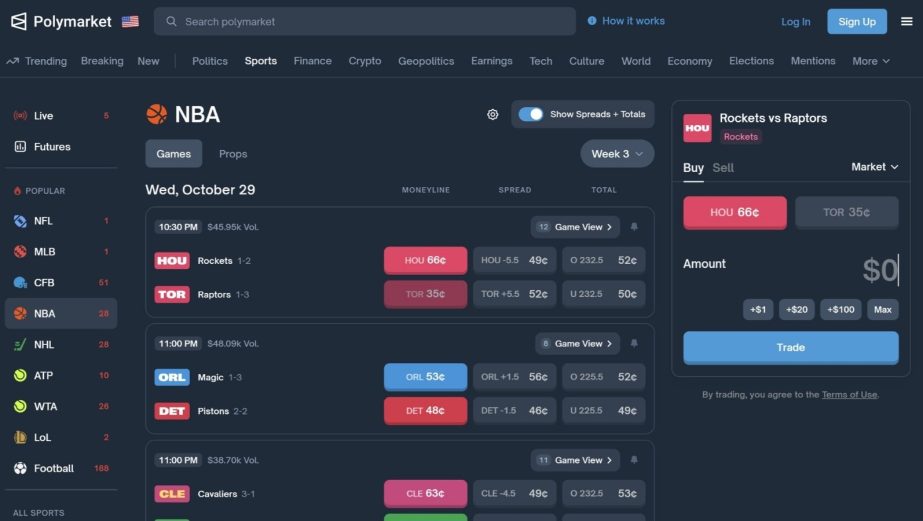
The top 1% of traders on Polymarket have captured 84% of all the gains on the platform, and 70.8% of users are in the red overall. That’s the summary of a new academic paper taking a hard look at the world’s largest prediction market.
The paper comes from four researchers: Pat Akey of ESSEC Business School in France, Vincent Grégoire of HEC Montréal, and Nicolas Harvie and Charles Martineau of the University of Toronto. What they did is the kind of thing you can only do with a blockchain-based platform: They pulled every single trade. Using Polymarket data from November 2022 through October 2025, they looked at 1.4 million users, 70 million trades, and more than $20 billion in volume.
And it’s not exactly a flattering picture for an industry that sells itself as a populist alternative to Wall Street.
The data paints an extremely top-heavy runout, with the top 0.1% of profitable users taking 58.5% of the gains. The aforementioned top 1% took 84.1%. The top 5% took 95.8%. By the time you focus on the top 25%, you’ve accounted for 99.6% of all winnings. The remaining three-quarters of winners are fighting over literal pennies. And “winners,” in this context, are the ones who knew what they were doing, as more than seven in 10 users ended up underwater.
So. Rigged game?
The paper says absolutely … not. In fact, the researchers show that the prices on the platform are remarkably accurate. When a contract trades at 30 cents, the underlying event occurs roughly 30% of the time. When it trades at 80 cents, it happens about 80% of the time. The market is right. The prediction market industry’s whole sales pitch, that real-money markets aggregate information better than most alternatives, is basically confirmed by the data.
But that’s the catch for retail traders wading into these waters. Accurate prices mean that beating the market requires actually knowing something other people don’t. It requires doing real work. It requires what the authors call “identifying genuine mispricings.” Which is a skill, and a rare one.
You can see it in something they call excess hit rate. For the top 2% of traders on the platform, their contracts resolve somewhere between 8 and 15 cents higher than what they paid for them. For the worst performers, it’s about 15 cents lower. The line from top to bottom is smooth and unbroken. Meaning the people who make money on Polymarket are genuinely good at picking winners, and the people who lose money are genuinely bad at it. The winners are not getting lucky. They are outperforming the same market everyone else is trading in.
The winners
So who are they?
The strongest signal points to market makers. The authors use something they call a “probit regression,” a statistical tool for figuring out what predicts losses, and found that moving from a pure taker (someone clicking “buy”) to a pure maker (someone posting prices) reduces your probability of losing money by nearly 36 percentage points. That is, to put it mildly, a gigantic effect.
The median Polymarket user has never posted a maker order. They click, they buy, they hope.
The other losing profile is the longshot bettor. Polymarket users place 63% of their trades at extreme prices, which the paper defines as contracts trading under 10 cents or over 90 cents. These are the lottery tickets of prediction markets. The payoff is big if the dog comes in, but the prices are accurate enough that, over time, you’re going to bleed out. And most retail users simply can’t resist.
What it adds up to
The paper complicates the story the industry prefers to tell. Prediction markets are pitched as information-aggregation engines, a more honest version of polling, a democratic way for the wisdom of crowds to get expressed in dollars. And on that score, the authors actually agree. The prices work, and the information really does get aggregated.
But underneath that, something less flattering is also happening: a steady transfer of money from a large group of unsophisticated traders to a tiny group of sophisticated ones. The authors put it this way: “Polymarket investors are, on average, trading against efficient prices they cannot profit from.”
Additionally, the researchers acknowledge that sophisticated users probably operate multiple wallets, meaning the real concentration at the top is likely worse than the 84% figure suggests.
Prediction markets get pitched as democratizing forecasting. This paper suggests that’s a overly generous description.