
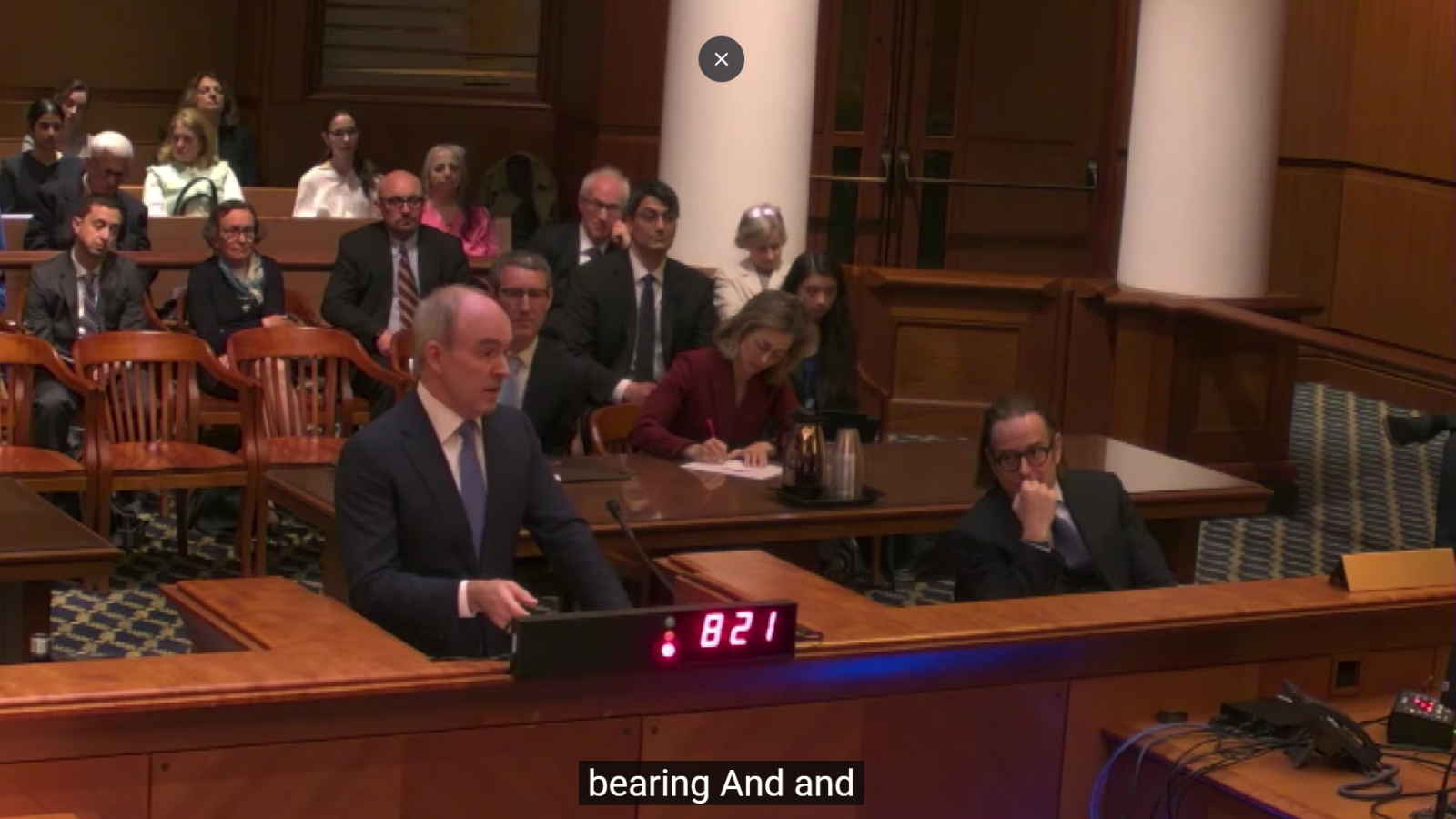
Both Kalshi and the state of Massachusetts faced probing questions from the Massachusetts Supreme Judicial Court in oral arguments Monday. But the nature of the case — in which Kalshi needs to win on two different points — means that the judges’ skepticism of arguments made by both parties may be favorable to the state.
Lawyers for Kalshi and Massachusetts made their arguments to the Massachusetts Supreme Judicial Court’s seven judges. Kalshi is appealing the Suffolk County Superior Court’s decision to grant an injunction that would ban the prediction market’s sports contracts from the state.
That injunction is not currently in effect while the appeal is being heard, but if it comes into force then Massachusetts would be the second state, after Nevada, to successfully ban Kalshi’s sports contracts.
While the question of whether Kalshi’s sports event contracts are legal will most likely only be finally settled by the Supreme Court of the United States, the state-level litigation in Massachusetts may decide whether the contracts are banned in the state until that final decision comes.
Preemption and swaps
While all sections of arguments from both sides came under scrutiny, it appeared that Kalshi’s lawyer faced especially probing questions over whether state law is preempted for sports contracts, while the state’s attorney faced a similar level of scrutiny over whether these contracts could be excluded from the definition of a “swap.”
Those two topics have been central to Kalshi vs. state arguments across the country. Kalshi argues that the Commodity Exchange Act (CEA) overrules state sports betting laws, and that sports event contracts meet the definition of a swap and so the preemption of state law applies to these contracts. States including Massachusetts disagree on both counts.
Kalshi’s wider argument in the case rests on both sports contracts being swaps, and state law being preempted. Meanwhile, winning on just one of those points would be enough for the state to win.
Therefore, if the court determines that sports contracts are swaps but state gambling laws are not fully preempted, Massachusetts would win the case.
In its opinion to grant an injunction, the Suffolk County Superior Court focused mostly on the preemption argument.
‘Completely different’
Early in his argument, Kalshi lawyer Grant Mainland said that Kalshi’s sports contracts are “completely different” to sports bets that may be available at a sportsbook, prompting skepticism from the bench.
“Complete different? Really, completely different?” asked Justice Scott L. Kafker. “For someone who wants to bet on a game, this is a way of betting on the game.”
Mainland went on to note differences between Kalshi’s sports contracts and sportsbook bets besides whether or not they are peer-to-peer, such as the presence of a clearinghouse and the fact that they are fully collateralized.
Justice Gabrielle R. Wolohojian was not convinced by this argument, noting that these features could easily exist in a traditional gambling environment.
“Those would not be, at least conceptually, incompatible with what we would historically understand to be a bet or wager,” she said.
Judge says Kalshi is swimming upstream
Kafker also suggested that he wasn’t convinced by the preemption argument.
“Two points from me,” he said. “The major policies doctrine from the Supreme Court said Congress would be explicit in making major policy changes. And second, sports gambling is huge. So why isn’t this the elephant being put in the mousehole? It just seems like if Congress was going to do this, it would do this more clearly and more distinctly.
“I just feel like you’re swimming upstream here.”
Mainland argued that it wasn’t “a radical change in state-federal relations” because the change would only apply to contracts on a CFTC-registered exchange, rather than overhauling how the law would work for state-regulated sportsbooks too.
Justice Dalila Argaez Wendlandt expressed a similar sentiment, questioning Kalshi’s argument that references to “exclusive jurisdiction” were enough to override state law.
“Usually, Congress would have used different words than ‘exclusive jurisdiction.’ That to me sounds like, ‘As to the CFTC and the SEC, this part is with the CFTC,’” she said. “Do you have any examples in all of the [U.S. Code] where ‘exclusive jurisdiction’ was a method of preemption over state authority?”
Mainland pointed to two cases where he said this took place: Slaney v. IAAF and Heart of America Grain Inspection Services v. Missouri Dept. of Agriculture. In Slaney, the Seventh Circuit determined that state laws about drug testing were preempted by international arbitration agreements for sports. In Heart of America, the Eighth Circuit determined that state laws about grain inspection were preempted by the federal Grain Standards Act.
Can non-action create preemption?
Justice Elizabeth N. Dewar also said it was hard to square the preemption argument with the fact that prediction market contracts are self-certified. Self-certification is a process where an exchange tells the CFTC that it plans to list a new type of contract and provides certain details, such as the applicable rules. If the CFTC does not object before the listing date specified, the contract may be listed, though it is not technically considered “approved.”
“The only CFTC action that exists is non-action,” she said. “These are self-certified contracts. Your argument for preemption relies on the CFTC’s non-action.
“There would be no argument whatsoever for preemption here but for that Kalshi has self-certified these contracts.”
Mainland argued that it wasn’t true “non-action” from the CFTC, because when Kalshi first self-certified sports contracts, the regulator asked it to demonstrate how the contracts were in compliance with the CEA.
Swaps defined broadly
The state’s lawyer Gergard Cedrone faced similarly tough questioning. He spoke for only seven seconds before the first time he was interrupted by a judge, when Justice Wendlandt pointed to the broad definition of a swap in the law.
Cedrone said they did not meet the definition of a swap as described in the CEA. According to the CEA, a swap includes “any agreement, contract, or transaction… that is dependent on the occurrence, nonoccurrence, or the extent of the occurrence of an event or contingency associated with a potential financial, economic, or commercial consequence.”
“Well, they pay out based on the occurrence or nonoccurrence of an event, don’t they?” Wendlandt asked.
Cedrone pointed to the U.S. District Court for the District of Nevada’s decision in a case concerning Crypto.com, where the court determined that who wins a game is not an “event,” and that the financial consequences associated with a swap must be inherent to the event, not downstream consequences. That Nevada decision would not be binding for the Massachusetts court.
“If anything that can happen is an event, and anything that might put money into and take money out of someone’s pocket is a financial consequence, then the rest of the definition is completely superfluous,” Cedrone said.
Justice Kafker pointed out that there were certain sporting outcomes that clearly did have financial consequences, for example if a furniture store offered free products if a specific team won.
Cedrone argued that the court should not use the small selection of sporting events where financial consequences were more relevant, because Kalshi was arguing for its ability to offer any kind of sporting events.
“We can’t dispute that there are some things that are going to be close to the line, but Kalshi is making a categorical argument,” he said. “Even if they could show this particular position or that position is a swap, that can’t prove their categorical argument.”
Busy court week
The oral arguments kicked off a busy week for prediction market litigation. On Thursday, Kalshi and Maryland will engage in oral arguments before the U.S. Court of Appeals for the Fourth Circuit, after the U.S. District Court for the District of Maryland denied Kalshi an injunction that would have shielded it from enforcement of Maryland gambling laws.
Briefs are also due this week in Kalshi’s lawsuits against Ohio and New York.