
While the true level of retail betting handle on Kalshi remains somewhat obscured, the prediction market is likely catching up to the sportsbook giants this quarter, and it may have already overtaken them, per InGame research.
Taker-side volume on the platform, a close proxy for handle, is now exceeding $200 million per day, ahead of the top sportsbooks’ handle. Even lower-bound estimates of an equivalent to handle this quarter could match DraftKings and FanDuel.
Volume can be flawed figure
Kalshi regularly reports its volume figures, which are sometimes compared to sportsbook handle. Volume on Kalshi has soared since the platform started offering sports and easily exceeds the amount wagered on DraftKings’ and FanDuel’s sportsbooks.
However, the figures are inflated compared to actual sportsbook handle. Both the taker side and the maker side of a trade are counted, even though the market maker for a bet — the party putting up the initial offer — is often a professional trader or institutional market maker rather than a typical bettor. This means that a $10 bet placed at 10% odds counts as $100 in volume even if it is more similar to $10 worth of sportsbook handle.
That issue is most acute for parlays, which have exploded in popularity since their September launch. Most parlays are at long odds, and market making on parlays is only possible through the Kalshi API, meaning that the market maker is virtually always a professional or institutional entity. Last week, FanDuel revealed that it is market making for parlays on a “third party” prediction market, but it did not specify which one.
Parlays have been growing rapidly on Kalshi and now make up around 26% of volume, compared to 13% in late December. That means that while Kalshi’s growth is fast by any measure, its volume figures have risen faster than handle-equivalent would have risen.
Kalshi’s fee revenue has risen sharply too, and its fees from sports alone comfortably exceed BetMGM’s sportsbook revenue, meaning the prediction market is already in a podium position in U.S. sports betting revenue. But it is still a long way behind the two leading sportsbooks.
Fees in the first quarter were $380 million, including $304.9 million on sports, compared to $1.09 billion for DraftKings or $1.14 billion for FanDuel.
However, Kalshi’s fees — averaging about 1.2% — are much lower than most sportsbooks’ hold percentage, so the prediction market would have to be much more successful than DraftKings and FanDuel from a handle perspective to catch the two leading sportsbooks in revenue.
Kalshi taker volume a closer handle proxy?
Because the vast majority of more recreational Kalshi user activity is taking bets that have been put up by market makers, volume from the taker side of trades alone can be a better proxy for betting handle.
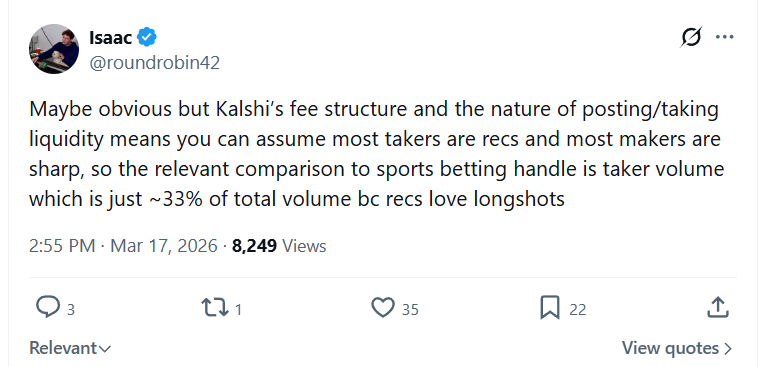
Kalshi’s taker volume in the first three months of the year came to $13.30 billion. FanDuel’s handle for the quarter was slightly higher — at $13.36 billion. For DraftKings, the figure was $14.08 billion.
Taker-side volume still isn’t a true like-for-like comparison to sports betting volume. One major difference is users trading out of positions. To cash out, a user sells their existing contracts to a market maker. The exchange is recorded as a second taker purchase as Kalshi trade data is anonymous, so there is no way to see which bets closed existing positions.
On the other hand, some recreational bettors do put up resting orders, acting as market makers for individual bets.
A lower bound for handle equivalent is likely Kalshi’s yes-side taker volume. That would effectively remove contracts where a user cashes out of an existing position, but it would also remove some other trades that do represent recreational user volume.
Kalshi yes-takers bet $8.93 billion during the first quarter of the year.
Kalshi catching up this quarter
But Kalshi has kept growing through the second quarter of the year.
Though some of its volume growth is inflated by the increasing share of volume coming from parlays, there is underlying growth beyond that.
Taker-side volume over the last seven days averaged $208.8 million. If that keeps up over a quarter, Kalshi’s total would be more than $18 billion, exceeding the top sportsbooks’ handle figures.
The lower-bound figure — yes-side taker volume — was $136.2 million per day. Over a quarter, that would be $12.2 billion.
Given that the second quarter of the year can be a quieter one in the sporting calendar, even that lower-bound figure may exceed DraftKings and FanDuel. Last year, DraftKings’ handle in the second quarter of the year was $11.5 billion, while for FanDuel it was $11.7 billion.
DraftKings’ own prediction market will likely add a few hundred million dollars in handle-equivalent volume this quarter, and FanDuel likely upwards of $100 million.
The figures also show that the growth in parlays on Kalshi has been strong, but in terms of absolute numbers the vertical is not as large a product as volume may suggest. Over the last seven days, taker-side volume on parlays was $13.9 million.