
In January, an Optimove report revealed that “the United States has treated the World Cup as a moment, not a season, with engagement peaking during the tournament and normalizing quickly in favor of domestic sports cycles.”
The World Cup, which started Thursday with two games in Mexico, will run through July 19 at sites in Canada, Mexico, and the United States. The first game in the U.S. will be Friday, when the U.S. plays Paraguay in a Group Stage game in Los Angeles.
Six months after the revelation, an Optimove executive shared a roadmap that gives operators the best chance to convert seasonal bettors into long-term customers. The caveat? Those who make a single deposit aren’t the bettors operators should go after.
“We don’t have a magic bullet so to speak, and the vast majority of players are going to come in and leave,” Optimove Director of Sales Jeff Laniado told InGame. “But there is a ton of data that we have that shows that second deposit” is critical.
So, those who deposit $10, bet on the U.S. team, and never come back probably aren’t worth the effort. But Laniado has plenty of suggestions for operators who see a second deposit from the same player within, say, a week or two.
Think themes — whether that is patriotism, favored bets, or geographical location.
It’s all about the data
As examples, Laniado suggests that a person who bets exclusively on the U.S. team could potentially be converted to a long-term online casino player if an operator cross-sells patriotic-themed slots, while a player who bets only soccer might be interested in soccer-themed slots, and a player who seems to be betting a favorite player might be enticed to place a prop on another big-time player, even if his/her team gets knocked out.
The key, Laniado said, is analyzing the mountain of data operators collect, and getting the timing right.
“I think the operators that are going to do well are the ones who will be tapping into the data they have, so if they can kind of glean the kind of bettors they have in, say, football, then they can kind of use what they know to apply to World Cup,” Laniado said. “It’s the little differences — being more personalized — that are important.”
The “little differences” are truly little. Given how much data gambling operators collect, it’s possible to get to down to a very granular level, whether that be how a customer prefers to be contacted (email? push notification?) or what time of day the customer would be most likely to be engage with the information. Laniado said everything from what the lead image in a communication is to offering the right kind of bonus in the right channel is important.
“Those things add up to have a meaningful impact,” he said.
2022 WC bears out the theory
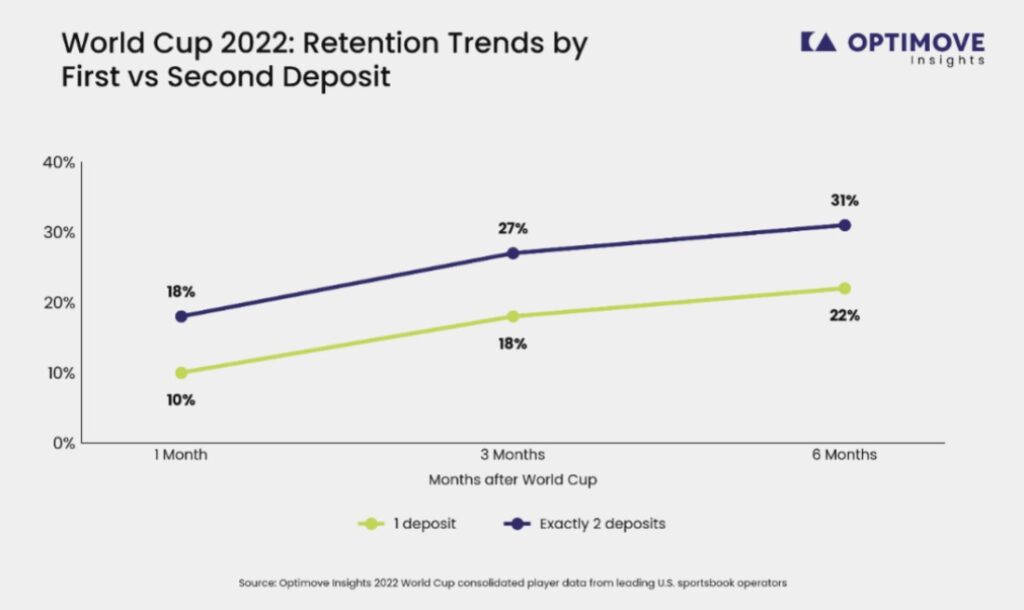
Optimove looked at retention rates for first and second deposits for the 2022 World Cup and found that six months after the event, 31% of those who made “exactly two” deposits were still active players compared to 22% of those who made only one. The company reviewed 200,000 transactions made by 157,000 bettors who were making their “first-ever” deposits on a sports betting platform.
The sample was from top U.S. sportsbooks, and a key difference between the 2022 World Cup and the 2026 version is time of year — traditionally held in the summer, the 2022 World Cup was in November due to the climate in Qatar, the host country. In November, U.S. sports bettors are heavily engaged in football, the most bet sport in the country, vs. now when the NBA and NHL finals are winding down and regular-season Major League Baseball is the only one of the big four professional leagues available to bet.
“Gross acquisition during a marquee event reveals very little on its own,” reads the report. “A first deposit only confirms a player showed up. The second is the earliest reliable signal that they’re becoming a recurring customer — and the metric worth tracking by acquisition channel and match type for operators focused on long-term value rather than a one-time World Cup spike.”
The conclusions don’t just apply to the World Cup, they could be applied to any one-off, big-stage event, including the Super Bowl, College Football Champion, or March Madness.
Evolution of a customer
Laniado said he looks at the “life cycle” of a customer, which has multiple iterations. The very start of the cycle is when a potential customer visits a platform, but hasn’t yet placed a bet. That anonymous visitor can then register, but wouldn’t be considered a new customer until the first deposit it made. A customer who makes a second deposit within a predetermined amount of time (one operator might have a seven-day window while another has a 10-day window), then becomes an active customer.
The goal is to keep the active customer, well, active, rather than have him/her “disengage” and become a “churn” or dormant customer. Should that happen, an operator may try to reactive the customer.
But “active customers” are the ones Laniado said operators should be trying to engage during the next month.
“Hopefully that cross-sell happens with casino before [the customer’s] team loses,” Laniado said. “I hear a lot of talk from our clients that the team is the primary driver, but a secondary driver is players. Will Messi or Ronaldo score? These premier players … become a viable second source of bets” for a new active player.