The taco stand heist
I walked up to the taco stand, the finest in all of Mexico City. I ordered tacos al pastor and pulled out my trusty Chase Sapphire Reserve to pay. The guy behind me in line grabbed the card and bolted. A younger, more agile me would have given chase. The current me, old and fat, shrugged, pulled out another card, and paid.
I called Chase to report the card stolen. They said they’d investigate, and if they determined it was actually stolen, they’d cancel it. Soon after, a spending alert: $4,500 at Sanchez’s Sombrero and Tajin Emporium. I called again. Same answer: They’d investigate, and if it turned out to be fraud, they’d take care of it. A couple hours later, Chase called back: There were “plausible reasons” to believe the card hadn’t actually been stolen. I was on the hook for $4,500.
Every line in that story is made up. The taco stand, the thief, the sombrero emporium: all fiction. The part that isn’t believable, even as fiction, is Chase’s response. That’s not how a regulated financial institution handles fraud claims. They investigate fast, they lean toward protecting the customer, and if something slips through, they eat the cost.
But that’s not how Kalshi handled mine.
Kalshi was presented with detailed, real-time evidence that the data source governing one of its markets was being artificially manipulated. It had time to delay settlement and investigate. Instead, it paid the market within minutes of rejecting my warning. The following day, Spotify removed enough streams to show the result was due to fraud.
Month-end Spotify bonds
I was winding down the evening of Sunday, June 28 like I often do: overseeing my vast financial empire. That’s when I saw something that was funny enough to deserve its own tweet:
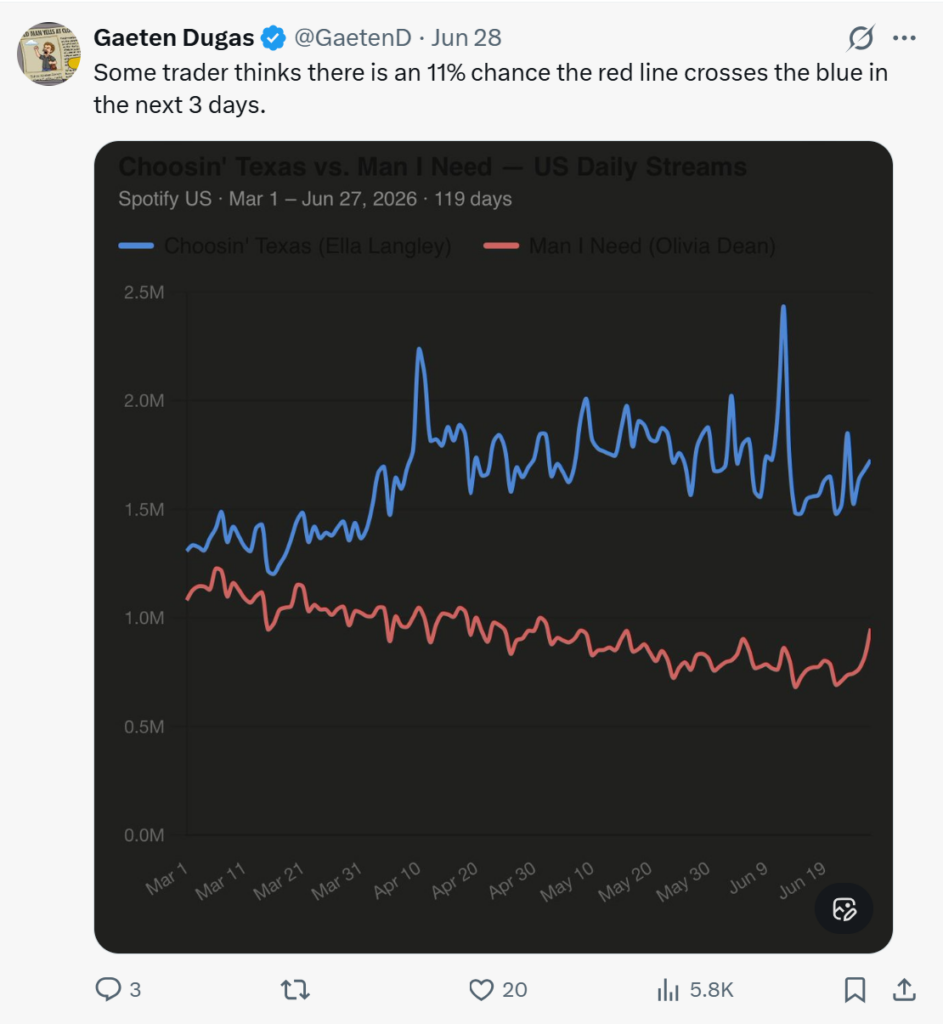
It was nearing month’s end, and I had gotten into the habit of parking a ton of money into dead brackets (artists with no realistic chance of winning) in the “Who will have a Spotify #1?” markets at the end of each month. New music typically drops on Friday and the Spotify charts tend to be fairly stable if no new competition drops, so after the final Friday of the month, you can usually rule out all but one or two artists as contenders. Put a couple hundred grand on those no-chance artists and you can make a couple grand risk-free — err “risk-free” — in a couple of days.
The blue line in the tweet is Ella Langley’s “Choosin’ Texas.” If Carrie Underwood’s “Before He Cheats” and the Juggernaut from the X-Men had a baby, it would be “Choosin’ Texas.” It will easily be the most-streamed song on U.S. Spotify this year (bonus alpha alert).
The red line is Olivia Dean’s “Man I Need.” While a total banger, it has only spent a single day at no. 1 on Spotify: Nov. 23, 2025. It has been remarkably stable this year, but at a level nowhere near no. 1. There was no reason to worry about it surging in the last three days of June, almost nine months after its release. I fell asleep with a smile on my face and dreamt of rainbows and puppy dogs.
That little rising line
I woke up in a sweat. That line! That little rising line! Did you see it?
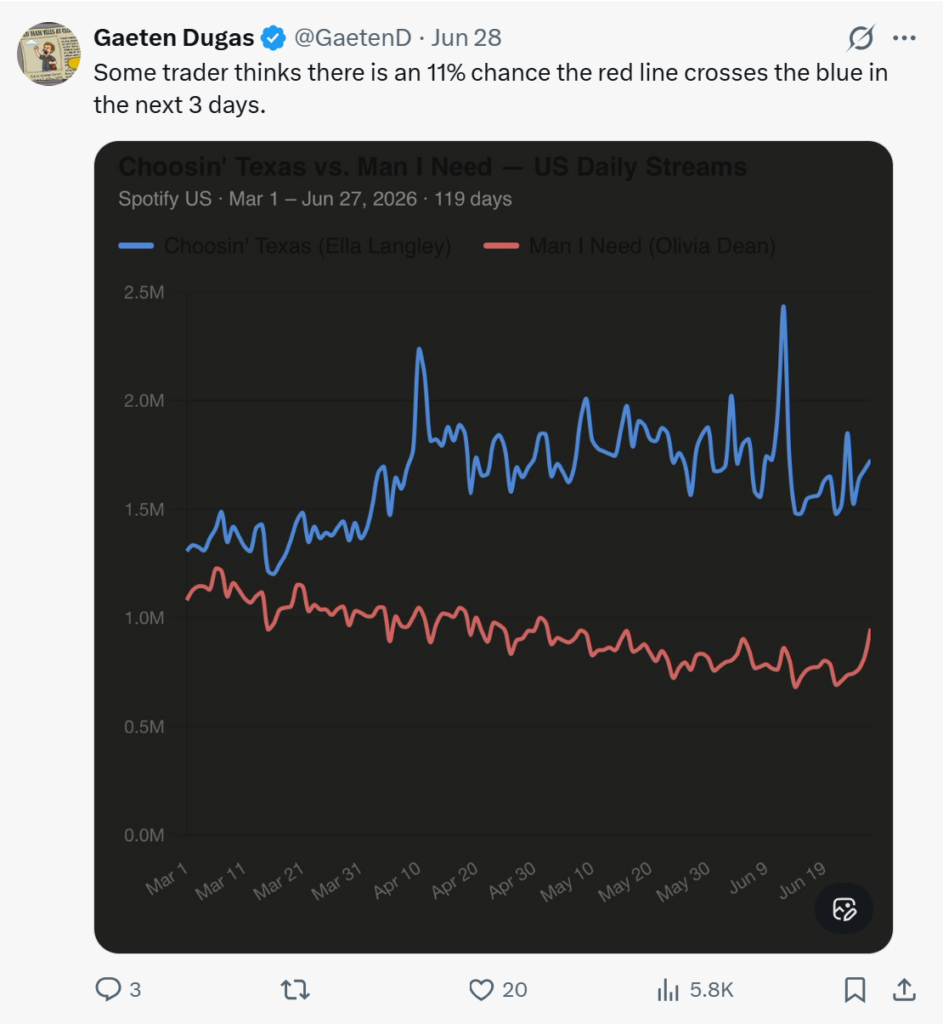
The streams tail up at the very end. I had seen that uptick the night before, but it seemed so implausible that I let it go. But that uptick paired with the pricing action warranted a closer look. The results were concerning:
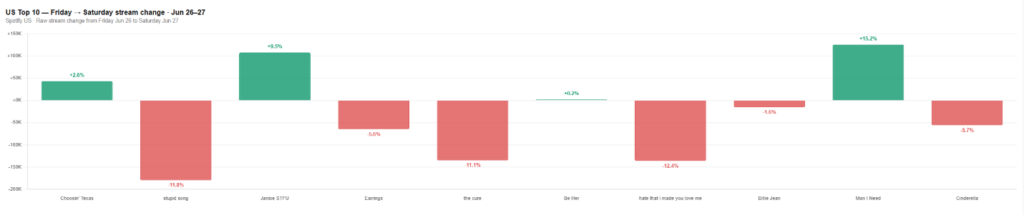
“Man I Need” and Drake’s “Janice STFU” had huge increases Friday to Saturday when normally Saturday sees a decrease (Ella Langley typically has strong Saturdays, so her songs increasing was not a surprise).
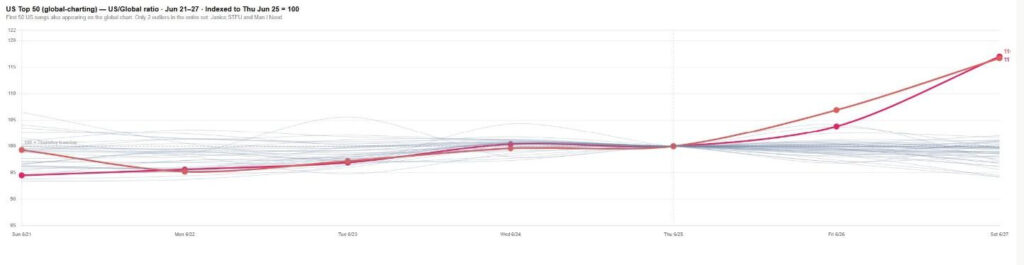
Furthermore, the increase was entirely from streams in the U.S. Both of those songs stuck out among the rest of the top 50 for seeing a U.S.-only surge. This is exactly what you’d expect if somebody was fraudulently boosting streams for a U.S. chart bet.
Finding the financial incentive
At this point, I was almost certain that somebody was artificially boosting streams. The next step was to see if anyone had a financial stake in those songs winning. The market was listed on both Kalshi and Polymarket. Because Polymarket is blockchain-based, all of the trades on the platform are public. On Kalshi they are not, so I looked at Polymarket for any suspicious activity and found it immediately. A single account had accumulated over 100,000 shares of Olivia Dean and over 20,000 shares of Drake. And that same account had a massive win earlier in June on a big upset:
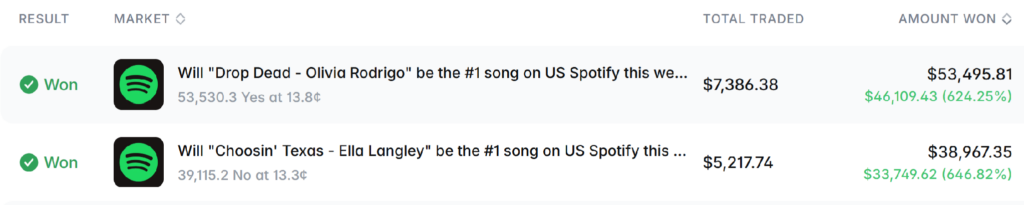
A follower on Twitter pointed me toward the trader’s other accounts, and the trail held up. The same username appeared across multiple platforms, including Reddit, where four years earlier he had advertised a stream-boosting service. On another account, he claimed to own a record label. None of this proved who was manipulating the streams, but it established an obvious financial incentive and a remarkably suggestive trail.
The Monday update
Convinced that I was witnessing fraud in real time, I was nervous waiting for Monday’s update. If Olivia Dean finished first, I would lose $13k. If Drake won, I would lose $17k. When the update dropped, Ella Langley had retained first place. I had survived another day, but there were two updates left. I dug into the details and found that I was probably screwed. The Monday update is for Sunday data, and Sundays almost always see a drop from Saturday. Rather than seeing a drop for “Janice STFU” and “Man I Need,” we saw a surge for both. Here is every song that was on both days’ charts:
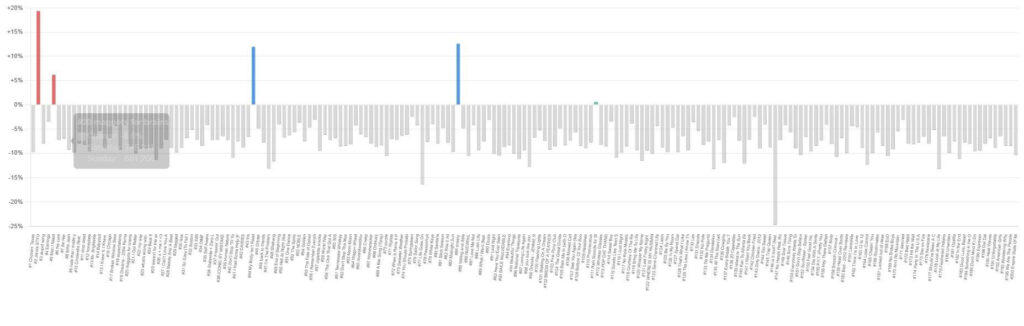
Of the approximately 200 songs, 195 saw a decrease in streams, one was flat, and four saw increases. Two of those were new, smaller songs (not too unusual for these to increase) and the other two were “Janice STFU” and “Man I Need” — the two songs showing the suspected manipulation. They now had two days in a row of extremely unusual results, and all the excess streams came from the U.S. Instead of leaving myself to the mercy of the scammer and Spotify’s filtering abilities, I notified Spotify and Kalshi of the fraud.
Initial communication with Kalshi
I DM’d Kalshi’s CEO, Tarek Mansour, on Twitter to alert him to the suspected fraud. Tarek provided me with the contact information for Robert DeNault, Kalshi’s head of enforcement and legal counsel. I sent him all the evidence I had, including a PDF detailing the Polymarket trader. The complete exchange appears in Appendix A. These were the most important lines:
I asked Kalshi to “hold off on paying out the market until an investigation has been completed.”
DeNault replied: “We are examining this information and will investigate any trading activity that appears suspicious on our platform.” But he added that “the main point of contention is with Polymarket, not Kalshi.”
I responded: “My main concern is with Kalshi paying out this market without a thorough investigation first.”
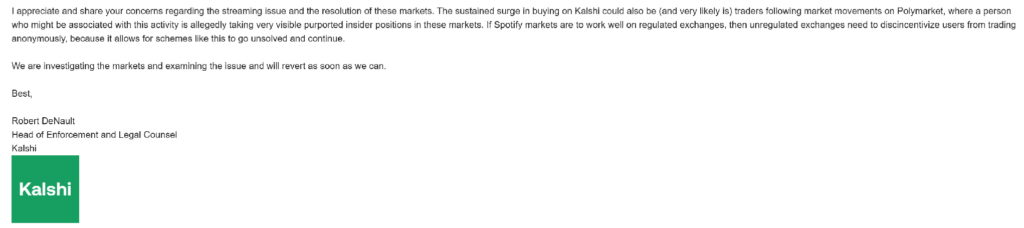
DeNault answered: “We are investigating the markets and examining the issue and will revert as soon as we can.”
The exchange showed the disconnect. DeNault focused on whether the Polymarket trader had violated Kalshi’s rules, but the key issue was that Polymarket and Kalshi shared the same resolution source. He did not answer my central question: whether Kalshi would delay settlement when this shared resolution source appeared to be under active manipulation.
The Tuesday update
I again nervously awaited the results on Tuesday morning. When the results came, I breathed a sigh of relief as the winner was neither Olivia Dean nor Drake. I had dodged a big loss for one more day. But the winner wasn’t the expected Ella Langley either. It was Malcolm Todd’s “Earrings”:
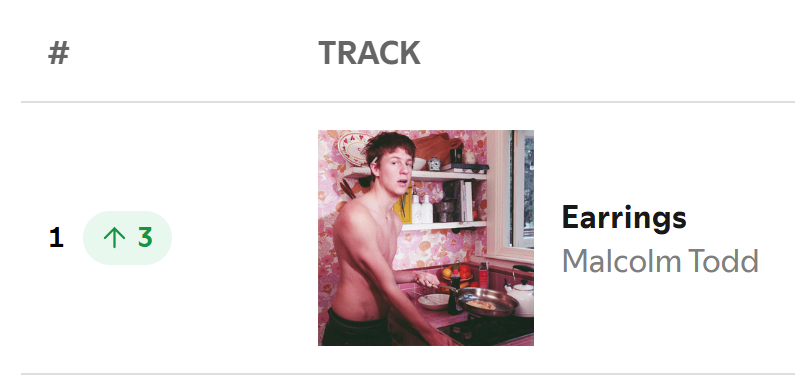
That was unexpected, and, unfortunately for me, expensive. I had risked $4,500 on “No” and had no reason to think he would win. He needed (and got!) a 70% surge in streams from Sunday to Monday to take first place after being stable for months. The surge came entirely from the United States:
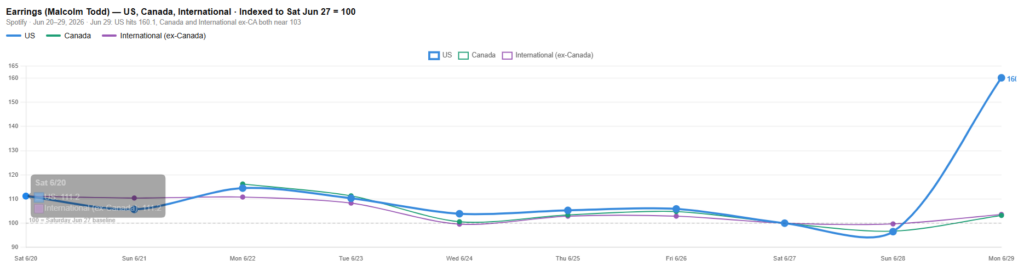
Here is every Sunday to Monday change for “Earrings” this year:
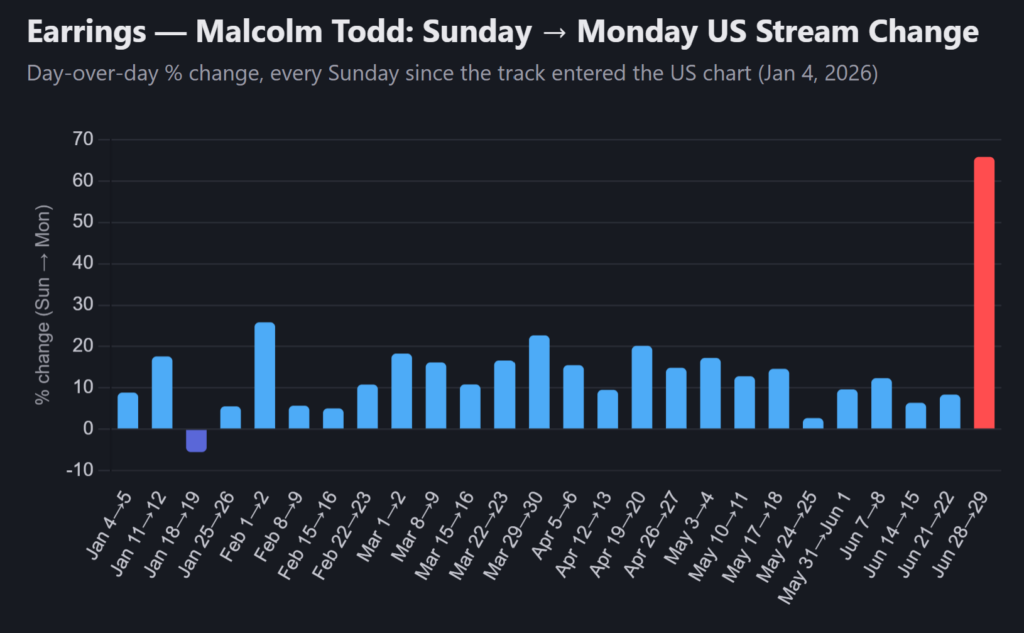
There was no way this was the result of organic activity. And the most damning part: Polymarket didn’t have an “Earrings” bracket at all. Nobody made a single cent from this on Polymarket.
Continued correspondence
At this point, I messaged Mr. DeNault again, explaining that Malcolm Todd’s win made no sense, that Polymarket did not even offer a bracket for the song, and that Kalshi’s own trading records could reveal who had accumulated Malcolm Todd shares. Six hours later, DeNault responded. The complete exchange appears in Appendix B.
He said “only Spotify can verify whether these are genuine numbers or the result of bots or manipulation,” while adding that others had identified “some plausible reasons” the numbers might be organic.
Minutes after sending that response, Kalshi paid out the market.
That decision cost me $4,500. More importantly, it told every trader that Kalshi would mechanically honor a result it had been warned was likely manipulated, even when the warning arrived before settlement.
The aftermath
The following day, Spotify removed 523,000 streams from the cumulative totals for “Earrings.” This was enough that it would have dropped “Earrings” from first to fourth the prior day, but Spotify never updates the daily charts retroactively. The “Earrings” win would forever be enshrined on June 29, 2026 even though it was the result of fraudulent streams. The next day, WIRED wrote an article on the story and got confirmation from Spotify that the streams were fraudulent:
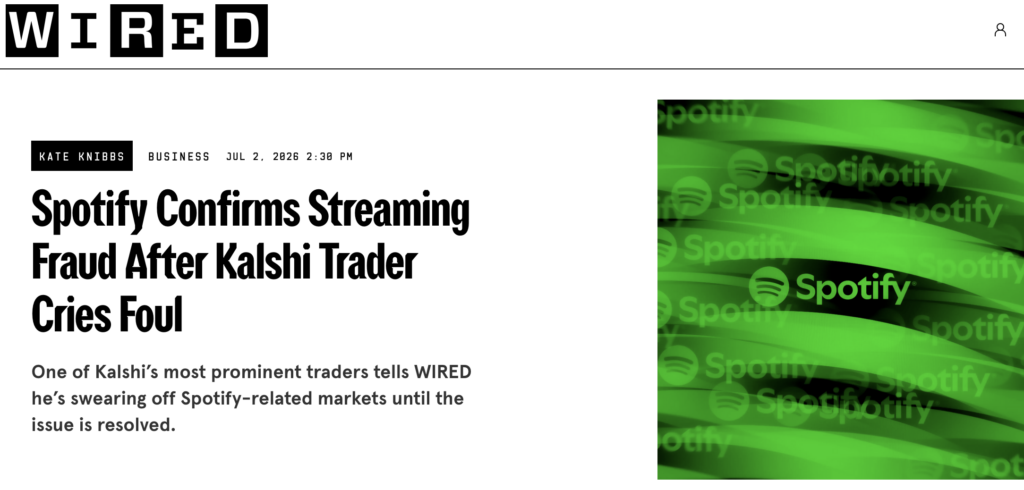
Neither DeNault nor Mansour nor anyone else at Kalshi has replied to me since the fraud was confirmed. Kalshi’s only public response came from spokesperson Elisabeth Diana, who told WIRED, “We’re in touch with Spotify and are actively investigating this matter.” Kalshi has stopped posting new Spotify markets, but the July market remains open and is actively being traded.
What Kalshi should have done
Kalshi didn’t need to crack the whole case before paying out. It just needed to recognize that paying out prematurely would be a disaster.
Pausing would have cost almost nothing. Trading could have been closed and payout delayed until an investigation was completed. Paying immediately did the opposite: It turned a disputed chart into a permanent transfer of money on exactly the day the chart was most in doubt. And Kalshi doesn’t have a rigid standard for fast payout in these markets. When Olivia Rodrigo got first in mid-June, the market wasn’t paid out until I notified Kalshi three days later. And when Michael Jackson got first early in the month, it took over a week to pay out those winnings. Any sense of urgency that was applied to this payout wasn’t present when it came to paying out artists whose wins weren’t suspicious.
DeNault told me only Spotify could say whether the streams were real. He was right, which is precisely why Kalshi should have asked Spotify before paying, not after. “Only Spotify can verify this” is an argument for waiting for Spotify’s answer, not for settling before the question is even posed. A quick note to Spotify asking whether the June 29 chart was under review would have cost a phone call.
Then there was Kalshi’s own order flow. DeNault wrote that Kalshi wasn’t seeing “any evidence of a trader or traders suspiciously benefiting from these numbers.” But open interest in the “Earrings” bracket increased from $2k to over $70k in the days prior to the fraudulent streams while other dead brackets saw no increase. Where did all these buys come from? How can they conclude those buys weren’t suspicious?
And once Spotify stripped 523,000 streams and confirmed the win was built on fraud, Kalshi could have made it right. Correct the settlement, void the market and return the money, reimburse the traders it burned. The specific mechanism matters less than the choice to do something instead of nothing. Instead Kalshi kept the erroneous result and the erroneous payout and said nothing.
What Kalshi should do now is simpler: Disclose what its investigation found, publish an actual manipulation policy, deal with the still-open July market, and pay back the traders its June settlement harmed.
Why this matters
In sports betting or financial markets, the resolution sources are rarely controversial. But in prediction markets, they can be literally anything. And once there’s money on the outcome, someone has a reason to reach in and change it. The CFTC already has rules against markets based on easily manipulable results, but what happens when results that were thought to be safe turn out not to be?
Kalshi’s defense can’t be that it paid what the chart said. The chart was the target. A market that mechanically pays whatever number shows up at the source hands every would-be manipulator the same playbook: push the source hard enough to print the result you’ve bet on, then collect before anyone corrects it. “Earrings” wasn’t a freak event. It was that playbook working exactly as designed.
Regulation was supposed to be the thing that made Kalshi the safe choice. A regulated exchange is meant to have better surveillance than an offshore book, better protection for its customers, and a real process when an outcome is disputed. I brought Kalshi a disputed outcome, with the evidence, before it paid. Regulation turned out to be a line in Kalshi’s marketing, not a safeguard.
Conclusion
Kalshi had everything it needed and the one thing that mattered most: time. It didn’t have to name the manipulator or prove his motive. It only had to see that paying immediately would turn a data anomaly it had been warned about into a result nobody could undo.
It paid anyway.
I’m not asking Kalshi to guarantee that every number it resolves on is perfect. No exchange can promise that. I’m asking it not to shut its eyes when a source is visibly being manipulated and the warning lands before the money moves.
The taco stand was fiction. The $4,500 loss was not. Neither was the warning Kalshi received before it paid.
Appendix A: Initial email exchange
Email from Caleb/Gaeten to Robert DeNault
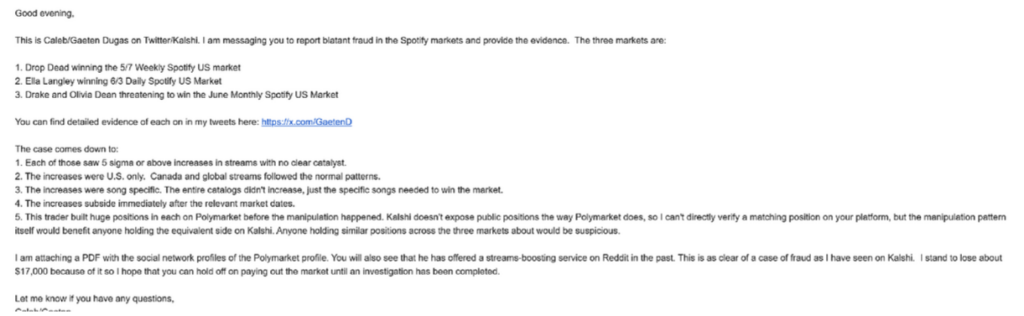
Response from Robert DeNault
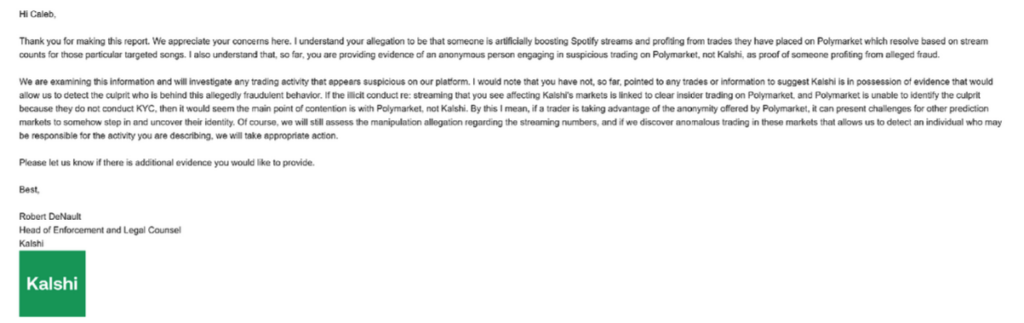
Follow-up from Caleb/Gaeten

Second response from Robert DeNault
Appendix B: Final Correspondence
Email from Caleb/Gaeten to Robert DeNault

Response from Robert DeNault