The U.S. Court of Appeals for the Ninth Circuit Friday ruled against Kalshi, saying that states can ban the prediction market’s sports event contracts, and seemingly teeing up a Supreme Court case that may finally settle the issue being debated in courtrooms around the country.
The court ruled 3-0 that states are allowed to enforce their gambling laws against Kalshi’s sports event contracts, as those contracts fail to meet the definition of a “swap” in the Commodity Exchange Act (CEA).
25-7516The stage now appears to be set for a possible Supreme Court case. Two circuit courts have disagreed on the case, which is the most common trigger for the Supreme Court to take up a case. In addition, New Jersey is set to submit a request for the Supreme Court to hear the case in a matter of days. The deadline is Sept. 3.
Not only did the Ninth Circuit rule against Kalshi, Crypto.com, and Robinhood, but its reasoning directly went against the main points in the Third Circuit’s opinion, rather than being focused on a different aspect of the debate.
The three-judge panel consisted of Ryan D. Nelson, Bridget S. Bade, and Kenneth K. Lee. Nelson wrote the court’s opinion, and Lee wrote a concurring opinion.
Swaps and preemption
The lawsuits between Kalshi and states mostly come down to two questions: Do sports event contracts qualify as “swaps” under the CEA, and does the CEA preempt state gaming laws with regard to transactions involving swaps? Kalshi would need the answer to both questions to be “yes” if it wants to prevent states from banning its sports contracts.
On the preemption question, the court determined that state laws are overruled when swaps are traded on a designated contract market (DCM), like Kalshi, citing use of the words “exclusive jurisdiction.”
However, the court said that sports event contracts are not swaps.
According to the CEA, a swap “is dependent on the occurrence, nonoccurrence, or the extent of the occurrence of an event or contingency associated with a potential financial, economic, or commercial consequence.”
The Ninth Circuit acknowledged that if it were to take a broad reading of those words, then sports contracts could qualify as swaps. The Third Circuit had previously argued for a broad reading of the law, determining that a definition narrow enough to avoid sports contracts would be going beyond that the text of the law said.
However, the Ninth Circuit did not believe this was the most sensible reading of the text. The court largely agreed with the Nevada District Court’s reasoning on whether or not sports event contracts are swaps. Like that court, it examined the words “event” and “occurrence,” and determined that while the definitions of those two words can overlap at times, Congress must have meant them to have different meanings or it wouldn’t have used two different words.
Looking at gambling context
It then looked at the wider context of the CEA and of sports event contracts to determine what limits might exist on the definition of a swap.
It said that as Kalshi’s products are presented as gambling, this should include the context of laws addressing gambling as well.
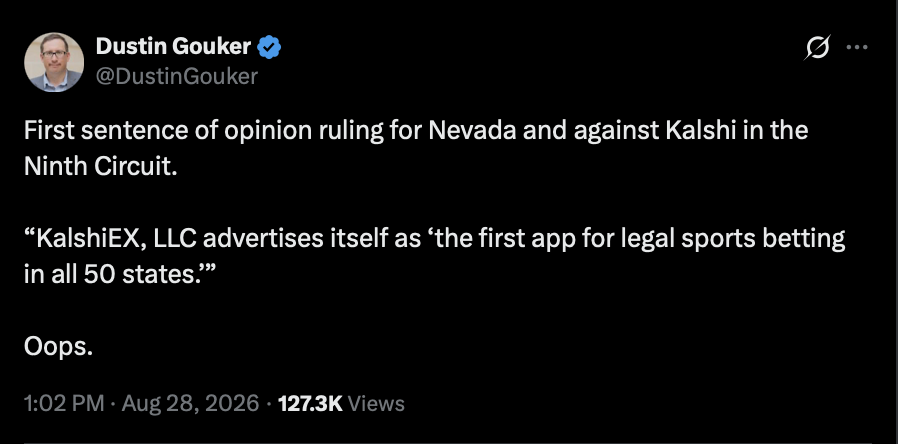
“The crucial context that leads us to resist the broadest possible reading is that Kalshi has a gambling problem,” the court wrote. “Kalshi describes and markets its sports event contracts offered on its DCM as ‘legal sports betting.’”
It noted that when Congress has discussed gambling, it has done so “repeatedly, deliberately, and specifically,” and so it would be hard to believe that it also intended gambling transactions to be captured within “broad definitions of the words used in a Wall Street Reform Bill.”
The Ninth Circuit added that another argument against defining swaps broadly is that “a word is known by the company it keeps.”
In this case, the definition of a swap lists other categories of contracts related to hedging risk on “interest rates, currency rates and security or commodity prices,” before getting to the definition involving a “potential economic, financial, or commercial consequence.” Given that context, the court’s opinion is that it is hard to believe the definitions would switch from narrow concepts specifically related to risks to a concept so wide that it could include almost any type of event.
“As Nevada points out, Kalshi’s sports event contracts do not help institutions or investors hedge against risk; they create risk, largely for ordinary consumers, where none previously existed,” the court said.
The court added that while there were some differences in the specifics between how a sports contract works on a prediction market and how a bet at a sportsbook works, “none of those distinctions have any connection to the statutory definition of ‘swap.’”
No limiting principle
The court listed “another problem” with defining swaps broadly — “it lacks a limiting principle.”
Citing part of the CEA that makes it illegal to trade off-DCM swaps, the court argued that accepting Kalshi’s definition would essentially make every sportsbook an unregistered swaps dealer. Here, the court again directly addressed the Third Circuit’s KalshiEx v. Flaherty (New Jersey) decision, which dismissed the possibility of Kalshi’s interpretation sweeping in transactions that would not typically be seen as under the Commodity Futures Trading Commission’s (CFTC’s) jurisdiction.
“While the court in Flaherty rejected the argument that a broad definition of swap would lead to ‘bingo games and pingpong matches fall[ing] under the CFTC’s jurisdiction,’ such a reality is not far-fetched,” the Ninth Circuit’s three-judge panel wrote. “Kalshi offers trading on the outcome of table tennis games.
“If Kalshi offers the opportunity to bet on the winner of a table tennis game, it can only do so because it certifies that event as a swap. And there is no distinction, in the statutes or regulations, between these games and the ‘friendly neighborhood ping pong match’ the Flaherty dissent discussed.”
The court determined that when the CEA refers to events “associated with a potential financial, economic, or commercial consequence,” it means the consequences should be inherent to the event, not indirectly related.
“Reading the statute so expansively as to include any conceivable downstream economic consequence would render the definition of swap so broad as to be meaningless,” it said. “We decline to read Congress’s deliberately chosen words so broadly.”
The judges said that including downstream consequences would create an “absurdity” and agreed with the district court’s decision to only consider inherent consequences.
What does law say about gaming contracts?
Elsewhere in its opinion, the court rejected Kalshi’s somewhat counter-intuitive argument that the CEA’s “special rule” — which provides provisions for the CFTC to ban contracts that “involve … gaming” — actually supports the legality of sports contracts because it shows that Congress put power over gaming contracts in the hands of the CFTC, not states.
The court determined that this argument did not hold up because of the CFTC’s own rule implementing the special rule — rule 40.11, which was a major point of discussion in the Ninth Circuit oral arguments. While the special rule appears to give the CFTC discretion over when to ban gaming contracts, rule 40.11’s wording reads more like an outright ban. Kalshi has argued that it is not a ban, because the rule goes on to list a way in which gaming contracts could be listed following a review. However, the court noted that the CFTC never invoked this review for Kalshi’s sports contracts.
“Thus, Section 40.11(c)’s discretionary authority was never used—and § 40.11(a)’s prohibition on Kalshi listing for trading on its DCM sports event contracts, that are in substance gaming contracts, remains in effect,” it said.
CFTC rulemaking complicates things?
There is another wrinkle to this part of the case, though, which is that the CFTC appears set to replace rule 40.11 with a rule that makes it more clear that gaming contracts would be subject to a case-by-case review. The court acknowledged the upcoming change, but it said that “proposed regulations have no legal effect” and it can only make decisions based on the rules in force right now.
“Until § 40.11(a) is amended in the manner described in the [Notice of Proposed Rulemaking], it bars Kalshi’s gaming-related contracts from being listed on a DCM,” the court said.
In a concurring opinion in the Ninth Circuit, Lee wrote that he believed that if 40.11 was not in place, the question of whether sports event contracts were swaps may be more debatable.
“Put another way, the statute does not seem to categorically bar all gaming contracts, despite the text and contextual clues suggesting otherwise,” he wrote. “So perhaps some unique sports events can be part of a swap trade if they meet the statutory requirements.
“Ultimately, I do not think we need to resolve this thorny statutory interpretation question right now because 17 C.F.R. § 40.11 bars gaming contracts. While CFTC has proposed revising that regulation, it remains in the books and controls the outcome of this appeal.”
Kalshi losing streak
The ruling is the latest in what now looks like a clear courtroom losing streak for Kalshi. District courts in Connecticut, New York, Utah, Wisconsin, and Montana have all ruled against the prediction market in recent weeks. Previously, federal court decisions appeared to be close to a 50/50 split, but recently, the majority of courts have sided with states. Before Friday, Kalshi’s main solace was that the only appellate court to rule had sided with the prediction market.
The Ninth Circuit is the largest of the appeals circuits, covering Alaska, Arizona, California, Hawaii, Idaho, Montana, Nevada, Oregon, and Washington. Kalshi’s sports contracts are already banned in Nevada and Washington, and the ruling may encourage more states in the circuit to take similar action.
Though the Ninth Circuit also heard appeals from Crypto.com and Robinhood about their own bans in Nevada and combined the appeals for oral arguments, Friday’s ruling deals only with Kalshi.
Circuit Court split sets stage for SCOTUS
The Ninth Circuit decision comes less than one week ahead of a Sept. 3 deadline for New Jersey to submit its appeal of the Third Circuit case to the Supreme Court. The deadline has been pushed back repeatedly.
Two circuit courts disagreeing is the most typical reason for the Supreme Court to take up a case, and those following the issue overwhelmingly believe that the court will take the case at some point.
Kalshi’s legal team includes the $3,250-an-hour Neal Katyal, one of the country’s best-known Supreme Court litigators, who has been more involved with authoring Kalshi’s briefs in recent months.
The Second, Fourth, Sixth, Seventh, and Tenth Circuits are all also hearing appeals regarding Kalshi’s sports event contracts.