The Seminole Tribe of Florida has sued DraftKings, accusing the company of offering illegal gambling via its prediction market and its Pick6 daily fantasy game.
The Tribe sued DraftKings, its prediction market subsidiary DraftKings Predictions, and DraftKings CEO Jason Robins Thursday in the Circuit Court for the Seventeenth Judicial Circuit in and for Broward County.
Seminole-Tribe-DK-ComplaintThe Seminole Tribe has offered online sports betting in Florida since 2021, via its Hard Rock Bet sportsbook, after agreeing to a tribal compact that granted it exclusive sports betting rights in the state. It operates via a “hub and spoke” model that means wagers placed with Hard Rock Bet anywhere in the state are legally considered to be on tribal lands because Hard Rock Bet’s servers are located on the Seminoles’ lands.
However, the rise of prediction markets has allowed other competitors, including DraftKings, to offer bets on sports across the country, including in Florida. DraftKings does not offer sports event contracts on the Seminoles’ land itself.
Tribe says DraftKings Predictions more like a sportsbook
The tribe argues that DraftKings is offering sports betting via its prediction market, in violation of Florida law.
Other prediction market operators such as Kalshi, Polymarket US, and Underdog also operate in Florida. So far, these operators have not been sued by the Seminoles.
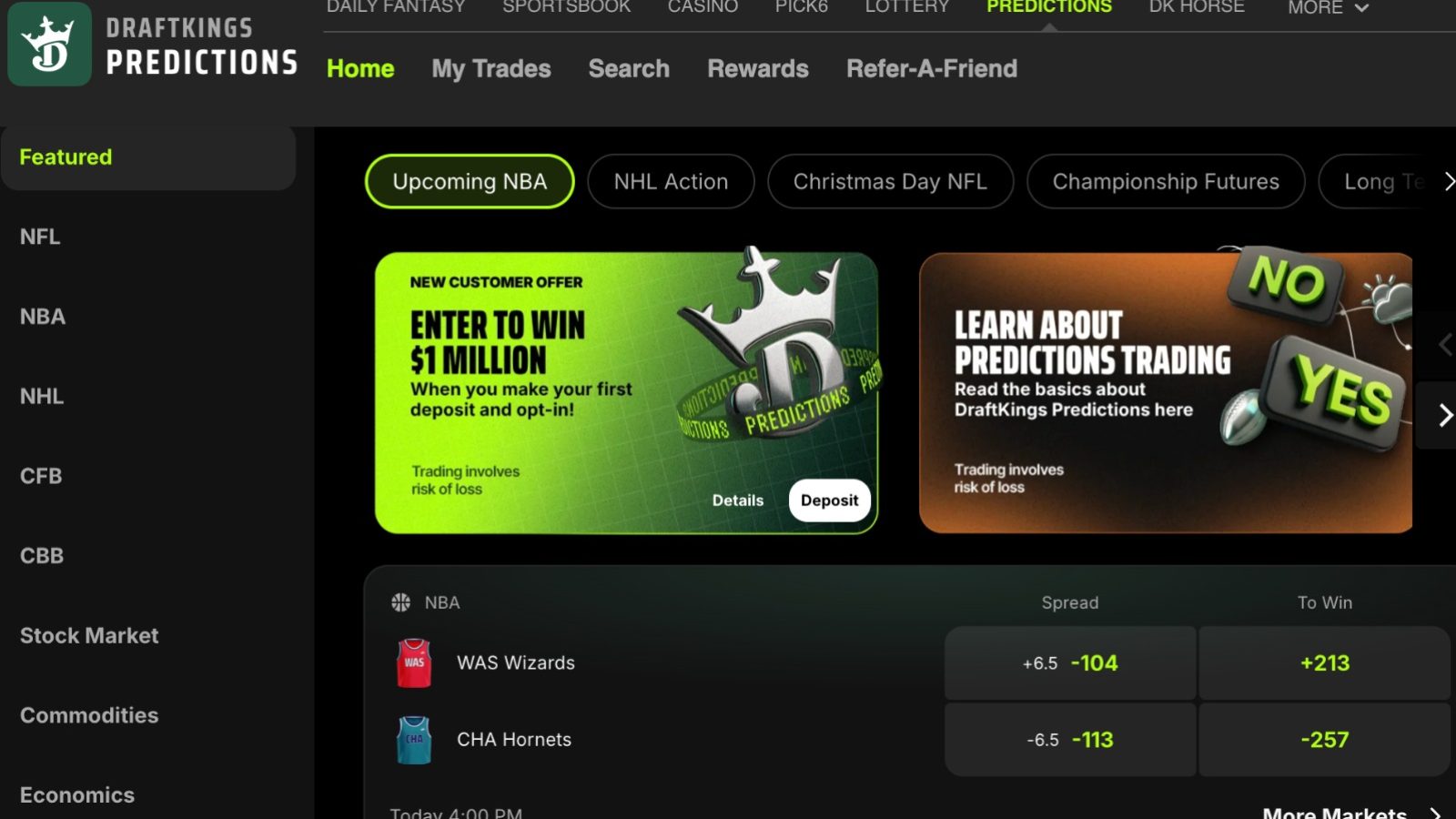
The tribe’s complaint describes the DraftKings Predictions product as an “illegal sportsbook,” noting that the product resembles a sportsbook to most users, and is advertised together with DraftKings’ sportsbook on nationwide ad campaigns for the company’s “Super App.”
The Seminoles argue that the product fit the sportsbook category much better than the category of a prediction market.
“Prediction markets have existed for decades as instruments for hedging commodity and financial risk — tools for institutional participants to manage exposure to price movements, economic indicators, and other measurable future outcomes,” the complaint says.
“In that traditional form, prediction markets served a legitimate informational function. DraftKings Predictions is not such a market. It is gambling and exists solely for entertainment purposes.
“There is no distinction — visual, functional, or experiential — between a sports bet powered by DraftKings Predictions in the Super App sportsbook and a wager placed on the Super App sportsbook in a State where DraftKings is licensed to operate.”
It adds that the DraftKings app in Florida lists sports event contracts under the “sports” category, while non-sports event contracts are listed as “predictions.” The tribe claims that this is “a deliberate attempt to cause consumers to believe that the items under the ‘Sports’ tab are not prediction markets contracts.”
Tribe points to ballot initiative, legal challenges
The tribe also notes that DraftKings’ move into prediction markets comes after the business backed a 2022 ballot initiative that would have allowed commercial sportsbooks such as DK to operate sports betting in Florida.
The tribe then claims the company “secretly funded” legal challenges to the Seminoles’ hub-and-spoke model, which were not successful, and framed DraftKings offering prediction markets as a third attempt to challenge the tribe’s exclusivity.
“Having failed to change Florida law through the ballot box and the courts, DraftKings — acting at the direction and under the control of Defendant Jason Robins — has now pivoted to proceeding as though the law, the Compact, and the Tribe’s exclusive rights simply do not exist,” the lawsuit says.
Money diverted from tribe?
The tribe also says that bets made via the DraftKings prediction market are taking money away from the tribe.
“Every wager that Defendants now accept through their illegal sportsbook siphons away revenue that funds both the Tribe’s and Florida’s public programs and government services; diverts betting from Florida’s regulated system into an underground, unregulated, and outlawed book; and deprives the Floridian who places such a bet of the consumer protections guaranteed by Florida law,” the tribe’s complaint reads.
In addition, the tribe argues that DraftKings sports event contracts lack the same protections that would apply to Hard Rock Bet and is available to those aged 18 and up instead of 21 and up.
“A Florida resident who wagers with DraftKings instead of Hard Rock Bet loses every protection the Compact and Florida law guarantee,” the complaint says. “Not only is DraftKings alert to this gap, but it has exploited it to drive growth.”
The tribe notes that Robins wrote in a May letter to investors that “Predictions customers are experiencing losses more quickly than Sportsbook customers,” and argues that this was because of differences in player protection rules and age limits.
In a press release, the tribe said it would “prioritize using funds recovered in this lawsuit from DraftKings for Florida-specific consumer protection initiatives and responsible gambling recovery programs.”
Pick6 targeted too
The tribe also argues that DraftKings’ Pick6 daily fantasy sports game is another form of illegal sports betting.
“Pick6 is functionally identical to the ‘player prop bets’ offered by every regulated sportsbook in the country, including the Tribe’s legally operated ‘Hard Rock Bet’ business,” the tribe argues.
The suit claims that pay-to-play fantasy sports has been illegal under an advisory opinion from Florida Attorney General Robert A. Butterworth that has “never been withdrawn or superseded.”
DraftKings responds
A DraftKings spokesperson told InGame that the company was confident both its prediction market and its Pick6 product are legal.
“DraftKings’ prediction markets offering operates in accordance with applicable law and the federal regulatory framework established under the Commodity Exchange Act,” the spokesperson said. “Furthermore, DraftKings Pick6 is a peer-to-peer fantasy sports variant centered on a simple ‘more or less’ mechanic tied to individual athlete performance metrics and is not sports betting.
“While the company has deep respect for Seminole Tribe’s sovereignty, we remain confident in our legal position.”