Nevada Gaming Control Board (NGCB) Chair Mike Dreitzer is clear in what he thinks of prediction markets and their sports event contracts — in the span of an hour Wednesday, he called them “dangerous,” “obscene,” and “criminal.”
The companies that offer products that mimic state-regulated sports betting “have created an untenable distinction without a difference … the fundamental arguments they make are about telling me that I’m looking at two apples, but they are trying to gaslight me to convince me that one of the apples is a banana.”
Speaking on the weekly New Normal webinar co-hosted by Indian Gaming Association Conference Chair Victor Rocha and IGA Executive Director Jason Giles, Dreitzer was joined by tribal lawyer Scott Crowell. Dreitzer leads the first gaming commission to challenge and win the opportunity to enforce its gaming laws against Kalshi and other prediction markets. Sports, entertainment, and election contracts are banned in Nevada.
Dreitzer said his agency’s main goal is safe and fair gambling, and he laid out why the NGCB viewed sports event contracts as a “scam” early on.
“The first claim is that this is peer-to-peer, so this is not gambling,” Dreitzer said. “Which obviously is a nonsense claim, but one that, in my view, doesn’t get refuted enough.” He went on to explain that there are multiple legal gambling options, ranging from poker to horse racing to bingo, that are peer-to-peer, making the claim that such activity is not gambling “completely inaccurate.”
Dreitzer went on to say several times that the idea that peer-to-peer gambling is not gambling has not gotten enough pushback in mainstream media.
Taking the scenario a step farther, Dreitzer explained why that it’s clear to him that prediction markets are not peer-to-peer, as in bettor-to-bettor, but rather are “hedge fund or other DCM [designated contract market] to casual bettor, and as a result, they are knocking the socks off of the casual bettor. That’s just flat what’s happening.
“Secondly, they say that what this means is that this allows them to have price discovery because it’s peer-to-peer, but the only price they are discovering is the maximum amount they can gouge individual casual bettors on their DCM. There is no price discovery, that is a fictional notion.”
He explained that often it is not just “some DCM” that is playing against the casual bettor, it is “the exact same DCM creating a third-party company to be on the other side. They call that liquidity and market making? I call that being a bookie.”
Third, Dreitzer said, prediction markets claim they allow bettors to get in and out of a position, that makes them “different.” But, he pointed out, traditional sportsbooks offer cashouts, meaning the two verticals offer the same option.
Finally, the idea that sportsbooks ban bettors when they succeed but prediction markets don’t is also a fallacy, he said. “When you talk about these market makers who get special pricing, special access, special rebates, they can decide that they don’t want to take certain contracts, so they effectively on the exchanges are banning people, too.”
‘Crime and deception are not innovation’
Giles pointed to the prediction market argument that their products — which they say meet the legal definition of a financial swap — are innovative. “I don’t know what the innovation is,” he said.
Dreitzer agreed, saying the NGCB “is not afraid of innovation,” but any gambling platform in Nevada must be licensed and follow the regulations and protections the state has put in place.
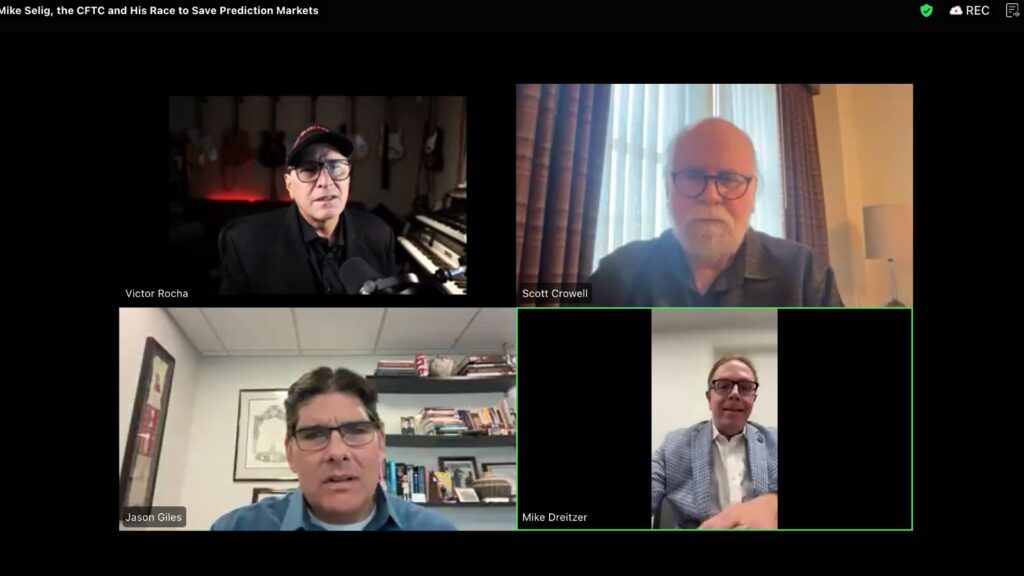
“What’s innovative about what they do?” Dreitzer asked. “Jason, that’s a really good question, and I’ve looked deeply into this, and what I’ve said at G2E and what I’ll say again here is that crime and deception are not innovation.”
Many prediction markets allow trades starting at age 18 while most states have a 21-year-old minimum for betting. Dreitzer said that allowing that younger age group to “wager billions of dollars is not innovation. Doing it in states in which it’s otherwise a violation of the penal code, that’s not innovation. I don’t want people to confuse innovation with committing a crime and having an unlicensed sportsbook. So, my answer to you, Jason, is I don’t see the innovation.”
Latest CFTC proposed rule ‘gamesmanship’
Working on the above premises, Dreitzer said with great pride that transparency in his state is critical. His agency, he said, can track every dollar wagered, and consumers have clear avenues to follow if they believe they’ve been wronged. “We show our work,” he said, while prediction markets “regulate by tweet.”
The panel dismissed the idea that the latest Commodity Futures Trading Commission (CFTC) interim rule banning casino-style games on prediction markets is another charade. Giles called it “a disgrace to democracy, this is weaponization of an agency, and it’s Orwellian,” as the CFTC “went after” two circuit courts and put parameters around what kinds of questions could be asked during the rulemaking process.
Crowell called it “gamesmanship,” and explained that federal agencies often use memos to come into compliance after losing a court case — and the CFTC and prediction markets have lost many to date. But this agency is doing the opposite, he said, attempting to use a memo to “nullify the court decisions.”
Referring to the state and tribal court arguments that Congress never intended to pull sports betting under federal regulation, Crowell went on to say that “they’re trying to … create the very regulatory structure that would have existed if Congress had actually intended for the CFTC to get into the regulation” of gambling.
The general theme on the panel was that CFTC Chair Mike Selig as the single voice on what should be a five-commissioner agency is pushing his own agenda forward.
This is a twist …
Dreitzer called the current situation the “Loper-not-so-Bright era” making a pun in relation to the Supreme Court ruling that overturned the 40-year-old Chevron Defense Doctrine in June 2024.
Chevron was the case law that “said that when a federal regulatory agency is promulgating a regulation, you give deference to its interpretation because of its expertise in implementing that area of the law,” Crowell said. Loper Bright said agency interpretations do not get that deterrence. He went on to point out that one of the first cases in which the new doctrine was applied was when Kalshi applied to the CFTC to allow election betting in late 2024.
In that case, the CFTC — under then Chair Rostin Behnam — said that election betting involved gaming and would be contrary to the public interest, and therefore in violation of CFTC rules, and the law of the Commodities Exchange Act. After a district court agreed with the CFTC, the U.S. Court of Appeals for the District of Columbia overturned that decision, allowing Kalshi to offer election betting, and opening the floodgates for myriad prediction market offerings.
“It’s interesting that some of the very same people who tried to use Loper Bright as a shield are now going to see it be used against them as a sword,” Crowell said. “When Selig goes to promulgate all these regulations, he’s not going to be given that deference by the federal courts that Chevron deference would have provided for him.”
Whatever happens, Dreitzer said, the real issue is consumer protections and fairness.
“What you are doing is dangerously conflating entertainment, which is sports betting, with investing,” he said. “One is not the other, and they are just trying to make it all the same thing. I say that as chairman of the Nevada Gaming Control Board. That’s bad. You have to regulate gaming, you have to do it properly, and you have to do it for the sake of an entertainment exercise.
“If you have an 18-year-old who thinks that betting on the Los Angeles Rams is a way to invest to then be able to cover their rent, as Kalshi has shown in one of their ads … that is super dangerous. And $8 billion-plus wagered on Kalshi since Jan. 1 by 18-, 19-, 20-year-olds, incredibly dangerous. All of this stuff will erode confidence over time, all of it is bad ethically and otherwise.”