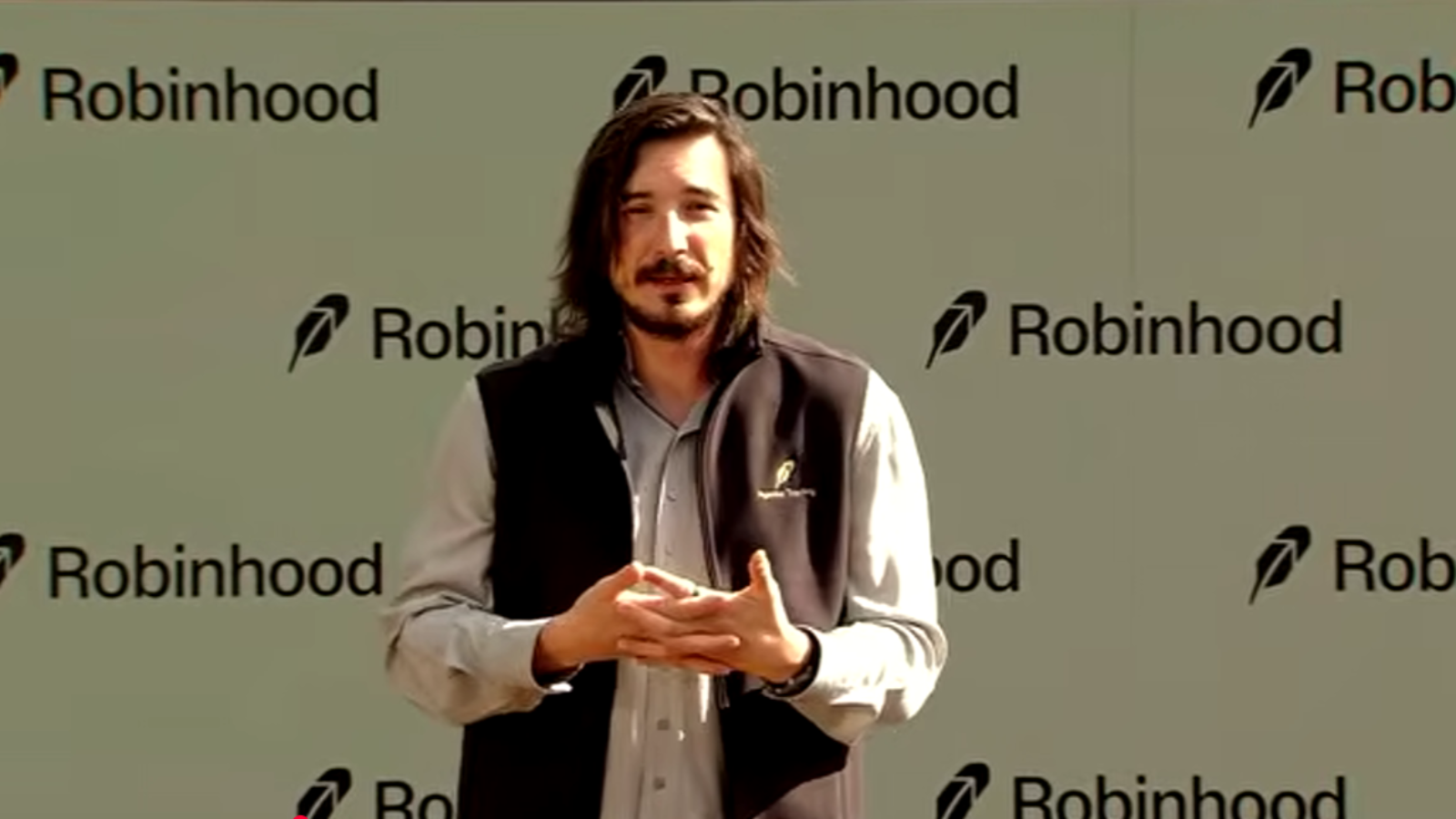
Robinhood is “less excited” about sports event contracts than other players in the prediction market world, and instead could “own” financial prediction markets, its CEO Vlad Tenev said Tuesday.
Meanwhile, the company’s CFO Shiv Verma said that Robinhood is working on “getting off” Kalshi by late 2026 or early 2027, to focus on Rothera and Crypto.com.
Speaking during the company’s third-quarter earnings call, Tenev discussed Robinhood’s prediction market offerings via its joint venture exchange Rothera, and third party exchanges like Kalshi, Crypto.com, and Cboe, which offers event contracts on companies’ key performance indicators, regulated by the Securities and Exchange Commission (SEC) rather than the Commodity Futures Trading Commission (CFTC).
Larger role in financial event contracts?
Tenev said that he saw Rothera, which Robinhood and Susquehanna each own a 45% stake in, playing a large role in financial event contracts, and believed this could be a way to differentiate the exchange from its competition when sports is the main focus elsewhere.
“Rothera can support more sophisticated financial contracts and be a leader there because I think we’re less excited about doing what everyone else is doing, which is just all sports all the time, because I think that’s rapidly going to get commoditized, and is just, frankly, a little bit less differentiated from my standpoint,” he said.
Verma — discussing all event contract trades through Robinhood, not just Rothera — added that “if you look in the quarter, it was actually about 30% non-sport, and that was up from 15% the quarter before.”
Tennev noted that 15-minute crypto markets — which have quickly become Kalshi’s top non-sports category — were “looking good.”
“We’ve been seeing a lot of growth in the crypto contracts and commodities,” he said. “I think that over time, we see an opportunity in integrating these financial contracts. I think we can own the financial category, because that’s a unique advantage we have.”
CFTC certifies Rothera Tesla contract
On Tuesday, the CFTC explicitly approved a Rothera contract on Tesla’s earnings per share. Outright approval of a new contract is uncommon, and usually reserved for new classes of product, as most contracts are instead self-certified.
Despite being similar to Cboe’s SEC-regulated key performance indicator contracts, Rothera argued in its filing to the CFTC that the contract was not security based, which would have put it under the SEC’s jurisdiction instead. The filing also noted that SEC Chair Paul Atkins had said that the SEC regulating Cboe’s similar contracts “does not foreclose ‘CFTC jurisdiction over KPI contracts based on the same underlying KPIs.’”
“Event contracts tied to specific corporate metrics, such as net sales, subscriber counts, or production volumes, differ fundamentally from contracts pegged to the price of a security,” Rothera’s filing said. “Rather than reflecting the market’s valuation of an issuer’s securities, contracts on corporate metrics provide a granular mechanism to hedge or take a view on discrete business outcomes.”
Robinhood ‘getting off’ Kalshi
During the quarter, Robinhood started offering its users access to Crypto.com’s event contracts, through a deal that gives Robinhood an equity stake in Crypto.com. The business currently still sends the majority of its prediction market volume to Kalshi, per an InGame analysis, though parlays may inflate Kalshi’s role in terms of Robinhood user volume.
However, Verma said that Robinhood was planning on “getting off” Kalshi, with Rothera becoming its main exchange and Crypto.com its main backup.
“It is good to have a resilient and a second exchange. What you should expect is Rothera will be our primary exchange, and Crypto.com/OG.com will now be our main second exchange, and we will be getting off most of our competitors,” he said. “By the end of the year into early next year, you should expect the vast majority of our flow go through both of those.
“From the financial standpoint, what we are doing now is, in addition to sending them flow, we are also becoming owners. Before, we were sending our flow to other exchanges, and we were not getting any financial incentives because of that.”
When Robinhood and Susquehanna International Group purchased the exchange that became Rothera in November 2025, a spokesperson told InGame that the business was not abandoning Kalshi at that time.
Robinhood played a major role in Kalshi’s growth in 2025, with volume on Kalshi surging when Robinhood launched a “predictions hub” and began offering Kalshi’s contracts on the NCAA Men’s Basketball Tournament. For much of that year, Robinhood was responsible for more than half of Kalshi volume, peaking at almost 60% in September.
However, soon after it launched parlays at the end of September 2025, Kalshi began outgrowing Robinhood. Today, less than 7% of Kalshi’s volume comes from Robinhood. While Robinhood cashed in on trading fees for contracts traded via its own exchange, it did not get a part of the rise in Kalshi’s valuation over the last two years, to a reported $40 billion today.
Tenev added that it is still useful to have a second exchange option for customers, which Crypto.com fills, rather than exclusively sending them to Rothera.
“We want to give our customers the best prediction markets experience. We want them to have choices too,” Tenev said. “I do not think we can send all of our flow to one venue. We think that the combination of Rothera and Crypto.com positions us well to actually serve our customers well, have great execution quality, and have broad coverage of all of the assets that our customers want to trade.”
Robinhood Q3 performance
Robinhood traded $16.4 billion worth of event contracts during the third quarter, including $6.1 billion in July.
Rothera specifically processed $6.4 billion worth of volume, making $100 million in revenue for Robinhood.
Overall, across all business areas, Robinhood made $1.42 billion in revenue for the quarter and a post-tax profit of $476 million, down 17% against the third quarter of 2025.
Robinhood shares fell sharply when markets opened Wednesday, by as much as 6.6% to $89.24. However, they recovered some of those losses as the day went on, closing at $91.43. That is down 19.2% for the year, and values the company at $72.3 billion.