LAS VEGAS — Former NBA guard Randy Livingston says he lost the millions he earned on the court to gambling, but his wife, Anita Odine Smith, stood by him as he battled to break his addiction and reclaim his life.
The lessons she learned — shared in her book, Assist, and chronicled with Livingston on FanDuel’s Trusted Voices podcast and web platform — provide a real-world example of what academia is studying about treating gambling addiction.
In a discussion of three bodies of research that collectively explore lessons learned from treating alcohol and opioid addiction, researchers shared Tuesday that principles used to treat alcohol and opioid addictions can be applied to make gambling addiction treatment more effective. The information was at the center of the “Treatment: Comorbidity & Mutual Aid” panel at the International Conference on Gambling & Risk Taking.
East Tennessee State University Ph.D. candidate Ryan Hjelle said his research shows that spirituality and support are key to recovery — yet in the 12 steps that Gamblers Anonymous (GA) adapted from the Alcoholics Anonymous (AA) 12-step program, spirituality is noticeably absent. AA, Hjelle said, is the “most utilized source of treatment” for alcohol addiction, with more than 2 million members attending sessions in the U.S., per a 2021 study. That same study reported there are 120,000 AA groups across the U.S., which may be as many as 10 times the number of GA groups.
12 steps not quite the same
Among the 12 steps used by both programs, five are different, with four in GA essentially removing references to spirituality or God and replacing them with putting the onus on the individual. As an example, Hjelle, said, AA Rule No. 2 reads: “Made a decision to turn our will and our lives over to the care of God as we understand him.” The GA version of the step reads: “Made a decision to turn our will and our lives over to the care of this Power of our own understanding.”
“Is spirituality a key?” Hjelle asked. It’s not clear, because the theory has not been tested.
Another noticeable difference in the steps is No. 4, in which AA refers to undertaking “fearless moral inventory of ourselves,” expanded by GA to “fearless moral and financial inventory of ourselves.” GA allows for “cross talk,” or for members to speak directly to one another at meetings, rather than address the group as is required at AA meetings. Those interactions may be considered more “confrontational,” but, Hjelle noted the addictions differ and by definition, treatments differ as well.
But Hjelle said AA is a historically more successful program than GA, and the latter’s participants could benefit from the lessons already learned about treatment.
More holistic approach?
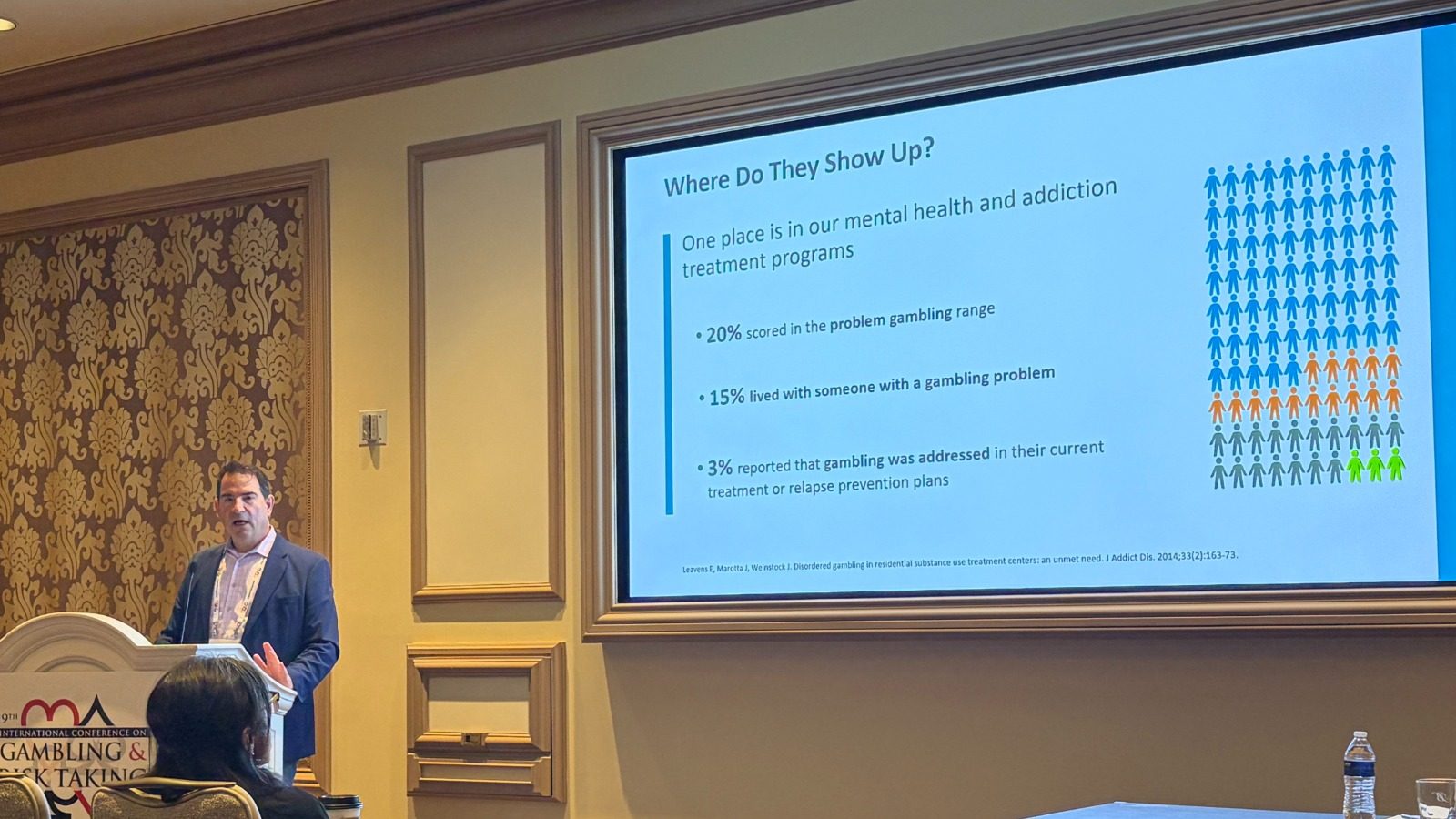
The conference panel’s second speaker, Jeff Marotta, president and senior consultant for Problem Gambling Solutions Inc., did not offer up a formal study, instead sharing some real-world statistics:
- 85% of Nevadans say they have gambled in the past 30 days, 13% say they have experienced harm, and 30% say they have been impacted by someone else’s gambling.
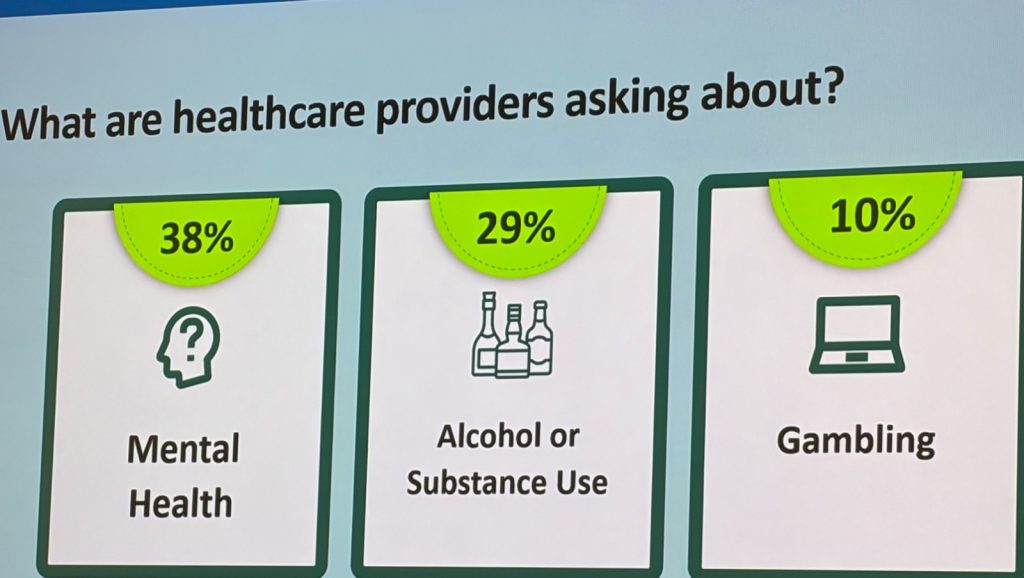
- 10% of health care providers ask patients about gambling, as compared to 29% who ask about alcohol or substance abuse.
Marotta, who is also an internationally certified gambling counselor, shared a graphic revealing that while about 20% of those in specialty treatment for opioid addiction drop out of programs, that percentage shoots up to more than 45% when those addicted to opioids also have gambling addiction.
He suggested that the health care system consider abandoning “specialty programs and consider the (Gambling Resources and Support Program) GRASP with the goal of improving opioid treatment outcomes and reducing problem gambling harm.” The program takes each addiction out of a silo for a more holistic view.
Alcohol, gambling addiction decline differs
The final presenter, Kristiana Carrasquillo, a Ph.D. candidate at the University of New Mexico, revealed results of a two-year longitudinal study that backed up Boston University School of Public Health research shared with the Massachusetts Gaming Commission earlier this month. Both studies showed a clear link between binge drinking — and drug use — and online sports betting.
Carrasquillo’s study set out to look at how problem gambling escalates and changes in frequency. It also considers family income to “better understand how these patterns unfold within broader economic context.”
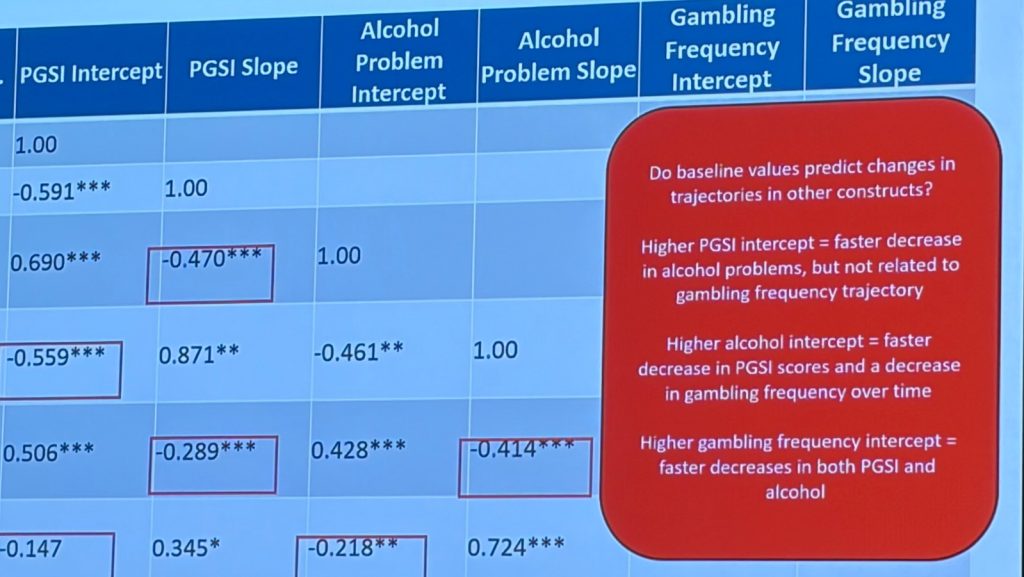
Carrasquillo looked at the Problem Gambling Severity Index for her subjects. She learned that with treatment, both alcohol and gambling addictions abate, but at different rates. She also discovered a higher family income is “associated with small decreases in non-gambling severity,” which she credited to the idea that those who have more, have more to protect.