A group of three California tribes contends that should a federal appellate court accept arguments from prediction platforms Kalshi and Robinhood, it would go against the intent of the Indian Gaming Regulatory Act (IGRA).
Blue Lake Rancheria, Chicken Ranch Rancheria of Me-Wuk Indians, and Picayune Rancheria of the Chukchansi Indians in July 2025 brought suit against the prediction platforms, claiming they are encroaching on tribal sovereignty and exclusivity by offering event contracts on reservations.
In California, tribes have exclusivity for Class II and III gaming under IGRA and through compacts with the state. Prediction markets are regulated by the federal Commodity Futures Trading Commission (CFTC) and are considered financial tools. They are currently not subject to state gambling regulation.
Five months after a U.S. district court judge in San Francisco ruled in favor of the prediction markets and denied a request to keep them off Indian lands, tribal lawyers filed a brief March 30 with the U.S. Ninth Circuit, writing that the decision is in conflict with IGRA. The 1988 federal law granted Indian Country across the U.S. the opportunity to regulate gaming on tribal land.
As part of that regulation, gambling entities must be licensed by a tribal regulator. Neither Kalshi nor Robinhood are licensed for gambling by the state of California or any of California’s tribes.
Since the March 30 filing, Kalshi and Robinhood have replied and Paradigm Operations filed an amicus brief, but the filings are not yet available publicly and no date for next steps has been set. A hearing to consider Kalshi and Robinhood’s request to dismiss the case in the U.S. District Court for the Northern District Court of California is set for April 30.
Intent of IGRA in question
Tribal lawyers wrote that the district court decision is “diametrically opposed” to the intent of IGRA. The interpretation, the lawyers wrote, also flies in the face of the 2010 Dodd-Frank Act, which regulates derivatives:
“If the District Court and Appellees’ statutory interpretation is accepted, Congress, in legislating to prevent unregulated derivatives trading from causing a repeat of the 2008 mortgage crisis, actually allowed derivatives trading to expand to include sports betting in all its permutations, nationwide, the legality of which is determined by the sports betting entity itself through self-certification.”
In addition, the attorneys argue, the district court’s interpretation of the law would render the Unlawful Internet Gaming Enforcement Act (UIGEA) void and would nullify sections of IGRA.
“The District Court erred in finding that UIGEA either supersedes IGRA or repeals IGRA by implication and Kalshi’s analysis in defense of the District Court’s conclusions is not legally coherent,” the tribes’ lawyers wrote. “In their opening brief, the Tribes comprehensively demonstrated that: (1) Congress was aware of the existence of the internet in 1988 when IGRA was enacted; (2) IGRA’s definition of class III gaming regulates all forms of gaming that are not class I or class II, irrespective of medium or technological format; (3) that UIGEA expressly does not supersede or repeal IGRA; and (4) Michigan v. Bay Mills Indian Cmty., 572 U.S. 782, 792 (2014) supplies the analytical framework for evaluating the situs of gaming activity in this litigation.”
The brief is the latest in the case, which the tribes have appealed to the Ninth Circuit, and the latest in a nationwide battle by the gambling industry to bring prediction markets under regulation by states for gambling, similar to sportsbook operators.
CNIGA chair: CFTC pushing envelope
To date the three California tribes and Wisconsin’s Ho-Chunk Tribe have sued Kalshi and the national group of tribes called the Tribal Amici has filed amicus briefs in support of states in several cases. The Indian Gaming Association (IGA) also has been actively educating its membership on the issue.
The states of Arizona and Massachusetts, meanwhile, have sued Kalshi in state court, and Kalshi itself has brought lawsuits against about a dozen states. In early April, the CFTC sued three states.
Lawyers in Indian Country and beyond believe the legality of sports event contracts will ultimately be decided by the U.S. Supreme Court, though Congress has the power to craft a law that would ban them. In fact, the Commodity Exchange Act (CEA) and the CFTC’s own rules prohibit contracts on gambling, but the current presidential administration has so far chosen not to enforce those rules and has encouraged change in them.
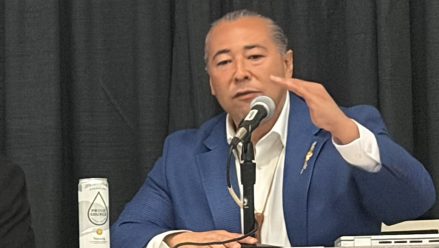
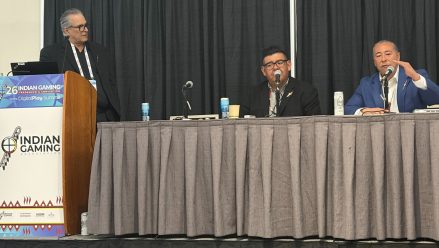
“There is no misinterpretation of the rules, it is an intentional change,” California Nations Indian Gaming Association Chair James Siva said last week during the annual IGA conference. “It’s expanding misregulation and deregulation.” Siva had a Zoom meeting with CFTC Chair Michael Selig and left it believing “we are not going to win on that battlefield.”
Said IGA Chair David Z. Bean: “It puts us between a rock and hard place. It’s not going to be won in the court of public opinion. … It’s going to be won in the courts. The Republicans are not going to take on the administration. It’s a steep hill and it gets steeper every single day by the billions.”
Waiting game
In the appellate brief in the California case, tribal attorneys call for the district court’s “implausible interpretations” to be reversed. They go on to argue that Kalshi is most certainly violating IGRA, and that the CEA does not supercede it (and even if it did, the CEA itself bans gambling contracts).
More than 2,000 miles away in Wisconsin, Ho-Chunk lawyers made similar claims and now await a May 24, 2027, court date. Since the court date was set, both sides have filed additional briefs in support of their arguments, including decisions in other court cases around the country.
Most recently, the tribe submitted a brief detailing a decision in the U.S. District Court for the District of Northern Ohio Eastern Division in which the court dismissed Kalshi’s argument that its sports event contracts are the “exclusive jurisdiction” of the CEA. Wednesday, an Arizona federal judge denied Kalshi’s request for a preliminary injunction, giving tribes another decision to cite or make courts aware of.
It seems likely that Kalshi will submit its own brief calling attention to Monday’s decision in the U.S. Third Circuit. The appellate court upheld a District Court ruling granting Kalshi an injunction that prevents the state of New Jersey from enforcing its gambling laws against the business. The decision was the first by an appeals court in any of the Kalshi cases examining how or if state sports betting laws apply to prediction markets.