
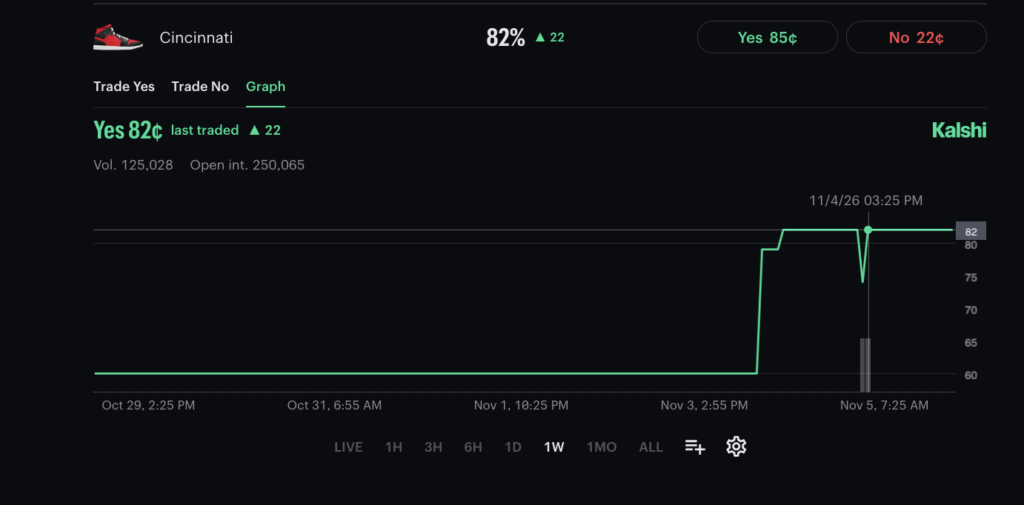
On Wednesday afternoon, two big block trades were made on Kalshi, each buying 125,000 YES contracts on the Cincinnati Bearcats to qualify for the 2027 NCAA men’s basketball tournament at 74 cents apiece. The trades were first noted in a report from market surveillance firm BETINT.
Each trade cost $92,500, for a combined $185,000. If Cincinnati makes the field when it’s announced in March, the YES side will collect $250,000. If not, the counterparty keeps the $65,000 posted for the NO side.
The trades came 19 minutes apart, at 2:44 p.m. and 3:03 p.m. ET. Both opened new positions, pushing open interest in the Cincinnati contract to 250,065.
That’s a big position for a market that barely traded until Wednesday. Kalshi opened its “Round of 76 Qualifiers” market on Sept. 22, months after the NCAA approved expanding the men’s and women’s tournaments to 76 teams, up from the 68-team format used since 2011.
The Bearcats, who compete in the Big 12 Conference, opened their regular season on Monday with a 79-53 victory over American University. They will host Green Bay Thursday evening. Last season they finished 18-15, ninth in the conference, and failed to qualify for the NCAA tournament.
Before these block trades, Cincinnati had traded a mere 39 contracts in six weeks. The two blocks now make up 95% of all trading across the market’s 126 listed teams, per BETINT. No other team has cleared 2,000 contracts as of this writing.
The blocks were also priced below the public market price. The last regular, non-block trade on Kalshi before them was 82 cents, on six contracts, and small trades since then have posted between 79 and 82 cents. As of Thursday morning, Kalshi showed Cincinnati with an 82% chance to make the expanded field.
A short list of sports blocks
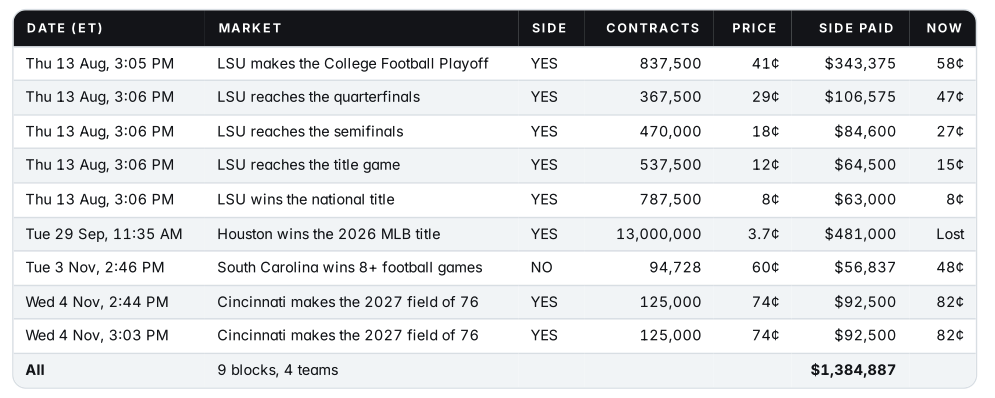
Block trades are negotiated off the exchange and then reported to Kalshi. They are limited to financial institutions, regulated insurers, investment funds, and entities with more than $10 million in assets, and they let parties take large positions without moving the public price.
BETINT counts nine Kalshi sports block trades (see above) since it began tracking them on July 27, about $1.38 million in total on the side bought. Each was a bet on a single team. That includes five blocks on LSU’s football team placed within 72 seconds in August, which together pay $3 million if the Tigers win the national title. That figure exactly matched coach Lane Kiffin’s national championship bonus. InGame previously reported the trades were placed by a third party that helps teams hedge bonus risk.
The others besides Cincinnati: a $481,000 YES block on the Houston Astros to win the 2026 World Series, by Houston furniture magnate Jim “Mattress Mack” McIngvale, which lost; and a NO block on Tuesday against the South Carolina Gamecocks winning eight or more football games this season. The Gamecocks are currently 5-3 with four games remaining, including a home date on Nov. 21 against No. 2-ranked Georgia.
Who’s behind it?
So far, nothing ties the Cincinnati trades here to a specific party or purpose. The two blocks matched on contract, side, size, and price, which BETINT says “fits one buyer splitting an order, or one broker filling two clients.” Kalshi does not publish the identities of block traders when the trades are made.
“It looks like the expanded NCAA tournament has its first big prediction market customer,” said BETINT co-founder and chief intelligence officer Dan Zimmermann. “I know that this is far from the last block trade we will see in sports.”
BETINT does not identify who is on either side, whether the blocks share a party with earlier sports blocks, or why anyone traded. But “no wrongdoing is alleged,” it says. It also notes that Kalshi’s reported times can lag behind the agreed trade by up to 15 minutes.
The LSU football trades first reported by InGame point to one possibility. Tournament appearance bonuses are common in college coaching contracts, and Kalshi’s rules bar employees of involved teams from trading, so any hedge would likely run through a third party. But in Cincinnati’s case, the $250,000 payout has not (yet) been matched to any known bonus for first-year Bearcats head coach Jerrod Calhoun, who spent the previous two seasons at Utah State. According to 247Sports, Calhoun’s bonus for reaching the tournament is only $100,000.
Unlike the LSU trades, though, Cincinnati is viewed by the market as likely to qualify for the tournament, so if it is a hedge, the protection is more costly in this case.
InGame has reached out to Kalshi for comment.